
This site is supported by our readers. We may earn a commission, at no cost to you, if you purchase through links.
Pull a bag of lettuce from your garden fridge and you’ll often find slick, yellowing leaves—moisture trapped against the plastic, heat locked in, and ethylene gas doing its quiet damage. The bag looked fine at harvest. The produce didn’t stay that way.
Mesh baskets solve this through physics, not guesswork. Open weave pulls heat away from respiring produce, drops ethylene concentration below the 0.1 ppm threshold that triggers ripening, and lets leaf-surface moisture evaporate instead of pooling. That’s the difference between greens that last three days and greens that last ten.
Why gardeners use baskets instead of bags comes down to one truth: fresh produce needs to breathe, and baskets let it.
Table Of Contents
- Key Takeaways
- Baskets Keep Garden Harvests Fresher
- Bags Trap Moisture and Heat
- Baskets Reduce Bruising During Harvest
- Baskets Make Harvesting More Efficient
- Basket Materials Suit Different Gardens
- Baskets Support Sustainable Garden Habits
- Frequently Asked Questions (FAQs)
- Why should you use a grow bag?
- How do grow bags differ from pots?
- Why do plants grow in grow bags?
- Are grow bags better than potted plants?
- What are the benefits of using baskets?
- Do basket planters actually boost tomato yields?
- Can baskets help regulate soil temperature naturally?
- Does basket soil improve root oxygenation and growth?
- What other uses do harvest baskets serve?
- How can you protect baskets from weather damage?
- Conclusion
Key Takeaways
- Open mesh baskets vent ethylene gas and dissipate field heat quickly, keeping greens fresh for up to ten days versus three in a sealed bag.
- Plastic bags trap moisture and warmth against your produce, creating exactly the conditions that fungal decay and microbial rot need to take hold within hours.
- Basket design — shallow rims, wide bases, single‑layer stacking — actively prevents bruising during transit, so delicate fruit actually reaches your kitchen intact.
- Material choice matters: stainless steel handles heavy, wet conditions; bamboo and rattan are lightweight and sustainable; recycled plastic offers weatherproof durability without the environmental cost of virgin plastics.
Baskets Keep Garden Harvests Fresher
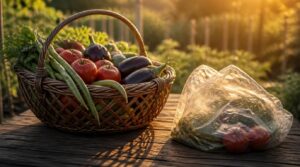
What you put your harvest in matters more than most gardeners realize. A basket’s open mesh isn’t just convenient — it’s actively working to keep your produce alive after picking. Here’s why that structure makes all the difference.
Knowing which harvest basket type suits your crops can mean the difference between produce that stays fresh for days and a wilted haul by dinnertime.
Better Airflow Around Produce
Mesh baskets don’t just hold your harvest — they actively work to keep it fresh.
Cross-ventilation through the gaps pulls away the heat produce generates during respiration, preventing warm pockets from forming. That steady air exchange also reduces temperature gradients between layers, keeping everything evenly cool.
Breathable containers dissipate field heat fast, buying you more time before quality starts to drop. Ensuring uniform airflow prevents hot spots can further extend the freshness of your produce.
Ethylene Gas Vents Away
Airflow does more than cool your harvest — it removes ethylene gas, the ripening hormone every piece of fruit naturally emits. Sealed bags trap it; baskets vent it away through unidirectional airflow.
Three reasons gas concentration management matters:
- Ethylene above 0.1 ppm accelerates premature aging
- Breathable containers dilute concentrations within minutes
- Consistent air circulation extends produce shelf life noticeably
Less Trapped Leaf Moisture
Ethylene isn’t the only invisible threat — leaf surface moisture is just as damaging.
Gaps in wicker weaving give moisture multiple escape routes, so it evaporates into surrounding air rather than clinging to leaves. That faster evaporation rate keeps surface wetness low, which directly disrupts the humid microclimate fungal spores need to germinate.
Your greens stay drier, crisper, and structurally intact longer.
Slower Mold and Rot
Those drier leaves from the previous section feed directly into mold prevention — less surface moisture means spore disruption before colonization starts.
Baskets support this through four mechanisms:
- Humidity control stays below 80% through constant airflow
- Mesh bottoms enable heat dissipation away from roots
- Fungal metabolism slows when temperature stability is maintained
- Quick cooling prevents warm microclimates where rot accelerates
Cooler Post-harvest Storage
Here’s the Cooler Post-harvest Storage section:
Once produce leaves the garden, field heat becomes your enemy — and baskets give you a head start on defeating it.
Open mesh lets heat escape immediately after picking, dropping surface temperature faster than any sealed bag can. From there, hydrocooling techniques — submerging your basket directly in an ice-water bath — can strip remaining field heat in minutes. That matters because respiration rate reduction is temperature-driven: cooler produce simply ages slower.
| Cooling Method | Best For | Chilling Injury Risk |
|---|---|---|
| Ice-water bath (hydrocooling) | Leafy greens, root crops | Low at 1–4 °C |
| Forced air | Berries, tomatoes | Low with gradual cooling |
| Room cooling | Dense vegetables | Minimal |
| Shade + basket venting | All crops, field-side | None |
| Refrigerated storage | Long-term crop preservation | Monitor sensitive crops |
Temperature monitoring tools like basic data loggers confirm your storage stays between 0–4 °C — the sweet spot for most greens and berries. Humidity sensors keep relative humidity near 90–95%, preventing wilting without creating wet surfaces where decay starts. Chilling injury prevention matters too — sensitive crops like tomatoes need gradual cooling, not a sudden plunge. Baskets support that stepwise postharvest handling naturally, staying breathable at every stage.
Bags Trap Moisture and Heat
Plastic bags might seem convenient, but they work against you the moment the harvest goes in. Heat and moisture build up fast — and that combination is exactly what spoils fresh produce. Here’s what’s actually happening inside those bags:
Switching to natural harvest baskets made from bamboo or rattan lets air circulate freely, keeping moisture and heat from turning a good harvest bad.
Plastic Encourages Condensation
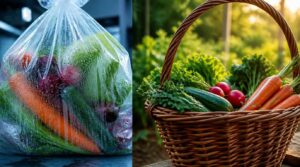
Plastic bags act like a sealed terrarium.
When warm produce meets cooler film, dew point dynamics kick in — water vapor releases as droplets on the inner surface. Textured plastic traps those microcondensation sites, and poor ventilation keeps humidity climbing.
The result: a wet, slippery interior where moisture wicking spreads dampness across every piece of produce you just picked.
Warm Produce Spoils Faster
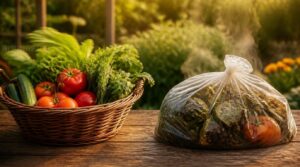
Sealing warm produce in plastic doesn’t just slow cooling — it locks in field heat that drives respiration rates up fast.
- Higher temperatures accelerate ethylene production
- Trapped heat eliminates convection cooling entirely
- Spoilage acceleration compounds without airflow
- Respiration burns through cell structure rapidly
That biological burn-off shortens shelf life before you even reach the kitchen.
Wet Leaves Decay Quickly
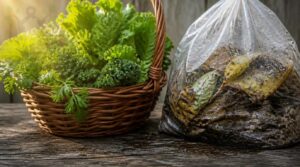
Wet leaves inside a sealed bag become a decay incubator almost immediately. Fungal hyphal growth kicks in within hours — moisture has nowhere to escape. Microbial respiration heat compounds the problem, and saprotrophic enzyme activity starts dismantling cell walls from the inside out. Even lignin, normally tough to break down, accelerates its breakdown when anaerobic decay pathways take over.
| Decay Driver | Effect Inside a Sealed Bag |
|---|---|
| Fungal hyphal growth | Colonizes wet leaf tissue within hours |
| Microbial respiration heat | Raises internal temperature, speeding decay |
| Saprotrophic enzyme activity | Breaks down cell walls rapidly |
| Lignin breakdown rates | Increase considerably under sustained moisture |
| Anaerobic decay pathways | Activate when oxygen is cut off |
Poor Ventilation Shortens Freshness
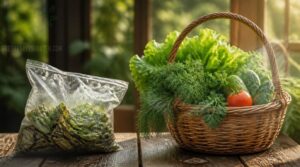
Poor ventilation quietly drains freshness before you notice.
- Stagnant air risks speed spoilage fast
- Humidity pocket decay rots leafy greens
- Ethylene buildup effects accelerate ripening
- Temperature spike spoilage browns soft fruit
- Surface moisture mold spreads overnight
Baskets fix this with airflow, rapid cooling, and steady temperature management — cutting food waste, not freshness.
Baskets Reduce Bruising During Harvest
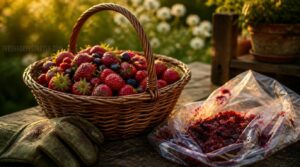
A bag full of berries turns into mush before you reach the kitchen. Design solves that problem at every step, from rim height to handle position. Here’s what makes a basket gentle on delicate produce.
A bag full of berries turns to mush before reaching the kitchen, but the right basket design protects every delicate piece along the way
Shallow Rims Protect Berries
Berries bruise the moment something presses too hard. Shallow rim design fixes that by limiting contact area, so weight never piles onto fragile fruit.
Rim-based weight support keeps berries upright instead of squashed sideways. The low edge also makes visual damage inspection easy — you spot bruised berries before they hit the kitchen. Gentle tipping techniques protect berry skin integrity, making garden baskets a smarter pick for fruit bruising prevention than any bag.
Wide Bases Spread Weight
A shallow rim holds vertical pressure. A wide base holds everything else.
Spreading weight across a broader footprint gives you real stability margin gains — even on bumpy garden rows. That’s tipping risk reduction in action, with better center gravity management and easier uneven terrain handling.
This load pressure distribution means harvest baskets stay upright, supporting fruit bruising prevention and steady harvest efficiency wherever you set them down.
Single-layer Produce Stacking
Stability keeps a basket upright. What’s inside it matters just as much.
Single-layer stacking spreads produce across the base instead of piling it high, preventing berry contact and skin tears from neighbors pressing in. That’s balanced weight distribution at work — even pressure, fewer crushed spots. Garden baskets built this way boost harvest efficiency too, since you’re not sorting bruised fruit later. Less waste, more usable produce.
Less Crushing in Transit
Get the basket from row to kitchen, and the woven structure keeps absorbing shocks the whole way. That’s shock absorption at work — flexible rims cushion the top layer when loads shift.
Single-layer layouts mean no stacked weight crushing fruit underneath. Lift the container instead of dumping handfuls, and balanced weight distribution holds steady, cutting food waste before it starts.
Stable Handles Limit Shifting
A handle’s grip job doesn’t end once you’ve lifted the load — it keeps everything steady the whole trip. Ergonomic grip design matches your hand span, while contoured shapes stop wrist rotation as weight shifts.
Dual grab points spread balanced weight distribution evenly, so your portable vegetable garden hauls stay level. Handle material durability, whether stainless steel or coated bamboo, keeps that comfort and stability intact — even on collapsible garden baskets.
Baskets Make Harvesting More Efficient
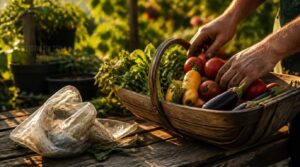
Speed matters when you’re racing daylight or rain. A good basket setup shaves seconds off every step, from picking to putting food away. Here’s where that efficiency really shows up.
Easy Row-by-row Picking
Picking row by row turns chaos into rhythm. Garden baskets mounted at ergonomic waist height let you move down each line without bending or reaching into the canopy.
Color-coded row markers keep your pace steady, while tilting offload designs and interlocking handle stability mean less spilling, less fatigue. Hit your batch picking quotas faster — and start the field-to-kitchen workflow already half done.
Soil Falls Through Mesh
Since loose soil sifts through small gaps, your basket’s metal mesh bottom doubles as a sieve. Mesh size selection decides how much escapes — finer weaves trap clumps, wider ones release fast. Walking jostles soil through vibration-induced loss.
- Galvanized steel mesh
- PVC-coated wire mesh
- Rustproofed mesh bottom
Clean these drainage holes; soil cohesion and weave pattern determine what stays trapped.
Faster Kitchen Transfer
Once your basket reaches the kitchen, the field-to-kitchen workflow tightens fast. A dedicated prep station layout near the counter lets you unload in under two minutes per batch. Color-coded sorting cuts searching time by 30 percent.
| Basket Feature | Transfer Benefit |
|---|---|
| Rigid rim | One-handed carrying stays stable |
| Collapsible design | Compact collapsible design clears counter space |
Batch transfer timing while other prep tasks run cuts idle waits by 20 percent.
Centralized Collection Points
A centralized produce collection point transforms chaotic harvesting into a lean, repeatable system. Position one basket hub near your row ends — it cuts cross-traffic and keeps your field-to-kitchen workflow tight.
Think of it as your garden’s loading dock: a fixed spot where standardized labeling processes and a real-time tally happens before anything reaches the counter, eliminating the guesswork of scattered containers.
Collapsible Storage Options
After a long harvest, the last thing you want is a shed cluttered with rigid containers.
Collapsible garden baskets fold flat to under 2 inches — stack five to seven units without deformation. Hinged side panels lock upright in under 30 seconds. Telescoping crate designs compress to a third of their height.
Less bulk stored means more room to work.
Basket Materials Suit Different Gardens
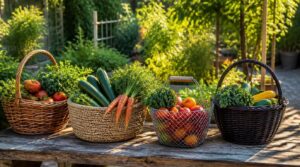
Not every basket works for every garden — material matters more than most gardeners expect. Your climate, budget, and how hard you push your tools through the season will point you toward the right choice. Here’s what each option brings to the table.
Stainless-steel Mesh Durability
Stainless-steel mesh earns its place in demanding gardens. Grades 304 and 316 resist corrosion, chloride exposure, and seasonal temperature swings without warping.
The interwoven wire supports tensile loads from heavy harvests, distributing stress evenly so nothing sags or tears. It’s abrasion-resistant, easy to rinse clean, and fully recyclable — built to last a decade with nothing more than basic drying between uses.
Bamboo and Rattan Charm
Metal undertakes the heavy lifting — but bamboo and rattan bring something steel can’t: natural character. Sourced from sustainable plantations with low embodied energy, these materials are lightweight, cutting transport weight by up to 40% versus ceramic alternatives.
- Bamboo regrows within 3–5 years after harvest
- Rattan bends without splitting, enabling tight curves
- Handwoven rattan develops a rich patina with age
- Natural finishes range from light tan to honey brown
- Both materials are fully biodegradable at end of life
For gardeners who want artisanal weaving textures alongside function, natural fiber baskets deliver.
Recycled-plastic Basket Options
Natural fiber has charm — but recycled-plastic baskets offer something different: weatherproof reliability. Made from post-consumer materials, they’re a strong plastic alternative for sustainable gardening without sacrificing toughness.
| Plastic Type | Key Strength | Best Use |
|---|---|---|
| Polypropylene | Impact resistance | Everyday harvests |
| HDPE | Sun durability | Outdoor year-round |
| ABS | Structural rigidity | Stacking multiple loads |
| Recycled PET | Content visibility | Sorting mixed produce |
Copolymer blend flexibility suits soft fruit — bending without cracking under load. These eco-friendly garden baskets rinse clean with a hose and won’t rot between seasons.
Natural-fiber Maintenance Needs
Recycled plastic is low-maintenance — handwoven rattan and natural fibers are not. They reward attention.
- Brush off dirt with a soft brush after each use
- Spot-clean with mild soap; never soak
- Dry in ventilated shade — direct heat cracks fibers
- Store with silica sachets above 60% humidity
- Inspect regularly for pest damage or frass
Biodegradable materials earn their durability through consistent care.
Seasonal Storage Considerations
Consistent care naturally carries into seasonal transitions. Before stacking away, do a quick audit — check for cracks, moisture damage, or mildew.
| Season | Storage Tip | Benefit |
|---|---|---|
| Spring | Air-dry fully before use | Prevents early mold |
| Summer | Daily harvest rotation | Reduces overripening |
| Winter | Stack space-saving designs | Clears shed space |
Regular visual inspections between cycles keep your garden baskets working hard season after season.
Baskets Support Sustainable Garden Habits
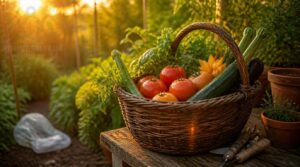
Switching to a basket doesn’t just improve your harvest — it quietly shifts how you interact with the garden as a whole. The choices you make at collection time ripple outward, from how much plastic you use to how long your tools actually last. Here’s where baskets make that difference most clearly.
Reusable Zero-waste Harvesting
A good basket doesn’t wear out — it earns its place.
Reusable garden baskets eliminate the need for single-use packaging entirely, embedding circular gardening practices into your daily routine. Whether you’re upcycling vintage finds from a thrift store or investing in stainless-steel mesh, each harvest reinforces a sustainable material lifecycle.
That’s zero-waste harvesting in its most practical form — no disposal, no replacement, just use.
Fewer Disposable Plastic Bags
Every bag you skip is a small but real win. Plastic bag bans worldwide have cut usage by billions — and reusable baskets are a direct reason why.
Bringing your own basket at harvest means fewer single-use bags enter the waste stream. Waste prevention programs recognize exactly this shift — redirecting demand away from disposable plastics before they’re ever produced.
Thrifted Basket Reuse
Thrifting your harvest baskets is one of the smartest moves in sustainable gardening. A $2 wicker find from a thrift store does the same job as a $20 new one — and keeps that item out of a landfill.
Vintage baskets also bring rustic aesthetic charm—your garden beds will thank you for.
Reusing and upcycling secondhand pieces builds real DIY skills while cutting costs considerably.
Biodegradable Natural Materials
Natural baskets aren’t just pretty — they’re built from renewable resources like bamboo and handwoven rattan that biodegrade completely. When you’re done with them, composting is a real end-of-life option.
No microplastics leach into soil. Microbial degradation does the work, returning nutrients instead of adding waste.
That’s a direct win against ocean pollution and landfill buildup.
Multi-purpose Garden Storage
A good harvest basket doesn’t retire when picking season ends. It keeps working.
- Market display on the counter, herbs and tomatoes arranged like a farmstand
- Off-season planter on the porch, holding herbs or trailing vines
- Tool organizer in the shed, corralling twine, labels, and pruners
Vintage finds from thrift stores cost almost nothing — and carry years of use still left in them.
Frequently Asked Questions (FAQs)
Why should you use a grow bag?
Grow bags excel at soil aeration and drainage, preventing compaction while boosting oxygen at the root zone. That triggers air pruning, creating denser roots, faster nutrient uptake, and a healthier microbe habitat—exactly what your plants need before harvest even begins.
How do grow bags differ from pots?
Fabric containers force air pruning at the walls, unlike solid plastic pots where roots circle endlessly. That means better drainage efficiency, faster moisture evaporation, and natural soil temperature regulation.
Grow bags breathe; pots trap. Root aeration improves dramatically once roots stop spiraling and start branching outward.
Why do plants grow in grow bags?
Breathable fabric triggers air pruning at the edges, stopping circling roots and pushing out denser growth. That root density boosts nutrient uptake. Plus, easier moisture management and drainage keep pathogens down—perfect for tight, urban garden spaces.
Are grow bags better than potted plants?
Hands down, grow bags crush plastic pots in container gardening.
Root air pruning stops circling, fabric drainage prevents soil compaction, and temperature regulation keeps roots cooler—solid pots trap heat and moisture, suffocating roots that desperately need oxygen and balanced soil moisture management.
What are the benefits of using baskets?
Garden baskets regulate ethylene gas, stabilize root zone temperature, and speed rapid heat loss.
Weight distribution stability prevents bruising.
Mesh bottoms simplify field-to-kitchen workflow, cut food waste, and offer lasting durability—turning everyday harvesting into a faster, fresher, less wasteful routine.
Do basket planters actually boost tomato yields?
Yes — tomatoes in basket planters produce up to 25% more fruit. Root zone oxygenation, natural root pruning, and soil temperature regulation drive that gain. Drainage-driven growth and enhanced fibrous roots give yields a measurable edge.
Can baskets help regulate soil temperature naturally?
Basket soil warms faster in spring and cools quickly during heat spikes. Mesh oxygenation reduces root-rot risk while elevated drainage keeps root zones dry. Natural thermal buffering holds temperatures steady without any intervention.
Does basket soil improve root oxygenation and growth?
Ironically, what seems like simple soil in a basket is quietly doing complex work underground.
Aerated basket soil boosts root oxygen levels, accelerating respiration, enhancing nutrient uptake, and triggering microbial activity — all while preventing the root rot that compacted, waterlogged media invite.
What other uses do harvest baskets serve?
Harvest baskets pull double duty. Beyond the garden, they work as rustic kitchen decor, craft storage, or artisanal gift packaging. Fill one with bread and fruit — instant, beautiful presentation.
How can you protect baskets from weather damage?
Weather won’t wait. Apply clear exterior varnish annually, line interiors with removable drainage liners, store elevated off damp floors, and wipe stainless mesh dry after rain to keep every basket harvest-ready.
Conclusion
Old wives knew it long before the icebox ever existed—keep your harvest breathing, and it keeps longer.
Why gardeners use baskets instead of bags isn’t rooted in tradition for its own sake; it’s applied plant biology working quietly in your favor. Open mesh pulls ethylene out, drops surface moisture below pooling point, and cuts bruising before it starts.
Swap the plastic. Your produce stops racing toward the compost bin—and you’ll taste the difference.
- https://ontheacre.substack.com/p/the-essential-garden-basket-guide
- https://www.gardenary.com/blog/harvest-basket-guide-find-your-perfect-garden-trug
- https://www.groworganic.com/collections/baskets-pails
- https://www.hgtv.com/shopping/product-reviews/best-garden-harvest-baskets-trugs-hods
- https://www.almanac.com/grow-bags-vegetables