
This site is supported by our readers. We may earn a commission, at no cost to you, if you purchase through links.

Most gardeners blame their plants when growth stalls—wrong variety, bad timing, too much shade. The soil rarely gets the scrutiny it deserves, even though it’s doing the hardest work.
A handful of healthy garden soil contains more living organisms than there are people on Earth, and those organisms drive nearly everything your plants depend on: nutrient uptake, disease resistance, water retention.
When that underground ecosystem is out of balance, even the best seeds underperform. Learning how to improve garden soil isn’t complicated, but it does follow a logical sequence—one that starts with understanding what you’re actually working with before changing anything.
Table Of Contents
- Key Takeaways
- Test Your Garden Soil First
- Improve Garden Soil With Organic Matter
- Fix Soil Structure and Compaction
- Balance Soil PH and Fertility
- Protect Soil With Mulch
- Grow Cover Crops and Rotate
- Maintain Living Soil Year-Round
- Frequently Asked Questions (FAQs)
- What can I add to my garden soil to make it better?
- How to fix poor quality soil?
- How to replenish poor garden soil?
- How to rejuvenate old garden soil?
- How can i Improve my soil?
- What makes a good garden soil?
- How do you maintain healthy soil?
- How do you take care of soil in your garden?
- How do you improve sandy soil?
- How do you improve soil texture?
- Conclusion
Key Takeaways
- Test your soil before adding anything — knowing your pH, nutrient levels, and organic matter percentage saves you money and prevents the kind of over-amending that quietly slows plant growth.
- Compost is your most reliable tool for building healthy soil, but it works best applied consistently across seasons rather than dumped in all at once.
- Protecting soil structure through permanent paths, low-till methods, and a steady mulch layer does as much for your plants as any fertilizer you could add.
- Cover crops and yearly crop rotation aren’t just filler between seasons — they actively rebuild fertility, break pest cycles, and leave your beds in better shape than they started.
Test Your Garden Soil First

Before you add anything to your garden, you need to know what you’re actually working with. Soil testing takes the guesswork out of the equation and points you toward the right fixes. Here’s what to check first.
A soil test for fall garden preparation gives you a clear picture of deficiencies before you spend money on amendments you might not need.
Collect Composite Soil Samples
Collecting a composite soil sample is your first real step toward understanding what’s happening beneath your garden beds. Instead of grabbing dirt from one random spot, visit five evenly distributed stations across your planting area. Avoid wheel tracks or recently fertilized patches — those skew your results.
At each station, push a soil probe to 25 cm depth, then collect two to four cores. Combine them thoroughly in one clean, labeled bag. That mixture — your composite — represents the whole plot far more accurately than any single scoop. Using a systematic zig‑zag pattern across the area helps guarantee thorough spatial coverage.
Keep these steps consistent every time:
- Space stations evenly, staying clear of disturbances
- Match sampling depth to your crop’s root zone
- Mix equal portions from every core before bagging
- Label each bag with plot name, date, and depth
Before heading out, prepare a field log noting station coordinates, weather, and any recent amendments. Snap a photo of your layout too — it’s easy to forget details later. Soil testing labs need this context to give you recommendations that actually fit your garden.
Check PH and Nutrients
Once your composite sample is ready, the next step is finding out what your soil is actually working with. A soil test tells you two key things: pH and nutrient levels. pH measures soil acidity — on a scale from 1 to 14, most vegetables thrive between 6.0 and 7.0, where nutrients stay most available to roots.
Review Organic Matter Levels
Your soil test does more than reveal pH — it also shows your organic matter (OM) percentage. Most garden soils fall between 1 and 6 percent.
Aim for at least 3 percent. Below that, nutrients cycle poorly, and soil dries out fast.
Think of humus — stable, decomposed organic matter — as your soil’s long-term savings account.
Identify Drainage Problems
Once you know your organic matter levels, it’s time to look at how water moves — or doesn’t — through your beds.
Watch for water pooling after rain. If puddles sit for 24 hours or more, drainage is failing. A simple percolation test tells you more: dig a 6-inch hole, fill it with water, and watch the clock.
Retest After Major Amendments
After adding lime, sulfur, or any major soil amendment, don’t assume the work is done. Retest your soil 4 to 12 weeks later using the same sampling pattern as your first test. This keeps results comparable.
You’re checking that soil pH, nutrient balance, and organic matter have actually shifted toward your target ranges — and deciding whether another round of adjustments is needed.
Improve Garden Soil With Organic Matter

Once you know what your soil is working with, it’s time to feed it. Organic matter is the backbone of healthy, productive garden beds — and there are several ways to add it. Here’s what actually works.
Add Finished Compost Seasonally
Compost is like a slow-release multivitamin for your garden beds. Timing your applications well makes a real difference. Here’s how to use finished compost through the seasons:
- Early Spring Compost — Spread a 1–2 inch layer across beds before planting to give crops a nutrient boost right from the start.
- Midseason Side Dress — Apply a ½–1 inch layer beside established vegetables mid-season to keep growth steady when plants need it most.
- Fall Compost Mulch — After harvest, a thin compost layer protects soil organic matter and feeds soil life through the cooler months.
- Winter Compost Layer — A light ½ inch application insulates the soil surface and promotes ongoing nutrient cycling even during dormancy.
- Seasonal Compost Application — Work aged compost 6–12 inches deep before cool-season crops for faster nutrient availability.
Consistent use of compost as a soil amendment is one of the simplest ways to build lasting soil health year after year.
Over time, compost also helps break up surface crusting—a common sign of struggling soil—which you can learn to spot and address with these clay soil amendment techniques for vegetable gardens.
Use Aged Manure Carefully
Aged manure is a powerful soil amendment, but timing and preparation matter. It needs to rest for several months before use — this reduces ammonia, lowers nitrogen burn risk, and eliminates most weed seeds and pathogens. Don’t rush it.
Well-rotted manure works nutrients into your soil gradually, supporting soil organic matter without overwhelming young roots.
Mix in Leaf Mold
Leaf mold — basically decomposed fallen leaves — is one of the most underrated soil amendments you can make.
Mix a 1–2 inch layer into your top 6–8 inches of soil each season.
It improves soil texture, lightens clay, and acts like a natural sponge, dramatically boosting moisture retention without adding excessive nitrogen.
Build Humus Over Time
Humus is the living legacy of every compost layer, aged manure application, and leaf mold you add. It doesn’t appear overnight — humus accumulation rate builds across multiple seasons as microbes, fungi, and earthworms steadily mineralize organic matter.
The payoff? Soil aggregate stability improves, water retention climbs, and nutrient release dynamics shift toward slow, steady availability that your plants genuinely thrive on.
Avoid Over-amending Beds
More isn’t always better — especially with soil amendments. Over‑applying organic matter can skew nutrient balance, causing phosphorus buildup or salt stress that slows plant growth.
Let your soil test do the thinking. It tells you exactly what’s missing, so you follow a smart soil amendment schedule instead of guessing.
Apply only what your soil health indicators call for, each season.
Fix Soil Structure and Compaction
Compacted soil is one of the sneakiest problems in a garden — plants struggle, water pools, and roots can’t go where they need to go. The good news is that fixing it doesn’t require heavy equipment or starting over. Here are five practical steps to get your soil structure back on track.
Avoid Working Wet Soil

Before you grab a spade, check soil moisture first — squeeze a handful of soil; if it clumps and doesn’t crumble, it’s too wet to work. Working wet soil destroys its structure, crushing the pore spaces plants need to breathe.
Wait for dry conditions, wear proper footwear to avoid slips, and clear surface water from beds to prevent compaction.
Create Permanent Garden Paths

Once you’ve stepped back from wet soil, the next move is making sure foot traffic stops being a problem altogether. Permanent garden paths are your answer.
By dedicating fixed walkways through your beds, you protect planting zones from the compaction that crushes soil structure and chokes root growth. Even simple flagstone or gravel paths with a 4–6 inch compacted base make a lasting difference.
Aerate Compacted Beds Gently

Permanent paths handle foot traffic, but what about the beds that are already packed tight? That’s where gentle soil aeration comes in.
Use a hollow tine aerator or garden fork when soil feels like a damp sponge — not soggy, not bone dry. Aim for 6–8 inch depth, spacing holes every 6 to 12 inches. Afterward, apply a 1–2 inch mulch layer to protect exposed soil.
Use Low-till Methods

Aeration opens the door — but how you follow up matters just as much. Low-till and no-till methods protect those newly freed pores by leaving soil largely undisturbed season after season.
- Use no-till drilling to place seeds directly without mixing soil layers.
- Apply strip till only where roots need it, leaving surrounding soil intact.
- Practice precision seeding to minimize unnecessary soil exposure.
Improve Clay With Compost

Clay soil can be stubborn — dense, slow-draining, and quick to compact.
But finished compost is the fix. Work a 2–3 inch layer into the top 6–8 inches each season. Compost breaks clay into loose aggregates, opens pores for roots and air, and releases nutrients slowly. Over time, it transforms heavy clay into rich, workable soil.
Balance Soil PH and Fertility
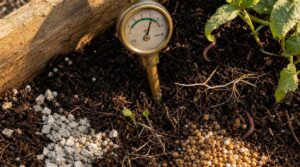
Getting your soil’s pH and fertility right is like tuning an instrument — everything works better when it’s in balance. Most plants thrive in a slightly acidic to neutral range, and small adjustments can make a big difference in how well they grow. Here’s how to bring your soil into that sweet spot.
Raise PH With Lime
If your soil test shows a pH below 6.0, lime is your best fix.
Calcitic lime raises pH gradually using calcium carbonate, while dolomitic lime also corrects magnesium deficiencies — a smart pick if your test flags low magnesium.
Apply 5–10 lb per 100 ft², work it into the top 6–8 inches, and retest after eight weeks.
Lower PH With Sulfur
When your soil runs too alkaline, elemental sulfur is the go-to fix. It reacts with soil moisture to gradually lower soil pH — usually within one to three months.
Apply 1–5 lb per 100 ft² depending on your current pH and soil texture. Sandy soils need less; clay needs more. Retest after six to eight weeks to avoid over-acidification.
Choose Organic Fertilizers
Once you know your pH, the next step is feeding your soil the right way.
Organic fertilizers — compost, aged manure, bone meal, or cover crops — release nutrients slowly, so your plants get a steady supply without the burn risk of synthetics.
Match your choice to your soil test results, and you’ll avoid guesswork entirely.
Prevent Nutrient Overload
Too much of a good thing can quietly wreck your garden. Even organic fertilizers can push soil nutrient balance past safe limits if you apply them without checking first.
Always establish test baselines before adding anything. Use slow-release amendments to avoid sudden spikes.
If levels run high, leach management — flushing excess salts with deep watering — can help correct the imbalance fast.
Match Amendments to Crops
Not every crop wants the same soil recipe. Crop nutrient timing matters — tomatoes and peppers need potassium for fruit quality, while root vegetables thrive when you front‑load phosphorus for early root development.
Legumes need species‑matched inoculants to fix nitrogen effectively.
Follow leafy greens with modest nitrogen, and always use your soil test to calibrate before adding anything.
Protect Soil With Mulch

Mulch is one of the simplest things you can do to protect your soil — and it pays off all season long. Think of it as a blanket that keeps moisture in, weeds out, and the soil structure intact. Here are the best ways to put mulch to work in your garden.
Apply Straw or Leaves
Layering straw or shredded leaves over your beds is one of the simplest things you can do for your soil. Spread straw 2 to 3 inches thick, keeping it a couple of inches away from plant stems to prevent rot.
A mix of straw and shredded leaves gives you the best of both — moisture retention plus a steady trickle of nutrients as the leaves break down.
Use Aged Wood Chips
Straw and leaves are a solid start, but aged wood chips take mulching a step further. Spread them 2 to 3 inches deep around established plants, and you get real staying power — chips break down slowly, feeding soil microbes the whole time.
- Suppresses weeds by blocking light from reaching germinating seeds
- Reduces surface evaporation, keeping roots consistently moist
- Invites mycorrhizal fungi that expand your plants’ nutrient reach
Conserve Soil Moisture
Good mulching doesn’t just stop at weed control — it’s your soil’s first defense against moisture loss.
Mulch layer depth matters: 2–3 inches of organic mulches like straw or shredded leaves can cut surface evaporation by up to 70 percent in warm conditions.
Pair that with drip irrigation placement at the root zone, and you’re delivering water exactly where it’s needed, reducing loss even further.
Reduce Weeds Naturally
Mulch does double duty — while it locks in moisture, it also blocks weeds before they start. A 2–4 inch layer of straw or shredded leaves cuts off the light weed seeds need to sprout.
For stubborn spots, manual weeding after rainfall, when soil is soft, pulls roots out cleanly. Combine both, and you’ll spend far less time weeding all season.
Prevent Erosion and Crusting
Rain hits bare soil like tiny hammers — breaking apart the surface into a tight, sealed crust that blocks water from soaking in. That’s why keeping soil covered is so important.
A 2–3 inch mulch layer absorbs raindrop impact, protects soil aggregates, and lets water infiltrate steadily. On slopes, drainage swales paired with cover crops slow runoff and hold soil in place.
Grow Cover Crops and Rotate
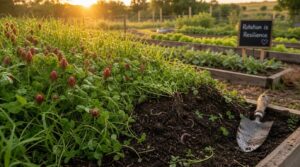
Cover crops are one of the best things you can do for your soil between growing seasons. They feed the ground, crowd out weeds, and set up your next planting for success. Here’s how to put them to work in your garden.
Plant Legumes for Nitrogen
Legumes are nature’s free fertilizer. Through biological nitrogen fixation, plants like fava beans work with soil bacteria called Rhizobia — tiny organisms that live in root nodules and convert atmospheric nitrogen into a form your plants can actually use. That’s free fertility, built right into the soil.
To get the most from this process, inoculate your legume seeds with a compatible Rhizobia strain before planting, especially in new beds where these bacteria may be sparse. At the right soil pH — between 6.0 and 7.0 — fixation works efficiently, sometimes contributing up to 300 pounds of nitrogen per acre.
When you turn legumes under at peak growth, residue management becomes key. Decomposing plant material releases that stored soil nitrogen gradually, feeding your next crop naturally.
Sow Rye or Buckwheat
Rye and buckwheat are two workhorses worth adding to your cover crop rotation.
Rye overwinters reliably, protecting bare soil through cold months and scavenging residual nitrates before they leach away.
Buckwheat, on the other hand, is a warm-season sprinter — its roots mobilize bound phosphorus, making it more available to whatever you plant next.
Turn Under Green Manure
Turning under your cover crop is where the real magic happens. Once green manure reaches early flowering stage, cut and work it into the top six inches of soil.
At this point, it releases nitrogen gradually — reducing your need for added fertilizer by up to 40 percent. Microbial activity visibly spikes within weeks, and weed suppression improves as decomposing biomass smothers germinating seeds.
Rotate Crop Families Yearly
Think of your garden beds like a game board — move the pieces every year, and the whole system wins. Crop family rotation shifts plant groups, such as legumes, brassicas, nightshades, and cucurbits, to different beds on a four-year cycle.
This breaks pest and disease cycles, balances nutrient use, and keeps soil health strong season after season.
Follow Legumes With Roots
After legumes, root vegetables thrive. Crops like carrots, parsnips, and beets love the soil legumes leave behind — loose, aerated, and quietly richer in nitrogen from those root nodules.
The deep taproots of your previous legume crop already cracked through compaction, so roots now push down with less effort. It’s a natural handoff that rewards smart rotation planning.
Maintain Living Soil Year-Round

Healthy soil isn’t just dirt — it’s a living system full of worms, bacteria, and fungi working around the clock for your plants. Keeping that system thriving takes a few consistent habits spread across every season. Here’s what to focus on.
Encourage Worms and Microbes
Your soil is alive — and the tiny creatures living in it do more work than most gardeners realize. Earthworms and soil microbes form the backbone of the soil food web, breaking down organic matter and releasing nutrients directly to your plant roots. Feeding them well is one of the smartest things you can do.
Earthworms and soil microbes quietly power your entire garden, breaking down matter and feeding roots every single day
Spread a thin layer of worm casting tea or finished compost across your beds each season. Worm castings concentrate nitrogen, phosphorus, and potassium in forms roots absorb easily. You can also apply microbial inoculants — liquid bacterial solutions — every few weeks to rebuild populations after soil disturbances.
Reduce Broad-spectrum Pesticides
What you use to fight pests matters as much as how often you use it. Broad-spectrum pesticides wipe out earthworms, beetles, and the microbial communities you just worked to rebuild.
Instead, try these targeted approaches:
- Set up a pheromone trap system to monitor pest thresholds before acting
- Support beneficial insect habitat with flowering plants that attract predatory wasps and beetles
- Apply biological pest control options only when monitoring confirms pest pressure exceeds tolerable levels
Integrated pest management keeps your soil biodiversity intact while still protecting your crops.
Add Mycorrhizal Inoculants
Protecting your pest defenses is only half the battle — the real magic happens underground. Mycorrhizal inoculants introduce beneficial fungi directly to your plant roots, forming a network that dramatically expands nutrient and water uptake.
Apply powder or liquid formulations at transplant time, placing spores in direct root contact for best results.
Water Deeply With Drip
Those underground fungal networks thrive when roots stay consistently moist — and drip irrigation delivers exactly that. Unlike overhead sprinklers, drip systems place water directly at the root zone, cutting evaporation by up to 50%.
Run longer, less frequent cycles to encourage roots to grow deeper.
Place emitters 12–24 inches apart near each plant’s drip line for even coverage.
Top-dress Beds Each Season
Think of topdressing as a seasonal reset for your beds. Each season, spread a ¼–½ inch compost layer evenly across the surface, then rake it gently in.
This replenishes nutrients, feeds soil microbes, and acts as organic mulch — all at once. Clear debris first, keep material away from stems, and lightly water after applying to help it settle.
Frequently Asked Questions (FAQs)
What can I add to my garden soil to make it better?
You can add finished compost, aged manure, leaf mold, worm castings, or biochar. Mulch, organic fertilizers, gypsum, and cover crop mixes also build healthier, more productive soil over time.
How to fix poor quality soil?
Poor soil quality often comes down to low organic matter, compaction, or imbalanced soil pH. Start with a soil test, then amend with compost and organic matter to rebuild structure and fertility fast.
How to replenish poor garden soil?
Replenishing poor garden soil starts with restoring soil organic carbon through compost and organic matter. These amendments rebuild structure, prevent nutrient leaching, and reactivate microbial life — turning depleted ground into a thriving, productive growing foundation.
How to rejuvenate old garden soil?
Old soil doesn’t retire — it just needs the right wake-up call. Refresh it with compost and organic matter, tweak pH, and restore soil microbial activity with worm castings or biochar amendment.
How can i Improve my soil?
Healthy plants start with healthy soil. Test first, then build with compost, mulch, and cover crops. Fix structure, balance pH, and protect soil life — and your garden will reward you all season.
What makes a good garden soil?
Good garden soil is a living system. It balances pH stability (0–0), strong soil structure, rich organic matter, healthy soil microbial life, and reliable aeration and drainage — all working together to increase nutrient availability and water holding capacity for your plants.
How do you maintain healthy soil?
Maintaining healthy soil comes down to consistency. Feed it regularly with compost, protect it with mulch, and let cover crops rebuild what each season takes out.
How do you take care of soil in your garden?
Taking care of garden soil means feeding it consistently with compost, mulch, and cover crops while monitoring pH, structure, and moisture. Healthy soil isn’t built overnight — it’s tended season by season.
How do you improve sandy soil?
Sandy soil drains too fast and holds little water or nutrients. Work in finished compost and biochar to boost organic matter, improve soil texture, and protect the root zone where it matters most.
How do you improve soil texture?
Start with a jar or ribbon test to assess your sand, silt, and clay balance. Then work in compost, apply gypsum for clay, and mulch consistently to build lasting structure.
Conclusion
Think of your garden as a house built from the ground up—without a solid foundation, nothing above it holds for long. Every step you take to improve garden soil is another brick in that foundation: better structure, balanced nutrients, living microbes working quietly beneath the surface.
You won’t see the results overnight, but you’ll feel them when your plants stop struggling and start thriving. Healthy soil doesn’t just grow plants—it grows confidence in every gardener.
- https://landresources.montana.edu/soilfertility/soilscoop/ss_GardenSoil.html
- https://extension.oregonstate.edu/news/add-organic-matter-improve-most-garden-soils
- https://kats-garden.nz/blog/improving-soils-organically
- https://alluvialsoillab.com/blogs/news/8-strategies-regenerate-soil-2025
- https://extension.umd.edu/resource/organic-matter-and-soil-amendments