
This site is supported by our readers. We may earn a commission, at no cost to you, if you purchase through links.

A cramped raised bed or a narrow side yard changes everything about which tiller you need. Big box stores push full-size rear-tine machines that weigh 200 pounds—completely useless between rows of tomatoes spaced 18 inches apart.
The garden tiller market for small spaces has quietly exploded, though, with lightweight cordless models, compact 4-stroke engines, and corded electrics that handle tight turns without destroying what you planted last season. Matching right machine to your soil, your garden dimensions, and your tolerance for maintenance separates a tool you’ll actually use from one that collects dust in the shed.
Table Of Contents
- Key Takeaways
- 10 Best Garden Tillers for Small Gardens
- 1. Mantis 7940 Honda Tiller
- 2. Earthwise Electric Tiller Cultivator
- 3. Snapper XD 82V Cordless Cultivator
- 4. Honda FG110 Mini Tiller Cultivator
- 5. Greenworks Electric Corded Tiller
- 6. Sun Joe Electric Garden Tiller Steel Tines
- 7. Black Decker 20V Max Garden Tiller
- 8. GardenTrax Mini Cultivator
- 9. Earthquake MC440 Mini Cultivator
- 10. Briggs Stratton 82V Lithium Snapper Battery
- Types of Tillers Available for Small Gardens
- Key Features to Evaluate Before Buying
- Choosing The Right Tiller for Your Garden
- Electric Vs. Gas Tillers for Small Gardens
- How to Use a Small Garden Tiller Effectively
- Soil Types and Tiller Selection Guide
- Safety Tips for Operating Small Tillers
- Tiller Maintenance and Storage Best Practices
- Frequently Asked Questions (FAQs)
- What size tiller for a small garden?
- When not to use a rototiller?
- Can I use a tiller on rocky soil?
- Whats the best season to till a garden?
- How deep should I till for vegetable gardens?
- Do tillers work well in clay soil conditions?
- Should I till wet or dry soil?
- Can tillers help with container garden soil?
- How loud are gas tillers in residential neighborhoods?
- Are mini tillers safe for beginners to operate?
- Conclusion
Key Takeaways
- Full-size rear-tine tillers are the wrong tool for small gardens — compact models under 30 pounds, with 6- to 10-inch tilling widths, give you real control between rows without wrecking what’s already growing.
- Your power source shapes everything downstream: corded electric delivers steady torque with zero maintenance headaches, cordless buys you freedom for about 30–60 minutes per charge, and gas wins only when you’re fighting compacted clay.
- Soil type is the decision-maker most buyers skip — sandy and loamy ground works fine with a basic front-tine mini tiller, but clay demands wider-spaced steel tines, a staged depth approach, and soil that’s damp, not soaked.
- sticker price is the smallest number that matters — steel tines outlast aluminum by years, electric models cut ongoing fuel and maintenance costs, and quality brands hold 40–60% of their resale value after three seasons.
10 Best Garden Tillers for Small Gardens
Finding the right tiller for a small garden doesn’t have to be a guessing game. The ten models below cover every power type, budget, and soil challenge you’re likely to face.
If you’re working with tougher ground, brushing up on fall soil preparation techniques can help you get the most out of whichever tiller you choose.
Here’s what made the cut for spring 2026.
1. Mantis 7940 Honda Tiller
The Mantis 7940 runs on a Honda 4-stroke, 25 cc engine — no oil mixing, no guesswork. Just fill it with unleaded gas and go.
At 24 pounds, it won’t wear you out hauling it down the garden path. Tines dig up to 10 inches deep and flip between tilling and cultivating modes, so you’re not buying two tools.
The finger-controlled throttle lets you slow down around seedlings or push harder through compacted clay. Priced at $489.99, it’s a capable, no-fuss workhorse.
| Best For | Home gardeners and seniors who want a lightweight, easy-to-use tiller for small-to-medium plots without the hassle of mixed fuel or heavy equipment. |
|---|---|
| Power Source | Gasoline |
| Tine Material | Metal |
| Max Till Depth | 10 in |
| Weight | 24 lb |
| Warranty | 2-year limited |
| Intended Use | Small-medium gardens |
| Additional Features |
|
- Honda 4-stroke engine starts reliably and runs on straight gas — no fuel mixing needed
- At 24 lbs, it’s easy to carry and maneuver in tight rows or raised beds
- Reversible tines plus optional attachments (edger, aerator, power-rake) make it a year-round yard tool
- Too small for large properties — expect multiple slow passes on anything over a third of an acre
- Requires ethanol-free gas, which can be harder to find and slightly more expensive
- Can bounce and vibrate on rough terrain, and may run rough after sitting unused for a few weeks
2. Earthwise Electric Tiller Cultivator
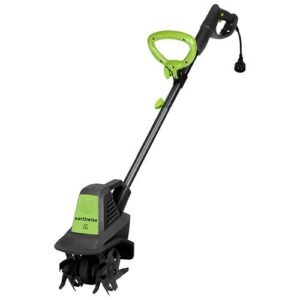
If gas feels like overkill for your raised beds, the Earthwise Electric Tiller Cultivator makes a solid case for keeping things simple. Plug it in, press a button, and you’re tilling. No fuel runs, no warm-up ritual.
The 2.5-amp motor spins four steel tines at 280 RPM, reaching 6 inches deep across a 7.5-inch working width. It weighs very little, fits anywhere, and runs quietly. For sandy or loamy beds, it does the job without fuss.
| Best For | Home gardeners with small-to-medium raised beds or flower beds who want a quiet, low-maintenance tilling option without the hassle of gas or batteries. |
|---|---|
| Power Source | Corded Electric |
| Tine Material | Steel |
| Max Till Depth | 6 in |
| Weight | Not specified |
| Warranty | Not specified |
| Intended Use | Small garden beds |
| Additional Features |
|
- Plug-and-go convenience — no fuel, no emissions, no warm-up time
- Lightweight and compact enough to store just about anywhere
- Quiet enough to use in residential areas without bothering the neighbors
- Struggles with rocky, hard, or root-heavy soil and has no reverse to help clear jams
- Small 7.5-inch working width makes large garden areas a slow, tedious project
- Cord-only design limits your reach and ties you to a 120V outlet
3. Snapper XD 82V Cordless Cultivator
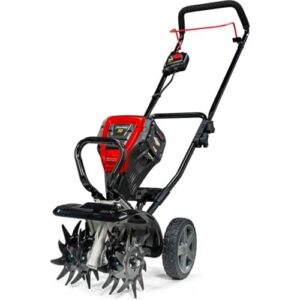
Want to cut the cord without losing power? The Snapper XD 82V Cordless Cultivator is worth a hard look.
Its brushless motor runs on an 82V lithium-ion battery, giving you quiet, exhaust-free operation wherever your garden takes you.
Tilling width adjusts from 5.25 to 10 inches, and removable outer tines let you squeeze into tight raised beds. It weighs just 12.3 pounds.
Battery sold separately, so factor that into your budget.
| Best For | Home gardeners with small yards, raised beds, or existing garden plots who want a lightweight, cordless option for routine soil prep. |
|---|---|
| Power Source | Battery (82V) |
| Tine Material | Metal |
| Max Till Depth | 5 in |
| Weight | 12.3 lb |
| Warranty | Not specified |
| Intended Use | Raised beds/small yards |
| Additional Features |
|
- Brushless motor keeps things quiet and low-maintenance — no exhaust, no fuss
- Adjustable tilling width (5.25"–10") makes it easy to work in tight spots and raised beds
- At just 12.3 lbs, it’s easy to carry around without wearing yourself out
- Battery and charger sold separately, which adds to the upfront cost
- Only about 30 minutes of runtime per charge — not ideal for bigger jobs
- Some users have run into assembly issues and missing hardware out of the box
4. Honda FG110 Mini Tiller Cultivator
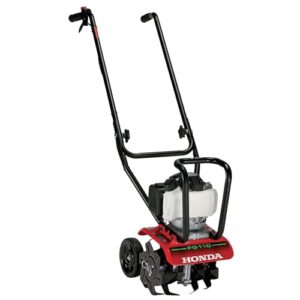
If you prefer the reliability of gas without the bulk, the Honda FG110 Mini Tiller hits a sweet spot. Its GX25 4-stroke engine runs on straight unleaded — no mixing, no fuss.
At 28 pounds, it’s easy to carry from bed to bed. Tilling width adjusts between 6 and 9 inches, so tight rows aren’t a problem.
The hybrid tines dig and cultivate in one pass, reaching up to 294 RPM. Two-year residential warranty included.
| Best For | Gardeners with small to medium beds who want a reliable, low-maintenance gas tiller without hauling around something heavy. |
|---|---|
| Power Source | Gasoline |
| Tine Material | Metal |
| Max Till Depth | Adjustable |
| Weight | 28 lb |
| Warranty | 2-year residential |
| Intended Use | Small-medium beds |
| Additional Features |
|
- 4-stroke engine means straight gas — no oil mixing, no hassle
- Light enough (28 lbs) to move around easily, even for older users
- Adjustable 6–9 inch width gets into tight spots and close to existing plants
- Struggles with compacted, rocky, or brand-new untreated soil
- Width may feel limiting if you’re working a larger garden
- Costs more than similar mini tillers, and the start-up process has a bit of a learning curve
5. Greenworks Electric Corded Tiller
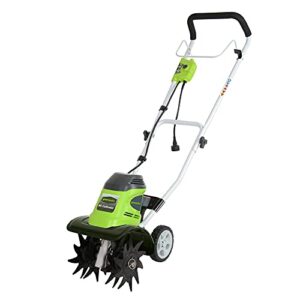
The Greenworks 27072 keeps things simple. Plug it in, press a button, and you’re tilling. No gas, no oil, no recoil cord to fight on cold mornings.
The 8-amp motor manages flowerbeds, raised beds, and vegetable patches without complaint. Four forward-rotating tines work up to 5 inches deep, and width adjusts between 8.25 and 10 inches — tight enough for narrow rows. At 29.3 pounds, it’s easy to maneuver. A 3-year warranty backs it up.
| Best For | Home gardeners with small-to-medium plots who want a simple, low-maintenance tiller — especially those who prefer skipping the hassle of gas and oil. |
|---|---|
| Power Source | Corded Electric |
| Tine Material | Steel |
| Max Till Depth | 5 in |
| Weight | 29.3 lb |
| Warranty | 3-year limited |
| Intended Use | Small-medium gardens |
| Additional Features |
|
- Push-button electric start makes it easy to use, even for seniors or anyone with limited strength
- Adjustable tine width and depth gives you decent flexibility for different garden beds and row sizes
- No fuel, no emissions, and low noise — cleaner and quieter than most gas tillers
- The power cord limits how far you can roam and takes some careful management to stay out of trouble
- Assembly instructions for switching between 2-tine and 4-tine setups can be confusing
- Struggles in heavily compacted or rocky soil, so dense sod should be killed or mulched first
6. Sun Joe Electric Garden Tiller Steel Tines
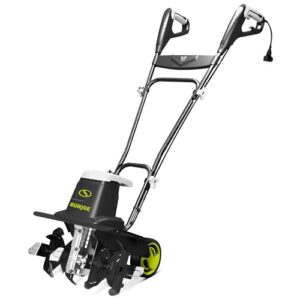
The Sun Joe TJ603E runs on a 12-amp motor and plugs straight into a standard outlet. Six rust-proof steel tines rotate forward, cutting up to 8 inches deep across a 16-inch working width. That’s solid coverage for raised beds and vegetable plots.
At $129.87, it won’t drain your wallet.
The folding handle makes storage easy, and quiet operation keeps the neighbors happy.
Just keep it away from rocky ground — large rocks can damage the tines fast.
| Best For | Home gardeners who want a low-maintenance, easy-to-store tiller for small vegetable beds and raised gardens without the hassle of gas or oil. |
|---|---|
| Power Source | Corded Electric |
| Tine Material | Steel |
| Max Till Depth | 8 in |
| Weight | Not specified |
| Warranty | Not specified |
| Intended Use | Residential gardens |
| Additional Features |
|
- Plugs into any standard outlet — no fuel, no oil changes, no fuss
- Tills up to 8 inches deep across a 16-inch width, solid for most backyard plots
- Quiet, lightweight, and folds down for easy storage
- The cord limits how far you can roam — you’ll need a long extension for bigger yards
- Struggles with rocky, heavily compacted, or clay-heavy soil
- Needs a break every 10 minutes to avoid overheating during longer jobs
7. Black Decker 20V Max Garden Tiller
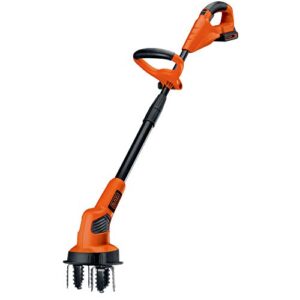
The Black+Decker LGC120 cuts the cord without the gas can. It runs on a 20V MAX lithium-ion battery — the same one that powers your trimmer or chainsaw if you’re already in the Black+Decker ecosystem.
Two counter-oscillating tines work through light to medium soil without tangling weeds around the shaft. At roughly 8 pounds, it’s easy to carry.
Coverage tops out around 325 sq ft per charge. Price is $124. Just budget for a second battery if your beds run large.
| Best For | Home gardeners with small to medium beds who want a lightweight, easy-to-use tiller without dealing with gas or a power cord. |
|---|---|
| Power Source | Battery (20V) |
| Tine Material | Metal |
| Max Till Depth | Not specified |
| Weight | ~8 lb |
| Warranty | 2-year limited |
| Intended Use | Garden beds/borders |
| Additional Features |
|
- Counter-oscillating tines break up soil cleanly without wrapping weeds around the shaft
- At ~8 lbs, it’s easy to maneuver around plants, fences, and tight corners
- Shares a battery with other BlackDecker 20V tools, so it fits right into an existing setup
- Runtime of 30–60 minutes per charge won’t cut it for larger gardens without a spare battery
- Recharging takes around 4 hours, which is a long wait mid-project
- Struggles with hard, compacted clay — expect multiple passes and some manual cleanup
8. GardenTrax Mini Cultivator
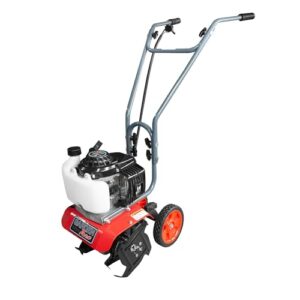
The GardenTrax Mini Cultivator (Model Y4007) runs on a 4-stroke gas engine, so no fuel mixing needed. It reaches about 4 inches deep — solid for flower beds and vegetable rows in lighter soils. At roughly 33 pounds with six forged steel tines spinning around 250 RPM, it manages small to medium clumps without much fuss.
Setup is quick, and customer support has a decent track record for swapping faulty units. Just follow the updated manual on oil amounts. The original got it wrong.
| Best For | Home gardeners with small-to-medium plots, flower beds, or vegetable rows in loose to moderate soil who want to skip the manual digging. |
|---|---|
| Power Source | Gasoline |
| Tine Material | Steel |
| Max Till Depth | 4 in |
| Weight | Not specified |
| Warranty | Not specified |
| Intended Use | Small residential lawns |
| Additional Features |
|
- No fuel mixing — it runs on straight gasoline, which keeps things simple
- Light and compact, so it’s easy to move around and store
- Customer support is responsive and will swap out faulty units with free shipping
- The rope-pull starter handle is fragile and has snapped on some users after just a few uses
- Starting issues are common if the oil level is off or the choke isn’t set right — stick to the updated manual
- Not built for tough, compacted soil — gearbox and throttle problems have been reported under heavier use
9. Earthquake MC440 Mini Cultivator
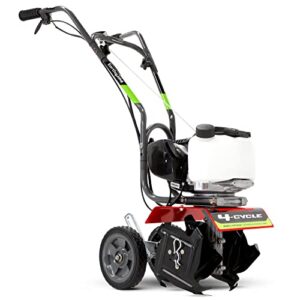
The Earthquake MC440 Mini Cultivator punches above its weight at $349. Its 40cc 4-stroke Viper engine runs on regular unleaded — no oil mixing, no guesswork.
Tines reach 8 inches deep at 10 inches wide, enough for most vegetable beds and flower rows. The stand-up start saves your back, and the 5-year warranty backs it up long-term.
Watch for hard starts after storage and fuel-line wear over time. Keep the carburetor clean and it’ll stay reliable season after season.
| Best For | Home gardeners and seniors who want a lightweight, easy-starting cultivator for flower beds and vegetable rows without the hassle of mixing oil and fuel. |
|---|---|
| Power Source | Gasoline |
| Tine Material | Stainless Steel |
| Max Till Depth | Not specified |
| Weight | Not specified |
| Warranty | 5-year limited |
| Intended Use | Flower beds/garden rows |
| Additional Features |
|
- 4-stroke engine runs on regular unleaded — no oil mixing, simple and clean
- Stand-up start is a back-saver, especially for older users or anyone with mobility issues
- Quiet compared to 2-stroke alternatives, so your neighbors won’t hate you
- Wheels sit too close together and the unit tips easily, so you’ll end up carrying it more than rolling it
- Hard starts after storage are a known issue — fuel line and carburetor need regular attention
- Struggles in compacted or heavy soil, so don’t expect miracles if your ground hasn’t been pre-tilled
10. Briggs Stratton 82V Lithium Snapper Battery
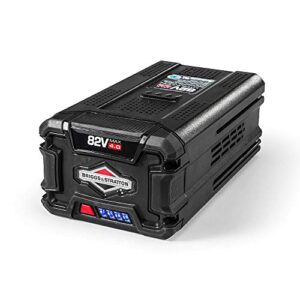
The Briggs & Stratton 82V Lithium Snapper Battery isn’t a tiller — but it powers one. Paired with the Snapper XD 82V MAX Cultivator, this 4.0 Ah battery delivers about 60 minutes of runtime on a full charge. One battery swaps across your whole Snapper XD lineup: mower, trimmer, blower.
The rapid charger refills it in roughly an hour. It’s heavier than the 2 Ah pack, and the $291 price stings, but longer runtime means fewer interruptions mid-bed.
| Best For | Snapper XD tool owners who want longer run time and fast recharging without juggling multiple battery systems. |
|---|---|
| Power Source | Battery (82V) |
| Tine Material | N/A |
| Max Till Depth | N/A |
| Weight | Not specified |
| Warranty | Not specified |
| Intended Use | Multi-tool battery system |
| Additional Features |
|
- Charges in about an hour, so you’re back to work fast
- One battery works across your whole Snapper XD lineup — mower, trimmer, blower, and more
- Consistent lithium-ion power holds steady even during long, high-demand sessions
- Heavier and longer than the 2 Ah pack, which can throw off balance on lighter tools
- Only works with the proprietary BSRC82 charger, sold separately
- At around $291, it’s a real investment — and a few users got units that wouldn’t charge right out of the box
Types of Tillers Available for Small Gardens

Not all tillers are built the same, and that difference matters more than most people realize. The right type depends on garden size, soil condition, and how much effort you want to put in.
Here’s a breakdown of the main options to help you figure out which one fits your setup.
Front-Tine Tillers for Tight Spaces
In tight spaces, a front tine tiller genuinely earns its keep. The tines sit up front, so you’re steering around plants instead of bulldozing them.
Most models weigh under 60 pounds, feature a foldable frame design, and use a staggered tine pattern for cleaner soil penetration. Quick width switching and edge clearance design let your compact garden tools work the borders without collateral damage.
For those seeking battery power, consider the cordless lithium‑ion battery models for quiet operation.
Rear-Tine Tillers for Deeper Soil Work
Rear-tine geometry flips the script on front-tine models. The tines sit behind the wheels, which means better leverage and traction when you’re pushing into clay or compacted ground.
Tilling depth hits 6 to 12 inches, so deep soil aeration is actually achievable.
Counter-rotating tines deliver serious torque amplification without stalling.
Rear tine durability holds up in tough conditions — adjustable tilling depth helps you match the setting to your small garden’s soil.
Mini and Handheld Cultivators Explained
Not every garden needs a rear-tine beast. Mini tillers and handheld cultivators are built around power-to-weight ratio — most weigh under 10 pounds, so maneuvering through a small garden never feels like a workout.
Tine spacing adjustability, vibration damping technology, and soil compaction mitigation features make compact garden equipment surprisingly capable. Battery runtime optimization on cordless cultivators usually runs 30 to 60 minutes — enough for most raised beds.
Corded Electric Vs. Cordless Vs. Gas Models
Power source comes down to three real trade-offs: freedom, torque, and upkeep. A corded electric tiller gives you steady power with zero emissions — no battery cuts, no fuel runs. A cordless tiller buys you mobility, usually 30–60 minutes of runtime per charge. A gas powered tiller wins on torque for tough clay.
Cost of ownership? Gas climbs fast. Corded vs. cordless wins for small garden simplicity.
Key Features to Evaluate Before Buying
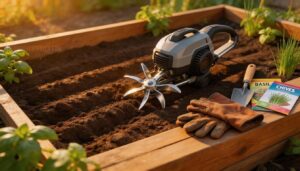
Not every tiller is built the same, and the differences matter more than you’d think.
Before you spend a dollar, there are four things worth checking so you don’t end up with the wrong tool for your beds. Here’s what to look at.
Tine Type, Material, and Arrangement
Tines do more work than most people realize. Stainless Steel Tines resist rust in wet beds, while Hardened Alloy Tines handle rocky ground without bending.
Bolo Tines churn broadly; Serrated Tines slice through stubborn roots.
A Swirl Tine Pattern or Dual Staggered Rows reduces clogging in heavy soil.
Interchangeable Tine Sets let you switch between tasks fast — that’s a smart tine design.
Adjustable Tilling Width and Depth
Width and depth control make or break your small garden results.
Most modern mini tillers offer Tool-Free Width Adjustment — Rapid Width Change in under 20 seconds, with Indexed Depth Stops preventing over-digging. Dial-Based Depth Control locks your setting via a Depth Locking Mechanism, keeping adjustable tilling width and tilling depth consistent across every pass.
That precision matters in tight beds.
Weight, Ergonomics, and Maneuverability
A well-balanced tiller saves your back. Look for adjustable handle height — most quality models accommodate users up to 6’4" — plus vibration damping to absorb shock from rocky soil.
A narrow wheelbase width improves turns in tight beds.
counterweight distribution and a low center of gravity keep the tiller planted, while lightweight design and compact size make weaving between rows easy.
Warranty Coverage and Brand Support
A tiller warranty is your safety net — don’t overlook it. Most mini tillers carry a 2-year warranty on motors and drive systems, but the fine print matters. Here’s what to check:
- Warranty Terms — confirm coverage excludes only wear parts
- Extended Coverage — some brands add up to 2 extra years
- Claim Process — look for online submission with tracking
- Support Channels — phone, email, and chat beat a single hotline
Buy from authorized dealers only.
Choosing The Right Tiller for Your Garden
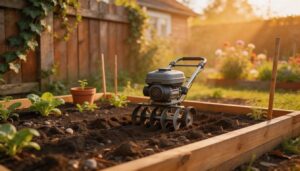
Picking the right tiller comes down to a few honest questions about your garden.
The size of your space, what your soil is actually like, and how much you want to spend all point you toward different answers.
Here’s what to think through before you buy.
Matching Tiller Size to Garden Dimensions
Size your tiller to your beds, not the other way around. Garden Layout Mapping starts with knowing your row spacing — a 12-inch bed needs a 12-inch tilling width, while an 18-inch bed calls for an 18-inch pass.
Bed Width Alignment and Tiller Width Ratio together cut wasted passes. For a small garden, adjustable tilling width and compact size give you real Dimension-Based Selection flexibility.
Assessing Your Soil Type and Condition
Your soil tells a story before you ever start tilling.
Do a quick compaction assessment — push a screwdriver six inches in. Too much resistance? You’ve got a problem.
Clay holds moisture but compacts easily. Sandy soil drains fast but needs organic matter level support.
Check soil pH testing results too, since nutrient availability shifts fast outside 6.0–7.0.
Soil health drives every tiller choice.
Budget Considerations and Long-Term Value
Price tags lie. The real number is total cost ownership — what you spend over five years, not just at checkout.
Price tags lie; the real cost of a tiller is what you spend over five years, not just at checkout
- Steel tines last 2–4x longer than aluminum, cutting replacement costs
- Electric models trim maintenance bills and offer real energy savings vs. gas
- Quality brands hold 40–60% resale value after 3 years
A 2-year warranty and honest depreciation rate tell you everything about price vs performance.
Portability Needs and Storage Constraints
Long-term value covers more than price — it covers where the thing lives when you’re done.
Most small tillers weigh 25–60 pounds, and foldable grips plus detachable wheels make moving them genuinely easy. A portable tiller with a foldable design just disappears when you’re finished.
Lightweight frame design and vertical storage options mean even a cramped shed works. Battery swappable packs tuck into compact slots.
Electric Vs. Gas Tillers for Small Gardens
Choosing between electric and gas comes down to more than just preference — it shapes how your tiller performs, how much upkeep you’ll do, and where it actually works best. Both power types have real strengths and real trade-offs worth knowing before you buy.
Here’s how they stack up across the things that matter most.
Performance and Torque Comparison
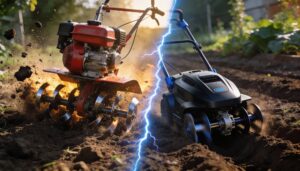
Gas wins on raw torque. A 25 cc engine hits peak torque at lower RPMs, giving you that instant bite in compacted clay.
Electric corded units hold torque consistency under load — no drop-off mid-row.
Cordless? Expect a 20% power delivery dip below 40% battery.
| Feature | Gas | Electric |
|---|---|---|
| Peak Torque | High | Moderate |
| Torque Curve | RPM-dependent | Flat, steady |
| Torque vs Soil | Best in clay | Best in loam |
Noise Levels and Environmental Impact
Torque tells half the story. The other half? Sound and what it does to your garden’s ecosystem.
Electric tillers sit in the 70–85 dB range — noticeably quieter, which matters for Bird Activity Disruption and Insect Communication Interference near active beds. Gas models run louder and emit carbon, raising your carbon footprint with every pass.
| Factor | Gas | Electric |
|---|---|---|
| Noise Level | High | Low |
| Emissions | Yes | Zero emissions |
| Wildlife Impact | Disrupts habitat | Wildlife Habitat Preservation |
Quiet operation isn’t just neighborly — some areas enforce Noise Compliance Regulations. Acoustic Damping Materials help, but emissions reduction starts with going electric.
Maintenance Demands for Each Power Type
Keeping your tiller running is where ownership gets real.
| Power Type | Key Maintenance Task |
|---|---|
| Battery | Battery Cycle Checks every 20 charges |
| Corded Electric | Corded Cord Inspection before each use |
| Gas | Gas Oil Changes every 20 hours |
| Front-Tine | Front Tine Tightening after heavy sessions |
| Rear-Tine | Rear Chain Adjustment per manual schedule |
Electric models demand far less — battery life management for cordless tillers mostly means smart storage at 20–25% charge.
Gas requires more: air filters, spark plugs, carburetor checks.
Maintenance warranty and safety tips for mini tillers vary by type, so match your patience to your power source.
Best Use Cases by Garden and Soil Type
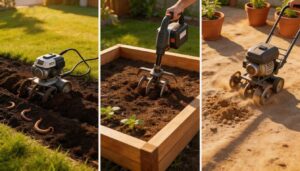
Not every tiller fits every patch of dirt. Match your power source to where you’re actually digging.
| Garden Type | Soil Condition | Best Match |
|---|---|---|
| Front yard edges | Loamy, light | Corded electric |
| Elevated garden beds | Peaty soil amendment | Cordless battery |
| Pot garden spaces | Dry sand preparation | Mini cultivator |
Gas wins in clay. Electric covers the rest.
How to Use a Small Garden Tiller Effectively
Owning a great tiller is only half the battle — knowing how to use it makes all the difference. A few simple habits before, during, and after tilling can protect your plants, extend your machine’s life, and get your soil garden-ready faster.
Here’s what to do at each step.
Preparing Your Soil Before Tilling
Think of your soil as the foundation — get it wrong and nothing else matters. Start with pH Testing and Nutrient Assessment so you know what you’re working with.
Clear rocks and weed roots, then focus on Compost Incorporation, mixing 2–4 inches deep for better soil aeration and soil compaction reduction. Moisture Control matters too — damp but not soggy is your target.
Setting The Correct Tilling Depth
Depth calibration techniques aren’t complicated — you just need to match your tilling depth to what your crops actually need. Shallow-rooted greens want 4–6 inches. Tomatoes need 8–12. Use your depth adjustment levers to dial it in.
Soil moisture impact matters too — till when it’s damp, not wet. depth consistency checks across several spots to confirm uniform soil aeration throughout.
Following a Methodical Tilling Pattern
Random tilling wastes time and leaves patchy results. Start with Alignment Markers — stakes or chalk lines — to map your Pattern Mapping grid before the engine even starts.
Use Pass Sequencing: shallow first, then deeper. Apply a Lane Overlap Strategy of one-third your tilling width per pass. Practice smart Turn Management at bed edges.
Good soil preparation efficiency comes from consistency, not speed.
Tilling Around Plants Without Causing Damage
Roots don’t forgive a careless pass. Set your tilling depth to 2–4 inches near plants and use a narrow adjustable tilling width to create a natural Plant Buffer around stems.
Precision Passes with Low-Impact Tines — rounded tips, slow movement — keep soil preparation effective without nicking shallow roots. Gentle Tilling from the outer edge inward gives you control where it counts.
Soil Types and Tiller Selection Guide
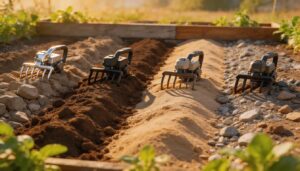
Not every tiller is built for every patch of ground. Your soil type is the deciding factor — and the wrong match wastes time and wears out your machine fast.
Here’s how to pair the right tiller to whatever you’re working with.
Tilling Sandy and Loamy Soils
Sandy and loamy soils are the friendliest ground you’ll ever till. Both respond well to a front-tine mini tiller set between 6 and 8 inches deep.
Before you start, mix in 2 to 3 inches of compost — organic matter integration boosts moisture retention strategies and guards against nutrient leaching prevention. Keep bulk density between 1.1 and 1.4 g/cm³ for strong soil porosity preservation.
Breaking Up Clay and Compacted Ground
Clay is a whole different game. Unlike sandy ground, hard soil fights back — and winning takes strategy, not brute force.
- Break clay in layers: start at 6 inches, then increase tilling depth gradually across passes.
- Time your tilling with Moisture Timing — soil should crumble, not clump.
- Apply gypsum for Clay Loosening Techniques and Layered Soil Aeration.
- Use Manual Soil Breaking with a broadfork before your tiller runs.
- Stick to narrow tilling width passes for better Compaction Prevention and soil loosening control.
Tilling Raised Beds and Container Gardens
Raised beds play by different rules. The soil is already loose and rich — your job is upkeep, not excavation. A mini tiller with a narrow tilling width (6–8 inches) keeps small garden maintenance tidy without disturbing roots.
| Task | Tiller Setting | Benefit |
|---|---|---|
| Soil loosening | 4–5 inch depth | Avoids root damage |
| Mulch Integration | Shallow pass | Blends organic matter |
| Soil Moisture Management | Surface tilling | Reduces evaporation |
| Crop Rotation Planning | Full-width pass | Refreshes bed structure |
| Companion Planting Benefits | Edge-only tilling | Protects plant clusters |
Keep Bed Edge Protection in mind — stay 2 inches from borders.
Adjusting Tiller Settings for Wet Soil
Wet soil punishes bad settings fast. Where raised beds let you coast, soggy ground fights back — wheel slip, smeared clods, bogged tines.
- Depth Bar Adjustment – Start at 2–4 inches; raise in 1‑inch steps only after each pass loosens up.
- Tine Speed Control – Slow it down. High RPM smears wet soil instead of breaking it.
- Rotation Direction Choice – Forward rotation keeps wet sod stable and prevents lifting.
- Wheel Slip Prevention – Till across the slope, overlap passes by one‑third of your tilling width.
Clod Management gets easier once soil moisture considerations guide your depth — adjustable tines and tilling width adjustment do the rest.
Safety Tips for Operating Small Tillers
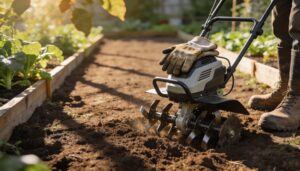
A tiller can chew through soil fast — but it doesn’t slow down for careless hands or forgotten obstacles.
Before you fire one up, a few safety habits make the difference between a productive morning and a trip to urgent care.
Here’s what to keep in mind before, during, and after every tilling session.
Protective Gear and Pre-Operation Checks
Before you fire up that tiller, gear up right.
Hard hats meeting ANSI Z89.1 helmet standards, gloves with snug glove fit for real handle control, and ear protection rated at least 22 dB — these aren’t optional.
Run a pre-start inspection: check oil, do a battery charge check on electric models, and confirm all guards are locked in place.
Identifying and Avoiding Hidden Hazards
Your garden can hide more trouble than you’d think. Scan for damaged cords and unlabeled controls before every pass.
Watch for cluttered walkways, hidden energy sources in stored mechanical parts, and fuel spills — keep spill containment mats handy near gas models. For cordless tillers, battery life management matters too: a dying mid-run battery causes rushed, careless moves.
Safe Handling During Clogs and Stoppages
A clog mid-run is no small thing — stop immediately. Follow your Engine Shutoff Procedure or Battery Disconnect Steps before touching anything.
Pull the spark plug boot on gas models. Then use your Tine Clearing Technique: a wooden stick, never your hands.
Check that safety Interlock Reset Guidance is complete before restarting. Build a Clog Prevention Routine by clearing debris before each session.
Gas Model-Specific Safety Precautions
Gas models demand a bit more respect than their electric cousins. Before each run, do your Spark Plug Inspection and Carburetor Leak Checks — cracks there cause real trouble fast. Use the Fuel Valve Shutoff after every session.
Store fuel away from heat in approved containers. Proper Ventilation prevents vapor buildup, and a clean Backfire Prevention startup routine keeps things running safely.
Tiller Maintenance and Storage Best Practices
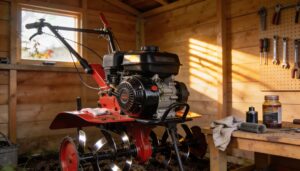
A good tiller lasts years longer when you treat it right between uses. Skipping maintenance is the fastest way to turn a reliable machine into an expensive headache.
Here’s what to do to keep yours running clean, sharp, and ready for the next season.
Routine Cleaning After Each Use
A dirty tiller is a broken tiller waiting to happen.
After every session, start with Tine Debris Removal — knock off soil clumps with a stiff brush, then dry the tines completely. Wipe the gearbox area for Gearbox Dust Prevention, clean Battery Terminal Cleaning contacts on cordless models, and dry Handle Grip Drying thoroughly.
This quick Post-Use Inspection routine keeps your clean and maintenance checklist short and your tiller running longer.
Tine Inspection and Replacement Schedule
Your tines are the teeth of the operation — and dull teeth don’t bite.
Before every use, run a quick Visual Inspection Routine: look for rounded edges, chips, or rust on your steel tines.
- Wear Indicator Signs: uneven height, wobble, or soil smearing
- Replacement Interval Guidelines: standard steel tines last 1–3 seasons
- Balanced Tine Sets: always replace in matched pairs
Log everything — Maintenance Log Documentation saves future headaches.
Battery and Oil Care by Power Type
Once your tines are sorted, power care is next.
For battery powered tiller models, Battery Lifespan Tips start with temperature — never charge below freezing, and store packs between 40–80°F. Regular Battery Pack Inspection catches swollen cells early.
Gas tillers need Oil Viscosity Selection attention: SAE 5W-30 works for most climates, and Synthetic Oil Benefits include reduced wear at high RPM. Change oil every 20 hours.
Compact Storage Solutions for Small Sheds
Now that your tiller is powered up and maintained, it needs a smart home too.
- Wall Mounted Shelving frees up floor space and holds up to 200 lb per shelf
- Pegboard Organization keeps hooks and bins within reach
- Vertical Overhead Racks store bulkier gear up high
A foldable workbench, lightweight design, and mobile tool carts make storage and portability solutions for garden tools surprisingly simple — even for a compact tiller.
Frequently Asked Questions (FAQs)
What size tiller for a small garden?
For gardens up to 1,000 square feet, a 6- to 10-inch tilling width and 6- to 8-inch tilling depth hits the sweet spot — lightweight, maneuverable, and right-sized.
When not to use a rototiller?
Skip it when soil is soaking wet, frozen, or on steep slopes.
Tilling too early risks frost heave, mud clumps, and compaction. It can also shred mulch layers and disturb wildlife habitat underground.
Can I use a tiller on rocky soil?
Yes, but carefully. Clear large rocks first, limit your tilling depth, and use reinforced tines.
A rock skid attachment helps manage engine strain. Rocky soil prep takes extra steps, but it’s doable.
Whats the best season to till a garden?
Spring is your sweet spot. Soil moisture sits in that 12–18% range, and the ground is workable.
Use a moisture meter to confirm timing. Fall tilling works too, especially before winter sets in.
How deep should I till for vegetable gardens?
Think of roots like hands reaching into the earth — they need room.
For most vegetables, a tilling depth of 6 to 8 inches hits the sweet spot for root zone depth and moisture.
Do tillers work well in clay soil conditions?
Tillers can handle clay soil, but engine power and tine durability matter most. Steel tines with wider spacing cut through hard soil better.
Moisture management is key — till when damp, never muddy, to avoid clogs.
Should I till wet or dry soil?
Somewhere between soggy and dusty lies the sweet spot. Use the Soil Crumble Test: grab a handful — if it crumbles loosely, you’re good. Too wet or bone-dry both cause compaction.
Can tillers help with container garden soil?
Yes, a mini tiller can refresh compacted container soil fast.
It improves soil aeration benefits, facilitates nutrient distribution enhancement, and boosts moisture retention improvement — all while staying compact, pot compatible with tine angle adjustment for shallow passes.
How loud are gas tillers in residential neighborhoods?
Gas tillers hit 85–95 decibels — think busy traffic next to your ear. Most neighborhood ordinances ban that noise before 8 a.m.
A well-maintained muffler helps, but electric still wins for quiet yards.
Are mini tillers safe for beginners to operate?
Mini tillers are about as beginner-friendly as power tools get. Look for an emergency shutoff mechanism, vibration damping benefits, and solid beginner safety features.
Wear your personal protective equipment, maintain child-free work zones, and you’re good.
Conclusion
Like a master gardener cares for their prized roses, you’ve carefully nurtured your small garden, and now it’s time to give it the right tools to thrive. As you navigate the field of garden tillers, remember that finding the perfect match is key.
Consider your soil, space, and needs, and don’t be afraid to explore options like the top-rated models featured here. With the right tiller, like those for garden tillers for small gardens, your garden will flourish.