
This site is supported by our readers. We may earn a commission, at no cost to you, if you purchase through links.
I’ve watched too many gardeners pick their bell peppers too early, left with bland, thin-walled fruits that lack the sweetness and crunch they were waiting all summer for. The difference between a mediocre pepper and an exceptional one often comes down to just a few extra days on the plant.
Your peppers give clear signals when they’re ready—a shift in color intensity, a certain firmness to the touch, a glossy sheen that catches the morning light. Learning to read these signs transforms your harvest from guesswork into precision.
Whether you’re growing sweet bells that’ll grace your dinner table or planning to preserve your bounty for winter cooking, timing makes all the difference in flavor, nutrition, and shelf life.
Table Of Contents
- Key Takeaways
- Bell Pepper Growth Timeline
- When to Harvest Bell Peppers
- Signs of Bell Pepper Ripeness
- Harvesting Bell Pepper Techniques
- Post-Harvest Handling and Storage
- Culinary Uses and Health Benefits
- Maximizing Bell Pepper Yield and Quality
- Frequently Asked Questions (FAQs)
- Can you leave bell peppers on the plant too long?
- Will a pepper be less hot if you pick it when it’s green?
- How do you harvest a bell pepper?
- How to identify when bell peppers are ready for harvest?
- When should you harvest bell peppers?
- How do you pick a bell pepper?
- Can you harvest bell peppers too early?
- Do bell peppers regrow after being harvested?
- How many bell peppers per plant typically?
- What causes bell peppers to crack or split?
- Conclusion
Key Takeaways
- Bell peppers signal harvest readiness through three key indicators: full size (3-4 inches), firm texture with a slight give, and glossy skin with even color throughout—green varieties mature in 60-90 days while fully colored peppers need an extra 2-3 weeks for peak sweetness.
- Harvesting technique matters as much as timing—use sharp pruners to cut the stem half an inch above the fruit while supporting it with your other hand, and pick in the morning after dew evaporates to preserve crispness and reduce water loss.
- Regular picking every 1-2 days during peak season triggers continued fruit production throughout the season, while leaving peppers too long invites pests, disease, and overripe fruit that loses firmness and flavor.
- Proper post-harvest storage at 45-50°F in perforated bags extends shelf life to 1-2 weeks for fresh use, while freezing at -18°C or dehydrating at low heat preserves your harvest for months without sacrificing nutritional value.
Bell Pepper Growth Timeline
Understanding the timeline from planting to picking helps you know exactly when your peppers will be ready.
Once your peppers hit full size and show their mature color, you can follow best practices for harvesting peppers for storage to keep them fresh longer.
Bell peppers don’t rush—they move through distinct growth phases that determine harvest timing.
Let’s break down the key stages so you can track your plants’ progress with confidence.
Days to Harvest
Your bell peppers usually reach harvest maturity 60 to 90 days after transplanting, while seed-started plants need 90 to 150 days total. Most varieties hit their sweet spot around 70 to 85 days from seed, though ripening factors like temperature and variety influence exact timing.
Days to harvest aren’t just numbers on a packet—they’re your roadmap to peak flavor and yield optimization. I always check the seed packet for specific harvest timing guidelines, then mark my calendar. Understanding these growth stages helps you plan picking schedules and optimize your harvest without leaving fruit too long on the plant.
Days to harvest aren’t just numbers—they’re your roadmap to peak flavor and perfectly timed picking
Gardeners benefit from knowing how factors affecting days to harvest like weather and soil quality can influence pepper maturity.
Seed to Fruit Growth
Once your seeds germinate in 7 to 14 days, you’ll see cotyledons emerge first, followed by true leaves within two to three weeks.
The Fruit Initiation happens around six to eight weeks after seedling development when floral buds form on new growth. The Pollination Process follows, and fruit set begins two to four weeks after flowering.
Track these Growth Stages closely—understanding how Seed Germination leads to Maturation Rates helps you predict when your pepper plant reaches harvest readiness.
Flowering to Ripening
Once fruit set locks in, you’re looking at a ripening process that spans roughly 50 to 60 days before harvest timing arrives. Hormone regulation kicks into gear as ethylene and abscisic acid levels shift, driving fruit maturation forward.
Color development starts at the base and works upward—green flesh transforms into vibrant red, yellow, or orange depending on your variety. Sugar accumulation intensifies as peppers ripen, boosting sweetness noticeably.
Watch for full-size fruit with glossy skin signaling peak ripeness, and remember that pepper ripening accelerates in temperatures between 70 and 85°F with plenty of sunlight.
When to Harvest Bell Peppers
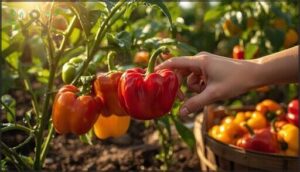
Now that you understand the growth phases, let’s talk about the actual harvest timing. You’ll want to pick your bell peppers when they’ve reached 3 to 4 inches in size—that’s your baseline for pepper readiness.
Green varieties are ready around 60 to 90 days after transplanting, while those ripening to red, yellow, or orange need an extra 2 to 3 weeks for full color change. Here’s what matters most: fruit firmness. Press gently—if it feels firm but gives slightly, you’re good to go.
Regular picking during ideal picking windows boosts your total yield!
Signs of Bell Pepper Ripeness
Knowing when your bell peppers are perfectly ripe takes the guesswork out of harvest time. You don’t need fancy equipment—just your eyes and hands to check a few key indicators.
Here’s what to look for when deciding if your peppers are ready to pick.
Color Indicators
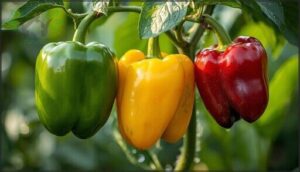
You’ll know your pepper is ready when its color tells the whole story. Green bell peppers can be harvested early, but letting them ripen on the plant unlocks sweeter flavors as chlorophyll breaks down and carotenoids emerge.
Watch for even color uniformity across the fruit—no green patches lingering at the shoulders. Red varieties signal full ripeness around 70-90 days after fruit set, while yellow and orange peppers follow their own timelines. That deep skin gloss you’re seeing? It’s nature’s way of confirming peak ripeness and maximum sugar development.
Size and Shape
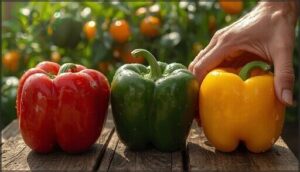
Beyond color, your bell peppers’ size and shape reveal harvest readiness. Most varieties reach mature dimensions of 3-4 inches in length and width, developing that characteristic blocky shape with defined lobes. When picking, you’ll notice ripe fruit feels firm and heavy—usually 200-350 grams depending on the pepper variety. Check for uniform growth and a plump, rounded appearance with thick walls.
Size indicators that signal it’s time for harvest:
- Mini varieties stay petite at 2-3 inches, while Big Bertha reaches 8 inches long
- Standard bells measure 4-5 inches across when fully developed
- Heavyweight feel means higher water and sugar content during ripening
- Symmetrical lobes and stable shape development show ideal fruit formation
- Shriveling or irregular contours mean you’ve waited too long for picking bell peppers
For more insight on, understanding mature dimensions can help you refine your harvest timing.
Skin Texture and Gloss
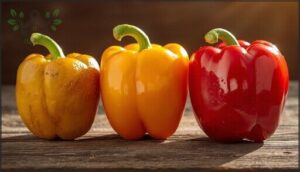
That telltale shine reveals harvest readiness better than you might think. When your bell peppers develop reflective highlights with strong gloss perception across the surface evenness, you’re looking at ideal ripening. Feel for firmness without soft spots. As texture transforms from rough to smooth and skin hydration increases, microtexture analysis confirms peak flavor development—your signal to harvest.
| Ripeness Stage | Gloss & Texture Indicators |
|---|---|
| Immature | Dull, matte surface; rough microtexture |
| Nearly Ready | Developing shine; firming skin |
| Peak Harvest | Glossy, even reflections; smooth texture |
| Overripe | Wrinkling; soft spots; reduced firmness |
Harvesting Bell Pepper Techniques
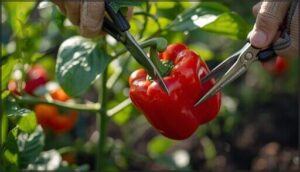
You’ve identified your ripe peppers—now it’s time to get them off the plant without causing damage. The way you harvest matters more than you might think, since rough handling can stress your plant and cut into future yields.
Let’s walk through the right tools, timing, and techniques to keep both your peppers and plants healthy.
Cutting Tools and Methods
Sharp pruners or kitchen shears are your best allies for clean pepper harvesting techniques. I recommend cutting the stem about half an inch above the fruit, supporting the pepper gently with your other hand. Tool material selection matters—stainless steel resists rust and maintains its cutting edge geometry longer than cheaper alternatives.
Proper harvest management protects your plants and maximizes yield. Here’s what you need:
- Blade sharpness – Clean cuts prevent disease entry
- Sanitation practices – Wipe blades between plants
- Proper grip – Control pressure during cuts
- Storage habits – Keep tools dry and clean
Harvesting at Optimal Time
Morning hours—right after dew evaporates but before heat builds—give you the best harvest timing for preserving fruit quality. You’ll catch peppers at their peak when temperatures stay cool, reducing water loss and maintaining crispness.
Check your plants daily during ripening stages to monitor the maturation process and snag peppers at perfect ripeness. Don’t wait for every pepper to reach full color! Ideal picking includes mature green ones, which triggers your plants to keep producing.
This strategic approach to harvesting extends your ripening window while ensuring each pepper reaches its best picking stage.
Handling and Storage Tips
Handle your harvested peppers gently—bruising accelerates decay and cuts shelf life short. Don’t wash them before refrigeration; surface moisture invites spoilage.
For cool storage, place unwashed peppers in perforated bags inside your crisper drawer at 45-50°F. They’ll maintain peak quality for 1-2 weeks. Green varieties store slightly less time than fully colored ones.
This fresh handling approach ensures food safety while maximizing your crop’s shelf life and flavor retention.
Post-Harvest Handling and Storage
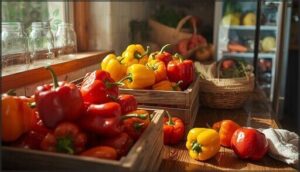
You’ve put in the work to grow and harvest your bell peppers at just the right time. Now it’s all about keeping them fresh and flavorful for as long as possible.
Let’s look at the best ways to store your harvest, whether you’re using them this week or saving them for months down the road.
Refrigeration and Shelf Life
After harvest, proper refrigeration transforms your bell peppers from a few-day snack into a weeks-long fresh ingredient. You’ll want to maintain your fridge between 40°F and 45°F with high humidity for ideal shelf life extension. Storage optimization starts the moment you bring peppers inside—keep them unwashed and whole in your crisper drawer for best results.
- Temperature control: Set your refrigerator to 40°F and avoid fluctuations above 5°F that shorten food preservation
- Humidity management: Use perforated plastic bags to maintain 90-95% humidity without trapping excess moisture
- Ethylene regulation: Store peppers away from apples and bananas that accelerate ripening
- Smart packaging: Wrap peppers loosely in paper towels to absorb condensation and prevent mold
- Regular checks: Inspect every 2-3 days to catch soft spots early
Freezing and Dehydration
Beyond refrigeration, you can extend your harvest through freezing or dehydration control. Wash peppers thoroughly, then dice them for frozen storage at minus 18 Celsius—they’ll maintain quality for months in your everyday food preservation and storage routine.
Freeze drying or cryogenic freezing preserves nutrients better than conventional methods. For culinary uses requiring concentrated flavor, dehydrate sliced peppers at low heat, then store airtight. Rehydration methods take just 5-10 minutes in warm water.
Pickling and Preservation
You can pickle your harvest using fermentation methods or quick vinegar-based pickle recipes. For food safety, maintain proper brine solutions with 5-8% acetic acid. Salt concentrations between 5-10% create ideal fermentation environments.
Process jars in a boiling water bath for 10-15 minutes. These food preservation and storage tips keep pickled peppers crisp for months—store in cool, dark locations after sealing.
Culinary Uses and Health Benefits

Now that you’ve harvested your bell peppers, it’s time to enjoy the fruits of your labor—literally.
These colorful gems aren’t just easy on the eyes; they pack serious nutritional value and work beautifully in countless dishes.
Let’s explore what makes bell peppers such a powerhouse in both your kitchen and your diet.
Nutritional Value and Versatility
You’ll find bell peppers deliver remarkable nutrient density for minimal calories—just 31 per 100 grams. Their vitamin content impresses, with red varieties providing 93 milligrams of vitamin C and 66 micrograms of beta-carotene.
Fiber analysis shows about 2 grams per serving, supporting your digestion. The antioxidant benefits from carotenoids and capsanthin protect your cells from damage. What makes culinary uses exciting is how color progression affects both flavor and nutrition—ripe peppers offer enhanced sweetness alongside exceptional health benefits.
Recipes and Cooking Methods
You’ve got five cooking techniques to bring out your bell peppers’ full flavor profile. Roasting Techniques at 450°F for 20 to 25 minutes create blistered, caramelized sweetness you’ll love in sauces. Sauté Methods using medium heat for 5 to 7 minutes preserve crisp texture while building depth.
Grilling Tips over medium-high heat add smoky char that transforms color and flavor. Stuffed Peppers baked at 350°F for 60 to 90 minutes turn them into complete meals. Drying Processes at 125°F to 135°F concentrate natural sugars into intensely flavorful chips.
Exploring Different Pepper Varieties
You’ll discover endless flavor possibilities when you explore pepper varieties beyond standard bell peppers. Understanding Pepper Classification helps you match Variety Selection to your garden’s Growing Conditions and your preferred Heat Levels.
Consider these popular options for diverse harvests:
- Sweet Capsicum annuum peppers – California Wonder bell peppers ripen from green bell peppers to red bell peppers in 70 to 90 days, delivering mild flavor
- Medium-heat varieties – Jalapeños and serranos offer 10,000 to 50,000 SHU with faster pepper ripening cycles
- Specialty Flavor Profiles – Aji Amarillo and chocolate bells provide unique fruity notes you won’t find elsewhere.
Maximizing Bell Pepper Yield and Quality
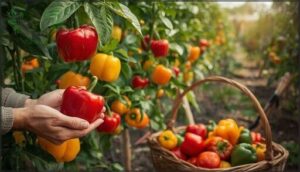
Getting the most out of your bell pepper plants isn’t just about when you pick them—it’s about how you care for them throughout the season. A few simple habits can double your harvest and keep those peppers crisp and flavorful for weeks.
Let’s look at three key strategies that’ll help you grow more peppers and make them last longer.
Regular Inspection and Harvesting
Think of your pepper plants as a production line—regular picking keeps them running smoothly. Check your plants daily during harvest timing to spot ripe peppers fast. I grab my shears every morning when the dew’s dried off, cutting peppers that show full color and glossy skin.
This daily pepper checks routine triggers more fruit monitoring and signals the plant to keep producing. Regular picking every 1 to 2 weeks prevents overcrowding and maximizes your pepper ripening success!
Supporting Plant Growth and Health
Strong pepper plant care drives bigger, sweeter harvests. Focus on soil conditioning with organic matter to improve nutrient balance, then practice water management with deep, infrequent soaking—not daily splashes.
Provide 6 to 8 hours of sunlight and guarantee air circulation by spacing plants 18 to 24 inches apart. Monitor for pest control needs weekly, treating aphids or whiteflies fast.
These gardening techniques create ideal conditions for vigorous plant growth and development.
Extending Shelf Life and Storage
Your harvest won’t last if you skip the storage basics. Keep peppers at 45–50°F in perforated Storage Containers for Humidity Management and airflow.
Temperature Control matters—cool conditions plus Ethylene Reduction (away from ripening fruit) deliver serious Shelf Life Extension.
For long-term food storage, blanch before freezing or try dehydration. These simple moves protect your hard-won food production from spoilage.
Frequently Asked Questions (FAQs)
Can you leave bell peppers on the plant too long?
Yes, you can! Letting peppers linger after color change invites pests, diseases, and overripe fruit that loses firmness.
Timely picking reduces plant stress, prevents spoilage, and keeps your harvest crisp and flavorful.
Will a pepper be less hot if you pick it when it’s green?
Bell peppers contain no capsaicin, so they’re never hot—green or ripe. Picking green won’t reduce heat because heat level stays at zero throughout ripening.
Chili pepper varieties develop capsaicin differently based on genetics.
How do you harvest a bell pepper?
Think of it as a gentle rescue mission—you’ll need sharp bypass pruners to cleanly cut the stem about 1/4 to 1/2 inch above the fruit while supporting it with your hand to protect the plant.
How to identify when bell peppers are ready for harvest?
Look for peppers measuring 3 to 4 inches wide with firm, glossy skin. They’ll feel heavy for their size.
Green peppers are ripe now, but you can wait for red, yellow, or orange color change.
When should you harvest bell peppers?
Your peppers are ready when they hit 3-4 inches, feel firm with a slight give, and display their mature color—green for early harvest or red, yellow, and orange for peak ripeness and sweetness.
How do you pick a bell pepper?
You’ll need sharp scissors or pruning shears to cut the stem cleanly about an inch above the fruit.
Cradle the pepper gently while cutting—this prevents branch damage and keeps your plant producing more.
Can you harvest bell peppers too early?
Yes, you can pick bell peppers too early. Premature picking leads to thinner walls, reduced sweetness, and a bitter taste.
Wait until they reach full size and color change for ideal ripeness and flavor development.
Do bell peppers regrow after being harvested?
Here’s the thing about pepper plants: once you pick that glossy fruit, the same stem won’t sprout another. But your plant keeps flowering and setting new peppers all season long!
How many bell peppers per plant typically?
You can expect around 5 to 10 bell peppers per plant throughout the season.
Plant density, pepper varieties, and consistent watering directly influence fruit production, while regular harvest frequency encourages your plants to keep delivering.
What causes bell peppers to crack or split?
Water stress tops the list—those dry spells followed by heavy watering create internal pressure that splits the skin wide open.
Temperature fluctuations and rapid fruit growth rate also trigger cracking, especially in thin-skinned pepper varieties.
Conclusion
Think of your pepper plant as a patient teacher—it won’t rush the lesson. When you learn when to harvest bell peppers by reading those color shifts, feeling that firm skin, and catching that telltale gloss, you’re not just picking vegetables.
You’re claiming the full reward of your season’s work. Trust the signals, use sharp shears, and store them right. Your kitchen will thank you with every crisp, sweet bite.
- https://www.nutritionletter.tufts.edu/healthy-eating/fats/which-color-of-bell-pepper-has-most-nutrients/
- https://pepperscale.com/when-do-peppers-change-color/
- https://www.gardenary.com/blog/3-signs-your-peppers-are-ripe-and-ready-to-be-harvested
- https://www.creativevegetablegardener.com/when-to-pick-peppers/
- https://askthefoodgeek.com/bell-pepper-growth-stages/