This site is supported by our readers. We may earn a commission, at no cost to you, if you purchase through links.

Plant a strawberry bed with nothing but strawberries, and you’re basically ringing a dinner bell for aphids, nematodes, and every weed seed in the county. Strawberries have shallow roots and thin canopies, so they can’t fight their own battles—they need backup. That’s where smart neighbors come in.
The right companion plants for strawberry garden setups do real work: borage pulls in pollinators, marigolds knock down nematodes, lettuce shades the soil like living mulch. Get the pairings wrong, though, and you’ll hand your patch over to Verticillium wilt or root competition instead.
Below, you’ll find exactly which plants earn a spot in your bed, which ones to keep far away, and how to space them for a strawberry patch that actually thrives.
Table Of Contents
- Key Takeaways
- Benefits of Strawberry Companion Planting
- Best Vegetable Companion Plants for Strawberries
- Best Herbs and Flowers for Strawberry Gardens
- Plants to Avoid Near Strawberries
- How to Design a Companion-Planted Strawberry Bed
- Frequently Asked Questions (FAQs)
- What else can be planted in a strawberry planter?
- What should I plant next to strawberries?
- What cannot be planted next to strawberries?
- What can I put around my strawberry plants?
- Can strawberries be planted in October?
- What can’t be planted next to strawberries?
- What is the best thing to put around strawberry plants?
- What is complementary to strawberry?
- What is the best pollinator for strawberries?
- When should companion plants be planted alongside strawberries?
- Conclusion
Key Takeaways
- Pair strawberries with borage, sweet alyssum, marigolds, chives, and lettuce to boost pollination, control pests naturally, and shade soil without competing for shallow root space.
- Keep tomatoes, potatoes, peppers, brassicas, fennel, mint, and tall plants like corn away from strawberries, since they spread disease, hog nutrients, or block airflow.
- Space companion plants 6–24 inches from strawberry crowns depending on species, using hexagonal spacing and staggered rows to maximize airflow and cut fungal risk.
- Nitrogen-fixing legumes like bush beans and peas enrich soil for strawberries naturally, while living mulches like lettuce and spinach suppress weeds and retain moisture.
Benefits of Strawberry Companion Planting

Strawberries don’t grow best in isolation, and the right neighbors can change everything about your harvest. Companion planting works on several fronts at once: pollination, pest control, soil fertility, and fruit quality all improve when you pair strawberries thoughtfully. Here’s what a well-planned bed can actually do for you.
If you’re setting up your bed for the first time, this guide to growing strawberries in raised beds covers the layout choices that make companion planting easier to pull off.
Better Pollination and Fruit Set
Since strawberries rely on insects to move pollen from flower to flower, more visitors mean better berries. Pollen deposition rates rise with pollinator diversity, boosting fruit set and shape.
- Plant borage and phacelia
- Stagger bloom times
- Choose open, fragrant flowers
- Maintain even soil moisture
- Welcome bees, hoverflies, wasps
Research shows that varying nectar production and pollen viability can heavily influence how pollinators interact with different strawberry varieties.
Floral accessibility and moisture-pollination links both matter—stressed blooms attract fewer pollinators.
Natural Pest Control
Pollinators aren’t your only garden allies—strawberries also need protection from aphids, mites, and thrips. Alliums and basil act as natural pest deterrents, while marigolds suppress nematodes. Sage and rue mask ripening scents from beetles.
Add sweet alyssum and calendula to draw hoverflies, whose larvae devour aphids—true biological pest control in action, no sprays required.
Healthier Soil Biology
Beyond pest control, companion planting feeds what you can’t see: the microbes running your soil’s engine room. Legumes fix nitrogen; borage taps deep minerals. This builds fungal root networks and symbiotic relationships that boost nutrient cycling.
- Richer soil life
- Fewer root diseases
- Stronger crowns
- Better yields
- Long-term garden health
Weed and Moisture Management
Underplanting with thyme or lettuce gives you living mulch that shades soil and chokes out weeds without herbicides.
| Method | Weed Reduction | Moisture Benefit |
|---|---|---|
| Organic mulch | Up to 70% | 20-30% less evaporation |
| Living ground cover | Moderate-high | Favorable moisture patterns |
| False seedbeds | Up to 60% | N/A |
Pair with drip irrigation and soil moisture sensors—precision beats guesswork every time.
If you’re gearing up for the season, this guide to essential gardening tools for spring planting covers everything you’ll need alongside your irrigation setup.
Cleaner, Healthier Berries
Grow your strawberries alongside pest-repelling herbs like sage and basil, and you’ll harvest cleaner fruit with less spray residue to wash off later. Living mulch reduces soil splash, cutting Botrytis mold risk.
Still, rinse berries under cool water, or try a quick vinegar wash—it cuts surface microbes a lot. Refrigerate promptly at 1-4°C to lock in antioxidants and firmness.
Best Vegetable Companion Plants for Strawberries
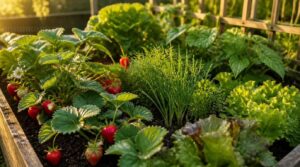
Not every strawberry neighbor needs to be a flower or herb; some of the best partners are vegetables already on your planting list.
These picks earn their spot by fixing nitrogen, shading soil, or filling gaps without competing for root space. Here are five vegetable companions worth planting alongside your strawberries.
Lettuce as Living Mulch
Lettuce doubles as a living mulch, blanketing bare soil within 4 to 6 weeks. Space seedlings 6-8 inches apart, choose fast leaf varieties, and you’ll get 70-90% ground cover fast.
That canopy cools soil, cuts evaporation up to 40%, and suppresses weeds. Just watch moisture levels—slugs love damp mulch. Mow every 3-5 weeks to keep strawberry crowns breathing.
Spinach for Soil Cover
Spinach builds a dense leafy canopy fast, blocking light to weed seeds and cutting soil moisture loss. Sow seeds 2-4 inches apart in cool, partial shade; you’ll get solid ground cover within 4-6 weeks.
That canopy also intercepts rain, curbing splash-borne pathogens onto your berries. Harvest outer leaves regularly, keeping this living mulch dense while feeding nutrient cycling below.
Bush Beans for Nitrogen
Free fertilizer that grows itself? That’s a bush bean.
Rhizobium bacteria in their root nodules pull nitrogen from the air, feeding both the beans and your strawberry plants nearby.
- Sow early, before nodulation peaks
- Keep soil pH 6.0–7.0
- Inoculate seed for stronger fixation
Skip synthetic nitrogen—it blocks nodulation. Decomposing bean residue keeps enriching soil health long after harvest.
Peas for Soil Fertility
Peas pull double duty: like beans, they’re a nitrogen fixer, but their deeper roots also mobilize soil phosphorus for nearby strawberries.
| Pea Benefit | Effect |
|---|---|
| N fixation | 40–100 kg N/hectare |
| Root exudates | Mobilizes phosphorus |
| Residue breakdown | Boosts organic matter |
| Root structure | Improves soil tilth |
Inoculate with Rhizobium bacteria and till residue back in after harvest.
Asparagus Between Strawberry Beds
Here’s a perennial pairing that actually works long-term: asparagus digs deep while strawberries stay shallow, so there’s no root competition. Space crowns 12–18 inches apart, letting soil porosity improve for both crops.
Harvest timing syncs nicely too—spears finish as berries ripen. Just watch for runner encroachment; trim aggressive strawberry runners so asparagus crowns keep their vigor.
Best Herbs and Flowers for Strawberry Gardens

Vegetables handle the heavy lifting underground, but herbs and flowers work the air around your strawberries. They pull in pollinators, chase off pests, and keep the whole bed smelling better than a berry patch has any right to. Here are five you’ll want in the mix.
Borage for Pollinators
Drop a few borage plants into your strawberry patch and watch the traffic pick up: bees, bumblebees, butterflies, all drawn in by high-sugar nectar and protein-rich pollen.
Why it works:
- Rapid nectar replenishment keeps visits frequent
- Diverse pollinators mean stable fruit set
- Long bloom window spans your whole season
- Self-seeding builds a returning colony yearly
Sweet Alyssum for Hoverflies
Sweet alyssum works differently than borage: it’s less about volume, more about precision. This low, frothy groundcover pulls in hoverflies, whose larvae devour aphids on contact—natural aphid suppression without lifting a finger.
Continuous bloom cycles keep syrphid adults fueled all season. Nectar quality stays high throughout, so beneficial insects stick around when strawberries need them most.
Chives and Garlic Repellents
Chives and garlic work through sulfur, not sweetness. Their thiosulfinates and allicin scramble pest olfactory cues, confusing aphids, spider mites, and Japanese beetles before they even land.
Border-plant them 12–18 inches apart for a scent barrier ringing your bed. Wind dilutes results, so cluster densely. Watch invasiveness—avoid garlic overrunning strawberry roots. Keep bloom timing separate from strawberry flowers to protect pollinators.
French Marigolds for Nematodes
French marigolds work below the soil line, where root-knot nematodes actually live. Their roots release allelopathic compounds that disrupt feeding and reproduction—choose Nema Gone or Tangerine cultivars, not Signet types, which skip this trait entirely.
Border-plant thickly or dedicate a full bed for strongest suppression. Chop tops into mulch after die-back; rotate susceptible crops out for several weeks to prevent resurgence.
Thyme, Yarrow, and Calendula
Thyme, yarrow, and calendula round out your herbal border with pest suppression and pollinator power. Thyme’s thymol content deters spider mites; plant it as low, drought-tolerant edging.
Yarrow’s flat blooms lure lacewings and ladybugs, feeding on pests naturally. Calendula attracts beneficial insects too, and its spent petals enrich soil organic matter—three low-maintenance workhorses for any strawberry bed.
Plants to Avoid Near Strawberries

Not every plant makes a good neighbor for strawberries, and some can actively work against you. Certain vegetables, herbs, and even ornamentals compete for nutrients, harbor shared diseases, or crowd out the airflow your berries need. Here’s what to keep at a safe distance in your strawberry bed.
Tomatoes, Potatoes, and Peppers
Skip the Solanaceae family near strawberries—tomatoes, potatoes, and peppers share Verticillium wilt susceptibility, aphids, and blight risk. Both crave similar sunlight and rich soil, creating fierce nutrient competition.
Their overlapping pest pressures undermine organic gardening goals and garden biodiversity. For a solid companion planting guide, rotate nightshades elsewhere and reserve strawberry beds for genuinely compatible neighbors instead.
Cabbage, Kale, and Broccoli
Brassicas are heavy feeders, and cabbage, kale, and broccoli all pull hard on the same nutrients strawberries need. This nutrient competition stunts root development fast.
Their cool season cultivation timing also overlaps, crowding your beds. Rotate brassicas to a separate plot entirely—managing brassica growth alongside strawberries just invites trouble, undermining the pest management and companion planting benefits you’re working so hard to build.
Fennel Growth Inhibition
Here’s the plant that breaks companion planting theory outright: fennel actively poisons its neighbors.
Fennel is the rare companion plant that actually poisons its neighbors instead of helping them
Allelopathic seed inhibition blocks germination through root and leaf leachates, while fennel essential oils trigger biochemical growth suppression in nearby seedlings—effects that are dose dependent and worsen with proximity. Beyond direct toxicity, fennel shifts soil microbial changes that compound nutrient competition. Keep it far from strawberry plants; this isn’t a pest management trade-off worth making.
Mint and Turf Competition
Give mint an inch and it takes a yard—literally, with rhizomes creeping up to 20 cm yearly, stealing water and root space from strawberry plants. It thrives in shade but casts its own micro-shade on neighbors, while root exudates shift rhizosphere microbes and nutrient uptake.
Physical barriers like buried edging help, but honestly? Keep mint in containers, far from your beds.
Corn and Sunflower Shade
Towering corn and branching sunflowers sound like generous neighbors, offering afternoon sun protection and soil temperature regulation. But at 6-12 feet, they choke airflow, inviting humidity risks and stem rot.
Strategic placement matters: if you want that shade in your garden layout design, keep these giants 3-5 feet off, west or northwest, for microclimate management without smothering crowns.
How to Design a Companion-Planted Strawberry Bed
Knowing which plants to pair is only half the job; where and how you place them matters just as much. Layout decisions affect airflow, root competition, and how easily you can tend each plant. Here’s how to put it all together, bed by bed.
Raised Bed Layouts
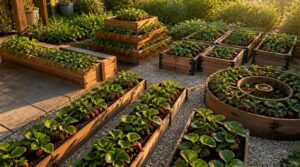
Five bed styles, five different strengths. Symmetrical Row Design keeps 4-foot beds parallel with 1–2 foot paths for easy harvest access.
Corner Space Optimization tucks L-shaped beds into tight patio edges.
Tiered Bed Ergonomics stack heights from 12–36 inches, easing backs while boosting drainage.
Modular System Expansion and Circular Garden Patterns round out your options, letting garden layout design grow or curve as needed.
Companion Plant Spacing
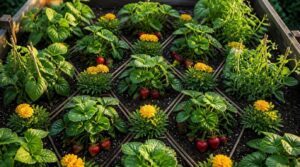
Get the numbers right and everything else falls into place. Hexagonal spacing, centers 8–12 inches apart, boosts bed efficiency.
Interplant bush beans 12–18 inches out; peas need 18–24 inch rows. Keep root systems from competing—6 inches minimum between species.
Adjust gaps seasonally: tighter in cool months, wider at peak fruiting for airflow. Containers need just 6–8 inches minimum.
Border and Row Planting
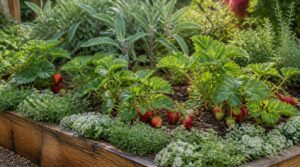
Borders need breathing room. Set companions 18–24 inches from crowns, leaving strawberries to send runners unbothered.
Stagger plantings rather than lining them up—it fills gaps, keeps airflow moving, and looks natural, not regimented.
Think in layers: taller herbs like sage toward the back, low living mulch (thyme, alyssum) up front. Widen spacing at bed ends where mature width demands more room.
Containers and Small Spaces
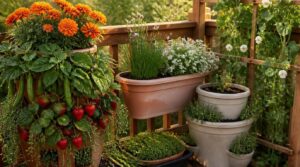
Not everyone’s got rows to stagger—pots and small beds need their own game plan.
Go vertical: stack a strawberry jar with trailing thyme below, bush beans mid-tier, marigolds up top.
- Use railing planters for chives or alyssum
- Try stacked pots to save floor space
- Pair light-colored containers for better root cooling
- Add trellised peas behind pots
- Keep living mulch shallow in tight beds
Disease Prevention Through Airflow

Packing plants tight feels efficient, but crowded crowns trap humid air, inviting gray mold and soilborne fungus. Space companions to keep leaves breathing. Even modest gaps matter—research on preventative spacing strategies for garden fungus control shows 18–24 inches between plants can cut microclimate humidity by 10–15%.
Favor low growers like thyme over dense shrubs, creating vertical airflow patterns that lift moisture upward. Avoid mixing Verticillium- or Fusarium-prone neighbors nearby. Good spacing means mitigating pathogen concentration naturally, no fungicide required—just smart layout and patience.
Frequently Asked Questions (FAQs)
What else can be planted in a strawberry planter?
Picture a half-barrel planter: bush beans staked at the back, basil edging the front, and lettuce filling gaps.
Beyond strawberries, plant nitrogen-fixing legumes, leafy greens as living mulch, aromatic herbs, and pollinator flowers for a thriving, productive mix.
What should I plant next to strawberries?
Reach for borage, sweet alyssum, chives, and French marigolds near your strawberries.
They boost pollinator insect diversity, offer natural pest deterrents, and enrich soil nutrients — all as low-competition, living-mulch-friendly neighbors that keep your berry patch thriving without crowding shallow strawberry roots.
What cannot be planted next to strawberries?
Some neighbors act like bad roommates, hogging resources and leaving a mess behind. Tomatoes, potatoes, brassicas, and fennel spread verticillium wilt, deplete nutrients, and inhibit roots — quiet soilborne troublemakers undermining your strawberry harvest before symptoms even show.
What can I put around my strawberry plants?
Border with thyme or clover as living mulch, tuck in calendula and nasturtium as pest lures, and let phacelia draw pollinators. These companions handle weed suppression, moisture retention, and pest control, all while boosting your berry yields naturally.
Can strawberries be planted in October?
October’s like a quiet handshake before winter’s slam—strawberries planted now root deep while soil’s still warm. In zones 7-9, dormant crowns establish safely; skip hard-freeze zones under 45°F without mulch protection.
What can’t be planted next to strawberries?
Skip nightshades (shared soilborne fungus risk), brassicas (heavy nutrient competition), fennel (growth inhibition), invasive mint, and tall shadings like corn or sunflowers.
Rotate crops yearly and keep pest-prone neighbors distant to protect your strawberries’ roots and yield.
What is the best thing to put around strawberry plants?
Botrytis gray mold ruins up to 30% of unprotected berries touching bare soil. Straw mulch stops that instantly, and pairing it with creeping thyme groundcover plus chives nearby locks in moisture, blocks weeds, and repels pests naturally.
What is complementary to strawberry?
Borage, sweet alyssum, and yarrow work as strong nectar sources and beneficial insect magnets, boosting pollinator attraction and aphid predators naturally.
French marigolds add nitrogen-fixing support and nematode suppression, giving your soil health and living mulch benefits strawberries thrive on.
What is the best pollinator for strawberries?
Picture a bumblebee doing tiny push-ups on a strawberry blossom—that vibration is pure gold. Bumblebee vibration efficiency beats honey bees hands-down. Add hoverflies for cooler, overcast days, and pollinator diversity keeps fruit set steady no matter the weather.
When should companion plants be planted alongside strawberries?
Timing matters most. Get lettuce and spinach into the ground alongside your strawberry crowns once soil hits 55°F. Hold off on alyssum and other tender flowers until after your last frost date passes.
Conclusion
A strawberry bed without allies is like a house with no locks on the door—open to every pest and disease passing through. Good companion plants for strawberry garden design change that story entirely.
Borage calls in pollinators, marigolds guard the roots, and lettuce keeps soil cool and weed-free. Skip the tomatoes and mint; give your berries breathing room and the right neighbors.
Plant thoughtfully now, and by harvest, you’ll be picking fruit worth the effort, season after season.
- https://plantura.garden/uk/fruits/strawberries/planting-strawberries
- https://www.gardenia.net/guide/strawberries-best-worst-companion-plants
- https://www.gardenary.com/blog/best-companion-plants-for-strawberries
- https://kellogggarden.com/blog/gardening/strawberry-companion-plants
- https://www.cropler.io/blog-posts/best-strawberry-companion-plants