This site is supported by our readers. We may earn a commission, at no cost to you, if you purchase through links.

A fruit tree that leafs out beautifully but drops fruit before harvest isn’t lazy—it’s hungry. Soil that looks fine can still be quietly starving your trees of the phosphorus and potassium they need to push through to a full yield. Most homesteaders discover this the hard way, chasing problems like yellowing leaves or stunted growth without realizing the fix starts underground.
The good news: feeding fruit trees well isn’t complicated once you understand what each tree actually needs and when it needs it. The right fruit tree fertilizers for homesteaders can turn a struggling orchard into one that produces with confidence, season after season.
Table Of Contents
- Key Takeaways
- Why Fruit Trees Need Proper Fertilizing
- Understanding NPK Ratios for Fruit Trees
- Organic Vs Synthetic Fertilizer Options
- Best Times to Fertilize Fruit Trees
- Tips for Choosing The Right Fertilizer
- How to Apply Fertilizer Correctly
- Top Fruit Tree Fertilizers for Homesteaders
- 1. Jobes Organic Fruit Nut Fertilizer Spikes
- 2. Dr Earth Organic Fruit Tree Fertilizer
- 3. Jobe’s Organics Fruit Nut Fertilizer
- 4. Jobe’s Fruit and Citrus Fertilizer Spikes
- 5. Down to Earth Organic Citrus Fertilizer
- 6. Espoma Organic Citrus Tone Fruit Tree Fertilizer
- 7. EarthPods Organic Fruit Tree Citrus Fertilizer Spikes
- 8. Fertilome Fruit Citrus and Pecan Tree Food
- 9. Concentrated Fruit Tree Booster Fertilizer
- 10. Miracle Gro Fruit Citrus Fertilizer Spikes
- Fixing Common Fruit Tree Problems
- Seasonal Feeding Tips for Specific Trees
- Frequently Asked Questions (FAQs)
- Conclusion
Key Takeaways
- Matching your fertilizer’s NPK ratio to your tree’s growth stage—more nitrogen for young trees, more potassium for fruiting ones—makes a bigger difference than any single product you buy.
- Timing matters as much as the fertilizer itself, so feed at bud break, split applications at bloom, boost potassium in summer, and stop nitrogen six to eight weeks before frost.
- Organic fertilizers build lasting soil health through better microbial activity and moisture retention, while synthetics work best as a fast fix for urgent deficiencies—knowing when to use each is the real skill.
- Always apply fertilizer at the drip line, not the trunk, water it in deeply, and get a soil pH test every one to three years to make sure nutrients are actually reaching your roots.
Why Fruit Trees Need Proper Fertilizing
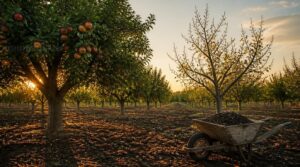
Your fruit trees can’t tell you what they need, but they sure show it. A little neglect shows up fast, in weak growth, sad leaves, or fruit that just won’t come. Here’s what’s behind all that, and why feeding your trees right makes such a difference.
Knowing how often fruit trees actually need fertilizing takes most of the guesswork out of keeping them happy.
Key Nutrients Fruit Trees Need
Think of your fruit trees like a hungry crew that needs the right meals to thrive.
Nitrogen for growth builds leafy canopies, while phosphorus root growth anchors trees and sparks flowers. Potassium fruit quality boosts size and flavor, and calcium cell strength keeps fruit from splitting. Magnesium photosynthesis support powers energy production.
These macronutrients and micronutrients work together, so balance truly matters. Maintaining the ideal soil pH between 6.0 and 6.8 is necessary for nutrient absorption.
Signs of Nutrient Deficiencies
Your tree talks through its leaves, so learn to listen. Watch for:
- Yellowing between veins (iron issue) or pale lower leaves (nitrogen)
- Leaf spot patterns, curling, or bud break delay
- Misshapen fruit, root zone weakness, or growth stunt signs
Check soil pH and consider organic fruit tree fertilizer with balanced NPK ratio before nutrient deficiency limits your fruit trees’ harvest.
Benefits of Regular Feeding
Once you know the warning signs, the next step is preventing them.
Regular feeding gives your trees steady growth support and keeps nutrient delivery consistent all season. It boosts soil microbial activity, improves moisture retention, and keeps canopy vigor strong.
The payoff? Better fruit set, higher crop yield, and lasting tree vitality, season after season.
Understanding NPK Ratios for Fruit Trees
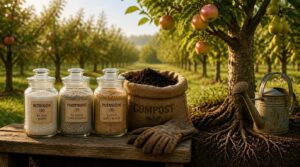
Those three numbers on every fertilizer bag aren’t random—they’re your roadmap to healthier trees. Once you know what each one does, picking the right bag gets a lot easier. Here’s what those ratios actually mean for your orchard.
What NPK Numbers Mean
Ever wonder what those three numbers on a fertilizer bag actually mean? Decoding NPK labels is simple once you know the basics. Each number is a percentage: Nitrogen, Phosphorus, and Potassium.
- N – fuels leafy growth and chlorophyll
- P – builds strong roots and blooms
- K – boosts fruit size and flavor
- Together, they create NPK balance benefits for healthy fruit tree fertilizers.
Matching Ratios to Tree Needs
Picking the right NPK ratio depends on your tree’s age and growth stage. Young trees need more nitrogen for leafy growth, while flowering trees want extra phosphorus.
| Tree Stage | Best Ratio Focus |
|---|---|
| Young trees | Higher nitrogen |
| Newly planted | Higher phosphorus |
| Mature, fruiting | Balanced potassium |
| Bearing trees | Calcium, magnesium |
| Fruit-set issues | Iron, zinc, manganese |
Seasonal ratio shifts and soil pH checks keep your fertilizer application effective year-round.
Organic Vs Synthetic Fertilizer Options
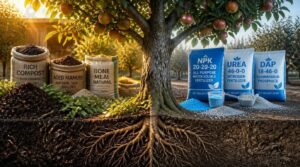
Now that you know your NPK basics, it’s time to pick a side, organic or synthetic. Both can feed your trees well, but they work in different ways and fit different goals. Here’s what you need to know to choose the right path for your orchard.
Benefits of Organic Feeds
Going organic isn’t just trendy, it’s a long game for your soil and your harvest. Organic fruit tree fertilizer boosts enhanced soil microbes, advances sustainable farming, and improves nutrient availability naturally.
| Benefit | What It Does | Why It Matters |
|---|---|---|
| Reduced Chemical Leaching | Keeps groundwater clean | Protects soil health |
| Higher Nutrient Bioavailability | Feeds roots steadily | Stronger fruit growth |
| Eco-Friendly Production | Uses natural inputs | Builds resilient orchards |
When Synthetic Makes Sense
Sometimes your trees need help fast, and that’s where synthetic fertilizers shine. They offer immediate nutrient availability, often showing results within one to two weeks.
| Situation | Synthetic Solution |
|---|---|
| Nutrient deficiency | Precise NPK ratios |
| Compacted soil | Compacted soil solutions |
| New plantings | Transplant shock relief |
| Urgent needs | Emergency nutrient boost |
| Steady feeding | Controlled release, concentrated formulas, fertilizer spikes |
Soil Health Considerations
Your fertilizer choice shapes more than this year’s harvest—it shapes your soil’s future. Organic inputs build aggregate stability, feed microbial diversity, and boost soil moisture retention over time.
Choosing organic over synthetic can make a real difference season after season, as explored in this deep-dive on how fertilizer affects fruit tree yield.
Your fertilizer choice shapes not just this season’s harvest, but your soil’s future for years to come
| Soil Factor | Organic Impact |
|---|---|
| Soil pH | Naturally balanced |
| Soil nutrition | Slow, steady release |
| Microbial life | Thrives and multiplies |
| Long-term soil health | Strengthens yearly |
Synthetics offer controlled release for quick fixes, but lean on organics for lasting soil health.
Best Times to Fertilize Fruit Trees
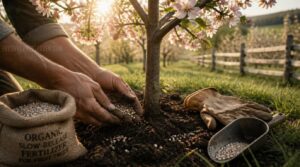
Timing your fertilizer matters just as much as picking the right one. Feed your trees at the right moments, and you’ll set them up for strong growth and a great harvest. Here’s a simple breakdown of when to feed, and when to hold off.
Early Spring Feeding Window
Spring is when your trees wake up hungry. As buds swell and break open, fresh leaves need fuel fast—this is Bud Break Nutrition at work.
Apply fruit tree fertilizers under the drip line for proper Root Zone Application, then water thoroughly. Soil Moisture Benefits from winter rains help nutrients soak in.
Choose a balanced NPK ratio, check soil pH, and use slow release organic fertilizers to manage frost risk.
Split Applications at Bloom
Think of bloom feeding like two smaller jobs done well. Give half your fruit tree fertilizers at bud break, then the rest once flowers open during the flowering stage. This split timing works like parallel filter processing, catching nutrient needs at different moments.
Use granular fertilizer or liquid fertilizer, even fertilizer spikes, and let adaptive split rebalancing—shifting feed as growth changes—keep roots fed without overwhelming them.
Summer Potassium Boosts
Summer turns up the heat, and your trees need potassium to keep pace. Potassium uptake timing peaks once daytime temps pass 25°C, supporting summer fruit size and sugar transport.
Try potassium sulfate or a foliar potassium application for quick heat stress management. Check soil potassium levels first, and pick fruit tree fertilizers with NPK ratios favoring K—organic fruit tree fertilizer works great here.
When to Stop Fertilizing
Once that potassium boost is done, watch for growth slowdown indicators as your cue to stop. Leaves turning color, fruit size leveling off, and soil cooling below 50°F all signal it’s time.
Stop nitrogen first, six to eight weeks before frost. This protects against frost damage, nutrient deficiency, and helps next season’s fruit production.
Tips for Choosing The Right Fertilizer
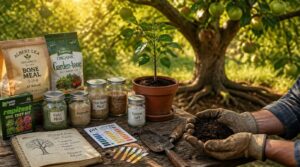
Picking the right fertilizer isn’t a one-size-fits-all job. Your soil, your tree, and even the pot it grows in all play a part. Here’s what to check before you grab that bag off the shelf.
Soil Type and PH Levels
Knowing your soil type changes everything about fertilizer choice. Sandy soil drains fast, so feed lighter and more often. Clay holds nutrients but compacts, so mix in organic matter.
Test soil pH every couple years, aiming for 6.0 to 7.0. Off-range pH locks up micronutrients like zinc and manganese, even when levels look fine on paper. Adjust with lime or sulfur based on results.
Tree Age and Species Needs
Once your soil’s dialed in, age and species take over. Young fruit trees want extra nitrogen for leafy growth, while mature fruit trees need balanced NPK plus a potassium boost for fruit quality.
Dwarf varieties do best with light, frequent feedings. Citrus craves magnesium during fruiting.
Match your fertilizer plan to each tree species, and adjust seasonally as needs shift.
Container-Grown Tree Requirements
Growing fruit trees in pots changes the rules a bit. Potted fruit trees burn through nutrients fast, so stick to slow-release granules or fertilizer spikes, plus a steady container watering schedule. Good soil mix drainage and a fresh soil amendment boost nutrient absorption.
Follow pot size guidelines and repot every 2-3 years for rootbound prevention.
Watch temperature management too; hot roots stress trees quickly.
Citrus and Specialty Trees
Citrus trees are hungry feeders, needing more nitrogen and specialized micronutrients than most fruit trees. Whether you’re growing finger lime for its tart, caviar-like pulp, yuzu for its aromatic juice in Asian dishes, or calamondin for festive decoration, all benefit from citrus-specific fruit tree fertilizers.
Buddha’s hand needs steady feeding and pruning for shape, while kumquats reward regular pruning with better fruit. Always check the NPK ratio and soil pH first.
How to Apply Fertilizer Correctly
Picking the right fertilizer is only half the job. How and where you apply it makes just as much difference for your tree’s health. Here’s what you need to know to get it right every time.
Proper Placement Around Trees
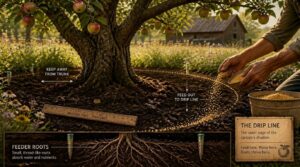
Where you place fertilizer matters as much as what you use. Always apply at least 18 inches from the trunk, spreading granular fertilizer or fertilizer spikes along the drip line, where feeder roots actively absorb nutrients.
This protects the root zone, promotes proper spacing from buildings, and ensures slow-release granules reach hungry roots, not bare soil near the base.
Watering After Application
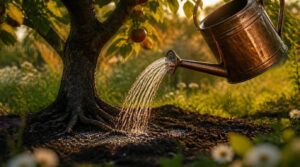
Water turns fertilizer into food your tree can actually use. After spreading granules along the drip line, give the area a slow, deep soak to start nutrient dissolution.
Aim for the top 6 to 8 inches of soil. This enhances root zone watering, encourages nutrient uptake, and prevents runoff.
Check soil moisture over the next day or two, adjusting irrigation timing if rain’s coming.
Avoiding Root Burn
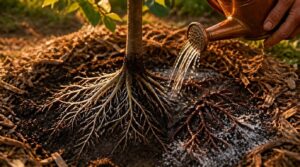
Too much fertilizer can stress roots faster than too little. Excess salts pull moisture away from feeder roots, so stick with low-salt fertilizer options, slow-release granules, or fertilizer spikes.
Top dressing with compost buffers salt buildup, and mulch helps too. Check soil pH yearly, monitor soil EC, and use a deep watering routine with occasional salt leaching to flush excess minerals away.
Foliar Feeding Tips
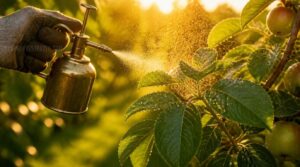
Sometimes your tree needs a fast fix, not a slow drink. Foliar feeding sprays liquid fertilizers straight onto leaves for rapid nutrient absorption.
Mix a light spray solution dilution, around 0.5 to 2 percent, and spray early morning or evening for best leaf absorption timing.
- Add a mild surfactant for even coverage
- Apply micronutrients like iron, zinc, or boron
- Check weather spraying conditions, skip windy or hot days
This promotes overall plant nutrition between soil feedings.
Top Fruit Tree Fertilizers for Homesteaders
Now that you know what your trees need and when to feed them, it’s time to pick a product. The market is full of options, but some stand out for quality and results. Here are ten fertilizers worth keeping on your homestead shelf.
1. Jobes Organic Fruit Nut Fertilizer Spikes
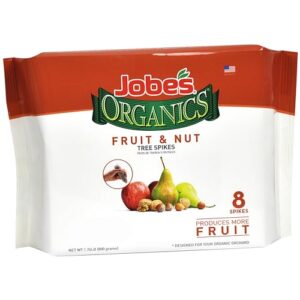
Drive these spikes into the ground, and your trees get steady nutrition without any guesswork. This 4-6-6 NPK formula comes from feather meal, bone meal, and sulfate of potash, all OMRI listed for organic gardens. Each spike feeds the root zone directly, cutting down on runoff and odor.
Citrus, fruit, and nut trees all respond well, especially in spring and fall. Just watch out: spikes can shatter in hard soil, so pre-dig your holes first.
| Best For | Gardeners with citrus, fruit, or nut trees who want an easy, organic way to feed roots all season long. |
|---|---|
| Form | Spikes |
| NPK Ratio | 4-6-6 |
| Organic Certified | OMRI Listed |
| Package Weight | 1.8 lbs |
| Tree Compatibility | Citrus, Fruit, Nut |
| Application Frequency | Twice yearly |
| Additional Features |
|
- Slow-release 4-6-6 formula keeps nutrients steady without constant reapplying
- OMRI listed, so it fits right into an organic gardening routine
- Helps cut down on runoff and bad smells while boosting soil life
- Spikes can shatter if the soil is too hard
- You may need to pre-dig holes, which adds extra work
- Costs more than some other fertilizer options on the market
2. Dr Earth Organic Fruit Tree Fertilizer
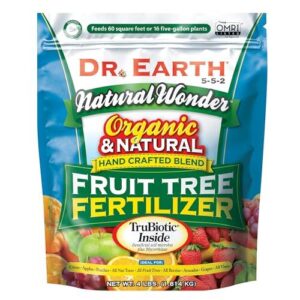
If spikes aren’t your style, this granular blend gives you the same organic boost. Dr Earth combines fish meal, kelp, and soft rock phosphate with TruBiotic microbes and mycorrhizae for stronger roots. The 5-5-2 NPK ratio feeds steadily without pushing too much leafy growth.
It works great for citrus, stone fruit, and pome varieties. Just sprinkle it around the drip line, water it in, and let those soil microbes get to work.
| Best For | Gardeners growing fruit trees, berries, grapes, nut trees, or avocados who want an organic granular feed for containers or backyard beds. |
|---|---|
| Form | Granules |
| NPK Ratio | 5-5-2 |
| Organic Certified | Organic Blend |
| Package Weight | 4.5 lbs |
| Tree Compatibility | Fruit, Berry, Nut, Avocado |
| Application Frequency | As needed |
| Additional Features |
|
- Organic land and ocean nutrient blend with TruBiotic microbes and mycorrhizae for stronger roots
- No synthetic ingredients or GMO chicken manure, with a steady 5-5-2 NPK ratio
- Works for transplanting new trees or top dressing established plants
- Can give off a noticeable organic or barnyard smell
- May attract small flies or other insects
- Needs to be mixed well into the soil, or you risk mold and might need higher amounts for results
3. Jobe’s Organics Fruit Nut Fertilizer
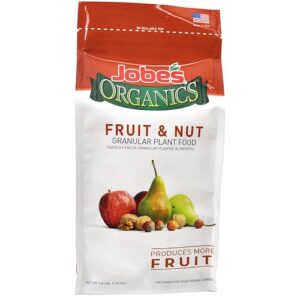
If you want a granular option with extra staying power, this blend from Jobe’s fits the bill. It’s built on a 3-5-5 NPK ratio with Biozome microbial technology, which helps break down organic matter so roots can actually use it.
Spread it under the canopy, water it in, and reapply every 6 to 8 weeks. It works well for citrus, apples, pears, and stone fruits, supporting steady fruit development all season.
| Best For | Home gardeners and small-scale growers who want an OMRI-listed organic feed to keep fruit, citrus, and nut trees healthy and productive. |
|---|---|
| Form | Granules |
| NPK Ratio | 3-5-5 |
| Organic Certified | OMRI Listed |
| Package Weight | 4 lbs |
| Tree Compatibility | Fruit, Citrus, Nut |
| Application Frequency | Every 4–8 weeks |
| Additional Features |
|
- Organic formula with no synthetic chemicals, so it’s safe for USDA organic gardens
- Boosts soil microorganism activity, which helps with root, seed, and overall plant development
- Easy-to-use granules that are simple to measure and spread
- Can give off a noticeable organic odor after application
- Needs reapplying every 4-8 weeks during the growing season, so it’s not a "set it and forget it" option
- Bags can be prone to breaking or tearing during shipping
4. Jobe’s Fruit and Citrus Fertilizer Spikes
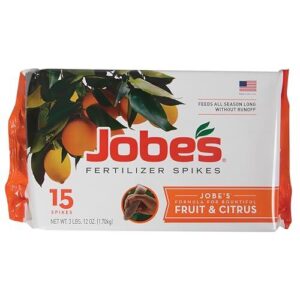
If hammering granular fertilizer into the soil sounds like too much work, these spikes offer a simpler fix. With a 9-12-12 NPK ratio, they’re built for fruit, citrus, and nut trees that need a steady nutrient supply.
Just pop off the cap, position the spike at the dripline, and hammer it in. The slow-release formula feeds your tree for weeks without runoff, mess, or odor problems.
| Best For | Anyone with fruit, citrus, or nut trees who wants an easy, low-mess way to keep their soil fed all season long. |
|---|---|
| Form | Spikes |
| NPK Ratio | 9-12-12 |
| Organic Certified | Not Certified |
| Package Weight | 12 oz |
| Tree Compatibility | Fruit, Citrus, Nut |
| Application Frequency | Twice yearly |
| Additional Features |
|
- Slow-release formula keeps nutrients feeding the tree for weeks
- No runoff, mess, or odor compared to granular fertilizers
- Protective caps make hammering them in cleaner and easier
- Hard or sandy soil may need pre-drilling before the spikes go in
- Spikes can splinter or break if you’re not careful while hammering
- You’ll need to reapply twice a year, in spring and fall, for best results.
5. Down to Earth Organic Citrus Fertilizer
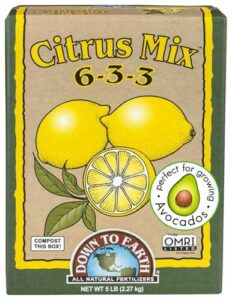
For granular feeding, this 6-3-3 blend is a solid all-rounder. It’s OMRI listed for organic production, made from feather meal, fish bone meal, and kelp meal, so you know exactly what’s going into your soil.
Sprinkle it from the trunk out to the drip line, then water it in well. Plan on feeding 3 to 4 times a year, and your citrus, vines, or ornamentals will thank you with lush, green growth.
| Best For | This is best for citrus growers who want an organic, granular fertilizer that supports long-term soil health. |
|---|---|
| Form | Granules |
| NPK Ratio | 6-3-3 |
| Organic Certified | OMRI Listed |
| Package Weight | 5 lbs |
| Tree Compatibility | Citrus, Vines, Ornamental |
| Application Frequency | 3–4 times per year |
| Additional Features |
|
- OMRI listed, so it fits right into organic growing setups
- Packed with a solid mix of nutrients plus calcium, sulfur, zinc, and iron
- Works well for citrus, vines, and ornamentals, and stays shelf stable if stored right
- Strong odor makes it a tough sell for indoor use
- Needs feeding 3-4 times a year to keep up results
- Has to be watered in well and stored in a cool, dry spot to stay effective
6. Espoma Organic Citrus Tone Fruit Tree Fertilizer
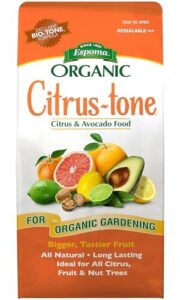
Citrus trees are hungry feeders, and this formula was built with that in mind. Espoma’s Bio-tone formula delivers a 5-2-6 ratio, with 5% calcium to strengthen rinds and support fruit development.
Apply it around the drip line, not the trunk, and work it lightly into the topsoil. It’s organic, sludge-free, and great for citrus, avocado, and nut trees. Just expect a strong odor after application.
| Best For | Citrus, avocado, and nut tree owners who want an organic granular fertilizer to boost growth, fruiting, and overall plant health. |
|---|---|
| Form | Granules |
| NPK Ratio | 5-2-6 |
| Organic Certified | Registered Organic |
| Package Weight | 4 lbs |
| Tree Compatibility | Citrus, Avocado, Nut |
| Application Frequency | As directed |
| Additional Features |
|
- Bio-tone formula with a 5-2-6 NPK ratio plus 5% calcium for stronger rinds and better fruit
- Fully organic with no toxic ingredients, great for eco-conscious gardening
- Easy ready-to-use granules that just need to be worked into the topsoil
- Strong odor after application can be off-putting
- Not recommended for indoor use
- Must be applied carefully around the drip line, not the trunk, for best results
7. EarthPods Organic Fruit Tree Citrus Fertilizer Spikes
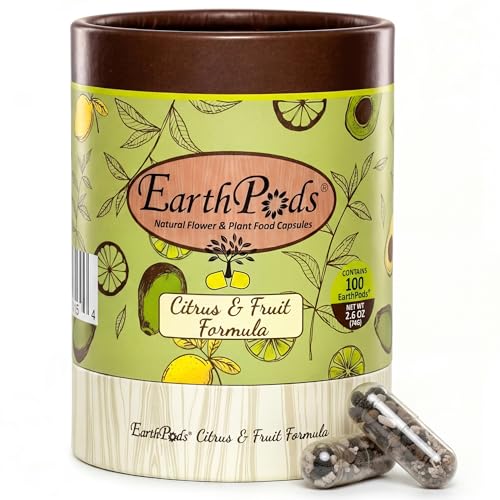
If mess-free feeding sounds appealing, these little capsules deliver. EarthPods skip the liquid measuring and odors entirely, using slow-release organic capsules packed with trace minerals and humates for steady root zone delivery.
Each tube holds 100 pods, lasting 14 to 21 days per application. They’re great for citrus, avocado, and potted fruiting trees, especially for elderly gardeners.
Just keep them dry, since humidity can cause early breakdown, and pair with liquid feeding for best results.
| Best For | Anyone with citrus, avocado, or other fruiting potted plants who wants an easy, mess-free feeding routine—especially elderly or physically limited gardeners. |
|---|---|
| Form | Capsules |
| NPK Ratio | Not Listed |
| Organic Certified | Not Certified |
| Package Weight | 3.9 oz |
| Tree Compatibility | Citrus, Avocado, Fruiting |
| Application Frequency | Every 14–21 days |
| Additional Features |
|
- No liquid measuring or odors, just simple capsule application
- Slow-release formula delivers nutrients straight to the root zone
- Packaging is eco-friendly, made from recycled paperboard and soy ink
- Performs best with extra liquid feeding on the side
- Capsules can break down early if stored somewhere humid
- Costs more per use than many other fertilizer options
8. Fertilome Fruit Citrus and Pecan Tree Food
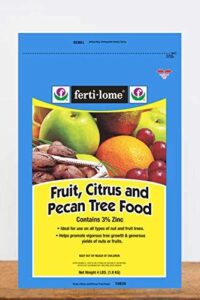
Got pecans, citrus, or other fruit trees on your land? This blend covers them all with a 19-10-5 NPK ratio plus zinc, which helps fight off rosette disease in pecans. Apply it twice a year, around the drip line, and water it in well.
It’s a solid all-in-one option for mixed orchards, so you’re not juggling different bags for different trees.
| Best For | Folks managing a mix of pecan, citrus, and other fruit trees who want one fertilizer that handles it all. |
|---|---|
| Form | Powder |
| NPK Ratio | 19-10-5 |
| Organic Certified | Not Certified |
| Package Weight | 4 lbs |
| Tree Compatibility | Fruit, Nut, Citrus |
| Application Frequency | Twice yearly |
| Additional Features |
|
- Covers a wide range of tree types, so no need for separate products
- Zinc content helps protect pecans from rosette disease
- Balanced NPK ratio supports healthy growth and better yields
- Needs to be applied twice a year, so it’s not a set-it-and-forget-it deal
- Has to be placed carefully around the drip line and watered in for best results
- Some application details might leave you reaching out to customer service for clarity
9. Concentrated Fruit Tree Booster Fertilizer
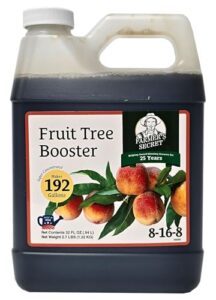
This one’s all about getting more done in fewer trips. The concentrated formula packs nitrogen, phosphorus, and potassium together with calcium, magnesium, zinc, and boron, supporting fruit set and stronger cells.
It’s pH balanced too, so you won’t throw off your soil chemistry near the drip line.
Dilute it carefully, one teaspoon per gallon for young trees, more for mature ones. Apply weekly during active growth for steady, reliable feeding.
| Best For | Home gardeners and orchard owners looking for an easy, all-in-one liquid fertilizer to boost fruit tree health from dormancy through early growth. |
|---|---|
| Form | Liquid |
| NPK Ratio | Not Listed |
| Organic Certified | Not Certified |
| Package Weight | 32 fl oz |
| Tree Compatibility | Fruit Trees, General |
| Application Frequency | As needed |
| Additional Features |
|
- High phosphorus content helps roots establish quickly for strong early growth
- Loaded with NPK plus zinc, iron, calcium, magnesium, and boron for well-rounded nutrition
- Long 10-year shelf life means no rush to use it all at once
- Requires careful dilution, since too much can harm your plants
- Works best in early growth stages, not as helpful once fruiting is underway
- Results can vary depending on the tree type and your local climate
10. Miracle Gro Fruit Citrus Fertilizer Spikes
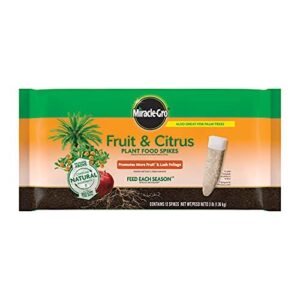
If you’d rather skip the mixing bowl altogether, these spikes are about as low-effort as it gets. With a 10-15-15 ratio, they feed apple, lemon, lime, and avocado trees with no measuring, no spills, no fuss.
Just drive one spike per foot of trunk diameter into the ground near the drip line, then water it in. The nutrients release slowly over weeks, right where roots can use them.
One catch: they can crumble in hard soil, so loosen things up first.
| Best For | home gardeners who want a no-mix, no-mess way to feed their fruit and citrus trees a couple times a year. |
|---|---|
| Form | Spikes |
| NPK Ratio | 10-15-15 |
| Organic Certified | Not Certified |
| Package Weight | 3 lbs |
| Tree Compatibility | Fruit, Citrus, Palm |
| Application Frequency | Twice yearly |
| Additional Features |
|
- Super simple to use—just push a spike into the ground, no measuring or mixing required
- Slow-release formula feeds roots steadily over time for better fruit and foliage
- Works great for popular trees like apple, lemon, lime, and avocado
- Spikes can crumble or break if your soil is hard or compacted
- Costs more than regular granular fertilizer, especially if you’ve got several large trees
- Shipping can sometimes leave spikes damaged or cracked
Fixing Common Fruit Tree Problems
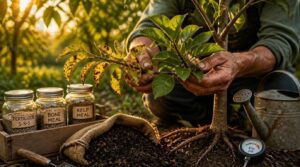
Even with the best care, fruit trees run into trouble sometimes. The good news is that most problems leave clues, and those clues point straight to the fix. Here’s how to read the signs and get your tree back on track.
Diagnosing Yellowing Leaves
Why are your leaves turning yellow? Start by checking the pattern.
Nitrogen deficiency shows on older leaves first, pale and uniform, with slow growth. Iron problems hit younger leaves, with green veins on yellow tissue—often tied to high soil pH.
Test your soil pH and look for pests like aphids or mites before assuming a nutrient issue.
Boosting Poor Fruit Production
Skimpy harvests usually trace back to phosphorus or potassium shortfalls. Phosphorus builds roots before bloom, while potassium fills out fruit size and sweetness. Don’t ignore micronutrients either—boron and zinc shape flower formation.
Pair fertilizer with pruning for yield, good water management, and pollinator-friendly blooms. Healthy soil microbial life and organic fertilizers round out solid nutrient management for bigger harvests.
Correcting Soil PH Issues
Even with the right NPK ratio, nutrients won’t reach your tree if soil pH is off. Test soil yearly—aim for 6.0 to 7.0.
Lime raises pH; sulfur lowers it, based on your soil buffer capacity. Apply seasonally, then retest in a few months. Small soil amendments now mean better nutrient uptake later.
Preventing Over-Fertilizing Mistakes
Getting soil pH right won’t help much if you’re piling on fertilizer too. More isn’t better—it’s just wasted money and stressed roots.
Stick to a soil test every one to three years, follow label rates for fertilizer scheduling, and choose slow-release options for steady feeding. After heavy applications, flush with water to manage nutrient leaching and protect your trees long-term.
Seasonal Feeding Tips for Specific Trees
Every fruit tree has its own rhythm regarding feeding. What works for an apple won’t always work for a fig, citrus, or banana. Here’s a quick guide to feeding each one right, so you get the timing and nutrients on point.
Fertilizing Apple and Cherry Trees
Apple and cherry trees reward consistency. Start with a balanced NPK ratio like 10-10-10 in early spring, then shift toward potassium as fruit develops. Keep soil pH between 6.0 and 7.0 for best absorption. Key practices include:
- Applying slow-release granules at the drip line each spring
- Adding calcium nitrate to strengthen apple cell walls
- Using foliar spray to correct zinc or boron gaps quickly
- Working compost in to boost organic matter and moisture retention
Fertilizing Peach and Fig Trees
Peach and fig trees have different personalities, but both respond well to early spring feeding with a balanced NPK ratio before new growth pushes hard.
| Care Factor | Peach & Fig Tip |
|---|---|
| NPK Ratio | 10-10-10 in spring |
| Deficiency Sign | Yellowing older leaves |
| Mulch Benefit | Slows nutrient leaching |
| Storage Tip | Keep granules dry and sealed |
Fertilizing Citrus and Mango Trees
Citrus trees and mango trees are heavy feeders — they need more attention than most fruit trees on your homestead. Higher nitrogen levels keep their foliage dense and healthy during active growth, while potassium and phosphorus drive fruit size and root strength.
Key priorities for these trees:
- Test soil pH regularly and keep it between 6.0 and 7.0
- Add micronutrient supplements with zinc, magnesium, and iron to prevent yellowing leaves
- Use organic fertilizers like compost or fish emulsion to support long-term soil health
Fertilizing Banana Trees
Banana trees are hungry growers, and potassium is their top priority — it drives bunch size, sweetness, and overall fruit weight. Use a balanced NPK ratio with elevated potassium every four to six weeks through the growing season. Slow-release granules work well here, reducing salt burn while feeding steadily.
For container banana feeding, apply smaller, more frequent doses and monitor soil pH to stay in the slightly acidic to neutral range.
Frequently Asked Questions (FAQs)
Which fertilizer is called the king of fertilizer?
Urea wears the crown. With a 46% nitrogen content — the highest of any solid fertilizer — it fuels rapid growth efficiently and cheaply, making it agriculture’s longtime reigning champion.
How does mulching affect nutrient absorption in orchards?
Mulching keeps soil moist, feeds beneficial microbes, and reduces nutrient leaching. As organic mulch breaks down, it releases nitrogen, phosphorus, and potassium directly into the topsoil, boosting nutrient availability right where your tree roots need it most.
Should fertilizer routines change after grafting fruit trees?
Yes, your routine must change. After grafting, start with a balanced 6-6-6 fertilizer, avoid high-salt blends, and wait for new growth before increasing nutrients gradually.
Can rainwater harvesting impact how nutrients reach roots?
Rainwater harvesting genuinely improves nutrient uptake efficiency. Soft, chlorine-free water reduces root stress, steadies soil moisture effects, and enhances water infiltration benefits — helping nutrients move freely through the root zone.
Conclusion
What’s the point of planting a tree you’ll never fully get to harvest? The right fruit tree fertilizers for homesteaders close that gap between what your trees promise and what they actually deliver.
Feed at the right time, match the nutrients to your soil, and your trees will stop dropping early and start filling baskets. You’ve done the hard work of planting—now give your orchard exactly what it needs and watch it finish strong.
- https://risso-chemical.com/how-to-apply-npk-fertilizer-for-fruit-trees
- https://extension.unh.edu/resource/fertilizing-fruit-trees
- https://www.groworganic.com/blogs/articles/when-and-how-to-fertilize-your-fruit-trees
- https://www.canr.msu.edu/news/spring_fertilization_of_garden_fruits
- https://www.starkbros.com/growing-guide/article/fertilize-new-fruit-trees