This site is supported by our readers. We may earn a commission, at no cost to you, if you purchase through links.

A 4×4 raised bed sounds modest until you realize 16 square feet can feed a family of four through summer—if you plant it right. Most gardeners pack in whatever fits and hope for the best. The ones who actually harvest armfuls of produce treat each square foot like real estate, choosing neighbors that protect each other.
That’s where companion planting meets square foot gardening. Basil beside your tomatoes fights off aphids without a single spray bottle. Marigolds crowding your cucumber squares confuse the beetles before they settle in. Every plant pulls its weight—and earns its square.
Table Of Contents
- Key Takeaways
- Plan Your Square Foot Layout
- Match Companions by Garden Goal
- Space Crops Per Square Foot
- Build Healthy Companion Beds
- Top 10 Square Foot Garden Beds
- 1. Kdgarden White Vinyl Raised Garden Bed
- 2. Cedar Raised Garden Box
- 3. Natural Wood Raised Garden Bed
- 4. Premium Cedar Raised Garden Bed
- 5. Anleolife Galvanized Raised Garden Bed
- 6. Yaheetech Wooden Raised Garden Bed
- 7. Olive Green U Shape Raised Bed
- 8. Seeding Square Plant Spacing Tool
- 9. Galvanized Extra Height Garden Bed
- 10. Best Choice Metal Raised Garden Bed
- Frequently Asked Questions (FAQs)
- Conclusion
Key Takeaways
- Strategic companion planting—like basil beside tomatoes or marigolds near cucumbers—acts as your garden’s natural pest defense, cutting the need for sprays and chemicals.
- Treating each square foot as prime real estate, with spacing rules from 1 to 16 plants per square, is what separates a packed, struggling bed from one that actually feeds your family.
- Tall crops belong on the north edge, trellises go on bed borders, and sun mapping comes before planting—get the layout right first and everything else follows naturally.
- Healthy soil is the foundation: Mel’s Mix, yearly compost, and rotating crop families every season keep your bed productive long after the first harvest.
Plan Your Square Foot Layout

Before you plant a single seed, getting your layout right makes everything else easier. A well-planned square foot garden gives every crop — and its companions — exactly the space it needs to thrive. Here’s how to set yours up from the ground up.
A solid square foot garden planning guide can take the guesswork out of spacing, companions, and bed layout before you break ground.
Choose Bed Size
Before you plant a single seed, your bed size sets the stage for everything. A 4 ft × 4 ft bed gives you 16 sq ft of planting area — easy to reach from all sides without stepping in.
- Twin: 38 × 75 in
- Twin XL: 38 × 80 in
- Full: 54 × 75 in
- Queen: 60 × 80 in
- King: 76 × 80 in
Divide One-foot Squares
Once your bed size is locked in, it’s time to break it into one-foot squares. A single square foot contains 144 square inches, which can be divided into that many 1‑inch squares.
A 4×4 bed gives you 16 squares total. Each square holds a single crop type.
Use a 3-inch sub-grid inside each square for 16 plants, a 6-inch grid for 4, or a 12-inch grid for just 1.
Place Tall Crops North
Once your squares are mapped out, think about height.
Tall crops north is the golden rule — position corn, sunflowers, or tall beans along the northern edge so they don’t shadow shorter plants in front. The sun travels across the southern sky, so sun reaches every square when your tallest growers stay back.
Add Trellises Strategically
Once tall crops claim the north edge, trellises take over where height meets function.
Place vertical stakes every 12 to 18 inches along bed edges and install end posts every 6 to 8 feet for stability.
Use corrosion-resistant hardware and choose lattice with 1 to 2-inch openings so that cucumbers, peas, and pole beans climb freely.
Map Sun and Water
Before planting a single seed, map your sun and water across the whole bed. Watch how light moves from morning to afternoon and mark full sun zones (six-plus hours), partial sun, and shade.
Note where water pools after rain. Elevated beds drain fastest, so place thirsty crops there.
Reassess mid-season as plants grow and shift light availability.
Match Companions by Garden Goal

Not every plant is a good neighbor, but the right pairings can do some serious heavy lifting in your square foot garden. Matching companions to your actual goals—whether that’s keeping pests away, boosting pollinators, or feeding the soil—makes the whole system work smarter.
Here’s how to pair plants based on what you want your garden to do.
Pest-deterring Herb Pairs
Herbs are some of the hardest-working companions in a square foot garden.
Basil repels aphids, whiteflies, and hornworms when planted beside tomatoes — and regular harvesting keeps its volatile oils strong. Mint along bed borders drives off ants and flea beetles.
Lavender guards brassicas from cabbage moths, while dill and marigolds shield cucumbers from beetles and leafminers naturally.
Pollinator-attracting Flowers
Flowers do more than add color — they’re recruiters, pulling in the pollinators your vegetables depend on.
- Calendula, alyssum, and nasturtium attract lady beetles and hoverflies
- French marigolds suppress whiteflies and soil nematodes
- Lavender and sweet alyssum release scent strongest in morning hours
- Sunflowers create visible nectar hotspots for bees
- Group 5–7 of the same flower to boost pollinator visits
Nitrogen-fixing Crop Partners
Some plants do the fertilizing for you. Bush beans and peas are nitrogen-fixing legumes — their roots host rhizobial bacteria that pull nitrogen from the air and deposit it into the soil.
Plant them beside corn or leafy greens, and those neighbors benefit too.
Keep your soil pH between 6.0 and 6.8 to keep that fixation process running efficiently.
Shade-sharing Plant Combinations
Not every square needs full sun. Tall tomatoes cast natural shade that cooler crops like lettuce actually welcome. Use this layered canopy design to your advantage:
- Place lettuce beneath tomatoes
- Tuck basil under peppers
- Grow ferns beside hostas
- Use heuchera as colorful ground cover
- Add mulch to retain shade moisture
Seasonal sun shifts matter too — reposition shade-lovers as light angles change.
Avoid Poor Plant Neighbors
Not every plant gets along. Fennel is notorious — it stunts peppers and tomatoes through allelopathy.
Keep brassicas away from tomatoes to avoid shared caterpillar problems.
Don’t crowd heavy feeders together; they’ll compete for nutrients fast.
Overlapping fungal susceptibilities spread disease quickly between neighbors.
Use a companion conflict chart to flag bad pairings before planting.
Space Crops Per Square Foot
Getting the spacing right in a square foot garden isn’t guesswork — it’s a simple set of rules tied to plant size. Each crop fits into one of four density categories, from one plant per square all the way to sixteen. Here’s how each spacing rule works and which plants belong where.
One Plant Per Square

Give tomatoes, peppers, and squash one full square foot each — that’s a 12-by-12-inch footprint dedicated entirely to a single plant. This spacing cuts nutrient competition, contains disease to one square, and leaves room for cages or vertical support installed before planting.
Run drip lines to each square for uniform irrigation, and you’ve got a clean, manageable layout.
Four Plants Per Square

Step down from one plant per square and you release a new level of garden productivity. Bush beans, Swiss chard, and kale fit four per square foot comfortably. Lettuce, spinach, and cilantro work here too — and they’re perfect for succession planting, letting you harvest and resow the same square multiple times per season.
Four key crops to try at this density:
- Bush beans
- Swiss chard
- Leaf lettuce
- Spinach
- Cilantro
Nine Plants Per Square
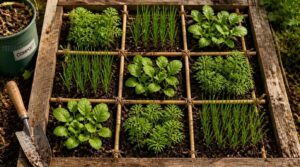
Go one step further and you hit nine plants per square foot — a 3×3 grid that suits carrots, onions, and radishes.
Use compact varieties with similar root depths to avoid underground competition.
Arrange them for maximizing light exposure, keep soil consistently moist, and add compost to support nutrient balance.
Companion planting works well here too — try pairing onions with carrots.
Sixteen Plants Per Square

At 3-inch spacing, you fit 16 plants per square foot — a 4×4 grid that works well for beans, radishes, and onions.
Here’s what to keep in mind:
- Use small seed varieties only
- Thin seedlings early to prevent crowding
- Keep soil moisture consistent
- Pair onions with carrots for pest control
- Harvest frequently to manage root density
Vining Crop Spacing
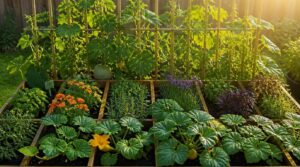
Vining crops like squash, cucumbers, and melons need 2–4 squares per plant. Use Trellis Support Systems to train growth upward, freeing ground space for companions below. Place trellises on the north side to avoid shading neighbors. Airflow Disease Prevention improves when vines climb rather than sprawl — reducing fungal risk dramatically.
| Crop | Squares Needed | Trellis Required |
|---|---|---|
| Cucumber | 2 squares | Yes |
| Squash | 4 squares | Optional |
| Melon | 4 squares | Yes |
Build Healthy Companion Beds

A thriving companion bed starts long before you drop a single seed — it starts with the soil beneath your plants.
Getting the foundation right means calculating volume, choosing the best mix, and building in habits that keep your bed productive season after season.
Here’s how to set yours up for the long haul.
Calculate Soil Volume
Before you order a single bag of soil, you need to know exactly how much your bed holds. Multiply length × width × depth to get your volume.
A 4×4 bed at 12 inches deep holds 16 cubic feet. Shallower 6‑inch beds limit root growth.
Convert to cubic yards by dividing by 27 when ordering bulk soil.
Fill With Rich Mix
Once you know your bed’s volume, fill it with Mel’s Mix — equal parts compost, peat moss, and coarse vermiculite. This blend delivers nutrient density, strong drainage, and healthy microbial activity.
Its near‑neutral pH of 6.5–7.0 suits most vegetables. Vermiculite prevents compaction and boosts aeration, while compost supplies nitrogen, phosphorus, and potassium for quick root establishment.
Add Compost Yearly
Every season, your Mel’s Mix loses nutrients. A 2–3 inch compost layer each spring restores soil fertility and boosts microbial soil activity.
- Compost improves water holding capacity, reducing irrigation needs
- Annual applications raise nutrient retention through higher cation exchange
- Organic gardening benefits from slow-release nutrients aligned with plant growth
Spread it across your bed before planting season begins.
Rotate Crop Families
Think of your beds like a relay race — each crop family hands off something valuable to the next. Rotate crop families every season across at least three beds.
Legumes fix nitrogen first, then brassicas follow, then nightshades or cucurbits.
This three-year rotation cycle disrupts soil pathogens, balances nutrient demand, and keeps your square foot garden productive year after year.
Manage Pests Naturally
Your square foot garden’s best defense is already alive. Beneficial insects like lady beetles cut aphid populations by up to 70 percent — plant dill or fennel to keep them around.
Plant dill or fennel and let lady beetles do the work — they’ll slash aphid populations by 70 percent
- Neem oil protects leaves for up to 14 days
- French marigolds suppress soil-borne nematodes naturally
- Row covers block pests without any chemicals
Top 10 Square Foot Garden Beds
The right bed can make or break your square foot garden before you even plant a single seed. Whether you prefer wood, vinyl, or galvanized metal, there’s a setup out there that fits your space, budget, and style. Here are 10 solid options worth considering.
1. Kdgarden White Vinyl Raised Garden Bed
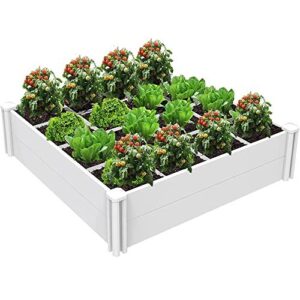
The Kdgarden White Vinyl Raised Garden Bed gives you a solid 4×4-foot footprint with 16 square feet of planting space — enough for a full square-foot grid. Its tool-free snap-together assembly means no screws and no frustration.
The UV-stabilized vinyl won’t rot, rust, or yellow, and it backs that up with a 20-year warranty.
You can stack units for extra depth, and cleanup is as simple as a garden hose rinse.
| Best For | Home gardeners, hobby growers, and pet owners looking for a low-maintenance, durable raised bed that’s easy to set up and clean. |
|---|---|
| Material | Premium vinyl |
| Dimensions | 48×48×13.3 in |
| Assembly Method | Tool-free snap |
| Primary Use | Raised bed gardening |
| Color/Finish | White |
| Base/Drainage | Open bottom |
| Additional Features |
|
- Snaps together in minutes with no tools or hardware required
- UV-protected vinyl won’t rot, rust, or yellow — backed by a 20-year warranty
- Stackable design lets you add depth without buying a whole new kit
- Panels can flex under heavy soil loads, so avoid over-filling
- Open bottom lets weeds and small pests in if placed on bare ground
- White finish may show dirt buildup over time and need occasional cleaning
2. Cedar Raised Garden Box
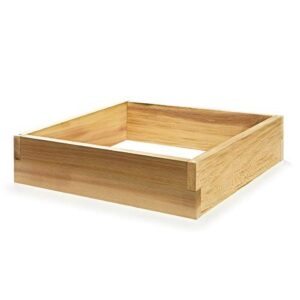
If you want the warmth of real wood, the Cedar Raised Garden Box is worth a look. It’s hand-crafted from untreated Western Red Cedar, which naturally resists rot and insects without any chemicals — making it safe for vegetables and herbs.
At 22 × 22 inches and 5.25 inches deep, it’s compact and stackable. You can build up height by layering multiple boxes. Assembly needs just a screwdriver and mallet, though upper tiers can require some notch adjusting.
| Best For | Home gardeners who want a natural, chemical-free raised bed for growing vegetables, herbs, or flowers — especially in smaller spaces where a compact, stackable design comes in handy. |
|---|---|
| Material | Western Red Cedar |
| Dimensions | 22×22×5.25 in |
| Assembly Method | Screwdriver and mallet |
| Primary Use | Raised bed gardening |
| Color/Finish | Natural red cedar |
| Base/Drainage | Open bottom |
| Additional Features |
|
- Made from untreated Western Red Cedar, so it’s completely safe for edible plants with no chemicals or preservatives to worry about
- Stackable and expandable design lets you customize the height and layout to fit your space
- Parts come pre-cut and pre-drilled, so assembly is straightforward with just a screwdriver and mallet
- The actual height (5.25 in) is noticeably shorter than some product images suggest, which could be misleading
- Dimensions run slightly smaller than advertised, so double-check measurements if you’re fitting it into a specific spot
- Untreated wood will need periodic sealing or staining to hold up well against ongoing moisture exposure
3. Natural Wood Raised Garden Bed
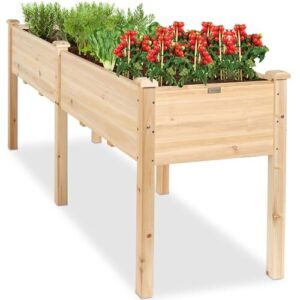
If real wood and standing-room ergonomics matter to you, this bed checks both boxes. Built from Chinese fir, it measures 72 × 24 × 30 inches and holds 8.4 cubic feet of soil — enough for a solid square-foot layout.
The 30-inch height means no crouching. Six drainage holes keep roots healthy.
The built-in divider panel helps organize companion pairings naturally. Chinese fir is a softwood, so seal or line it before filling to extend its life.
| Best For | Gardeners who want a roomy, ergonomic raised bed in natural wood and don’t mind a little upfront prep to protect it. |
|---|---|
| Material | Chinese fir wood |
| Dimensions | 72×24×30 in |
| Assembly Method | Standard hardware |
| Primary Use | Elevated raised bed |
| Color/Finish | Natural wood |
| Base/Drainage | Six drainage holes |
| Additional Features |
|
- The 30-inch height is genuinely back-friendly — you can tend your plants without bending or kneeling
- Lots of growing space at 8.4 cubic feet, with a built-in divider to keep companion plants organized
- Elevated design keeps pets and critters out, making it a great fit for patios, decks, or small yards
- Chinese fir is a softwood that will weather and rot over time without sealing or lining
- Assembly takes 30–40 minutes and some drill holes may need extra work to align properly
- Protecting the wood long-term adds an extra step (and cost) before you can start planting
4. Premium Cedar Raised Garden Bed
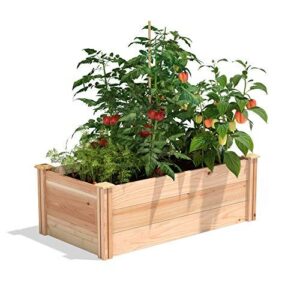
Cedar is a step up from softwoods like fir. This bed uses untreated North American cedar and measures 2 ft × 4 ft × 16.5 in, holding up to 11 cubic feet of soil — plenty for a dense companion planting grid.
Cedar’s natural oils resist rot and insects without chemicals, so your soil stays clean. Tool-free dovetail joints lock boards into corner posts fast. Beds are stackable, letting you expand your layout as your garden grows.
| Best For | Gardeners who want a chemical-free, expandable raised bed that’s quick to set up and safe for growing vegetables, herbs, and fruit. |
|---|---|
| Material | North American cedar |
| Dimensions | 24×48×16.5 in |
| Assembly Method | Tool-free dovetail |
| Primary Use | Raised bed gardening |
| Color/Finish | Natural brown cedar |
| Base/Drainage | Open bottom |
| Additional Features |
|
- Untreated North American cedar naturally resists rot and insects, keeping your soil free of chemicals
- Tool-free dovetail joints make assembly fast and straightforward — no hardware required
- Stackable and modular design lets you expand or reconfigure your garden layout over time
- Untreated cedar will weather and gray over time, so you may need to seal or stain it to maintain its look
- The rough finish can include knots and uneven edges that may cause minor soil leakage or splinters during handling
- Decorative caps have no pre-drilled holes, so careful alignment and gloves are recommended during installation
5. Anleolife Galvanized Raised Garden Bed
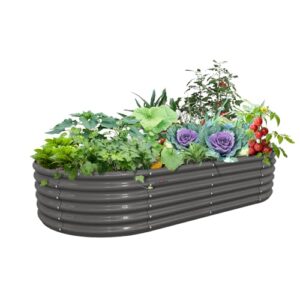
Metal raised beds built to last — that’s the Anleolife’s core promise. 22-gauge galvanized steel panels resist rust through every season, and the brand claims a service life of 20-plus years.
The 8 ft × 4 ft footprint gives you 32 square feet of planting area, while the 18-inch depth reduces back strain during planting.
Tool-free assembly using wingnuts and pre-drilled holes means you’re set up in under 45 minutes.
| Best For | Home gardeners who want a durable, long-lasting raised bed that’s easy to assemble and gentle on the back. |
|---|---|
| Material | Galvanized steel |
| Dimensions | 96×48×18 in |
| Assembly Method | Tool-free wingnuts |
| Primary Use | Raised bed gardening |
| Color/Finish | Quartz grey |
| Base/Drainage | Open bottom |
| Additional Features |
|
- Built from 22-gauge galvanized steel with anti-rust hardware, designed to last 20 years through all weather conditions
- The 18-inch height makes planting and harvesting far more comfortable, reducing the need to crouch or kneel
- Tool-free wingnut assembly with pre-drilled holes means most people can get it set up in under 45 minutes
- Some packages ship without center support rods, so you may need to buy or fabricate them separately
- Once assembled and filled with soil, the frame is heavy and difficult to move on your own
- Overtightening the horizontal support brackets can dent the corrugated steel panels, so installation requires a careful hand
6. Yaheetech Wooden Raised Garden Bed
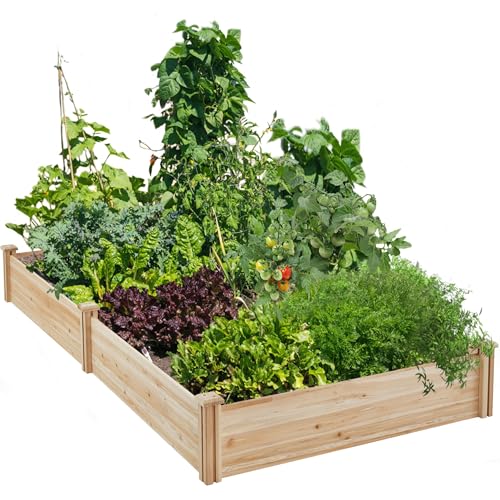
If natural wood is your style, the Yaheetech Wooden Raised Garden Bed is worth a close look. It’s built from natural fir wood — untreated and free of paints or sealants — so it blends easily into any backyard or patio setting.
The 8 ft × 4 ft footprint gives you 32 square feet of growing space, and the removable middle panel lets you run it as one large bed or two separate 4 × 4 sections. Assembly is tool-light and straightforward.
| Best For | Gardeners who love a natural, rustic look and want a versatile, easy-to-assemble bed that can flex between one large growing space or two separate sections. |
|---|---|
| Material | Fir wood |
| Dimensions | 96×48×10 in |
| Assembly Method | Tool-free slot system |
| Primary Use | Raised bed gardening |
| Color/Finish | Natural fir |
| Base/Drainage | Open bottom |
| Additional Features |
|
- Modular and stackable — split it into two 4×4 beds, keep it as one big 8×4, or stack frames for deeper soil and bigger harvests
- Tool-free assembly — the slot system snaps together quickly, making it a great weekend project even for beginners
- Natural fir construction — no paints or chemical sealants, so it’s a clean choice for edible gardens and looks great in any outdoor space
- Untreated wood needs upkeep — without sealing or oiling, moisture will shorten its lifespan considerably
- Can shift in wind — the lightweight build means you may need to anchor it down if your space gets breezy
- Takes up serious space — the 8×4 ft footprint isn’t going to work on a small balcony or cramped patio
7. Olive Green U Shape Raised Bed
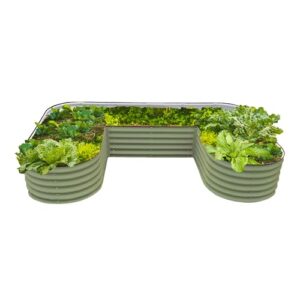
If you want a raised bed that works as hard as you do, the Olive Green U Shape Raised Bed is worth serious attention. Its wrap-around design gives you walk-in access from a central aisle — no more reaching awkwardly across your plants.
The 17-inch depth accommodates strong root systems, and the VZ 2.0 alloy steel construction is built to last 20+ years. The olive green powder coat holds up through seasons without fading.
| Best For | Gardeners who want a long-lasting, low-maintenance raised bed with easy walk-in access and room for a wide variety of plants. |
|---|---|
| Material | VZ 2.0 alloy steel |
| Dimensions | 66×102×17 in |
| Assembly Method | Tool-free fasteners |
| Primary Use | Raised bed gardening |
| Color/Finish | Olive green |
| Base/Drainage | Open bottom |
| Additional Features |
|
- VZ 2.0 alloy steel construction is built to last 20 years without rusting or fading
- U-shaped design lets you reach all your plants from a central aisle — no awkward stretching
- 17-inch depth gives roots plenty of room to grow, and the modular system lets you add trellises, covers, and more over time
- Higher upfront cost than basic wood or plastic beds
- Heavy metal construction makes it difficult to move once it’s set up
- The 17-inch depth may not be enough for deep-rooted crops like certain root vegetables
8. Seeding Square Plant Spacing Tool
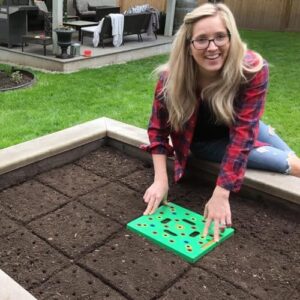
Precise spacing is the difference between a thriving bed and a chaotic one. The Seeding Square Plant Spacing Tool takes the guesswork out entirely.
Its color-coded 12-inch template maps exactly how many plants fit per square foot — from 1 to 16 — and the built-in dibber pokes holes at the right depth.
You just drop seeds through the funnel and move on. It’s simple, repeatable, and genuinely useful for beginners and experienced gardeners alike.
| Best For | Beginner gardeners, families, and anyone using the square foot gardening method who wants consistent, high-yield planting without the trial and error. |
|---|---|
| Material | Food-grade plastic |
| Dimensions | 12×12×0.2 in |
| Assembly Method | Ready to use |
| Primary Use | Seed spacing guide |
| Color/Finish | Green |
| Base/Drainage | Flat template |
| Additional Features |
|
- Takes the guesswork out of seed spacing with a clear color-coded template that supports 1–16 plants per square foot
- The built-in dibber and funnel make planting faster and more accurate — no extra tools needed
- Dense, even spacing naturally crowds out weeds and holds in moisture, which means less maintenance overall
- Only works well in beds or containers that are at least 12 inches square, so it’s not great for small pots
- No flower-seed placement chart, which limits its usefulness if you’re growing ornamentals
- The plastic can become brittle over time if left out in direct sunlight for extended periods
9. Galvanized Extra Height Garden Bed
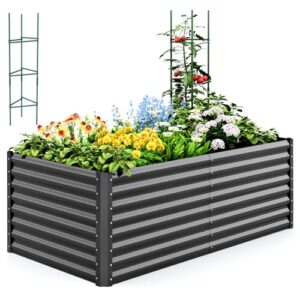
If bending over your garden bed is wearing you out, the Galvanized Extra Height Garden Bed was built for you. At 22.4 inches tall — nearly double the standard depth — it gives deep-rooted crops like tomatoes and carrots the room they need. The powder-coated galvanized steel shrugs off rust and rain year-round.
It includes a tomato support cage and holds enough soil depth for serious growing. Assembly takes patience, so grab a helper.
| Best For | Gardeners with back pain or limited mobility who want to grow deep-rooted vegetables like tomatoes and carrots without constant bending. |
|---|---|
| Material | Galvanized alloy steel |
| Dimensions | 72×36×22.4 in |
| Assembly Method | Wingnuts and hardware |
| Primary Use | Deep raised bed |
| Color/Finish | Dark gray |
| Base/Drainage | Open bottom |
| Additional Features |
|
- At 22.4 inches tall, it’s nearly twice the height of standard beds — much easier on your back
- Powder-coated galvanized steel holds up to rust, rain, and year-round outdoor conditions
- Comes with a tomato cage included, so you can start growing vertically right away
- Assembly can be tricky and time-consuming — some users found the wing-nut threading frustrating
- The crossbars can crease or bend if you’re not careful during setup
- You’ll need a lot of fill material to bring the soil up to a usable depth
10. Best Choice Metal Raised Garden Bed
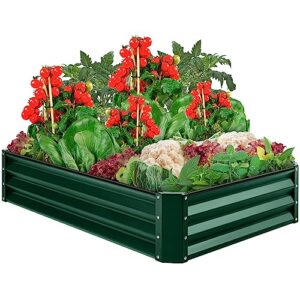
The Best Choice Metal Raised Garden Bed packs serious value into a 72 × 36 × 12-inch footprint. Its powder-coated alloy steel panels resist corrosion and limit soil leaching, keeping your growing environment stable season after season. The open-base design lets roots dig deep and water drain freely.
Assembly uses wingnuts and Phillips-head screws, though long screws can slow you down. In humid climates, watch for surface rust over time.
| Best For | Gardeners who want a durable, low-maintenance raised bed for vegetables, herbs, or flowers on patios, backyards, or in greenhouses where ground-level planting isn’t ideal. |
|---|---|
| Material | Alloy steel |
| Dimensions | 72×36×12 in |
| Assembly Method | Wingnuts and screws |
| Primary Use | Raised bed gardening |
| Color/Finish | Dark green |
| Base/Drainage | Open bottom |
| Additional Features |
|
- Powder-coated steel panels resist corrosion and limit soil leaching, keeping your growing environment stable
- Open-base design promotes healthy drainage and deep root access, reducing the risk of waterlogging and root rot
- Straightforward wingnut and Phillips-head assembly makes setup manageable without specialized tools
- Long screws and wingnut clearance can make assembly slower and more frustrating than expected
- Steel panels may develop surface rust over time in humid or rainy climates
- The central support bar can lack rigidity under heavy loads, requiring careful alignment during setup
Frequently Asked Questions (FAQs)
Can companion planting work in container gardens?
Yes, companion planting works in containers. Assign 1-foot microplots within each pot, group plants by water needs, and place basil near tomatoes to deter aphids and whiteflies naturally.
Which companions thrive together in shaded areas?
Shade lovers like hostas, ferns, and lettuce thrive together. Pair spinach with cilantro to deter pests. Nasturtium traps aphids near shaded beds. Dill and basil attract beneficial insects in low light.
How do you companion plant in cold climates?
In cold climates, pair brassicas with chives to deter aphids and flea beetles. Use row covers to protect companions from frost. Rotate beds yearly to prevent soil-borne diseases that thrive in cold, wet conditions.
Can companion planting reduce the need for fertilizers?
Companion planting reduces fertilizer needs. Legumes like beans fix nitrogen, feeding nearby crops naturally. Flowers attract beneficial insects, cutting pest stress. Healthy soil biology from diverse roots unlocks nutrients already present.
What companions help improve poor-draining soil?
Plants like lupine and red clover drive roots deep into compacted, waterlogged soil, opening drainage channels naturally. Creeping thyme reduces surface crusting. Adding compost annually builds soil structure that moves moisture downward more efficiently.
Conclusion
Your garden is a living puzzle, and every piece has a purpose. When you apply companion planting square foot garden principles, each square becomes a carefully negotiated alliance—basil guarding tomatoes, marigolds standing watch over cucumbers, beans quietly enriching the soil beneath them.
You’re not just growing food; you’re engineering a small ecosystem.
Sixteen square feet doesn’t sound like much until it’s feeding your family all summer long, harvested by hands that planted with intention.
- https://thecapecoop.com/beginners-guide-to-square-foot-gardening
- https://www.almanac.com/planning-companion-planting-garden
- https://www.azurefarmlife.com/farm-blog/companion-planting-chart-for-a-healthier-happier-garden
- https://homesteadandchill.com/benefits-companion-planting-chart
- https://extension.umd.edu/resource/how-make-compost-home