
This site is supported by our readers. We may earn a commission, at no cost to you, if you purchase through links.

Two plants growing side by side can either compete or cooperate—and that gap in outcomes shows up fast in a raised bed.
Swap a random layout for a thoughtful raised bed companion planting plan, and you’ll notice the difference within a season: fewer pest problems, richer soil, and harvests that actually fill a bowl.
The logic behind it isn’t magic. Beans feed nitrogen to hungry brassicas. Marigolds push nematodes away from pepper roots. Nasturtiums pull cucumber beetles off your cucumbers so you don’t have to.
What follows is a practical guide to pairing, positioning, and rotating crops so every square foot of your bed pulls its weight.
Table Of Contents
- Key Takeaways
- Companion Planting Basics for Raised Beds
- Map Your Raised Bed First
- Choose Crop Families Wisely
- Build High-Success Plant Pairings
- Avoid Bad Neighbor Combinations
- Design Smart Bed Layouts
- Use Flowers and Herbs Strategically
- Prevent Crowding and Disease
- Rotate Beds by Season
- Follow a Sample Planting Plan
- Frequently Asked Questions (FAQs)
- Conclusion
Key Takeaways
- Pair plants by what they trade: beans feed nitrogen to hungry brassicas, while marigolds and nasturtiums pull pests away from peppers and cucumbers.
- Group crops by family first—nightshades, brassicas, legumes, alliums, cucurbits—then keep known enemies apart, like tomatoes away from potatoes and dill away from carrots.
- Design your bed with structure in mind: tall crops to the north, lettuce on the edges, roots tucked between fruiting plants, and flowers in the corners.
- Rotate by season (spring greens, summer fruiters, fall roots, winter cover crops) and give plants their full mature spacing to keep airflow up and disease down.
Companion Planting Basics for Raised Beds

Raised beds work best when plants help each other out. Pair the right crops, and you get stronger roots, fewer pests, and bigger harvests for less work. Here’s what makes companion planting click in a raised bed.
For tested pairings that fit tight raised-bed spacing, this vegetable garden companion planting guide breaks down which crops actually thrive side by side.
Pair the right crops in a raised bed, and roots strengthen, pests fade, and harvests grow bigger for less work
Shared Nutrients
Good neighbors share their groceries.
Leguminous plants like beans and peas pull nitrogen from the air through nitrogen fixation, then release it through their roots. These root exudates feed soil microbes, driving nutrient cycling that other crops tap into.
Deep roots mine minerals below; shallow roots catch what’s near the surface.
Everybody eats.
Pest Confusion
Sharing space breeds confusion too. Yellow leaves might signal nutrient‑pest overlap, not infestation—classic symptom misdiagnosis.
Heat mimics pest damage, a case of environmental symptom mimicry, while visual cue ambiguity hides true causes.
Sticky cards help, but diagnostic tool limits remain real.
Add pest deterrent plants and trap crops for natural pest control, easing pest management before guesswork costs a harvest.
Pollinator Support
That confusion fades once you add pollinator attraction to your raised bed mix.
Plant pollinator-friendly flowers like marigolds and nasturtiums for continuous bloom cycles from spring through fall. Add shallow pollinator water sources and brush piles for nesting habitat creation. Sunny, wind-sheltered corners naturally aid microclimate management and foraging efficiency strategies, boosting beneficial insects and garden biodiversity through companion planting.
Soil Diversity
Below the surface, your raised bed thrives on biodiversity.
Mixed roots feed the soil microbiome, fueling nutrient cycling processes, driving soil nutrient cycling and microbial food webs. Varied depths improve soil texture and cation exchange capacity, while mycorrhizal fungi partnerships boost organic soil fertility.
- Legumes fix nitrogen
- Roots aerate soil
- Mulch boosts soil health
- Rotation stops disease
- Diversity builds resilience
In sandy substrates, macropores promote infiltration enhancing aeration for root systems.
Better Harvests
When you pair fast growers with slow growers, you fully utilize space and close every gap. Add vertical growth on trellises, and you free up ground for more crops. Succession planting keeps your bed working nonstop.
Better nutrient availability, plus real pollination boosts from companion flowers, add up to bigger, healthier harvests every season. Track it on a companion planting chart.
Map Your Raised Bed First

Before you plant a single seed, take a good look at the bed itself. Every raised bed has its own quirks, from shape to shade to how far you can reach. Here’s what to check first.
Bed Size and Shape
Size shapes everything in raised garden beds. Stick to 4 feet for ideal bed width—reachable from both sides—and 6 to 8 feet for length planning.
- Square or rectangular for simple garden design
- L-shaped for corner design options
- Curved beds for shape versatility
Smart garden layout plan choices boost garden space optimization, proving raised bed garden layouts thrive on space maximization strategies.
Sunlight Patterns
Before you plant, track the sun across your bed. Seasonal sun angles shift through the year, so mapping light zones each season pays off.
Microclimate bed quadrants form as south sides catch midday intensity management needs, while north corners need shade tolerance.
Use reflective surface light wisely, height hierarchy, and smart garden design to round out your garden layout plan.
Water Access
A bed far from your hose becomes a daily chore. Place raised beds near a spigot or a rainwater harvesting barrel for quick refills.
Drip irrigation boosts water use efficiency and keeps leaves dry, cutting disease risk. Check your tap’s water quality standards and plan hose reach into each bed’s microclimate.
Pathway Reach
Can you reach every plant without trampling another? Follow Aisle Width Standards: 18 inches minimum, 24 to 36 inches near gates for carts.
Choose gravel or stepping stones as Path Surface Materials for stable, easy‑clean footing.
Smart Ergonomic Garden Design keeps tool storage and hoses within arm’s reach, cutting wasted trips across your raised garden beds.
Harvest Zones
Not every corner of your raised bed ripens the same.
Microclimate mapping reveals harvest zones shaped by:
- Soil texture variation and drainage pattern analysis
- Sunlight exposure effects on ripening speed
- Nutrient concentration mapping for fruit quality
Match your companion planting chart to these zones, a core piece of smart garden planning that keeps harvest access easy across raised garden beds.
Choose Crop Families Wisely

Every vegetable belongs to a family, and that family shapes who it gets along with. Some groups feed the soil while others drain it, and pairing them right makes all the difference. Here are the five families you’ll work with most in your raised bed.
Nightshades
Once you’ve mapped your bed, group your nightshade family crops together: tomatoes, peppers, eggplants.
| Nightshade | Garden Benefit |
|---|---|
| Tomatoes | Vitamin C, lycopene |
| Peppers | Capsaicin, vitamin A |
| Eggplant | Fiber, nasunin |
Watch for solanine risks in green, unripe fruit. Pair tomatoes and peppers with basil and marigolds for natural pest control in raised garden beds.
Brassicas
Switch gears from nightshades to brassicas: broccoli, cabbage, kale, Brussels sprouts. These cool-season crops want soil pH around 6.0 to 7.0 and steady moisture.
- Pick clubroot-resistant varieties
- Test soil pH before transplanting
- Space evenly for airflow
- Mulch to retain moisture
- Cook briefly to preserve nutrients
Glucosinolates offer real health perks, and proper spacing curbs clubroot risk naturally.
Legumes
Brassicas feed heavily, so plant legumes nearby to even the score. Beans and peas host rhizobia symbiosis in their roots, fixing nitrogen straight into your soil.
| Legume | Garden Benefit |
|---|---|
| Bush beans | Nitrogen fixation |
| Peas | Soil aeration |
| Pole beans | Pairs with corn, squash |
Try three sisters planting for corn, beans, and squash. Beans also pack serious protein density.
Alliums
Once your beans finish feeding the soil, bring in alliums to guard it. Onions, garlic, leeks, and chives release sulfur compounds that confuse pests sniffing out neighbors.
- Pair carrots and onions for mutual pest defense
- Plant garlic near roses for aphid control
- Use chives as a living mulch edge
- Try ornamental alliums for pollinators
- Harvest leeks for milder, kitchen-ready flavor
Cucurbits
Cucurbits like cucumbers, squash, and melons crave heat. Wait until soil hits 70°F before planting.
Trellis vines for cleaner fruit and better airflow, cutting disease vectors like powdery mildew. Space plants 12 to 72 inches apart by variety.
Pair with corn and beans, the classic Three Sisters trio, and tuck in flowers nearby to boost pollination.
Build High-Success Plant Pairings
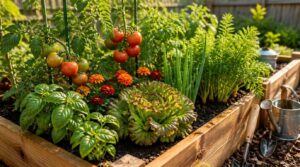
Now that you know your crop families, it’s time to put them to work. Some plant combinations just click, boosting flavor, fighting off pests, and growing stronger side by side. Here are five pairings worth building your raised bed around.
Tomatoes With Basil
Tomatoes and basil are the classic power couple of raised garden beds, and the pairing earns its reputation through real flavor enhancement science, not folklore.
- Aromatic oil transfer adds herbal notes to nearby fruit
- Shared moisture needs simplify watering schedules
- Root depth differences prevent competition underground
- Basil’s scent confuses pests seeking tomato leaves
- Compact growth habit suits tight plant compatibility
Cucumbers With Nasturtiums
Once cucumber beetles show up, nasturtiums earn their keep as a trap crop, pulling pests onto their own leaves instead.
| Plant | Role | Space Needed |
|---|---|---|
| Cucumber | Fruiting vine | Trellis, vertical |
| Nasturtium | Trap crop | 12–18 inches away |
| Both | Companion pair | Shared trellis space |
This pest distraction zone also retains soil moisture, and flowers add peppery flavor to salads.
Carrots With Onions
Onions and carrots split the work below ground, so neither crop competes for the same bite of soil.
- Root depth synergy: onions sip shallow water, carrots reach deep
- Scent-based protection confuses carrot flies
- Onion residue suppresses soil fungi
- Flavorful sautéing pairs them in the kitchen too
- Harvest timing: pull onions first, let carrots finish
Smart garden design planning for raised garden beds.
Peppers With Marigolds
Peppers and marigolds make a classic pest-control duo in raised garden beds. French marigolds release compounds that target nematode suppression near roots, while blooms boost pollinator attraction and soil microbial activity. Gardeners note pepper flavor enhancement too.
| Benefit | Marigold Trait | Planting Distance |
|---|---|---|
| Nematode control | Root compounds | 12-18 inches |
| Pollinators | Bright blooms | 12-18 inches |
| Soil health | Decomposing foliage | 12-18 inches |
| Pest deterrence | Scent barrier | 12-18 inches |
Lettuce With Radishes
Radishes work like a fast clock next to slow-growing lettuce. They mature in 20 to 30 days, giving you staggered harvest timing while lettuce takes its time.
Roots loosen soil for better aeration, easing nutrient competition between the two. Both crops thrive in cool season synergy, and radishes offer flea beetle deterrence.
Space plants 6 to 8 inches apart for tidy intercropping.
Avoid Bad Neighbor Combinations

Not every plant gets along with its neighbors. Some combinations quietly sabotage each other — stunting roots, inviting pests, or blocking growth before you even notice something’s wrong. Here are the pairings you’ll want to keep apart in your raised bed.
Tomatoes Near Potatoes
Tomatoes and potatoes are cousins, and that’s the problem. Both carry fungal pathogen risks like Fusarium and Verticillium wilt, spread through infested soil.
They also share shared pest vulnerabilities: Colorado potato beetle and tomato hornworm move freely between them.
Add nutrient competition issues for potassium and nitrogen, plus humidity buildup, and you’ve got real trouble.
Keep these crops in separate raised garden beds.
Beans Near Onions
Beans and onions look like a mismatched pair, but the truth is murkier.
Nitrogen fixation feeds the bed, and aphid deterrence runs both ways. Still, watch for:
- Water competition during dry spells
- Shifted pollinator activity near bean flowers
- Root depth diversity aiding rotation
- Reduced shared disease pressure
- Mixed results on most companion planting charts
Check your raised garden beds’ moisture before committing.
Carrots Near Dill
Onions and beans had mixed results. Dill and carrots don’t.
Dill releases growth inhibiting compounds into the soil, stunting root development and causing nutrient competition for phosphorus. Flavor profile changes show up too—carrots turn milder, less sweet.
Pest movement dynamics shift as well, drawing carrot fly closer.
Keep an ideal buffer spacing of 12 to 18 inches, or use separate raised bed garden layouts entirely.
Squash Near Potatoes
Squash and potatoes seem like a natural match. They’re not.
Both crops compete hard for potassium and phosphorus, leaving tubers undersized. Sprawling squash vines also block airflow, raising blight risk on potato foliage.
- Keep 2-3 feet of spacing between hills and rows
- Trellis squash vines instead of letting them sprawl
- Rotate beds yearly to break shared disease cycles
Separate plots work better than squeezing both into one bed.
Corn Near Tomatoes
Corn towers over tomatoes, and that height becomes a problem fast.
Shading risks cut into fruit set, while dense stalks trap microclimate humidity that invites foliar disease. Tomato hornworms create shared pest pressure between both crops. Plant corn north in your bed, leave real plant spacing, and watch pollinator activity stay strong near tomato blossoms instead.
Design Smart Bed Layouts
Layout is where companion planting really pays off. A smart design puts every plant where it can do the most good, not just where it fits. Here’s how to map it out, piece by piece.
Tall Crops North

Place tall crops — corn, sunflowers, or okra — along the north side of your bed. This protects shorter plants from shade while letting everyone grab sunlight.
Tall crops also create a windbreak microclimate, reducing stress on neighboring vegetables. Space them 12–24 inches apart, and trellis climbers to keep airflow moving cleanly through the bed.
Lettuce on Edges
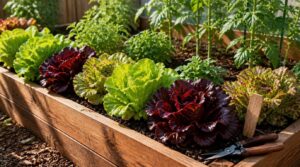
Around the border, lettuce earns its keep. Set plants 6 to 8 inches apart for compact, productive rows, choosing butterhead or loose-leaf for fast recovery.
Succession plant every two weeks for a steady edge harvest. Snip outer leaves often, keep soil moist with mulch, and mix in colorful varieties — productive and good-looking, right where you’ll notice it.
Roots Between Fruiting Crops

Slot root vegetables between your fruiting crops — they’re doing more than filling gaps. Carrots, onions, and radishes have varying root depths, so they tap different soil layers without competing directly.
- Carrots break compacted layers
- Onions deter soil pests
- Radishes loosen structure
- Roots share mycorrhizal networks
- Exudates support microbial activity
Space them 4–6 inches from fruiting stems.
Flowers Near Corners

The corners of your raised bed are prime real estate. French marigolds at each corner deter nematodes and draw pollinators into the growing space.
Add low-growing nasturtiums along the edges to trap aphids away from your main crops. Zinnias or cosmos fill seasonal gaps with color while creating reliable pollinator landing zones right where your vegetables need them most.
Paths for Maintenance

Good paths make good gardens. Keep them at least 18 inches wide so a wheelbarrow turns without scraping your beds.
Lay pavers or mulch underfoot to stay dry during watering.
Build your raised bed edges slightly higher than path level to hold soil in place.
Clear debris each season to prevent slips and maintain clean, year‑round access.
Use Flowers and Herbs Strategically

Flowers and herbs do more than fill empty space in your raised bed — they work. The right ones repel pests, lure pollinators, and protect your vegetables without any extra effort on your part. Here’s how to put each one to work.
French Marigolds for Pests
French marigolds pull double duty in a raised bed. Their scent-based pest deterrence confuses and repels aphids, whiteflies, and tomato hornworms without a single spray.
Plant them as a natural pest barrier along your bed’s border, or interplant them directly with tomatoes and peppers for targeted nematode suppression. Their blooms also draw in lady beetles and parasitic wasps — built-in, chemical-free pest control.
Borage for Pollinators
Marigolds repel pests, but borage calls pollinators in. Its star-shaped blue flowers sit high above the leaves, easy for bees to find, and they produce heavy nectar volume for weeks.
Plant borage in clusters near tomatoes and cucumbers to build a real pollinator corridor. Let some self-seed for lasting habitat, and snip a few blooms for salads without losing pollinator traffic.
Basil Beside Tomatoes
Borage pulls pollinators in; basil pushes pests out. Pair tomatoes and basil for natural pest control, plus better flavor enhancement in every dish.
Match sunlight requirements: both need full sun. Keep root zone spacing at 12 to 18 inches. Basil shades soil for moisture retention benefits, and staggered harvest timing means fresh leaves now, ripe tomatoes later—a reliable companion planting chart staple for raised bed garden layouts.
Nasturtiums as Trap Crops
Basil repels pests. Nasturtiums pull them away entirely. Their mustard oil volatiles lure aphids and cabbage worms off your crops, acting as a sacrificial plant in your raised bed garden layouts.
Place them right:
- Windward edge placement intercepts drifting pests early
- Time blooms for peak pest interception timing
- Check weekly for trap crop monitoring
That’s sacrificial plant management—natural pest control without sprays.
Sage for Moths
Sage works on smell, not sacrifice. Its sage essential oils, camphor and 1,8-cineole, confuse cabbage moths and cut moth oviposition near brassicas.
Plant it as a scented hedgerow design along bed edges. Trim often for fresh growth and stronger scent. Sage also boosts beneficial insect attraction, like hoverflies, when flowering. Mind basic sage growth requirements: full sun, good drainage, zones 5-8.
Prevent Crowding and Disease

A crowded raised bed turns into a disease zone fast. Tight spacing traps moisture and lets fungus spread leaf to leaf. Here’s how to keep your plants healthy and breathing room intact.
Mature Spacing
Crowded beds breed disease. Always plant for mature size, not seedling size.
On-center measurement prevents root competition and protects light access:
- Tomatoes: 24–36 inches
- Peppers: 18–24 inches
- Lettuce: 12–18 inches
- Carrots: 2–4 inches
Canopy spread determines true planting density. Follow these spacing guidelines now, and your raised bed garden layout rewards you with strong airflow management later.
Airflow Gaps
Even a well-spaced bed can trap moisture if airflow gaps close between plants. Canopy ventilation prevents powdery mildew by letting heat and humidity escape through staggered openings. Soil respiration depends on loose, uncovered channels near the crown. Good microclimate regulation means air moves freely, keeping leaf surfaces dry and disease pressure low.
| Gap Type | Why It Matters |
|---|---|
| Canopy gaps | Reduce leaf humidity |
| Soil surface gaps | Support root zone airflow |
| Trellis spacing | Ventilate fruiting crops |
| Crown gaps | Prevent fungal buildup |
Humidity control starts with your plant spacing guidelines — don’t fill every inch.
Trellised Cucumbers
Trellises turn cucumbers from sprawling ground-huggers into vertical gardening powerhouses. Mount a sturdy vertical support system — at least five to six feet tall — before vines take off.
Train side shoots upward every one to three weeks.
Airflow disease prevention improves dramatically, and fruits hang clean, straight, and easy to harvest.
Marketmore and Arrow climb best in raised bed garden layouts for small spaces.
Pruned Lower Leaves
Those bottom leaves aren’t doing your plants any favors once the bed fills in. Snip them off, and you get better airflow, faster drying after rain, and real disease prevention.
Light penetration improves too, helping fruit ripen evenly. Removing old growth redirects resources straight to developing fruit.
Always use clean, sharp tools, and prune only crowded or yellowing leaves.
Mulched Soil Surface
Bare soil invites trouble. A 2 to 4 inch layer of organic mulch locks in moisture retention, blocks weed germination, and steadies soil temperature through hot spells.
It also boosts water infiltration and feeds soil quality through organic decomposition. Good mulch choices:
- Wood chips
- Straw
- Shredded leaves
Keep mulch off plant stems to prevent rot.
Rotate Beds by Season
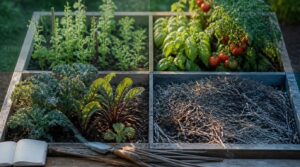
Your raised bed changes jobs with the calendar, not just the crops in it. Each season calls for a new plan, built around what grew there before. Here’s how to rotate smart, season by season.
Spring Greens
Start your rotation with spring greens. Kale, loose-headed cabbage, spinach, and chard fill your raised bed first, ready for harvest in 30 to 60 days.
Snip the outer leaves often for steady production and strong nutrient density.
Pair greens with garlic or lemon in the kitchen.
Refrigerate unwashed, use within 2-3 days, and start succession planting as space opens.
Summer Fruiting Crops
Once your spring greens are cleared, swap in your summer fruiting crops. Tomatoes, cucumbers, and peppers all need daytime temps of 21–30°C and consistent moisture — around 25–38 mm per week.
Trellis cucumbers and tomatoes vertically. Feed every 1–2 weeks.
Pair tomatoes with basil and marigolds to deter aphids and whiteflies naturally.
Fall Root Vegetables
As summer fruiting crops wind down, fall root vegetables take over. Sow carrots, beets, and turnips 8–10 weeks before first frost.
Cold nights trigger frost sweetness, deepening flavor naturally. Loosen soil 12–18 inches deep and keep pH at 6.0–6.8.
Pair carrots with onions for pest control. Tuck lettuce on edges as a quick-harvest companion.
Winter Cover Crops
Once roots are pulled, don’t leave your bed bare for winter. Sow rye or crimson clover for nitrogen scavenging and erosion control.
Roots hold soil through rain, residue suppresses weeds, and clover feeds pollinators early. Come spring, terminate growth to release nitrogen and boost organic matter for the next planting.
Family-based Rotation
Rotation isn’t just about crops — it’s a chance to share the work. Assign age-appropriate tasks: younger kids water and mulch, teens track planting dates.
Keep a family rotation journal to log bed layouts, harvest yields, and crop sequences. Review it together each season, adjust roles, and set shared harvest goals that keep everyone invested in what grows.
Follow a Sample Planting Plan
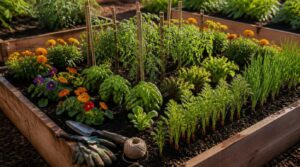
Theory only gets you so far. Sometimes you just need a layout you can copy straight into your own bed. Here’s a set of sample plans to get you started, from bed sizes to crop pairings to upkeep.
4×4 Raised Bed
Sixteen square feet packs in more than you’d think. A 4×4 raised bed suits beginners using a square foot garden approach.
- Cedar wood durability for long seasons
- Corner joint reinforcement for stability
- Drainage layer setup underneath soil
Calculate soil volume calculation at 14 to 30 cubic feet, then top with mulch for moisture retention. Try tomatoes, basil, and marigolds together.
4×8 Raised Bed
A 4×8 raised bed doubles your planting space and accommodates multiple crop families at once. Orient tall crops like tomatoes along the north edge so they don’t shade shorter plants. Use 12 to 18 inches of soil depth, add a gravel drainage layer below, and run a soaker hose under mulch for consistent moisture. Cedar boards with galvanized screws last longest.
| Zone | Crop | Companion |
|---|---|---|
| North row | Tomatoes | Basil |
| Center | Peppers | Marigolds |
| South edge | Lettuce | Radishes |
| East side | Cucumbers | Nasturtiums |
| West side | Carrots | Onions |
Tomato Companion Layout
Tomatoes are social plants—give them the right neighbors and they’ll reward you with fewer pests, better flavor, and heavier harvests all season long. Build your layout around verticality first: stake or cage tomatoes along the north edge so they don’t shadow companions.
- Plant basil 12 inches away on each side
- Tuck marigolds at the bed corners to block nematodes
- Keep roots varied—basil stays shallow while tomatoes run deep
- Use a companion planting chart to track spacing before you dig
Cucumber Companion Layout
Cucumbers climb, so let them. A Vertical Trellis Design along the bed’s back edge frees ground space for companions and optimizes efficient space usage.
Plant nasturtiums and dill at the trellis base for pest protection—pest repelling herbs that confuse cucumber beetles. Tuck radishes and lettuce between rows for quick harvests. Keep soil nutrient rich with compost, and prune lower leaves for a solid disease prevention layout.
Maintenance Checklist
Think of this checklist as your bed’s year-round rulebook.
Test soil pH annually and aim for 6.0–7.0. Apply compost each spring at 1/4‑inch deep.
Check drip lines monthly, and inspect leaves weekly for aphids or mildew.
Reapply mulch at 2–3 inches once the soil warms.
Rotate crop families every season to break disease cycles.
Frequently Asked Questions (FAQs)
Can companion planting work in small container gardens?
Yes. Container root limits call for shallow pairs like lettuce and radishes. Match watering needs, keep potting mix consistent, and use vertical space for trellised cucumbers and nasturtiums in tight small-space gardening setups.
How often should I fertilize a companion-planted raised bed?
Feed every 4 to 6 weeks during active growth, adjusting for sandy soil, heavy rainfall, and growth stage. Watch for yellowing leaves, a deficiency sign, and switch to organic fertilizers or compost to support long-term soil health.
Does companion planting eliminate the need for pesticides entirely?
No, it won’t. Pests adapt and travel in from nearby areas regardless of neighbors. Treat companion planting as one piece of integrated pest management—pair it with monitoring, row covers, and organic sprays for real disease suppression and pest deterrence.
How long before companion planting benefits become noticeable?
Rome wasn’t built in a day, and neither is plant synergy.
Expect pest reduction within 2 to 6 weeks, pollinator arrival by week five, soil microbes activating around week four, nitrogen fixation by week six, and visible yield signals near harvest’s first flush.
Conclusion
Picture a 4×8 bed where tomatoes shade lettuce, marigolds hold the pest line, and beans quietly rebuild the soil below. That’s not luck—that’s a raised bed companion planting plan doing exactly what it’s built to do.
Every pairing you choose either earns its space or costs you yield. Get the combinations right, rotate each season, and your bed stops being a garden patch. It becomes a system that works while you’re not watching.
- https://ag.umass.edu/sites/ag.umass.edu/files/fact-sheets/pdf/companion_planting.pdf
- https://www.almanac.com/content/three-sisters-corn-bean-and-squash
- https://homeguides.sfgate.com/companion-plants-pole-beans-peppers-80432.html
- https://www.youtube.com/
- https://gardenplanner.almanac.com/garden-plans/894101/connecticut/2018/kitchen-garden/