This site is supported by our readers. We may earn a commission, at no cost to you, if you purchase through links.
Soil loses roughly 15% of its top-layer moisture every single day once temperatures climb past 30°C—and your plants feel that deficit long before you notice the wilting. By the time leaves curl and tips turn crispy, the root zone has already been running on empty for hours.
Most gardeners respond by grabbing the hose at noon, which is the horticultural equivalent of pouring water onto a hot skillet.
The right summer garden irrigation systems solve this problem at the source, delivering water directly to roots during the narrow morning window when soil can actually absorb and hold it.
Table Of Contents
- Key Takeaways
- Why Summer Irrigation Matters
- Choose The Best Irrigation System
- Drip Irrigation for Vegetable Beds and Raised Beds
- Soaker Hoses for Perennials, Shrubs, and Tree Zones
- Sprinklers for Wider Lawn and Garden Coverage
- Olla Irrigation for Drought-prone Garden Beds
- Watering Cans for Containers and Patio Plants
- Matching System Type to Garden Size
- Water Pressure and Flow Rate Considerations
- Water-saving Efficiency by System Type
- Design a Water-Smart Garden Layout
- Measuring Coverage Areas Before Installation
- Sketching Tubing, Emitters, and Connector Placement
- Dividing The Garden Into Irrigation Zones
- Grouping Plants by Water Needs
- Choosing Emitters for Vegetables, Herbs, and Flowers
- Using Filters and Pressure Regulators Correctly
- Combining Drip and Sprinkler Zones Efficiently
- Adding Mulch to Retain Soil Moisture
- Install and Maintain Your System
- Top 9 Summer Irrigation Kits
- 1. TJJFMM Drip Irrigation Kit
- 2. Adjustable Garden Drip Irrigation Kit
- 3. Adjustable Misting Sprinkler Irrigation Kit
- 4. MIXC Quick Connect Drip Irrigation
- 5. Toki dot Drip Irrigation Misting System
- 6. Kafuzi Drip Irrigation System
- 7. HIRALIY Drip Irrigation System
- 8. Abakuku 240 Foot Drip Irrigation
- 9. MIXC Greenhouse Micro Drip Kit
- Frequently Asked Questions (FAQs)
- What is the 30/30 rule for irrigation?
- What is the 30 30 rule for drip irrigation?
- What type of irrigation is best for a vegetable garden?
- How long should an irrigation system run in summer?
- Whats the best irrigation timer schedule for vegetables?
- How do you prevent irrigation line clogs effectively?
- Can you automate irrigation systems with phone apps?
- Whats the ideal water pressure for drip systems?
- How often should irrigation filters be cleaned?
- How long do drip irrigation systems typically last?
- Conclusion
Key Takeaways
- Watering between 4–8 AM is your single biggest efficiency win, cutting evaporation loss and letting roots absorb moisture before heat shuts the process down.
- Drip irrigation outperforms every other system for vegetable beds, delivering water directly to the root zone while keeping foliage dry and slashing fungal disease risk.
- Matching your irrigation system to your garden’s actual size, slope, and plant water needs isn’t optional — get it wrong and you’re either drowning roots or watching soil crack by mid-July.
- Overwatering in summer heat is just as destructive as drought, triggering root suffocation, fungal pathogens like Pythium, and salt buildup that mimics the exact drought stress you’re trying to prevent.
Why Summer Irrigation Matters
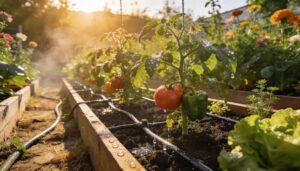
Summer heat doesn’t just tire you out — it drains your soil fast, and plants feel it before you do.
Building a stronger soil base before the heat peaks is exactly what protecting plants through summer heat stress is all about.
Getting your irrigation right means the difference between a thriving garden and one that’s constantly playing catch-up.
Here’s what you need to know about why consistent summer watering is non-negotiable.
Heat Stress and Rapid Soil Moisture Loss
When temperatures climb past 30°C, heat-induced evaporation accelerates fast — soil moisture in the top 7 cm can drop 15 percentage points in a single day.
Stomatal closure effects slow plant cooling without stopping moisture loss, while surface soil crusting blocks rehydration.
Drip irrigation aids root zone cooling and soil water holding capacity, preventing microbial activity decline that quietly undermines your garden’s long‑term resilience.
Enhancing soil water‑holding capacity is essential for reducing heat stress impacts.
Benefits of Consistent Summer Watering Schedules
A steady watering schedule does more than just keep plants alive — it keeps them thriving. Stable soil moisture prevents the root shrink-and-swell cycle that stresses crops and invites pest pressure.
A steady watering schedule doesn’t just keep plants alive — it keeps roots stable, crops thriving, and pests at bay
Consistent delivery helps enhance nutrient uptake, improves fruit quality, and reduces water waste through better irrigation efficiency. Pair that routine with a smart timer, and your summer garden irrigation system practically runs itself.
Signs Plants Need More Water
Your plants will tell you when they’re thirsty — you just need to know the language. Watch for these four warning signs:
- Leaf Curl and upward-curling edges signal water deficit.
- Crispy Leaf Tips and Pale Foliage indicate prolonged underwatering.
- Wilting Lower Leaves appear before upper canopy stress.
- Dry Soil Cracks confirm soil moisture tension has dropped critically.
A soil moisture sensor removes the guesswork from plant hydration monitoring entirely.
Risks of Overwatering in Hot Weather
Too much water is just as damaging as too little.
Overwatering in summer heat triggers Root Suffocation by displacing oxygen from the root zone, invites Fungal Pathogen Growth from Pythium and Phytophthora, and causes Salt Accumulation that mimics drought through Nutrient Deficiencies.
| Risk | Cause | Symptom |
|---|---|---|
| Root Suffocation | Waterlogged soil | Wilting, brown roots |
| Fungal Pathogen Growth | Anaerobic conditions | Mushy stems, rot |
| Pest Attraction | Surface moisture | Fungus gnats, mold |
Best Times of Day to Irrigate in Summer
Timing your irrigation is one of the easiest wins in soil moisture management. Water between 4 and 8 am for Dawn Soil Saturation and Morning Evaporation Reduction — roots absorb moisture before stomata close, and foliage dries before nightfall, supporting Evening Leaf Drying.
Avoid Midday Heat Avoidance windows from 11 am to 4 pm to cut water waste and evapotranspiration reduction.
Use an irrigation timer for weather-based irrigation and Nighttime Root Uptake efficiency.
Choose The Best Irrigation System
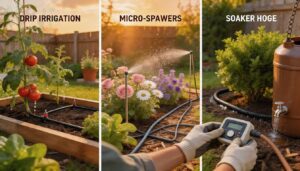
Picking the right irrigation system is less about preference and more about matching your setup to your plants, your space, and your water source. Get that match wrong, and you’re either drowning your roots or watching your soil crack by mid-July.
Here’s a breakdown of every major system type so you can make the call with confidence.
Drip Irrigation for Vegetable Beds and Raised Beds
Drip irrigation is the go-to choice for vegetable garden irrigation and raised bed garden setups.
UV‑Resistant Tubing withstands summer sun without cracking, while drip emitters deliver water directly to the Root Zone Targeting each plant’s base.
Emitter Spacing Strategies of 6 to 12 inches for dense beds, pair with Pressure Balancing at 10–20 psi, and your Water Use Monitoring will confirm real soil moisture management and water conservation gains.
Soaker Hoses for Perennials, Shrubs, and Tree Zones
Soaker hoses shine in perennial beds, shrub borders, and tree zones where slow, steady delivery beats any overhead spray. Pore Size Selection determines seepage rate, so match hose grade to your soil type.
Hose Looping Techniques around shrub bases and along drip lines for Root Zone Targeting.
Pressure Regulation Tips: keep it under 10 psi.
Seasonal Leak Inspection each spring to protect water conservation and maintain consistent soil moisture.
Sprinklers for Wider Lawn and Garden Coverage
When your lawn stretches beyond what drip lines can reasonably handle, sprinklers become your best tool for uniform water distribution across wide coverage areas. Match the type to your layout:
- Rotary Sprinkler Range reaches up to 40-foot radii with adjustable arcs
- Traveling Sprinkler Automation moves across the lawn without repositioning
- Oscillating Sprinkler Width suits long, rectangular beds
Factor in water pressure, garden zoning for irrigation, Impact Sprinkler Coverage, and Pop-up Sprinkler Benefits before committing.
Olla Irrigation for Drought-prone Garden Beds
Olla clay pot irrigation is one of the oldest low‑tech irrigation methods still worth using today. Buried unglazed clay pots use soil moisture tension to pull water directly into the root zone, making self‑regulating watering automatic.
Clay pot placement every 2–4 feet enhances bed spacing strategy and root zone deepening, while cutting water use up to 70% — a reliable drought stress mitigation and dry farming water conservation strategy.
Watering Cans for Containers and Patio Plants
Sometimes the simplest tool is the right one. For containers and patio plants, a well-chosen watering can beats overengineered DIY irrigation installation every time.
- Rose Types: swap fine-spray roses for seedlings, wide-fan heads for densely planted pots
- Ergonomic Grips: dual-grip designs reduce fatigue during longer sessions
- Material Choices & Capacity Guidelines: galvanized 1–2 gallon cans balance durability with lifting ease
Clean spouts monthly to protect plant health, optimization, and water conservation.
Matching System Type to Garden Size
Choosing the right irrigation system for garden size is where most gardeners either nail it or waste money. A watering can works for patio pots, but scale up and you need a real plan.
| Garden Size | Best System Match |
|---|---|
| Small Yard Drip (under 200 ft²) | Inline drip with compact timer |
| Raised Bed Systems (up to 250 ft²) | Adjustable emitter drip kit |
| Medium Garden Zoning (up to 1,600 ft²) | Multi-zone drip plus sprinkler combo |
| Large Property Planning (1,600+ ft²) | Rotors, drip laterals, smart controls |
| Sloped Lot Solutions | Pressure-regulated drip with shortened runs |
Coverage area and customization options both matter here. Scalability of irrigation setups for expanding gardens means choosing modular connectors now so you’re not ripping everything out next season.
Water Pressure and Flow Rate Considerations
Once garden size is locked in, water pressure and flow rate become the next variables to get right. Running drip emitters flow rate at 30–60 psi keeps distribution even — too far outside that window, and you’re either misting or trickling.
Pressure Regulator Selection matters here: inline regulators handle hydraulic pressure control zone by zone. Factor Zone Pressure Loss on long runs, match Pump Sizing Basics to your emitter count, and use Gauge Placement Tips at active lines for Flow Rate Matching.
Water-saving Efficiency by System Type
Once pressure is dialed in, efficiency gaps between system types become obvious.
Drip irrigation leads in Precision Water Delivery, cutting evaporation loss by up to 40% through direct root-zone application. Olla pots push water conservation efficiency past 90% in dry beds.
Smart Moisture Sensors and Low Evaporation Timing sharpen every system’s output, while Modular System Scaling and Adaptive Pressure Control keep water-saving technology performing across zones.
Design a Water-Smart Garden Layout
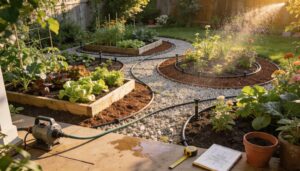
A good irrigation system is only as effective as the layout behind it. Before you run a single line of tubing, you need a clear plan that accounts for coverage, plant groupings, and water pressure across every corner of your garden.
Here’s how to design a layout that puts water exactly where it needs to go.
Measuring Coverage Areas Before Installation
Before you buy a single fitting, measure every bed, path, and planting zone. Emitter Reach Assessment starts with walking each row and recording dimensions on graph paper.
Use a soil moisture sensor for Moisture Sensor Validation and a light meter for Light Meter Verification to confirm even distribution. Coverage Radius Calculation and Uniformity Mapping make sure your irrigation zones hit target moisture within a 5% variance.
Sketching Tubing, Emitters, and Connector Placement
Once your measurements are in hand, transfer them into a Blueprint Sketch on graph paper.
Mark Tubing Routing along bed edges, note Emitter Spacing at 12 to 18 inches between plants, and flag Connector Positioning at each branch point.
Indicate Flow Direction arrows so your modular irrigation design stays logical during drip line installation.
Quick-connect technology and adjustable emitters make last-minute customization options easy to execute.
Dividing The Garden Into Irrigation Zones
Once your sketch is ready, dividing your garden into zones transforms a rough plan into a working system.
Apply Slope-Based Zoning to redirect runoff, use Sunlight Segmentation to separate full-sun beds from shaded corners, and define Soil Texture Zones where sandy or clay soils demand different cycles.
Root Depth Partitioning and a solid Valve Isolation Strategy give you true zone control over every square foot.
Grouping Plants by Water Needs
Once your zones are mapped, Hydrozoning Basics gives you the framework to stop guessing and start grouping with intention. Sorting plants into Water Need Categories keeps every root zone watering precisely matched to demand.
- High: Tomatoes, leafy greens — frequent, consistent soil moisture
- Medium: Daylilies, basil — balanced cycles
- Low: Succulents, lavender — deep, infrequent intervals
- Zone Soil Matching + Mulch Depth Influence: 2–3 inches of mulch stabilizes Plant Water Profiles across watering zones
Choosing Emitters for Vegetables, Herbs, and Flowers
Not every plant wants the same drink. Flow Rate Matching starts with knowing what’s in the ground — tomatoes and peppers need 1.0–2.0 GPH per plant, herbs run best at 0.6–1.2 GPH, and flowers sit somewhere between.
Adjustable emitters let you dial in Seasonal Flow Adjustments without swapping hardware. Pair clog‑resistant emitters with smart Emitter Spacing — one per vegetable plant, every 12–18 inches for herb rows — and you’ve got precise Root Zone Targeting through consistent microdroplets.
| Plant Type | Emitter Flow Rate | Emitter Spacing |
|---|---|---|
| Tomatoes / Peppers | 1.0–2.0 GPH | 1 per plant |
| Leafy Greens | 0.5–1.0 GPH | 1 per plant |
| Herbs | 0.6–1.2 GPH | Every 12–18 in |
| Flowers | 0.5–1.5 GPH | Every 12–24 in |
Adjustable emitters handle plant root zone watering across growth stages without guesswork.
Using Filters and Pressure Regulators Correctly
A clogged emitter is usually a filter problem in disguise. Your filter placement strategy starts at the main supply line — install a water filter with 100–150 micron filter screens upstream of every valve.
Follow it with a pressure regulator set between 15–30 psi for reliable regulator pressure tuning. Sediment removal benefits every emitter downstream, while leak-proof filter maintenance and pressure drift troubleshooting keep pressure compensation consistent across all zones.
Combining Drip and Sprinkler Zones Efficiently
Running drip and sprinkler zones off one system demands smart planning.
Assign adjustable emitters to vegetable beds and sprinkler heads to open lawn areas, then use Smart Controller Integration for Hybrid Scheduling — separate programs prevent overlap.
A pressure regulator manages Pressure Balancing between both zone types, while Zone Synchronization and zone control valves keep each area independent.
That’s your Water Use Optimization and customization options working together.
Adding Mulch to Retain Soil Moisture
Once your zones are dialed in, mulch does the quiet work of keeping moisture where it belongs. A 2–4‑inch layer of organic mulch — wood chips, shredded bark, or straw — cuts evaporation by up to 50%.
- Mulch Depth: Keep it 2–3‑inch from stems
- Organic Mulch Types: Wood chips outlast straw in heat
- Maintenance Practices: Replenish annually for continuous moisture retention
Install and Maintain Your System
Getting your irrigation system in the ground is only half the job — keeping it running efficiently through a long, hot summer is where most gardeners either win or fall short.
From the initial assembly to monthly maintenance checks, each step builds on the last to keep your plants watered and your water bill in check.
Here’s exactly how to handle every stage of the process.
Step-by-step Setup for a DIY Irrigation Kit
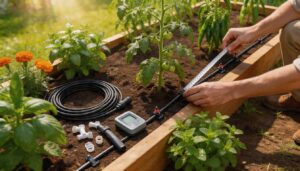
Before you touch a single fitting, run through your Tool Checklist: mainline tubing, emitters, tees, adapters, and a controller.
Measure each bed, then sketch your Tubing Routing so mainlines follow logical paths.
Punch holes for Emitter Spacing based on plant groupings, apply Zone Labeling at each split, and finish with Controller Programming for daily run times.
Quick-connect Assembly and Hose Attachment
Once your layout is mapped, quick-connect technology makes the physical assembly surprisingly fast. The MIXC QuickConnect Drip Irrigation System snaps together in under 10 minutes using quick connector technology and standard ¾‑inch garden hose thread.
Follow these four steps:
- Connector Lock Mechanisms – Engage the ball‑latch collar until it clicks
- O‑Ring Seal Checks – Inspect nitrile O‑rings before coupling
- Swivel Adapter Benefits – Attach swivel adapters to eliminate kinking
- Color‑C Fittings – Match stems to bodies by color; add Pressure Relief Valves at the source
Setting Timers for Daily or Weekly Watering
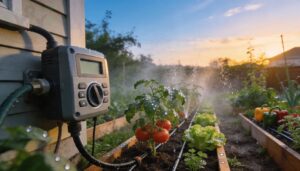
Once your system is connected, a programmable timer turns that hardware into a fully automated irrigation system.
Set your Start Time Optimization by programming early‑morning cycles — most smart timers support durations from 1 minute to 3 hours 59 minutes, with daily or weekly Program Frequency.
| Setting | Recommended Value |
|---|---|
| Start Time | 5:00–6:00 AM |
| Duration | 15–30 min |
| Zone Prioritization | Vegetables first |
| Seasonal Adjustments | Reduce by 20% in fall |
Using Rain Delay and Soil Moisture Controls
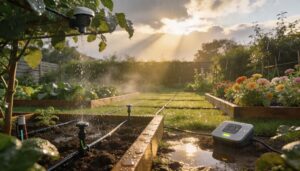
Even the best timer schedule falls apart after a rainstorm — that’s where rain delay and soil moisture controls take over. Set your smart timer’s Delay Override Settings to pause cycles for 24–72 hours post‑rain.
- Position rain sensors above the canopy for accurate Rain Sensor Placement
- Apply Adjustable Moisture Thresholds per zone — vegetables, ornamentals, and lawns differ
- Enable Integrated Weather Forecasting on your smart irrigation controller for weather‑based irrigation
Flushing Drip Lines to Prevent Clogs
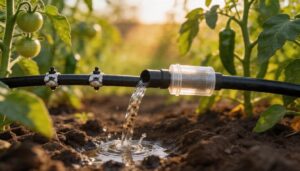
Neglect your drip lines long enough, and sediment quietly chokes every emitter you’ve got.
Start with Pre-Flush Timing — flush at season’s start and end, running each zone 2–5 minutes until discharge runs clear. Use the Reverse Flow Technique by opening end caps to push debris back toward the supply. Pair 120-mesh filter screens with a Flush Frequency Schedule to keep clog-resistant emitters flowing all summer.
Troubleshooting Low Pressure and Blocked Emitters
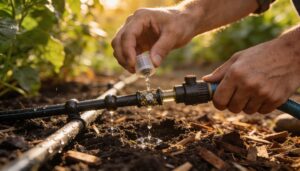
When your emitters trickle instead of drip, start with Emitter Clog Diagnosis — debris or mineral scale can cut discharge by 60%.
Check Pressure Drop Causes like air pockets, long lateral runs, or a dirty filter.
Purge air lines, adjust your regulator above 15 psi, and flush filters each season.
Swap suspected emitters with clog-resistant units to confirm whether it’s blockage or low pressure starving the zone.
Seasonal Maintenance and Winterizing Basics
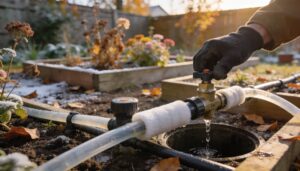
Summer ends, but your irrigation investment doesn’t have to suffer for it. A proper Winter Drain Procedure — shutting off supply lines, opening drain valves, and clearing standing water — is your first line of defense against freeze damage.
- Complete a Seasonal Leak Inspection before temperatures drop
- Apply Freeze Protection Measures using foam wrap on exposed valves
- Confirm your Backflow Device Check after every winter
- Run a Spring System Flush to clear sediment buildup
- Adjust schedules during seasonal checks to match new plant needs
Top 9 Summer Irrigation Kits
Getting the right kit makes everything else fall into place. These nine options cover everything from compact greenhouse setups to large-scale drip systems, so there’s a practical match for nearly every garden size and watering goal.
Here’s what’s worth your attention this summer.
1. TJJFMM Drip Irrigation Kit
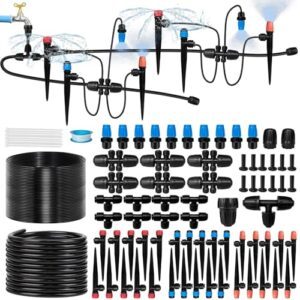
At $36.99, the TJJFMM Drip Irrigation Kit packs serious reach into a budget-friendly package — 33 ft of 1/2" main line paired with 197 ft of 1/4" drip line gives you 230 ft of total coverage across raised beds, greenhouse rows, or garden plots.
You get 40 nozzles in three interchangeable types — stream, vortex, and misting — so you can match moisture delivery to each plant’s needs.
The tool-free, quick-connect couplers snap onto 1/4" tubing in minutes, though you’ll want to add a separate timer for automated scheduling.
| Best For | DIY gardeners and small-scale growers who want an affordable, easy-to-set-up drip system for raised beds, greenhouses, or garden rows. |
|---|---|
| Total Tubing Length | 230 ft |
| Emitter Types | Stream, vortex, misting |
| Price | $36.99 |
| Main Tubing Size | 1/2 inch |
| Built-in Timer | No |
| Tool-free Install | Yes |
| Additional Features |
|
- 230 ft of total tubing coverage gives you a lot of flexibility for the price
- Three emitter types let you dial in the right watering style for different plants
- Tool-free snap connectors make setup and reconfiguration quick and painless
- Flow can weaken toward the far end of the line, so distant emitters may underperform
- No built-in timer means you’ll need to buy one separately for hands-free scheduling
- The kit can run short on connectors if your layout gets more complex, which means extra purchases
2. Adjustable Garden Drip Irrigation Kit
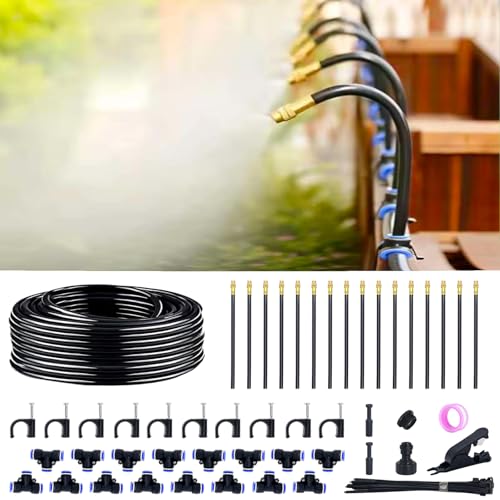
Looking for precision in every drop? The Adjustable Garden Drip Irrigation Kit lets you tailor water flow from 0.5 to 2.5 liters per hour per emitter, so you can target each plant’s root zone without waste.
Quick-connect fittings and flexible tubing mean you won’t wrestle with hardware—just expand or tweak layouts as your garden grows.
You get reliable pressure regulation and filtration, so clogs and inconsistent watering won’t derail your routine. It’s ideal for vegetable beds, herbs, and mixed flower borders.
| Best For | Gardeners who want flexible, targeted watering for vegetable beds, herbs, or mixed borders without a complicated setup. |
|---|---|
| Total Tubing Length | 50 ft |
| Emitter Types | Misting only |
| Price | $26.99 |
| Main Tubing Size | 5/16 inch |
| Built-in Timer | No |
| Tool-free Install | Yes |
| Additional Features |
|
- The 5/16" tubing moves more water than standard 1/4" lines, so dry spots are less of a headache.
- Those 360° copper nozzles let you aim water exactly where you need it—great for greenhouses, patios, or tight garden beds.
- The quick-connect system makes it easy to add sections or rearrange things without pulling out a toolbox.
- A few users ran into minor leaks at the connections, which points to some inconsistency in how the nozzles are crimped.
- The end plug can be tricky to seal properly without extra tools or a clamp on hand.
- The included fixing nails are on the short side, so you may need to grab longer ones if you’re mounting to thicker wood.
3. Adjustable Misting Sprinkler Irrigation Kit
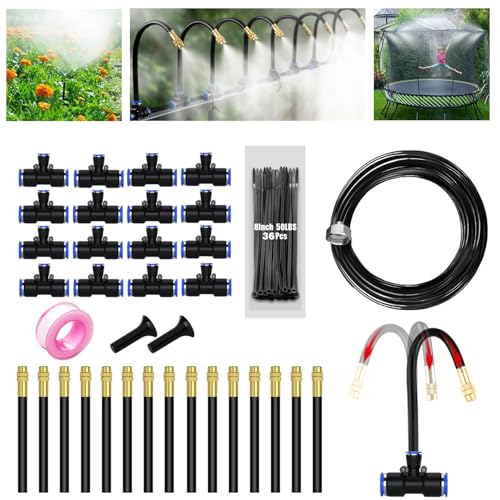
When precision watering isn’t enough and you need to cool the air around your plants too, this kit steps in. The Adjustable Misting Sprinkler Irrigation Kit runs 82 feet of tubing with a solid-copper rotatable nozzle that switches between spray and straight-jet modes, covering roughly a 10-foot diameter per head.
At $18.04, it’s a practical pick for patios, greenhouse benches, or chicken runs. Just note: hard water clogs these copper nozzles faster, so flush them regularly.
| Best For | Gardeners, backyard entertainers, and small-scale farmers who want an affordable way to cool outdoor spaces or water raised beds, patios, and animal enclosures without a complicated setup. |
|---|---|
| Total Tubing Length | 82 ft |
| Emitter Types | Spray and jet |
| Price | $18.04 |
| Main Tubing Size | Not specified |
| Built-in Timer | No |
| Tool-free Install | Yes |
| Additional Features |
|
- 82 feet of tubing gives you solid coverage for the price — $18.04 is hard to beat
- The bendable 20 cm tube and rotatable nozzle let you aim water exactly where you need it
- Quick-connect fittings mean no tools, no fuss — just plug it in and go
- Copper nozzles clog fast if you have hard or dirty water, so expect regular maintenance
- The mist can get heavy and drench an area if you’re not careful with placement
- Quick-connect fittings won’t hold up as long as traditional threaded ones over time
4. MIXC Quick Connect Drip Irrigation
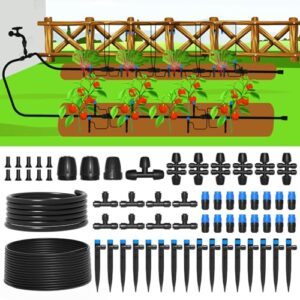
If you’re managing a medium-sized garden and want something you can configure under 10 minutes, the MIXC DIT-03 is worth a close look.
Its 230-foot kit — 33 ft of 1/2" mainline plus 197 ft of 1/4" branch tubing — accommodates up to 32 emitters across multiple zones.
Three emitter types (drip, vortex, mist) give you real flexibility across raised beds, containers, and greenhouse rows.
At $39.99, it’s a solid all-in-one setup, though you’ll want a pressure regulator if your supply runs inconsistently.
| Best For | DIY gardeners with small to medium plots who want a fast, flexible drip setup without spending a lot. |
|---|---|
| Total Tubing Length | 230 ft |
| Emitter Types | Drip, vortex, mist |
| Price | $39.99 |
| Main Tubing Size | 1/2 inch |
| Built-in Timer | No |
| Tool-free Install | Yes |
| Additional Features |
|
- Snaps together in about 10 minutes — no tools, no hassle
- Three emitter types let you water beds, pots, and greenhouses all from one kit
- 230 feet of tubing and 32 emitter slots give you plenty of room to expand
- No pressure regulator included, so performance can get spotty on weak or uneven water supplies
- Flow rates aren’t published, so you’re guessing a bit on actual water usage
- Tubing can stiffen over time, making it a pain to move or reconfigure later
5. Toki dot Drip Irrigation Misting System
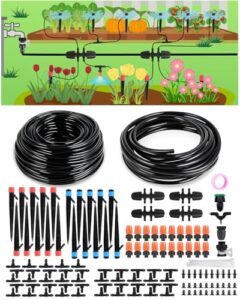
If you need both drip and mist coverage in one kit, the Toki dot TD-text-10 manages both without requiring two separate systems. Its 230-foot network — 30 ft mainline plus 200 ft distribution tubing — accommodates 40 adjustable sprinklers and 20 spray heads across multiple zones.
The 10 PSI pressure regulator keeps flow consistent on uneven terrain, and pressure‑compensated emitters prevent dry spots.
Assembly runs about 15 minutes tool‑free, though unclear instructions mean you’ll likely want a YouTube walkthrough nearby.
Timer and pump sold separately.
| Best For | Gardeners with patios, raised beds, or hydroponic setups who want drip and mist coverage in one kit without running two separate systems. |
|---|---|
| Total Tubing Length | 230 ft |
| Emitter Types | Spray and drip |
| Price | $39.99 (est.) |
| Main Tubing Size | 1/2 inch |
| Built-in Timer | No |
| Tool-free Install | Yes |
| Additional Features |
|
- Covers 230 feet across multiple zones with both drip emitters and spray heads built in
- Pressure-compensated emitters keep flow even on slopes, so no dry spots
- Saves up to 70% water compared to traditional sprinklers — great for drought-prone areas
- Instructions are notoriously unclear; most users end up on YouTube to figure it out
- No timer or pump included, so automated watering costs extra
- The less-common ½-inch OD main line makes finding replacement tubing a hassle
6. Kafuzi Drip Irrigation System
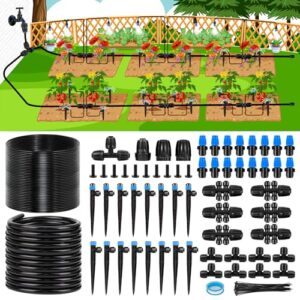
Toki dot manages mist and drip in one shot, the Kafuzi takes a more methodical approach — built around low-pressure operation at 0.5 to 1.0 bar with inline filters and pressure regulators already included.
Pressure-compensating emitters rated at 1, 2, or 4 liters per hour keep discharge uniform across uneven run lengths.
Color-coded tubing simplifies main line and lateral identification, and the modular design lets you expand zones as your garden grows.
Fertigation compatibility is a genuine bonus for vegetable beds.
| Best For | Gardeners of all skill levels who want a flexible, budget-friendly drip system for lawns, raised beds, greenhouses, or cooling setups without spending a lot of time on setup. |
|---|---|
| Total Tubing Length | 100 ft |
| Emitter Types | Vortex and spray |
| Price | $48.97 |
| Main Tubing Size | 5/16 inch |
| Built-in Timer | No |
| Tool-free Install | Yes |
| Additional Features |
|
- Comes with a solid variety of parts — 197 ft of tubing, three different sprinkler heads, and enough connectors to cover most small-to-medium gardens right out of the box.
- Easy to set up even if you’ve never done irrigation before, with labeled components and a layout most people can figure out in under an hour.
- Versatile enough to split into two separate sections, which is handy for larger spaces or lower water pressure situations.
- Vortex sprayers need strong water pressure to work well — if your supply runs low, you’ll notice a real drop in performance.
- The 1/4″ tubing has to be fully seated in the connectors or you’ll get leaks, and some barb connectors don’t play nicely with existing 1/2″ drip lines.
- A few users have received units with missing parts like the blue mist tips, and the instructions aren’t always clear or even included.
7. HIRALIY Drip Irrigation System
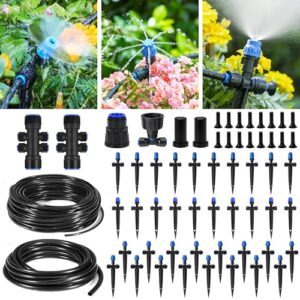
Where Kafuzi leans on color-coded tubing and fertigation compatibility, HIRALIY keeps things straightforward — and that’s exactly its appeal.
The 100 ft kit pairs 98.4 ft of 1/4" UV-resistant black tubing with 24 blue adjustable drip emitters, each switchable between stop, micro-drip, and spray modes, so you can dial in the right output for tomatoes, herbs, and ornamentals on the same line.
The solid brass splitter — with individual butterfly-switch control per line — is a genuine standout, resisting rust and holding a leak-proof 3/4" thread seal.
Keep runs short and add a pressure regulator for consistent flow end-to-end.
| Best For | Gardeners who want a flexible, easy-to-reconfigure drip system for mixed planting areas like veggie beds, raised beds, or greenhouses without a steep learning curve. |
|---|---|
| Total Tubing Length | 230 ft |
| Emitter Types | Drip, vortex, mist |
| Price | $29.99 |
| Main Tubing Size | 1/2 inch |
| Built-in Timer | No |
| Tool-free Install | Yes |
| Additional Features |
|
- Quick-connect fittings make setup and layout changes genuinely fast — most installs take around 10 minutes
- Three nozzle types (drippers, vortex emitters, misters) give you real versatility across different plant needs
- The 6-way connectors let you branch off a main 15 mm hose, which keeps things tidy and organized
- No built-in pressure regulator, so you’ll likely need to buy one separately to keep flow consistent
- User reports flag connector leaks, hose splitting, and nozzles wearing out faster than expected
- Pressure drops noticeably after four fittings per line, which can limit how far you stretch a single run
8. Abakuku 240 Foot Drip Irrigation
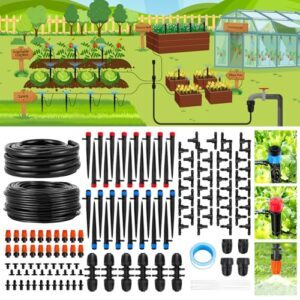
Where HIRALIY maxes out at 100 ft, the Abakuku SG-240 doubles the reach — giving you 240 ft of combined 1/2" main line and 1/4" distribution tubing to loop across multiple raised beds, vegetable rows, or greenhouse perimeters without a pressure drop mid-run.
The UV- and corrosion-resistant polypropylene construction holds up through a full summer season, and the quick-connect fittings mean you’re up and running in under 10 minutes, no tools needed.
Adjustable emitters let you fine-tune flow per plant, and the system pairs cleanly with an external timer for hands-free daily watering.
| Best For | Home gardeners and small-scale growers who need to cover a lot of ground — multiple raised beds, veggie rows, or fruit trees — without piecing together multiple shorter systems. |
|---|---|
| Total Tubing Length | 210 ft |
| Emitter Types | Stream, vortex, misting |
| Price | Not listed |
| Main Tubing Size | 15 mm |
| Built-in Timer | No |
| Tool-free Install | Yes |
| Additional Features |
|
- 240 ft of tubing gives you serious range, enough to cover a full backyard garden or greenhouse without running short mid-layout.
- Tool-free setup with adjustable emitters means you can dial in the right flow for each plant and be done in minutes.
- Works with an external timer, so once it’s set up, your watering just… happens on its own.
- Water pressure has to be in a pretty specific range — too high and fittings pop off, too low and some heads just won’t run.
- Getting a tight seal on end plugs and adapters can be a real hassle, especially if you don’t have a lot of hand strength.
- The emitters drip only — there’s no spray pattern, so plants that need broader coverage might not get what they need.
9. MIXC Greenhouse Micro Drip Kit
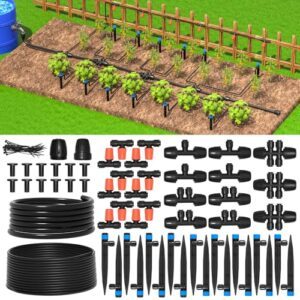
Compact but surprisingly capable, this kit packs 26 ft of 1/2" mainline and 75 ft of 1/4" distribution tubing into a 160 ft² coverage footprint — enough for a dense greenhouse bench or a pair of raised beds.
The 4×6-way connector splits flow into up to 16 branches from a single faucet, and swappable microdrip, mist, and full-spray heads let you tailor delivery to seedlings, ferns, or vegetable rows without rewiring the whole layout.
| Best For | Home gardeners and greenhouse hobbyists who want an affordable, all-in-one drip system for raised beds, container plants, or small growing spaces. |
|---|---|
| Total Tubing Length | 240 ft |
| Emitter Types | Drip and spray |
| Price | Not listed |
| Main Tubing Size | 1/2 inch |
| Built-in Timer | No |
| Tool-free Install | Yes |
| Additional Features |
|
- Comes with everything you need right out of the box — mainline, distribution tubing, emitters, connectors, and a faucet adapter.
- Swappable mist, drip, and spray heads let you dial in the right watering style for each plant without rebuilding the whole setup.
- Splits into up to 16 branches from one faucet, so you can cover a lot of ground without extra hardware.
- The instruction manual is only in German, which is a real headache if you don’t speak the language.
- Barbed fittings can be tricky to lock in place, especially if you haven’t worked with drip systems before.
- The tubing can struggle under high water pressure, and you only get one faucet adapter — so multi-zone setups will cost you extra.
Frequently Asked Questions (FAQs)
What is the 30/30 rule for irrigation?
The 30/30 rule limits your irrigation rate to 30% of soil infiltration capacity to prevent runoff, while supplying roughly 70% of plant water needs through the system — letting rainfall or residual soil moisture cover the rest.
What is the 30 30 rule for drip irrigation?
More tubing doesn’t always mean better coverage — it often means drier plants.
Keep each ¼-inch line under 30 feet and total flow under 30 gallons per hour to maintain even pressure and consistent moisture delivery.
What type of irrigation is best for a vegetable garden?
Drip irrigation is your best bet for vegetables.
It delivers water directly to the root zone, cuts evaporation losses, limits weed spread, and keeps foliage dry — reducing fungal disease risk substantially.
How long should an irrigation system run in summer?
Run times depend on your system: drip beds need 30–60 minutes, sprinkler zones 15–30 minutes, and soaker hoses 60–90 minutes. In peak heat, add 10–20% more time to offset faster evaporation.
Whats the best irrigation timer schedule for vegetables?
For vegetables, aim for 1 to 5 inches of water per week, split across 2 to 3 sessions. Schedule cycles early morning to cut evaporation and keep foliage dry overnight.
How do you prevent irrigation line clogs effectively?
Install a fine mesh filter (120+ micron) at the supply line, flush drip lines for 1–2 minutes before each cycle, and maintain pressure between 15–40 psi to keep emitters clear and flowing.
Can you automate irrigation systems with phone apps?
Yes — most modern irrigation controllers connect to smartphone apps over Wi‑Fi, letting you start, stop, and adjust zone schedules remotely.
Some even local weather data to pause watering automatically during rain.
Whats the ideal water pressure for drip systems?
Most drip systems perform best between 20 and 30 psi. Drop below 15 psi and emitters underperform; push past 30 psi and you risk damaging them. A pressure regulator keeps everything dialed in.
How often should irrigation filters be cleaned?
Clean your irrigation filters every two to four weeks during peak summer use.
If your water source carries visible sediment or well water with iron, bump that up to every three to seven days.
How long do drip irrigation systems typically last?
Different components age at wildly different rates. Emitters wear out in 1–10 years, tubing lasts 4–7 years, while mainlines can hold strong for 10–20 years with proper care.
Conclusion
As Benjamin Franklin once said, "You don’t have to great to start, but you have to start to be great." With your summer garden irrigation systems in place, you’re poised to beat the heat.
By delivering water directly to roots during the morning window, you’ll reduce evaporation and runoff.
Choose the right system, design a water-smart layout, and install with care. Your plants will thrive with consistent moisture from your new summer garden irrigation systems.
- https://www.honeysucklenurserydesign.com/are-garden-irrigation-systems-worth-it/
- https://www.conservairrigation.com/richmond/about-us/blog/2024/october/the-benefits-of-water-irrigation-systems-for-you/
- https://www.gardeners.com/how-to/how-to-choose-a-watering-system/8747.html
- https://fixmyheads.com/blog/essential-irrigation-maintenance-for-hotter-months/
- https://www.nasimlandscape.com/news/maximizing-irrigation-efficiency-for-hot-summer-months