
This site is supported by our readers. We may earn a commission, at no cost to you, if you purchase through links.

Most people assume fruit gardening demands a yard, a plot of land, and years of patience before the first harvest. Blueberries break that assumption cleanly.
A single container-grown plant can produce quarts of fruit annually, and with the right cultivar, it’ll do it on a balcony barely wide enough for a lawn chair.
The catch—and there is one—is that blueberries demand acidic soil in a range most garden centers never mention at the register. Get that pH dialed in between 4.5 and 5.0, match your variety to your climate, and you’re holding the keys to one of the most rewarding small-space crops you can grow.
Table Of Contents
- Key Takeaways
- Why Grow Blueberries in Pots
- Choose The Best Blueberry Variety
- Pick The Right Pot
- Prepare Acidic Soil and Plant
- Care for Potted Blueberries
- Harvest, Prune, and Overwinter
- Frequently Asked Questions (FAQs)
- Do blueberries grow well in pots?
- What does Epsom salt do for blueberries?
- What do coffee grounds do for blueberry plants?
- What size container do you need to grow blueberries?
- Can you grow blueberries in containers?
- How to plant a blueberry bush in a pot?
- Can blueberries grow in pots?
- Why do blueberries grow in containers?
- Can I grow a blueberry bush in a 5 gallon bucket?
- How long do blueberry plants live in pots?
- Conclusion
Key Takeaways
- Containers let you dial in soil pH between 4.5 and 5.0 with precision — something that ground beds make frustratingly difficult — giving your blueberries exactly the acidic conditions they need to thrive.
- Matching your cultivar to your climate and chill hours isn’t optional; get it wrong and you’ll face weak blooms, empty branches, and years of wasted effort.
- A pot at least 24 inches deep and wide, made from a heat-reflective material with solid drainage, protects root health more than any fertilizer or watering trick ever could.
- Consistent post-harvest care — dormant pruning, root inspection, winter insulation, and occasional watering during dormancy — is what keeps a container blueberry productive for a decade instead of three seasons.
Why Grow Blueberries in Pots
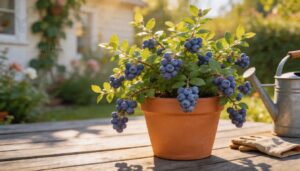
Growing blueberries in pots isn’t just a workaround — it’s actually one of the smartest ways to grow them.
You get full control over soil pH, drainage, and nutrients — making containers a surprisingly reliable path to growing fruit plants year-round.
You get more control, more flexibility, and honestly, better results in a lot of situations.
Here’s why so many gardeners are ditching the ground beds and going with containers instead.
Space-Saving Benefits for Patios and Balconies
Even a narrow balcony becomes a productive garden when you think vertically. Railing Gardens, Vertical Planters, and Tiered Stacking let you grow dwarf blueberry varieties without sacrificing walking room. Portable Layouts mean you can rearrange anytime. Try these small-space solutions:
- Hanging Baskets free up floor space entirely
- Tiered Stacking multiplies planting spots per square foot
- Railing Gardens hug balcony edges cleanly
- Corner containers keep center space open for seating
Easier Soil Acidity Control
Growing in pots puts soil pH management for blueberries firmly in your hands. In the ground, pH is stubborn — in a pot, it’s adjustable.
Pots put soil pH in your hands — stubborn in the ground, adjustable in a container
Use acidic soil amendment with peat moss, apply elemental sulfur application for gradual correction, and rely on rainwater pH management to avoid alkaline tap water drift.
Regular pH monitoring every few weeks, paired with pH buffering amendments and controlled release lime, keeps that sweet spot between 4.5 and 5.0.
Remember that buffering capacity and CEC influence how much lime is needed.
Better Mobility for Sun and Weather
Container mobility is one of the best reasons to grow blueberries in pots.
When temperatures spike above 85°F, you can roll your large weatherproof container into afternoon shade. When frost threatens, move plants to a sheltered location without missing a beat.
You control sunlight exposure for blueberries’ season by season — no plant stays stuck in the wrong spot.
Ideal for Small-Space Fruit Gardening
Small-space fruit gardening opens up when you think vertically. Balcony gardening with a large pot and smart layout lets you fit 2–4 plants in just 10 square feet.
- Vertical trellising and container stacking multiply your yield per square foot
- Seasonal rotation keeps plants in their ideal microclimate year‑round
- Companion planting reduces weeds while stabilizing soil pH naturally
Limited space was never really a limit.
Choose The Best Blueberry Variety
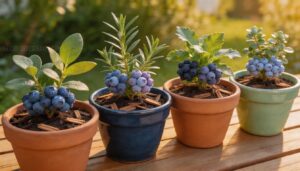
Not every blueberry thrives in a pot — the variety you pick from the start shapes everything from harvest size to winter survival.
The good news is that there are several container-friendly cultivars built exactly for this kind of growing. Here’s what to know before you choose.
Dwarf and Compact Cultivars
Dwarf blueberry varieties are your best bet for pots — they stay under 2 feet tall, bring a compact growth habit that fits neatly on a balcony, and still deliver fruit size consistency, season after season.
Look for heat‑tolerant dwarfs like ‘Top Hat’ or ‘Jelly Bean’, which combine impressive root zone efficiency with solid winter hardiness ratings, making them reliable producers in tight spaces.
Northern Highbush Vs Southern Highbush
Your climate is the deciding factor here.
Northern Highbush thrives in zones 4–7, manages longer Winter Dormancy Length, and delivers a crisp Fruit Flavor Profile with larger, firmer berries.
Southern Highbush suits zones 7–10, offers stronger Heat Tolerance, and stays compact within a smaller Plant Height Range — a natural fit for container gardening for blueberries where Root Zone Temperature and soil pH for blueberries need close management.
Half-High Varieties for Cold Climates
If cold winters have kept you away from growing blueberries, half-high varieties change that equation entirely. Their Frost Resistant Buds handle temperatures down to -25°C, and their Bushy Growth Form stays compact — perfect for containers.
They need Reduced Chill Need compared to northern types, making them dependable even in unpredictable springs. With Root Zone Insulation and smart Winter Sun Exposure, these cold-hardy performers deliver year after year.
Self-Pollinating Vs Cross-Pollinating Plants
Most blueberries are self-pollinating, but that doesn’t mean one plant is enough. Self-pollinating varieties like ‘Sunshine Blue’ give you pollinator independence — fruit set happens even without bees nearby.
Add a second compatible cultivar, though, and cross-pollination kicks in: better fruit quality, stronger yield stability, and broader genetic diversity.
For container growers, smart variety selection and cross-pollination planning is the simplest way to double your harvest.
Matching Varieties to Chill Hours
Your blueberry harvest lives or dies by one number: chill hours. Match that number incorrectly, and you’ll get weak bloom and empty branches.
- Low chill cultivars (100–400 hrs): Zones 7–10, southern highbush types
- Medium chill varieties (400–700 hrs): Temperate zones 5–7
- High chill requirements (700–1,000 hrs): Northblue, half-high varieties, zones 3–5
- Chill zone mapping + microclimate adjustments: Use shaded spots to boost effective chill, for hardiness zone adjustments for container plants
Best Cultivar Pairs for Higher Yields
Pairing the right cultivars is where good harvests become great ones.
Match an early-bearing dwarf like Jelly Bean with a late-ripening Northblue — that Early-Late Harvest combo extends your picking window and can push yields up 15–25%.
A Dwarf-Compact Duo improves airflow and fruit set, while Half-High Pairing with crosspollinating varieties reduces flower drop.
Vigor Matching and Hybrid Yield Pairing round out a container that genuinely delivers.
Pick The Right Pot
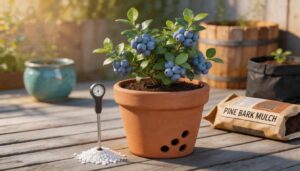
The pot you choose shapes everything — root health, moisture levels, even how well your plant survives a heat wave. Get this part right, and blueberries have a real shot at thriving year after year.
what to look for before you buy.
Minimum Pot Size for Mature Plants
five-gallon pot won’t cut it for a mature plant — roots run out of room fast, and yields drop.
minimum container dimensions of 24 inches deep and wide give roots the root volume requirements they need.
Large deep containers also improve wind stability and maintain the right air space ratio so roots breathe properly.
Best Container Materials for Root Health
Once you’ve nailed the size, pot material becomes your next decision.
Porous terracotta breathes well, keeping root development healthy by releasing excess moisture. Insulating fiberglass resists cracking in cold snaps. Moisture-retaining plastic works if your lightweight potting media dries fast. Wood fiber composite reduces heat buildup, while glazed ceramic stays stable with proper drainage holes. Each material guards against root rot differently.
Why Drainage Holes Matter
Drainage holes in pots do more than let water escape — they’re your frontline defense for root oxygenation, salt leaching, and moisture balance.
Good drainage management in pots protects your plants by:
- Flushing accumulated salts after every watering
- Restoring soil aeration so roots breathe freely
- Supporting temperature stability by preventing cold, waterlogged pockets
Without drain holes, drainage in containers fails completely.
Elevating Pots to Prevent Waterlogging
Even with drainage holes doing their job, water can still pool at the base if your pot sits flat on the ground. That’s where Elevated Base Benefits come in.
A 2–3 cm Air Circulation Gap — created by bricks, pot feet, or stainless risers — promotes good drainage, dries well-draining soil faster, and keeps roots from sitting in saturation.
| Support Material Choices | Clearance Height Standards | Stability Against Wind |
|---|---|---|
| Bricks or pavers | 2–3 cm minimum | Wide, flat base required |
| Plastic pot risers | Up to 5 cm ideal | Low center of gravity |
| Stainless steel stands | Match drainage hole level | Anchor in exposed spots |
Smart drainage management in pots starts from the bottom up.
Light-Colored Pots for Heat Control
Pot color does more work than most gardeners expect. Black containers can hit 126°F in direct sun — well past the stress threshold for blueberry roots. Light-colored pots deliver Reflective Surface Benefits through Material Finish Effects that slow heat transfer into your mix.
Choose light for Hot Surface Placement:
- White or beige pots lower root-zone temps by up to 7°C
- Glossy finishes enhance temperature regulation in pots on sun-baked concrete
- Light fabric containers improve Color Soil Temperature stability during heat waves
When to Upsize Young Blueberry Plants
Young blueberries start in a five-gallon pot, but they won’t stay comfortable there forever.
Watch for rootbound signs like roots circling the drainage holes, a water demand spike that has you watering daily, or leaf color change toward yellow.
These growth stagnation clues mean it’s time for repotting.
Move up gradually to container size recommendations of 24 inches — late summer works best for smooth root growth.
Prepare Acidic Soil and Plant
Getting the soil right is where blueberry success actually begins. Blueberries are picky about their growing conditions — especially pH — so what you put in that pot matters more than most people realize.
Here’s exactly what you need to know to get your plant off to a strong start.
Ideal Soil PH for Potted Blueberries
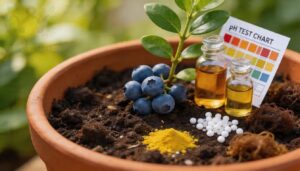
Blueberries are pH snobs — and that’s not a bad thing once you know the rules. Your pH Target Range sits between 4.5 and 5.5, with the sweet spot closer to pH between 4.5 and 5. Drift above 5.5, and Iron Chlorosis Signs appear fast: yellow leaves, green veins, weak growth.
Stay in control with these pH Drift Management essentials:
- Sulfur Application lowers pH gradually — mix it in weeks before planting
- Ammonium Sulfate Use feeds nitrogen while keeping acidic soil conditions stable
- Annual testing catches drift early, before your plant pays the price
Best Potting Mix Ingredients
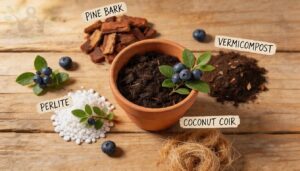
Think of your potting mix as the foundation that everything else rests on. Start with a Peat Moss Base or Coconut Coir Mix for moisture retention and natural acidity.
Add perlite for Perlite Aeration — about 10% keeps roots breathing.
Fold in aged Pine Bark Mulch for structure, plus a handful of Vermicompost Nutrients. These organic amendments for soil acidity give blueberries exactly what they crave.
Using Ericaceous or Azalea Mixes
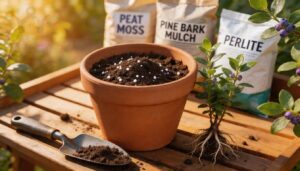
Ericaceous or azalea mixes take the guesswork out of acidic soil preparation entirely. Pre-adjusted to a pH between 4.5 and 5, they combine peat moss, pine bark mulch, and perlite for drainage efficiency and mix longevity.
Many include slow-release nutrients, iron availability support, and mycorrhizal inoculants — giving roots everything they need from day one:
- Stable acidity without constant testing
- Built-in drainage that prevents root rot
- Iron and manganese for deep green leaves
- Slow-release nutrients matched to acid-loving plants
- Mycorrhizal inoculants that expand root uptake
Step-by-Step Planting Instructions
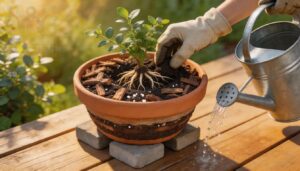
Getting this right starts before the plant ever touches the soil.
- Container Base Bricking — Raise the pot on bricks for drainage.
- Soil Mix Placement — Fill halfway with your acidic mix.
- Root Ball Loosening — Gently tease apart circling roots.
- Set and backfill — Match the original soil line exactly.
- Mulch Insulation Layer — Add 2–3 inches on top.
- Initial Water Infiltration — Water deeply until it exits the drainage holes.
| Step | Action | Key Detail |
|---|---|---|
| Soil preparation for potted blueberries | Mix peat, bark, perlite | Target pH 4.5–5.0 |
| Selecting appropriate pot size for blueberries | 24" deep × 24–30" wide | One plant per container |
| Watering schedule for potted blueberries | Water when top 2" is dry | Make sure drainage holes flow freely |
| Plant spacing in pots | 18–24 inches apart | Prevents root competition |
Proper Planting Depth and Spacing
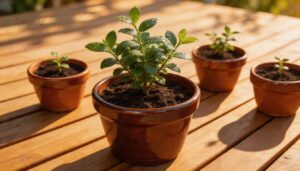
Once the planting steps are done, depth and spacing lock everything in.
- Crown Leveling — Keep the crown even with the mix surface, never buried.
- Root Ball Centering — Set the ball flat and centered; no leaning.
- Pot Depth Standards — A five-gallon pot works for young plants; mature plants need 24 inches deep.
- Inter-Pot Spacing — Keep 12–24 inches between containers for airflow and light.
Watering and Mulching After Planting
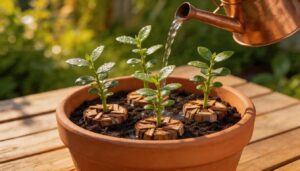
Depth and spacing set the stage — now water and mulch seal the deal. Soak the root zone fully until water drains from the bottom, a key Initial Soil Saturation step that prevents dry pockets.
Apply a 2–3 inch organic mulch layer — pine bark or wood chips work well — keeping it clear of the stem. This Mulch Thickness Management locks in moisture and acidity from day one.
Care for Potted Blueberries
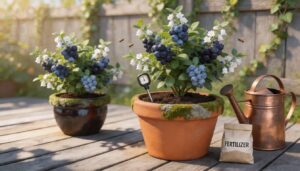
Getting your blueberries into the ground is just the start — now the real work begins. How you water, feed, and care for your plants day-to-day is what separates a decent harvest from a genuinely great one.
Here’s what your potted blueberries need to thrive all season long.
Sunlight Requirements for Strong Fruiting
Blueberries are sun-hungry plants — give them less than they need and you’ll notice it in the harvest. Aim for 6–8 hours of full sun daily. Here’s what to keep in mind:
- Morning sun benefits leaf drying and cuts disease risk
- Sunlight duration directly shapes berry sweetness and size
- Light intensity impact drops in dappled shade, reducing yield
- Afternoon shade strategies protect plants when heat exceeds 85°F
- Seasonal sun adjustments may call for supplemental grow lighting indoors
How Often to Water Containers
Sunlight sets the stage, but water keeps the show going.
Your watering frequency for containers depends on pot size, weather, and season — not a fixed schedule. Use the Finger Moisture Test daily: if the top inch feels dry, water it.
Weather Adjusted Schedule matters too — hot days may demand daily irrigation, while mild weather allows every 2–4 days. Smaller pots dry faster, so Pot Size Influence is real.
Morning Watering Routine reduces evaporation and keeps roots evenly moist.
Deep Watering and Even Moisture
When you water, don’t just dampen the surface — wet it thoroughly until water drains from the bottom. That’s Root Zone Saturation in action, and it’s what separates struggling plants from productive ones.
- Apply water slowly over 15–30 minutes for Even Moisture Distribution.
- Use Soil Probe Usage to confirm 6-inch depth saturation.
- Calibrate drip emitters for Drip System Calibration.
- Practice Watering Duration Control — stop once drainage appears.
- Check watering frequency for containers daily in heat.
Mulching to Retain Moisture and Acidity
Think of mulch as your pot’s built-in moisture manager. Spread pine bark or pine needles — both excellent acidic mulch types — to a 2–3 inch mulch depth around each plant, keeping a small gap at the stem.
This moisture retention layer cuts evaporation substantially and nudges pH downward naturally. Plan your mulch refresh timing every 6–12 months as organic material breaks down.
Fertilizer Schedule for Acid-Loving Plants
Feed your potted blueberries with a slow-release fertilizer formulated for acid-loving plants each spring — that’s your Spring Acid Feed window.
Apply Slow-Release Granules every 4–6 weeks through early summer, then hit the Summer Nutrient Pause to avoid root burn.
In fall, a Fall pH Adjustment keeps soil in range.
Don’t skip Micronutrient Timing; boron and iron matter for healthy fruiting.
Pollination Tips for Bigger Harvests
Blueberries won’t reach their full potential without help from pollinators. Here’s how to stack the odds in your favor:
- Plant Bee-friendly Plantings like borage near your pots to boost pollinator attraction.
- Add Nectar-rich Borders with sunflowers to keep bees returning through bloom.
- Use Windbreak Placement to slow wind and stabilize foraging activity.
- Practice Insecticide Avoidance during flowering — one application can clear your garden of bees.
- Set up shallow Water Stations nearby to support visiting pollinators.
Pair a self-pollinating variety with a cross-pollinating cultivar to satisfy all pollination requirements for blueberries and increase yield.
Preventing Pests, Disease, and Bird Damage
Your biggest harvest threat isn’t weather — it’s the birds, bugs, and fungal problems you didn’t catch in time.
Stay ahead with these five defense layers:
| Strategy | Method | Timing |
|---|---|---|
| Physical Netting | Install 1–2 cm mesh bird netting on a frame reaching the ground | At first fruit set |
| Habitat Modification | Remove fallen fruit, standing water, and bird feeders within 150 feet | Ongoing through season |
| Repellent Strategies | Rotate reflective tape, ultrasonic deterrents, and non-toxic sprays every 4–6 weeks | Throughout fruiting |
| Sanitation Barriers | Harvest ripe fruit promptly, clean debris, seal pot cracks | Weekly |
| Monitoring Detection | Inspect leaves weekly with a hand lens; log pest sightings and weather conditions | Weekly |
Consistent organic pest control and fungal disease prevention come down to one habit: check your plants every week without skipping.
Harvest, Prune, and Overwinter

Growing blueberries in pots doesn’t stop at harvest — what you do afterward shapes next year’s crop. From picking berries at the right moment to pruning, repotting, and carrying your plants through winter, each step builds on the last.
Here’s what you need to know to close out the season strong.
Signs Blueberries Are Ready to Pick
Don’t guess — your berries will tell you exactly when they’re ready. Look for uniform deep blue color from stem to blossom end, with that dusty powdery bloom coating the skin.
Ripe fruit feels firm yet yielding under gentle pressure and reaches plump pea size. Easy berry detachment means one soft pull releases them cleanly.
sweet aromatic scent near the cluster confirms peak fruit flavor development.
How to Harvest Without Damaging Fruit
Once you’ve spotted that dusty bloom and felt the fruit yield gently to your touch, technique matters.
Use gentle picking — hold the berry between your thumb and forefinger, twist upward lightly, and let it release on its own.
Bruise-free handling means no tugging.
Keep a light picking schedule across multiple sessions, and use cushioned packaging like shallow, cloth-lined containers to protect every berry.
Short-Term Storage After Harvest
Getting your harvest into cold storage fast is what separates firm, market-quality berries from soft, wasted ones. Aim to cool them within one hour of picking.
- Use ventilated clamshells to keep air moving around fruit
- Target 31–32°F for ideal cold storage
- Maintain humidity management at 90–95% to prevent shrivel
- Apply forced-air cooling rather than passive room cooling
- Practice condensation prevention by avoiding sudden temperature swings
Fresh blueberries last about 14 days under proper conditions — don’t push it.
Dormant Pruning for Better Yields
Once your berries are safely stored, turn your attention to the plant itself.
Dormant pruning of blueberry shrubs in late winter — before bud break — sharpens next season’s yields dramatically.
Focus on cane renewal by cutting older wood (4–6 years) and managing spur clusters to concentrate energy.
Control your pruning weight, protect bud viability, and angle cuts slightly to speed wound healing.
Repotting Rootbound Blueberry Plants
After pruning, check whether your plant has outgrown its home. Slide it out and inspect the root ball — if roots are circling the edges or matting densely, it’s time to repot.
Use root pruning techniques to tease apart and trim those circling roots by one‑third. Refresh with an acidic ericaceous mix, size up to 2–4 gallons, and your plant’s growth management resets completely.
Winter Protection for Container Roots
Container roots freeze faster than in-ground plants — that’s the cold truth of overwintering.
Start winterizing potted shrubs before the first hard freeze with these three steps:
- Wrap pots in burlap bag layers or bubble wrap as insulation materials
- Apply 3-inch surface mulch for moisture management and root zone heating
- Position against a south-facing wall using windbreak strategies
temperature monitoring to catch dangerous dips early.
Watering During Dormancy
Dormancy doesn’t mean drought. Your blueberries still need occasional Root Zone Moisture to survive winter without desiccating.
Check every four to six weeks using Moisture Meter Use — target a 5–8 reading on a 10-point scale.
| Condition | Action |
|---|---|
| Top 2 in. feels dry | Water slowly at midday |
| Mix still moist | Skip and recheck in two weeks |
Frequently Asked Questions (FAQs)
Do blueberries grow well in pots?
Yes, blueberries thrive in pots.
With the right acidic soil, proper pot size selection, and well-draining soil, you’ll control root zone temperature and fruit flavor development far better than most in-ground setups allow.
What does Epsom salt do for blueberries?
Epsom salt delivers a magnesium uptake boost and sulfur nutrient support to blueberries, correcting interveinal yellowing fast.
foliar spray method for quick deficiency symptom correction, but watch for salt buildup caution in containers.
What do coffee grounds do for blueberry plants?
Coffee grounds pull double duty: they nudge soil pH lower while releasing nitrogen slowly.
They boost microbial activity, aid moisture retention, and offer light weed suppression — just don’t over-apply, or salt buildup follows.
What size container do you need to grow blueberries?
For a single blueberry plant, you need a minimum 15- to 20-gallon container — roughly 20 inches in diameter and 18 inches deep.
That root volume needs room to spread without sitting in moisture.
Can you grow blueberries in containers?
Growing blueberries in containers works just like tailoring a suit — you control every condition.
With the right soil pH, a five-gallon pot, and acidic fertilizer, container gardening delivers fresh, seasonal flavor anywhere you have sunlight.
How to plant a blueberry bush in a pot?
Start with a Root Inspection Technique: loosen circling roots before setting the plant in your 5‑gallon pot.
Use Soil Moisture Pre-Soak on your soil mix first, then follow a simple Pot Filling Sequence — acidic planting media, Plant Orientation Sun, fill, firm, and water deeply for proper drainage and moisture control in large pots.
Keep soil pH management for blueberries at 5–0, and match your Initial Watering Volume to fully saturate the root zone.
Can blueberries grow in pots?
Yes, blueberries thrive in pots — berry good news for small-space gardeners. Container gardening gives you full control over soil pH management for blueberries, drainage, and seasonal placement wherever sunlight follows.
Why do blueberries grow in containers?
Blueberries thrive in containers because you control everything — soil acidity management, microclimate flexibility, and water retention balance included. Pots bring urban balcony and patio blueberry gardening within reach.
Limited space? Not a problem.
Can I grow a blueberry bush in a 5 gallon bucket?
A five-gallon bucket works, but only as a starting point. Dwarf blueberry varieties thrive short-term, yet root space limits growth quickly.
Upgrade to a larger pot within two years for real harvests.
How long do blueberry plants live in pots?
With good care, potted blueberries generally live 6 to 8 years — sometimes 10 or more.
Root zone longevity depends on mix renewal frequency, container lifespan management, and avoiding plant vigor decline through repotting before roots get bound.
Conclusion
The ball is in your court now. Every choice covered here—pot size, pH, pruning timing—works together like a system, and that system is what separates a struggling plant from one that delivers quarts of fruit on a six-foot balcony.
Growing blueberries in pots isn’t a compromise for gardeners without land; it’s a sharper, more controlled way to grow. Dial in the details once, and the plant does the rest for years.
- https://extension.umd.edu/resource/growing-blueberries-containers
- https://hort.extension.wisc.edu/articles/growing-blueberries-containers/
- https://www.aces.edu/blog/topics/fruits-lawn-garden/home-gardening-rabbiteye-blueberries/
- https://www.mdpi.com/2071-1050/12/16/6453/pdf
- https://www.bushelandberry.com/blueberry-care