
This site is supported by our readers. We may earn a commission, at no cost to you, if you purchase through links.

Grapevines don’t reward half-measures. Try to wing it, and you’ll end up with tangled shoots, meager clusters, and a season’s worth of frustration. But when you match the right variety to your patch of earth, train the vines with intent, and stay ahead of pests and disease, those same plants transform into reliable, fruit-heavy workhorses.
Grape plant care and maintenance isn’t about luck—it’s about understanding the rhythms of your land and working with them. From soil to harvest, every decision shapes the vines’ future, and the difference shows in every basket you bring in from the row.
Table Of Contents
Key Takeaways
- Matching grape varieties to your specific climate, soil pH (6.0-6.5), and intended use—whether table grapes, wine, or juice—determines whether your vines thrive or struggle for years to come.
- Strategic pruning during dormancy, combined with proper canopy management that maintains 20-40% openness, boosts yields by 15-30% while slashing disease pressure by 25-40% through improved airflow and light penetration.
- Proactive pest and disease monitoring through daily visual checks catches 98% of problems early, while integrated management programs using timed interventions cut infection events by 40-60% compared to reactive approaches.
- Post-harvest handling makes the difference between weeks and days of quality—rapid cooling to 0-1°C within hours of picking, paired with 95-105% humidity, extends shelf life to 6-8 weeks versus 1-2 weeks at warmer temperatures.
Selecting The Best Grape Varieties
Choosing the right grape variety isn’t just about planting what sounds good—it’s about matching your climate, soil, and purpose to the vine that’ll actually thrive in your hands. Your success starts here, because the wrong variety means years of disappointment, while the right one sets you up for abundant harvests.
Success with grapes begins by matching your climate, soil, and goals to the variety that will truly thrive for you
Let’s break down exactly how to pick varieties that’ll deliver the grapes you want, where you’re.
Climate and Soil Compatibility
Beyond choosing a variety you love, matching your site’s climate conditions and soil science determines whether your vines thrive or struggle. Regional adaptation starts with understanding your climate zones and microclimate effects—those sun pockets and frost dips that shape ripening.
Consider these grape soil requirements:
- Well-drained loamy textures with infiltration above 1 cm/hour
- pH levels between 6.0–6.5 for ideal nutrient uptake
- Organic matter content around 1–2% for vine vigor
- Avoid compacted or waterlogged sites
- Test soil texture and drainage before planting
Smart soil and climate considerations release serious yields. Understanding the literature review process is vital for making informed decisions about grape cultivation.
Varieties for Fresh Eating, Wine, or Juice
Once you’ve matched your site to climate and soil, pick varieties based on how you’ll use the fruit. Table grapes dominate home plantings at 60–70%, prized for fresh eating and minimal fuss. Wine grapes demand more canopy management in humid zones but reward you with layered grape flavor profiles. Juice varieties often pull double duty—fresh snacks or rich concentrates scoring 78–85 in sensory trials.
| Purpose | Top Vitis Vinifera Picks |
|---|---|
| Fresh Eating | ‘Flame’, ‘Italia’ |
| Wine Making | ‘Cabernet’, ‘Chardonnay’ |
| Juice Production | ‘Concord’, hybrid selections |
| Dual Use | Seedlessness factors vary by cultivar |
Seedless Vs. Seeded Grapes
Seedless grapes command 70–80% of retail sales because you don’t wrestle seeds, and breeding breakthroughs cut development time from twelve years to six. Consumer preference surveys show 68–82% favor seedless for fresh eating, driving market trends upward.
Yet seeded varieties deliver deeper flavor complexity and longer storage life—wine production relies 100% on them. Genetic research keeps refining seedlessness while preserving the strong character that built viticulture.
Popular Varieties for Home Gardens
Home gardens host dozens of grape varieties, yet a few rise above the noise. In temperate zones, Chardonnay Seedless and Sugraone yield 12–18 pounds per vine—solid table grapes with crisp fruit quality.
Coastal plots favor Thomcord, a drought-tolerant seedless option with Concord parentage that cuts irrigation needs by 20–30%.
Disease-resistant picks like Valiant slash fungicide inputs by 25–40%, giving you mastery over vine management with less chemical hassle.
Preparing The Ideal Planting Site
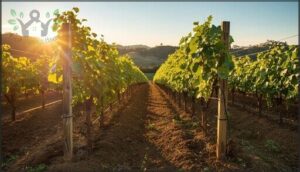
You can’t expect your grapevines to thrive if you throw them in the ground and hope for the best. The site you choose and how you prepare it will determine whether your vines struggle or flourish for decades to come.
Let’s walk through the essentials—from sunlight requirements to soil chemistry and the support structures that’ll carry your vines through their productive life.
Choosing a Sunny Location
Your grapevines won’t thrive in the shadows—they need sunlight like fuel for a fire. When scouting locations, prioritize full sun exposure with at least 6–8 hours daily. Here’s what grape plant care demands:
- South-facing slopes accelerate ripening by 1–2 weeks through excellent heat accumulation
- Shade reduction prevents 25–40% yield losses from inadequate light
- Microclimate assessment identifies ideal sites for higher sugar content
- Strategic afternoon shade in scorching climates protects photosynthetic capacity
Soil Preparation and PH Requirements
Before planting, soil testing reveals whether your grape soil care strategy will succeed or stall. Target a pH between 5.5 and 6.5 for ideal nutrient cycling. Apply lime if tests show acidity below 5.5, or sulfur for excessive alkalinity.
Incorporate 2–5% organic matter to boost calcium management and soil structure. pH balancing done right transforms dirt into a thriving foundation for soil preparation for grapes.
Installing Trellises and Support Structures
Within weeks of planting, proper trellis design transforms your vines from wandering shoots into productive powerhouses. Install galvanized steel or pressure-treated wood posts—built to last 15–25 years—before vine training begins.
Pre-tension wires to 22–33 pounds, which cuts sagging by 25% and optimizes canopy management. This wire tension creates the backbone for pruning and training techniques that boost yields 15–30% through improved airflow and sunlight penetration.
Spacing and Planting Depth
Your vine density and row spacing choices will make or break yields for decades to come. Balance machinery access with canopy health using these grape planting instructions:
- Space vines 1.8–2.4 meters apart in rows for most home plantings
- Set rows 2.7–3.0 meters apart to promote airflow and reduce disease risk by 30–40%
- Position graft unions 5–8 centimeters above soil for proper planting depth
- Allow root zones to access 1.5–2 meters of soil volume for deep establishment
This foundation sets up exceptional grape plant care and maintenance from day one.
Planting and Establishing Grape Vines
Getting your grape vines into the ground properly sets the stage for years of productive growth. The timing, technique, and early care you provide during those first few weeks will determine how quickly your vines establish strong roots and healthy growth patterns.
Here’s what you need to know to give your new vines the best possible start.
Best Time to Plant Grapes

Timing is everything when you’re launching your own vineyard. In temperate climate zones, you’ll want to plant during late winter to early spring while vines are dormant—specifically when soil temperature consistently exceeds 50°F and frost dates have passed. This planting window gives roots time to establish before shoot growth begins, setting the foundation for stronger grape cultivation and simplified grape vine care throughout the season.
Understanding AP study resources can help you prepare for the challenges of vineyard management.
Proper Planting Techniques
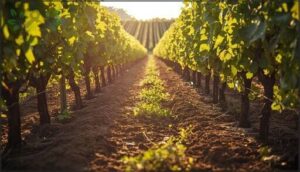
Your grapevines need the right foundation to thrive. Position the graft union 2–3 inches above ground to protect rootstock integrity, then backfill with amended soil—aim for that 6.0–6.5 pH sweet spot to boost nutrient uptake.
Space vines 6–10 feet apart with trellis installation completed at planting, giving roots room to expand and shoots immediate support for proper grape cultivation.
Watering New Vines
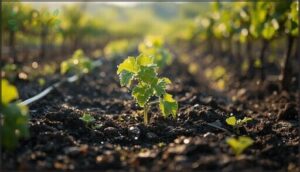
You’ve set the stage—now deliver the water your vines demand. New plantings crave 1.0–1.5 inches weekly to drive root development deep, where resilience lives.
Soil moisture at 25–50% volumetric content keeps transplant shock at bay without drowning roots.
Skip overhead watering grapes; drip irrigation at the base prevents water stress and foliar disease, establishing vine hydration that fuels your dominance over the vineyard.
Early Growth Care
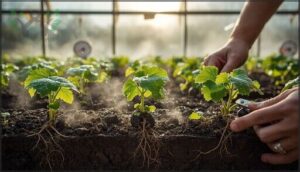
Beyond watering grapes, early seedling care demands precision. Keep nighttime temperature control between 15–18°C—growth stalls above 25°C. Soil conditioning with 3%+ organic matter boosts water retention 12–18%, anchoring root development.
Light management matters: daily integrals exceeding 12 mol m⁻² d⁻¹ accelerate grapevine growth 25–40% during the first eight weeks.
Pruning grapes starts now—strip excess latent buds within two weeks to gain 8–12 cm per vine.
Essential Grape Plant Maintenance
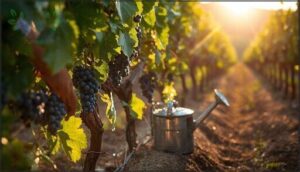
Once your vines are in the ground, the real work begins—and that’s where most growers either set themselves up for abundant harvests or watch their plants struggle. Getting the basics right with water, nutrients, pruning, and airflow separates thriving vineyards from disappointing ones.
Here’s what you need to master to keep your grapes healthy and productive year after year.
Watering Strategies for Healthy Growth
You’ll master grape watering strategies by understanding soil moisture dynamics and irrigation scheduling. Drip systems deliver 0.5–1.0 inches weekly during peak grapevine growth, targeting 60–80% field capacity for water conservation. Young vines need frequent, smaller waterings to establish roots.
Monitor evapotranspiration data to time your irrigation precisely—overwatering dilutes fruit quality while strategic deficits at veraison can improve flavor. Smart grape plant care and nutrition starts with the root zone.
Fertilization and Nutrient Management
Your irrigation game sets the stage, but fertilizer types and soil testing trigger explosive growth. Annual soil testing catches nutrient gaps before they stunt your vines, while smart fertigation strategies deliver nitrogen, phosphorus, and potassium exactly when your plants crave them.
Grape nutrition and health depends on three moves:
- Split nitrogen applications after bloom to curb vegetative chaos and boost fruit set by 20–30%
- Target leaf petiole nitrate-N at 1,500–3,000 mg/kg for balanced vigor
- Correct micronutrient management gaps with foliar sprays within 7–14 days
Fertilizing isn’t guesswork—it’s precision control over plant nutrition and nutrient cycling.
Pruning and Training Techniques
Pruning and training grapevines during dormancy slashes vine vigor by 20–40% while dialing in your fruiting potential. Cane pruning delivers 70–90% bud productivity in temperate zones, while spur pruning with 2–4 buds per node tightens fruit set consistency by 15–25%.
Choose vertical shoot positioning or Guyot training systems to architect vine structure that channels energy exactly where you want it.
Managing Canopy Density for Airflow
With 20–40% openness as your target, canopy management drives airflow strategies that slash disease pressure by 25–40% in humid climates. Leaf thinning at veraison boosts internal air movement by 5–12%, drying foliar surfaces 8–15% faster after rainfall.
- Execute lateral thinning passes to increase light penetration by 15–25%
- Schedule thinning early-season and again at veraison for sustained airflow
- Combine density control with targeted irrigation to limit leaf wetness duration
- Use vertical shoot positioning to reduce shading by 10–20%
- Monitor canopy porosity regularly to adjust vineyard management tactics
Preventing and Managing Pests and Diseases
Your vines won’t reach their full potential if pests and diseases take hold, so learning to spot trouble early makes all the difference. From aphids munching on new growth to fungal infections spreading through dense canopies, grapevines face threats at every stage of development.
Here’s how to identify common problems, prevent outbreaks before they start, and take action when your vineyard needs protection.
Common Grape Pests and Identification
You’ll face 6–8 major grape pests depending on your region, each leaving distinct calling cards. Grape berry moths tunnel into fruit, while Japanese beetles skeletonize leaves in striking fashion. Spider mites thrive when it’s hot and dry, bronzing foliage and slashing yields by 10–25%. Phylloxera attacks roots silently—rootstock resistance cuts losses by 30–60%.
| Pest | Damage Pattern | Peak Activity |
|---|---|---|
| Grape Berry Moth | Tunnels in fruit clusters | Mid-summer bloom |
| Japanese Beetles | Skeletonized leaf tissue | June–August heat |
| Spider Mites | Stippling, bronzed leaves | Hot, dry periods |
| Grape Leafhoppers | 20–40% photosynthetic loss | Early season hatch |
Master grape pest management by learning these signatures early—your vines will thank you.
Disease Prevention and Control
You can’t afford to wait until disease strikes—grape disease management demands a proactive stance. Integrated management programs cut infection events by 40–60% when you scout early and use disease forecasting models to time interventions. Here’s your prevention framework:
- Vineyard sanitation: Remove mummified fruit and debris to slash primary inoculum by 35–50%
- Canopy management: Reduce leaf density 15–20% to lower powdery mildew risk by 30–40%
- Biological controls + fungicide rotation: Combat fungicide resistance while suppressing downy mildew and botrytis bunch rot by 10–40%
Master pest and disease control through vigilance, not reaction.
Organic and Chemical Treatment Options
In Grape Disease Management, you hold the reins—choose Organic Solutions like copper-based fungicide applications for up to 40% fewer fungal outbreaks, or Chemical Alternatives that push control rates to 90%.
Pairing these with smart Pest Control and Soil Remediation keeps your Grape Care sharp. Remember, integrated Grape Pest Control means you dictate the rules, not the pests.
Monitoring and Maintenance Tips
Ever wonder why some growers seem to dodge disaster year after year? It’s relentless vigilance. Daily visual checks catch 98% of pest or disease symptoms early, while soil monitoring and water management cut waste and stress.
Pair sharp Crop Tracking with smart Pruning methods, and your Grape Plant Care and Maintenance becomes a fortress—disease prevention and pest control working hand in hand.
Harvesting and Storing Grapes Properly
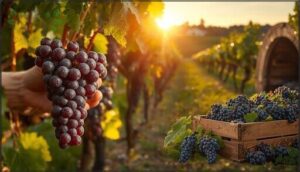
Getting grapes from vine to table takes more than just picking at random. Timing, technique, and storage all play a role in keeping your harvest at its best.
Here’s what you need to know before you start gathering your crop.
Signs of Grape Ripeness
Ripeness Indicators aren’t just guesswork—they’re your roadmap to perfect Grape Harvesting. Watch for color changes unique to your variety, a noticeable drop in Berry Firmness, and rising Sugar Levels (Brix 16–25%). Acidity Tests confirm flavor balance. Ignore these, and you’re gambling with quality. Grape Ripeness is everything if you want bold flavor and maximum yield.
- Color shifts mark maturity, not just beauty
- Berry Firmness drops as sugars rise
- Acidity Tests reveal harvest window
Harvesting Methods and Timing
When Berry Ripening peaks, your Harvest Timing window opens—don’t blink or you’ll miss it. Sugar Accumulation climbs fast in heat, so monitor daily. Morning Harvesting keeps berries cool, boosting shelf life. Every method shapes quality—choose your Grape Harvesting Methods with intent.
Hand-picking preserves firmness, while mechanical Grape Harvesting Techniques win on speed but risk skin breakage.
| Harvest Method | Impact on Fruit Quality |
|---|---|
| Hand Harvest | Maximum firmness |
| Mechanical | Faster, more breakage |
| Morning Picking | Cooler, longer storage |
| Afternoon Pick | Warmer, softer berries |
| Delayed Harvest | Sweeter, risk overripening |
Post-Harvest Handling and Storage
Once your Grape Harvest is in, the real test begins—Cool Chain Management makes or breaks Grape Preservation. If you want to outsmart shrivel and rot, follow these steps:
- Rapid cooling within hours
- Maintain 0–4°C Cold Storage Techniques
- High humidity for Fruit Storage
- Gentle handling for Post Harvest Care
- Controlled atmosphere for premium Fruit Production and Harvesting
Preserving Grape Quality After Harvest
You’ve hustled to get your harvest in and cooled—now, it’s all about holding the line on quality. Cold Storage at 0–1°C, high humidity, and Ethylene Control keep Berry Firmness and Shelf Life Extension in play.
Smart Grape PostHarvest Care means sorting, gentle handling, and the right packaging. Here’s a quick reference:
| Storage Temp | Humidity (%) | Shelf Life Extension |
|---|---|---|
| 0–1°C | 95–105 | 6–8 weeks |
| 2–4°C | 90–95 | 3–5 weeks |
| 5–7°C | 85–90 | 1–2 weeks |
Frequently Asked Questions (FAQs)
How long do grapevines take to produce fruit?
Most varieties will reward your patience with their first fruit 2–3 years after planting, though climate, pruning habits, and rootstock choice all influence when you’ll taste that debut harvest.
Can grapes be grown in containers or pots?
Yes, you can grow grapes in containers—dwarf varieties thrive in 15-gallon pots with proper drainage.
Choose container soil rich in organic matter, manage water carefully, and expect fruiting within 2–3 years.
What companion plants benefit grapevines in the garden?
Picture rows of vines humming with pollinators—that’s companion planting at work. Oregano, marigolds, and alliums slash pest pressure while legumes enrich soil microbes, boosting biodiversity benefits and transforming grapevine care through strategic edible landscaping techniques.
How to rejuvenate old or neglected grapevines?
Grape pruning techniques drive vine rejuvenation. Renewal planning starts with hard pruning strategies—remove 60–80% of old wood to stimulate vigorous shoots.
Grapevine recovery accelerates when renovation techniques restore canopy health within two growing seasons.
Are grape leaves edible and how are they used?
Absolutely—they’re widely enjoyed in Mediterranean cooking. You’ll find them stuffed with rice and herbs (dolma), pickled for preservation, or used fresh in edible landscaping.
Cooking reduces their natural tannins, enhancing flavor and texture beautifully.
Conclusion
Good vineyards aren’t born—they’re built, season by season, decision by decision. When you commit to grape plant care and maintenance with the same discipline you’d bring to any craft worth mastering, the vines respond.
They’ll push out stronger canes, heavier clusters, and fruit that actually tastes like something. Skip the shortcuts, stay consistent with your pruning and pest watch, and you’ll harvest exactly what you put in: results that prove the work was worth it.



Michael Thomas
April 16, 2026 at 08:18 PM
Thank you for the great information I appreciate the valuable advice