
This site is supported by our readers. We may earn a commission, at no cost to you, if you purchase through links.

Most home gardeners treat grapevines like ornamental plants—beautiful on an arbor, forgettable at harvest. The truth is that a single well-chosen vine, matched to your climate and pruned correctly, produces clusters worth more per square foot than almost anything else in your garden.
Grapes reward precision. Get the variety, the soil, and the training system right, and you’re picking fruit by late summer. Get them wrong, and you’re nursing a woody tangle that flowers but never ripens.
Growing grapes at home isn’t complicated—it’s specific. Everything that follows tells you exactly what to do and why it matters.
Table Of Contents
- Key Takeaways
- Choose The Right Grape Variety
- Match Grapes to Your Climate
- Pick The Best Planting Site
- Prepare Soil Before Planting
- Install Trellises or Supports
- Plant Grapevines Step by Step
- Care for Young Grapevines
- Train and Prune Grapevines
- Prevent Pests and Diseases
- Harvest and Use Homegrown Grapes
- Frequently Asked Questions (FAQs)
- Are grapes easy to grow at home?
- How long does it take to grow grapes?
- How do you grow grapes for beginners?
- Do grapes come back every year?
- When can I expect my first grape harvest?
- How do I know when grapes are ripe?
- Whats the best way to store fresh grapes?
- Can grapes be grown successfully in containers?
- How do I propagate grapevines from cuttings?
- How long until new vines produce fruit?
- Conclusion
Key Takeaways
- Matching your grape variety to your specific climate—not your personal preference—is the single most important decision you’ll make, because the wrong choice means years of struggling vines instead of a real harvest.
- Annual dormant pruning controls how much fruit your vine produces the following season, so skipping or rushing it is the fastest way to end up with leafy growth and empty clusters.
- Grapevines need 3–4 years before they yield a real crop, meaning the first two seasons are entirely about building roots, trunk, and structure—not picking fruit.
- Soil drainage, sunlight, and air circulation aren’t optional extras; they’re the foundation that determines whether your vine thrives or slowly declines from disease and root stress.
Choose The Right Grape Variety
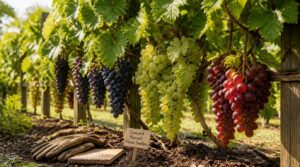
The grape you choose shapes everything — how you tend it, when you harvest, and what you do with the fruit. Not every variety suits every backyard or goal, so it pays to know your options before you plant. Here’s what to keep in mind.
Each variety comes with its own quirks, so brushing up on grape harvesting techniques and timing can help you avoid costly mistakes before you’re deep into the season.
Table Grapes
Table grapes are bred for one purpose: eating fresh off the vine. Varieties like Himrod, Reliance, and Mars deliver the large, thin-skinned, seedless berries most home growers want.
Look for cultivars reaching 16–20 degrees Brix at harvest — that’s the sweetness window where flavor peaks. Harvest timing matters too, since grapes won’t sweeten after picking. Selecting varieties based on climate suitability factors is essential for long-term success.
Wine Grapes
Wine grapes demand more from you than table varieties — but they reward the effort.
Harvest timing matters critically here: most wine cultivars ripen best at 21–25 degrees Brix, with a pH between 3.0 and 3.6. Cabernet Sauvignon needs a long, warm season, while cold-hardy hybrids like Marquette survive down to minus 30°F.
Juice Grapes
If wine grapes are about complexity, juice grapes are about abundance — deep flavor, easy processing, and reliable harvests season after season.
Concord leads the pack here. Its slip skin lets pulp separate from the skin with a simple squeeze, making home crushing fast and clean. At 16–18 degrees Brix, Concord delivers enough natural sugar for balanced, full-bodied purple juice without added sweeteners.
Seedless Versus Seeded
Juice grapes make the choice feel straightforward — but seedless versus seeded is where things get personal.
Seedless grapes win at the table. No prep, no seeds to spit out, and thin skins give each berry a clean, crisp bite. Seeded varieties, though, bring firmer flesh and richer phenolic depth — worth the extra prep if you’re cooking or drying.
Climate-matched Cultivars
Picking the right cultivar starts with your climate. Marquette and Frontenac survive down to minus 30°F, making them reliable cold zone selections for USDA Zones 4 and 5.
In USDA Zone 7 and warmer, Cabernet Sauvignon and Grenache thrive. For humid southern gardens, muscadine hybrids like Carlos handle heat and disease where European vines fail.
Match Grapes to Your Climate

Not every grape thrives in every backyard — the variety that flourishes in coastal California might struggle through a cold Michigan winter. Your climate is the first filter, and choosing wrong means fighting your vines instead of harvesting from them.
Choose your grape variety by climate first, or you will spend years fighting your vines instead of harvesting from them
Here are the main grape types and what growing conditions each one actually needs.
American Grapes
American grapes are the go-to choice if your winters regularly bite hard. Vines like Concord — hardy to USDA Zone 4 — handle deep freezes that would kill most European varieties outright. They also tolerate humid summers far better, making them ideal for the Northeast, Great Lakes, and Midwest.
Here’s what sets American grapes apart:
- Slip skin fruit separates easily from the pulp, making home jelly and juice processing surprisingly quick
- Their foxy flavor profile — bold, aromatic, unmistakably grape — defines classics like Concord and Niagara
- Better disease resistance means fewer fungal headaches in wet, humid climates
Plant them on a sturdy trellis, stay consistent with pruning, and you’ll reach harvesting season with healthy, productive vines.
European Grapes
European grapes demand warm, dry summers and a soil pH of 6.0–7.0. Their cold hardiness limits sit near 0°F — too harsh for Zone 5 winters. Target 20–26 Brix sugar levels before harvesting. Consistent trellis setup, open canopy management pruning, and phylloxera-resistant rootstocks carry vines through vintage harvest timing.
| Cultivar | Best Climate |
|---|---|
| Cabernet Sauvignon | Long warm seasons |
| Chardonnay | Cool to moderate |
Muscadine Grapes
If you’re gardening in the Deep South, muscadines are built for your conditions. Native to the southeastern United States, these vines thrive in USDA Zones 7–10, handling long humid summers that would overwhelm most European varieties.
- Self-fertile cultivars pollinate themselves; plant one per three female vines within 50 feet.
- Vines need 6–8 hours of full sun daily for strong fruit development.
- Sandy loam with pH 5.8–6.5 promotes healthy root growth; avoid heavy clay.
- Space vines 16–20 feet apart on a single wire trellis set 5–6 feet high.
- Berries ripen August through September, separating easily from the stem when ready.
Prune newly planted vines back to 2–3 buds to push vigorous early growth. Harvest only when berries soften and show full color — sugar won’t improve after picking.
French-American Hybrids
French-American hybrids bridge hardiness and wine quality. Hybrid breeding history began in late 1800s France, crossing Vitis vinifera with North American species to fight phylloxera. These vines offer improved disease resistance and cold tolerance that pure vinifera can’t match — perfect for the Northeast and Upper Midwest. Train on a sturdy trellis, thin the canopy, and prune annually to one-year-old wood.
| Hybrid | Regional Climate Fit |
|---|---|
| Seyval Blanc | Cool Northeast and Great Lakes |
| Vidal Blanc | Cold zones; icewine production |
| Chambourcin | Mid-Atlantic and lower Midwest |
| Marechal Foch | Short-season northern vineyards |
| Baco Noir | Ontario and New York humid zones |
Frost-free Growing Days
Your frost-free growing season is simply the number of days between your last spring frost and your first fall frost. Most grapes need 155 to 180 frost-free days to ripen reliably.
If your season runs short, check these organic fruit harvesting tips to make the most of every frost-free day you’ve got.
Count yours from local records, then match that number to your chosen cultivar — early-ripening varieties for short seasons, vinifera only where seasons stretch past 170 days.
Pick The Best Planting Site
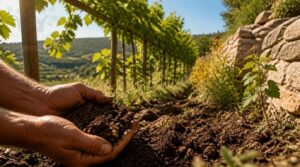
Where you plant your grapevines matters just as much as which variety you choose. The right site sets the stage for healthy growth, better fruit, and fewer problems down the road. Here’s what to look for before you put a single vine in the ground.
Full Sun Exposure
Grapevines are sun-hungry plants — they need 6 to 8 hours of full sun daily to ripen fruit properly. Morning light matters most, as it dries dew from leaves early, cutting disease risk.
Watch your site throughout the day. If a fence, tree, or building steals several hours of sunlight, move your planting location before you dig.
South-facing Slopes
A south-facing slope does more than give you extra sun — it creates a warmer microclimate where vines wake up earlier and ripen more reliably. Solar heat gain on these slopes raises soil and air temperatures across the whole growing season, giving your grapes the sustained warmth they need to hit full flavor before fall cooling shuts things down.
Here’s what that early soil warming means practically:
- Roots become active sooner, pulling nutrients faster in early spring
- Shoots push out days ahead of vines on flat or north-facing ground
- Enhanced ripening builds higher sugar levels and deeper color in the fruit
- Longer heat exposure drives flavor compounds to full development before harvest
One trade-off you’ll manage is irrigation needs — south-facing ground dries faster, especially in sandy soils during summer dry spells. Water more often, and use mulch to hold moisture around the root zone. On steeper ground, also plan for erosion prevention using cover crops or terracing to keep rain from washing your soil downhill.
Frost Protection
Warm slopes help, but site selection doesn’t stop at sun angles — cold air drainage shapes your frost risk just as much. Cold air is denser than warm air, so it flows downhill and settles in low spots. Plant above hollow floors where that chilled air pools.
Delayed pruning can also push budbreak back by one to two weeks, buying critical buffer time.
Row Orientation
Once you’ve settled your cold-air drainage strategy, turn your attention to how your rows face the sun.
North-south row orientation lets sunlight reach both sides of the canopy as the sun travels east to west through the day — no single wall stays shaded. On flat ground, this balanced exposure keeps leaves and clusters actively ripening from morning through afternoon.
Air Circulation
Poor air circulation is one of the quietest killers in a home vineyard. When air stalls between dense leaves, moisture clings — and fungal disease follows fast.
Position your rows to catch prevailing breezes, and don’t crowd vines. Canopy management and pruning keep the trellis open so air moves freely through, drying leaves before problems start.
Prepare Soil Before Planting
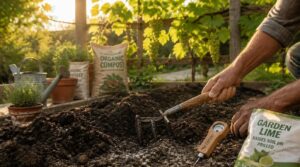
Grapes are picky about their roots — get the soil wrong and you’ll fight the plant instead of nurture it. Before you put a single vine in the ground, a few key soil conditions need to be in place. Here’s what to check and fix before planting day.
Well-drained Sandy Loam
Grapevines don’t forgive soggy roots. Well-drained sandy loam gives your vines the balance they need — moisture without waterlogging.
Its coarse sand fraction opens up pore spaces so water moves downward fast, keeping roots oxygenated and healthy. That loose, crumbly texture also lets young vine roots spread easily through the soil without fighting compaction.
Ideal Soil PH
Soil pH sits quietly in the background — but it controls how well your vines actually feed themselves. Aim for a pH between 6.0 and 6.8. That sweet spot keeps nutrients moving freely to the roots. Drop below 6.0 and phosphorus locks up; climb above 7.5 and iron becomes scarce.
Test your soil before planting — adjustments are far easier then.
Drainage Improvements
Bad drainage kills grapevines faster than most pests ever will. Start with surface grading — reshaping low spots so water flows away from your vine rows instead of pooling around roots. Even a gentle slope makes a real difference. If your site stays wet after heavy rain, dig open ditches along the perimeter to carry runoff to a safe outlet.
For persistently soggy ground, install subsurface perforated pipe below the root zone. A simple swale channel can also intercept water before it ever reaches your trellis line — just make sure every system connects to a clear drainage outlet, or the water has nowhere to go.
Compost Amendments
Think of compost as a slow-release investment in your soil’s long-term health.
Work 2 to 4 inches of mature compost into the top 6 to 10 inches before planting — this builds organic matter, improves drainage in clay, and boosts water retention in sandy ground.
Choose fully composted plant or manure-based material with a balanced carbon-to-nitrogen ratio near 30:1 to feed microbial activity without shocking young roots.
Weed Removal
Weeds are a quiet threat — let them root now and you’ll fight them for years once vines are in the ground.
Clear perennial rhizome weeds like bindweed and bermudagrass first using a digging fork when soil is slightly moist. Follow up with a stale seedbed cycle: water, wait 7–14 days, then flame-weed or shallowly hoe the flush of annual seedlings before planting.
Install Trellises or Supports
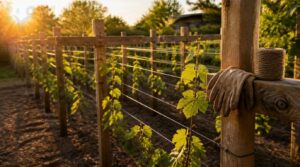
Grapevines can’t support themselves — they need something solid to climb and spread across from day one. The structure you choose affects not just how your vines grow, but how easy they are to manage at pruning and harvest time. Here are the main support options worth considering.
Trellis Options
Five trellis systems stand out for home grape growing, each suited to different vine types and yard sizes.
- Vertical Shoot Positioning — best for low-to-moderate vigor vines; keeps clusters well-lit and dry
- High Wire Cordon — ideal for vigorous American varieties; shoots hang down naturally
- Geneva Double Curtain — splits the canopy across two parallel wires for high-vigor sites
- T Bar Trellis — spreads foliage sideways for strong-growing vines with row clearance
Arbor Growing
An arbor turns your vine into a living overhead canopy instead of a narrow wall of foliage.
Build posts 7–8 feet tall, buried 24–36 inches deep, using 4×4 or 6×6 lumber. Space arbor bays 6–8 feet wide with crossbeams 18–24 inches apart.
Train one trunk upward, then spread 2–4 arms across the top frame for balanced canopy control.
Fence Supports
Not every backyard has room for a freestanding trellis — sometimes your existing fence does the job.
- Chain link fences provide excellent airflow and dozens of attachment points for tendrils.
- Wooden fence panels need support wire added 8–12 inches out front to prevent moisture damage.
- Planting clearance of 8–12 inches protects the trunk from rubbing wounds.
- Use soft training ties — never hard wire — to secure young shoots.
Kniffin System
The four-arm Kniffin system is one of the simplest trellis setups you can build — two horizontal wires, one at 3 feet and one at 5 to 6 feet high.
Your vine grows a single trunk straight up, then sends four fruiting canes outward, two per wire. Concord and other American grapes thrive on it.
Space for Spreading
Space matters more than most beginners expect. A single pruned vine needs at least 4 feet of spread in every direction — and a cordon-trained vine commonly claims 3 feet of wire on each side of the trunk.
- Space vines 6–10 feet apart along the trellis
- Set rows 8–10 feet center-to-center
- Build arbors 7–8 feet high for walkway clearance
- Keep a 3-foot access path for pruning and harvesting
- Watch for canopy overlap — crowded shoots reduce airflow and fruit quality
Plant Grapevines Step by Step
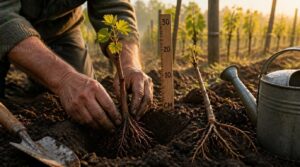
Planting day is where everything you’ve prepared finally comes together. The steps aren’t complicated, but the details — timing, depth, spacing — make a real difference in how well your vines take hold. Here’s exactly what to do from start to finish.
Best Planting Time
Timing your planting around the early spring window is one of the most reliable moves you can make. Once the soil thaws and crumbles in your hand — not smears — conditions are ready.
Most bare root vine shipments arrive in late winter for this exact reason. In Zones 6–7, aim for March through April; in colder Zones 3–5, wait until late April or May, after frost-safe timing confirms freezing nights have passed.
Bare-root Preparation
Unboxing a bare root vine is where real preparation begins. Before anything else, do a root inspection — cut a small root tip and look for a moist, white or cream interior. Healthy roots feel firm and flexible; black, mushy, or sour-smelling sections get trimmed away cleanly.
- Soaking duration: submerge roots in clean water for 2–6 hours
- Keep the trunk and buds above the waterline
- Root trimming: cut broken tips back to smooth, light-colored tissue
- Cane selection: reduce to one strong cane with 2–3 healthy buds
Moisture handling matters right through this whole process — wet roots dry fast in wind and sun, so plant your dormant bareroot plants immediately after soaking.
Planting Hole Depth
Dig your hole wider than deep — roots spread outward, not down.
Match the finished soil line to the nursery color mark on the stem. Keep the graft union 2–4 inches above grade. For container vines, set the root ball level with surrounding soil.
After first watering, check depth again — settling can quietly pull everything lower than you intended.
Vine Spacing
How far apart you set your vines today shapes how manageable your vineyard becomes for the next 20 years.
American and European vines do well at 6–8 feet apart within the row, while Muscadines need 10–20 feet — their vigor is simply in another league.
Keep rows 8–10 feet apart so you can walk, prune, and harvest comfortably on both sides.
First Watering
Water the vine immediately after planting — don’t wait until the next day. Backfill the hole, then pour 4–8 liters slowly so it soaks the full root zone, roughly 20–30 cm deep. A deep soak settles loose soil around the roots and closes air pockets.
If water pools for hours, your drainage needs attention before regular irrigation begins.
Care for Young Grapevines
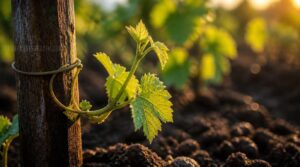
Young grapevines are more fragile than they look — the first season sets the tone for everything that follows. Getting the basics right now means stronger roots, healthier growth, and a vine that actually produces. Here’s what to focus on during those critical early months.
Watering Schedule
Getting the water right in year one makes or breaks your vine’s future.
New grapevines need irrigation once or twice a week during dry weather — not daily — so roots develop depth rather than staying shallow. Each session should moisten soil 30 to 45 centimeters deep. A 25mm soaking rain can replace one scheduled watering entirely.
Spring Feeding
Once roots settle in, your vine gets hungry — and spring feeding is where you step in.
Apply balanced 10-10-10 fertilizer lightly around the vine in a 2-foot ring, keeping it 6–12 inches from the trunk. Three rules to follow:
- Test soil pH first — target 5.5 to 6.5
- Feed after bud swell, not before
- Stop nitrogen by midsummer
Mulching Around Vines
Once feeding is done, mulch is your next move.
Spread clean straw, shredded bark, or aged wood chips in a ring around each vine — aim for a 5 to 8 centimeter depth. Keep a 8–15 centimeter gap from the trunk to prevent moisture buildup and bark damage.
| Mulch Type | Best Use | Watch Out For |
|---|---|---|
| Clean straw | Young vines, sandy soil | Breaks down fast |
| Shredded bark | Established rows | Slower decomposition |
| Aged wood chips | Dry, hot sites | Needs coarse texture |
Mulch holds soil moisture between waterings — especially helpful in sandy soil — and moderates summer heat. In cooler climates, wait until late spring to mulch so soil warms fully first.
Weed Control
Mulch slows weeds down, but it won’t stop them completely — that’s where active weed control steps in.
Keep a 3-foot weed-free strip centered on each vine. Cultivate shallowly and only when soil is dry, so uprooted weeds can’t reroot. Never cut deep — grape roots run close to the surface. Pull perennial weeds like bindweed by hand before they reclaim ground.
Root Establishment
Strong root establishment begins underground — where the real work of the vine’s future happens.
In well-drained soil, young roots push 15–30 cm deep and outward within months. Mycorrhizal inoculation at planting boosts nutrient uptake by linking roots to soil fungi. Loose, uncompacted soil lets roots spread freely — compaction traps them in the original hole.
Train and Prune Grapevines
Training and pruning are where you actually shape what your grapevine becomes — left alone, it’ll grow wild and give you very little worth eating. Every cut you make is a decision about next year’s fruit, so it pays to know what you’re doing before you pick up the shears. Here’s what you need to work through, step by step.
First-year Training
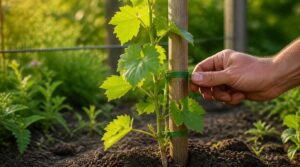
The first year of vine training is less about fruit and more about foundation. Pick the strongest single shoot early in the season and remove everything competing with it. Tie it loosely to a stake every 8–12 inches of growth using soft stretch tape — never wire.
- Rub off base suckers by hand while they’re soft
- Remove every flower cluster so energy goes into trunk growth
- Check ties regularly so fast summer growth doesn’t girdle the stem
This keeps the vine focused on reaching the trellis wire.
Dormant Pruning
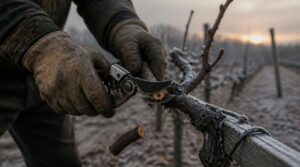
Cutting back your vines during dormant pruning — while they’re leafless and fully inactive in late winter — is one of the most important tasks you’ll do all season.
Prune before bud swell begins to avoid damaging tender growth. In frost-prone areas, pruning slightly later can delay bud break, buying you a small but useful buffer.
Bud Count Basics
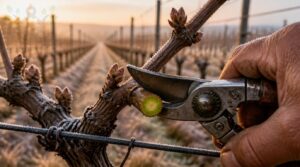
Bud count is simply the number of dormant buds you keep on a vine after pruning — and getting it right directly controls your harvest size. For wine grapes, aim for 20–30 buds per vine. On spur-pruned vines, keep 2–3 buds per spur.
After a hard winter, cut open a few canes: green tissue inside means a live bud; brown means it’s dead.
Summer Canopy Pruning
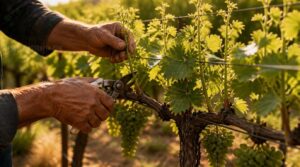
Once dormancy ends, your vine doesn’t stop needing attention — summer canopy pruning keeps growth balanced and fruit zones open.
Thin shoots when they’re 5–12 inches long, targeting 3–5 shoots per foot of row. Hedge tall canes 6–8 inches above the top catch wire. Remove leaves around clusters after fruit set to improve airflow and spray coverage.
Pruning Mistakes
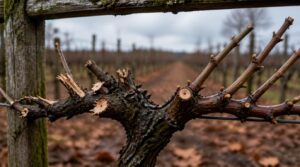
A few wrong snips can cost you a whole season. Over-pruning removes too much wood, pushing leafy growth instead of fruit.
Timing matters too — prune after leaf fall, not before. Avoid jagged cuts; clean ones heal faster. Pick well-browned canes for cane pruning, plump buds for spur pruning. Good trellis training keeps your vine’s structure sound for years.
Prevent Pests and Diseases
Your vines have made it this far, so don’t let pests or disease undo all that work. A few common troublemakers tend to show up year after year, and each one has its own fix. Here’s what to watch for and how to handle it.
Powdery Mildew
Powdery mildew shows up as white, flour-like patches on leaves, shoots, and berries — caused by Erysiphe necator, which spreads through air without needing wet surfaces.
Apply sulfur-based fungicide before infections establish, especially from early shoot growth through fruit set. Thin leaves around clusters to improve airflow and spray penetration. Remove fallen debris each season so the fungus can’t overwinter and restart next spring.
Black Rot
Black rot hits harder than powdery mildew because it destroys berries entirely. The fungus Guignardia bidwellii overwinters in mummified fruit and cane lesions, releasing spores every spring rain.
Watch for reddish-brown leaf spots first, then berries shriveling into black mummies. Clear all infected debris after pruning and apply copper or sulfur fungicide from bud break through bloom.
Aphids and Mealybugs
Fungal diseases kill berries — insects drain the life out of vines more slowly, but just as surely.
Aphids cluster on shoot tips and young leaves, curling and distorting new growth. Mealybugs hide in stem crevices, covered in white waxy fuzz. Both feed by sucking sap directly from plant tissue, weakening vines over time.
Introduce ladybugs to control aphids naturally.
Neem Oil Use
When ladybugs aren’t enough, neem oil steps in. Derived from neem seeds, it works as a contact insecticide that disrupts insect feeding, molting, and egg-laying.
Mix it with water and a surfactant — it won’t disperse otherwise. Apply in the early morning or evening to reduce breakdown from sunlight. Repeat every 7–14 days, as it degrades quickly.
Bird Netting
Birds will raid your ripening clusters fast — mesh netting is your best defense.
Choose a 3/4-inch polyethylene mesh for general vineyard protection; it blocks sparrows and starlings while still allowing airflow. Select UV-stabilized netting so sunlight doesn’t degrade it mid-season.
Drape it fully over the canopy, secure the edges, and inspect regularly for tears or gaps where birds slip through.
Harvest and Use Homegrown Grapes
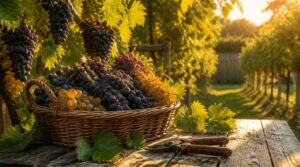
All that pruning, watering, and waiting finally pays off at harvest time. Knowing when and how to pick makes the difference between grapes that taste delicious and a cluster you pull too soon. Here’s what to look for and how to make the most of what your vines produce.
Signs of Ripeness
Grapes don’t announce their readiness — you have to read the signs. Watch for a uniform color change across the whole cluster, whether that’s deep red, blue-purple, or yellow-green. Berry firmness matters too: ripe grapes feel plump, not rock-hard or collapsing. Check the stem condition — browning, drying stems signal advancing ripeness, while bright green stems mean wait. A natural skin bloom on unhandled berries usually indicates good harvest condition.
- Color uniformity — no green stragglers in the cluster
- Plump, firm feel — not hard, not mushy
- Browning stems — drying canes confirm maturity
- Easy detachment — ripe berries release with little force
- Skin bloom intact — waxy coating signals undisturbed ripeness
Taste Testing Grapes
Color and stem condition hint at readiness, but taste is the real test. Pick one berry from the top, middle, and bottom of the cluster — ripeness varies within a single bunch.
Chew fully to catch skin tannins and seed bitterness. Look for balanced sweetness and mild tartaric acidity, a floral or fruity aroma, and firm but yielding flesh.
Harvesting Clusters
Once the taste test gives you the green light, move fast — grapes stop ripening the moment they leave the vine. Cut at the peduncle using sharp pruning shears, supporting the cluster with your free hand so it doesn’t drop.
Choose clean, healthy clusters first and leave cracked or moldy ones behind. Diseased clusters should come out of the vineyard entirely, not linger on the ground.
Fresh Storage
Once you’ve cut those clusters, your next move matters. Keep grapes unwashed until use — surface moisture is mold’s best friend. Remove any damaged berries before chilling.
Store them in a ventilated, shallow container in your crisper drawer at 0–4 °C. Stored right, they’ll hold firm texture and good flavor for up to two weeks.
Garden-to-table Uses
Your homegrown grapes don’t stop working once they leave the vine. Table grapes are perfect straight from the bowl — rinsed, chilled, and eaten as-is. Press juice grapes for fresh-squeezed drinks, or simmer them into jelly. Wine grapes reward patience with homemade batches worth sharing.
Even a small harvest can anchor a meal, a snack, or a neighbor’s afternoon.
Frequently Asked Questions (FAQs)
Are grapes easy to grow at home?
Grapes aren’t especially difficult, but they do reward attention. Match variety to climate, keep up with annual pruning, and give vines full sunlight — do those three things, and you’re most of the way there.
How long does it take to grow grapes?
Most vines need 3 years before delivering a real harvest. From planting to first fruit, expect one year of root-building, one of training, and one of actual production.
How do you grow grapes for beginners?
Where do you even begin? Start with site microclimate and soil testing, then plant grape vines on a south-facing slope, install trellis training early, prune with sharp pruning tools, and practice careful harvest handling.
Do grapes come back every year?
Yes, grapevines come back every year. They’re perennial plants that enter a dormant season each winter, then push new growth from stored energy every spring — reliably, for decades.
When can I expect my first grape harvest?
Like a slow-burning fire, your first grape harvest rarely comes fast. Most vines need 3 to 4 years before yielding a real crop — patience and annual pruning make all the difference.
How do I know when grapes are ripe?
Grapes don’t announce themselves as ready — you have to read the signs. Check skin color, berry texture, stem shift, seed color, and taste together for an accurate picture.
Whats the best way to store fresh grapes?
Don’t let the harvest go to waste." Keep grapes unwashed and stem-on, refrigerated at 30–32°F in a ventilated bag. They’ll stay fresh up to three weeks.
Can grapes be grown successfully in containers?
Container-grown grapes are absolutely possible. With the right pot, support, and pruning routine, a vine can thrive on a sunny patio or balcony — no garden bed required.
How do I propagate grapevines from cuttings?
Propagating grapevines from hardwood cuttings is straightforward. Take pencil-thick canes during dormancy, cut 12–16 inches long, dip in rooting hormone, and plant with only the top bud exposed.
How long until new vines produce fruit?
Most new vines won’t produce a real crop until year three. The first two seasons focus on plant establishment — roots, trunk, and structure. Pushing fruit too early weakens the vine long-term.
Conclusion
The vine that looks dormant in winter is already deciding your harvest. That’s the paradox at the heart of growing grapes at home—patience isn’t waiting, it’s working invisibly beneath the surface.
Every pruning cut, every training decision, every soil check compounds into the cluster you’ll eventually hold in your hand. Get the fundamentals right, and the fruit follows naturally. The vine doesn’t forgive shortcuts, but it rewards precision with something you can truly taste.
- https://www.arborday.org/planting-your-tree/grapes-planting-care-instructions
- https://extension.umn.edu/fruit/growing-grapes-home-garden
- https://winemakermag.com/articles/213-common-grape-growing-questions-backyard-vines
- https://www.starkbros.com/growing-guide/how-to-grow/berry-plants/grape-vines/soil-preparation
- https://modernfarmer.com/2021/07/a-beginners-guide-to-growing-your-own-wine-grapes