This site is supported by our readers. We may earn a commission, at no cost to you, if you purchase through links.
When growers spray their fields season after season, they’re not just fighting pests—they’re training them. Resistance builds, beneficial insects vanish, and the chemical treadmill spins faster.
Long-term integrated pest management solutions break this cycle by shifting from reactive spraying to proactive ecosystem design. Rather than chasing pests with stronger compounds, IPM harnesses natural predators, strategic crop rotations, and precision monitoring to keep damage below economic thresholds.
The evidence is compelling: farms implementing thorough IPM frameworks reduce pesticide use by 40–70% while simultaneously boosting yields and protecting soil vitality. You’re not sacrificing control when you adopt these methods—you’re building resilience into every acre.
Table Of Contents
- Key Takeaways
- What is Long Term Integrated Pest Management?
- Key Components of Sustainable IPM Programs
- Biological and Ecological Control Methods
- Minimizing Chemical Use in IPM
- Long-Term Benefits of Integrated Pest Management
- Overcoming Challenges in Long-Term IPM Adoption
- Future Directions for Integrated Pest Management
- Frequently Asked Questions (FAQs)
- Conclusion
Key Takeaways
- Long-term IPM reduces pesticide use by 40-70% while simultaneously increasing crop yields by 8-12% over five years through ecosystem-based strategies that combine biological controls, cultural practices, and threshold-based decision-making rather than reactive chemical applications.
- Economic thresholds guide intervention timing—you act only when pest populations justify the cost of control—cutting unnecessary pesticide applications by 25-70% and reducing year-to-year yield variability by 15-25% while lowering input costs by 20-40%.
- Biological control methods deliver 65% of documented pest suppression in IPM systems, with natural predators and parasitoids reducing target pests by 40-70% in a single season while beneficial microorganisms like Bacillus thuringiensis achieve 60-90% suppression of specific pest groups.
- IPM builds long-term soil health and environmental resilience by increasing soil organic matter 0.5-1.5 percentage points, boosting microbial biomass 12-35%, and reducing erosion 20-40% while cutting pesticide runoff and protecting beneficial organisms that sustain natural pest control across multiple growing seasons.
What is Long Term Integrated Pest Management?
Long-term Integrated Pest Management represents a fundamental shift in how you approach pest control—moving away from reactive chemical applications toward proactive, ecosystem-based strategies. Unlike conventional methods that rely heavily on pesticides, IPM uses a combination of biological, cultural, physical, and chemical tools to manage pests sustainably over time.
Understanding what sets this approach apart will help you see why it’s become the benchmark for effective, responsible pest management.
Definition and Core Principles
Long-term Integrated Pest Management (IPM) is your ecosystem-based approach for preventing and controlling pests sustainably. Rather than relying on routine applications, IPM systems use informed decision-making grounded in pest ecology and biology, combining multiple integrated strategies to keep pest populations below damaging thresholds.
Core principles include:
- Prevention first: You’ll modify habitats, rotate crops, and choose resistant varieties to stop pests before they establish
- Accurate identification: You monitor and identify pests precisely to guide targeted sustainable pest management actions
- Threshold-based decisions: You intervene only when pest levels justify action, protecting ecosystem balance
Differences From Conventional Pest Control
Unlike conventional pest control’s reliance on blanket chemical pesticides, you’ll find IPM slashes pesticide use by 40–60% through multiple tactics that protect ecosystem balance. Traditional methods lean on single strategies—inviting resistance—while your integrated pest management approach rotates tools and monitors thresholds.
IPM slashes pesticide use 40–60% by rotating tactics and monitoring thresholds, unlike conventional methods that invite resistance
This chemical reduction delivers 10–30% better yields in vegetables, proving sustainable practices outperform routine spraying for environmental impact and biological control success.
Goals of Long-Term IPM Strategies
Your long-term integrated pest management strategies aim for sustained pest suppression across multiple seasons—72% of growers report success over three consecutive years. Economic thresholds guide your interventions, cutting emergency applications by 40% while reducing crop yield variability by 15–25%.
You’ll achieve ecosystem balance through sustainable practices that stabilize pest management strategies, with biological control and sustainable agriculture methods reaching measurable stability within 2–4 growing seasons while maintaining agricultural sustainability.
Understanding the main theme development concepts is essential for effective pest management planning.
Key Components of Sustainable IPM Programs
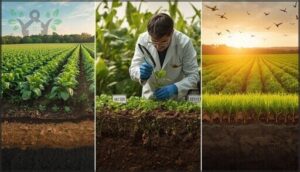
You can’t build a successful IPM program on good intentions alone—it requires a structured framework that tackles pests at every stage. The foundation rests on three interconnected components that work together to reduce pest pressure without defaulting to chemical solutions.
Let’s examine how prevention, monitoring, and economic decision-making create the backbone of sustainable pest management.
Prevention and Cultural Controls
Prevention forms the backbone of Integrated Pest Management, stopping problems before they start. Cultural methods like crop rotation reduce pest pressures by 29% on average, while sanitation practices cut harborage by 40–75%.
Selecting pest-resistant varieties and using biological barriers—such as row covers—work together to create resilient systems that minimize pest populations without chemical dependency from day one.
Understanding main topic branches is essential for effective Integrated Pest Management strategies.
Monitoring and Accurate Pest Identification
You can’t manage what you don’t measure. Accurate diagnosis drives every decision in Integrated Pest Management, and effective pest surveillance demands systematic monitoring techniques paired with reliable identification tools. Here’s how detection methods support rigorous pest management:
- Field scouting every 7–14 days catches infestations early
- DNA barcoding slashes misidentification from 22% to 6%
- Pheromone traps detect pests 21 days before visible damage
- Smartphone apps identify 64% of species with expert confirmation
- Understanding pest ecology guides targeted interventions
Economic Thresholds and Decision-Making
Effective Integrated Pest Management hinges on knowing when to act. Economic thresholds mark the pest density at which control costs become justified by preventing crop yield losses—usually when populations exceed critical levels by 20–60%. Threshold analysis incorporating decision frameworks and economic modeling reduces pesticide applications by 25–70% without sacrificing agricultural productivity, delivering substantial economic benefits of IPM while managing pest resistance risk.
| Threshold Component | Key Variable | Impact on Decision |
|---|---|---|
| Pest density monitoring | Population count per plant | Triggers intervention timing |
| Economic injury level | Market price fluctuations | 15–40% threshold variation |
| Real-time frameworks | Weather + pest pressure data | 10–35% efficiency improvement |
| Mixed-species systems | Infestation complexity | 40–55% farmer uncertainty |
| Pesticide reduction | Threshold-based decisions | 25–70% fewer applications |
Biological and Ecological Control Methods
When you work with nature instead of against it, you access some of the most powerful pest control tools available. Biological and ecological methods tap into existing relationships between organisms, turning your ecosystem into a self-regulating system that keeps pest populations in check.
Let’s look at three proven approaches that form the backbone of sustainable, long-term pest management.
Natural Predators and Parasitoids

You can utilize the power of natural enemies—predators and parasitoids to suppress pest populations without chemicals. Studies show beneficial insects deliver 65% of documented pest suppression in IPM systems, with parasitic wasps and predatory mites reducing target pests by 40–70% in a single season.
Predator conservation and ecosystem services form the backbone of biological control methods, supporting sustainable pest management strategies through natural pest control that protects both your crops and beneficial insects.
Use of Beneficial Microorganisms
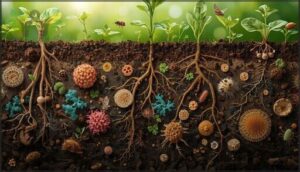
Microbe applications bring invisible allies to your soil microbiology arsenal—bacterial agents and fungal controls that transform biopesticide development. Bacillus thuringiensis slashes lepidopteran pests by 60–90%, while Beauveria bassiana delivers 40–70% suppression of exposed-stage insects.
These biological control tools integrate seamlessly into sustainable pest control programs, offering ecosystem services without the drawbacks of conventional chemicals in your integrated pest management strategies.
Conservation of Biodiversity for Pest Suppression

You’ll boost pest suppression by 34% when you protect natural enemy diversity in your fields—hedgerows and flowering strips alone cut pest densities 18–40% without synthetic chemicals.
Ecosystem balance through biodiversity conservation strengthens biological control, delivering 12–25% yield gains while slashing pesticide use by half.
That’s ecological sustainability working for your agroecosystem management, turning pest ecology and ecosystem services into practical integrated pest management tools that maintain ecological balance season after season.
Minimizing Chemical Use in IPM
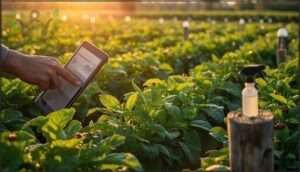
You don’t have to eliminate pesticides completely to practice effective IPM—you just need to use them smarter. When you apply chemicals selectively and only when monitoring shows they’re truly necessary, you protect both your crops and the environment.
Let’s look at three practical strategies that keep chemical use minimal while maintaining strong pest control.
Selective and Targeted Pesticide Applications
When you focus chemical pesticides on pest hotspots rather than blanket coverage, you’ll slash your chemical load by 40–70% while maintaining strong pest control. Targeted sprays guided by precision timing reduce applications by up to three events per season.
This cornerstone of IPM systems maximizes pesticide efficiency, protects beneficial organisms, and strengthens your pest resistance and management strategy without sacrificing suppression.
Reducing Chemical Resistance in Pest Populations
Targeted sprays work only if you prevent pesticide resistance from eroding your control options. Rotating at least three chemical classes delays resistance onset by 2–4 years, while structured refuges cut resistance in pest populations by 60–80%.
You’ll preserve long-term efficacy and protect your investment by integrating these Integrated Pest Management strategies:
- Alternate pesticide modes of action each growing season
- Maintain untreated refuge zones to dilute resistant alleles
- Combine chemical rotation with biological controls for layered suppression
- Monitor resistance alleles with genomic tools for early detection
- Apply chemicals only at economic thresholds to reduce selection pressure
Real-time pest monitoring paired with resistance management extends effective control duration by 10–20%, keeping pest populations vulnerable season after season.
Environmental and Human Health Considerations
Beyond preserving pesticide efficacy, you protect workers, ecosystems, and future yields by reducing toxic loads. Agricultural workers exposed to organophosphates face 1.3–2.3 times higher respiratory risks, while children show neurodevelopmental effects from ambient residues—stark human risk factors driving integrated pest management strategies.
| Impact Category | Exposure Pathway | Measured Effect |
|---|---|---|
| Worker health | Dermal, inhalation | Respiratory symptoms ↑130–230% |
| Child neurodevelopment | Household residues | Moderate cognitive effects |
| Pollinators | Drift, treated forage | Abundance ↓15–40% |
| Aquatic systems | Runoff, sedimentation | Invertebrate diversity ↓25–60% |
| Soil microbes | Repeated applications | Enzyme activity ↓10–25% |
Toxicology studies confirm that reducing chemical inputs by 30% or more delivers net health gains and curbs environmental toxicity. Hazard communication and protective equipment cut exposure biomarkers 20–40%, while biomonitoring in farming regions shows 15–45% declines after training—tangible proof that smarter pest control safeguards ecosystem services and biodiversity.
Minimizing environmental pollution through IPM isn’t optional; it’s the foundation of environmental conservation and long-term ecological resilience.
Long-Term Benefits of Integrated Pest Management
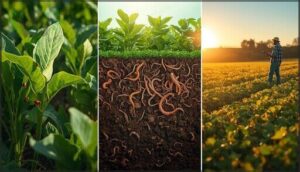
When you commit to long-term IPM, you’re not just solving today’s pest problems—you’re building a foundation for lasting success.
The benefits extend far beyond immediate pest control, touching everything from your bottom line to the health of your soil.
Let’s look at three major advantages that make IPM a smart investment for the future.
Enhanced Crop Yield and Quality
You’ll see real gains with long-term Integrated Pest Management Strategies—pilot programs show an 8–12% yield increase over five years, while Crop Protection and Yield Enhancement efforts raise Crop Yields by improving quality scores 6–9%.
Agricultural Productivity stabilizes with 15–25% less year-to-year variance, and Harvest Quality Control delivers 4–11% more marketable produce.
Integrated Pest Management, combined with Soil Health Optimization, Nutrient Balance Techniques, Crop Yield Management, and Pest Resistance Strategies, strengthens your operation from the ground up.
Economic Advantages for Growers
Your bottom line improves steadily—IPM delivers 8–15% input efficiency gains within five years, cutting pesticide costs by 20–40% while boosting profit stability through reduced volatility.
Economic savings compound as monitoring sharpens decisions, lowering unnecessary interventions by 25–35%.
Sustainable practices open premium markets worth 1–6% extra revenue, and certified programs ease credit access.
Cost savings plus market access equals reliable revenue growth and stronger agricultural productivity.
Environmental Protection and Soil Health
Ecosystem services flourish when you embrace Integrated Pest Management. Soil organic matter climbs 0.5–1.5 percentage points, microbial biomass surges 12–35%, and erosion drops 20–40% through conservation tillage and residue retention.
Water quality improves as pesticide runoff declines, supporting biodiversity management and ecological balance.
Sustainable agriculture thrives on this foundation, with soil health gains strengthening environmental impact mitigation and long-term agricultural sustainability through improved soil conservation.
Overcoming Challenges in Long-Term IPM Adoption

Adopting IPM for the long haul isn’t always smooth sailing—you’ll face real hurdles that can slow progress or derail your efforts entirely. Understanding these barriers upfront helps you plan smarter and stay committed when obstacles arise.
Let’s look at the two biggest challenges you need to prepare for as you implement sustainable pest management strategies.
Initial Investment and Resource Needs
Getting started with IPM systems means planning for upfront outlays that pay off over time. Your initial investment—equipment expenses, training budget, and labor costs—usually ranges from $50,000 to $150,000 for mid-sized farms.
Resource allocation for monitoring tools, staff certification, and data systems drives agricultural productivity. Economic savings from reduced pesticide use make these pest management strategies worthwhile investments in sustainable operations.
Addressing Pest Resistance and Adaptation
Resistance management starts with smart pest monitoring and adaptive strategies. When you rotate pesticide modes of action, you’ll cut resistance development by 25–40% across vegetables and cereals.
Crop rotation disrupts pest cycles, while biotech solutions paired with integrated pest management reduce chemical reliance by 15–30%.
Your IPM systems work best when you diversify pest control tactics before pesticide resistance takes hold.
Future Directions for Integrated Pest Management
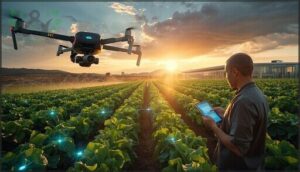
The future of IPM isn’t standing still—it’s evolving through smarter tools, stronger support systems, and proven results from the field. You’ll see how precision agriculture and advanced technology are reshaping pest management into something more targeted and efficient.
We’ll also look at the policies driving adoption forward and real-world examples where long-term IPM strategies have delivered lasting success.
Technological Innovations and Precision Agriculture
You’ll find advanced tools transforming Integrated Pest Management into a precision science. Drone Technology captures high-resolution crop images, while Sensor Networks track pest activity in real time. AI Decision systems analyze this data, guiding targeted interventions that boost Agricultural Productivity and Sustainability.
Robotics Automation manages scouting and mechanical pest control, slashing chemical use by 20–50%. Precision Farming integrates these innovations, enhancing Crop Protection while minimizing the Environmental Impact of Pest Control—delivering smarter, greener results.
Policy Incentives and Support Programs
You can tap into substantial Public Funding streams that reward Integrated Pest Management adoption. Government Initiatives across regions offer Subsidy Programs covering 20–40% of monitoring costs, while Tax Incentives support non-chemical investments in Agricultural Sustainability and Development.
Regulatory Framework changes now tie farm eligibility to proven Sustainable Agriculture Practices, driving Environmental Conservation Efforts and Ecosystem Management Techniques that protect your bottom line and the environment.
Case Studies Demonstrating Long-Term Success
Real-world results prove your Integrated Pest Management investment pays off. Here’s what strategic Pest Management Strategies and Sustainable Farming Practices deliver:
- Tropical fruit farms cut insecticide use 62% over 10 years while keeping 95% of yields through smart Crop Monitoring Techniques.
- Vineyards boosted harvests 12% using pheromones and natural enemies—40% fewer chemicals applied.
- Rice systems dropped sprays 28% after three seasons with threshold-based pest control and Ecosystem Balance Restoration.
- Apple orchards reduced broad-spectrum treatments 70% across six years without sacrificing fruit quality.
- Greenhouse tomatoes lowered input costs 15–25% through continuous Integrated Pest Management Approaches over multiple cycles.
These Environmental Impact Assessments confirm IPM works long-term—protecting your operation and the planet.
Frequently Asked Questions (FAQs)
How does climate change affect IPM strategies?
Like shifting sands beneath your feet, climate change rewrites the IPM playbook—warmer winters boost pest survival by 20–40%, accelerate generations, push species into new territories, and weaken natural enemies’ effectiveness.
Can IPM be applied in urban settings?
Yes, Urban IPM thrives in city ecosystems. Monitoring-based pest control in green spaces cuts pesticide use 40-60%, while integrated approaches targeting ants, roaches, and rodents reduce costs 15-30% through sanitation, exclusion, and ecosystem management.
What training resources exist for new farmers?
New farmers find foundational IPM training through online courses, farmer workshops, mentor programs, field training, and resource guides. 72% access web-based modules, and 68% receive extension service support for sustainable agriculture skills.
How do international regulations impact IPM adoption?
International regulations shape IPM adoption through stricter pesticide approvals, residue limits in trade agreements, and policy incentives for sustainable pest control. Compliance costs and environmental stewardship standards drive farmers toward integrated approaches, improving agricultural sustainability and supporting global standards.
What role do pollinators play in IPM?
Pollinators strengthen ecosystem services by supporting natural pest suppression networks.
Conserving biodiversity through pollinator-friendly practices enhances biocontrol agents, improves ecological balance, and delivers measurable pest management benefits alongside crop productivity gains.
Conclusion
You design ecosystems that defend themselves. You monitor thresholds instead of spraying calendars. You invest in predators, not just poisons.
Long-term integrated pest management solutions demand upfront effort, yet the payoff compounds: lower input costs, healthier soil, resilient crops that withstand pressure without escalating chemical dependence.
The farms that thrive decades from now won’t be the ones fighting harder—they’ll be the ones that stopped fighting nature and started working alongside it.
- https://southernipm.org/about/what-is-ipm/
- https://www.govinfo.gov/content/pkg/USCODE-2010-title7/html/USCODE-2010-title7-chap6-subchapII-sec136r-1.htm
- https://www.rd.usda.gov/programs-services/all-programs/cooperative-services
- https://ipmworld.umn.edu/
- https://extension.umd.edu/programs/agriculture-food-systems/program-areas/ornamental-horticulture/ipmnet