This site is supported by our readers. We may earn a commission, at no cost to you, if you purchase through links.
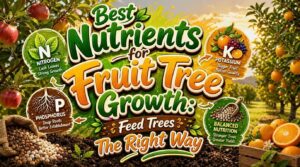
Most fruit trees will grow with almost any fertilizer you throw at them—but thriving, heavy-fruiting trees are a different story. A tree struggling with pale leaves or sparse harvests isn’t lazy; it’s missing something specific.
The best nutrients for fruit tree growth work together like a team, each one handling a distinct job from root establishment to sweetening fruit on the branch. Nitrogen builds the leafy canopy that captures sunlight, phosphorus anchors strong roots early, and potassium quietly loads sugars into every ripening fruit. Get the balance right, and your trees will show it.
Table Of Contents
Key Takeaways
- Nitrogen, phosphorus, and potassium each play a distinct role—nitrogen builds the leafy canopy, phosphorus anchors strong roots, and potassium loads sugars into ripening fruit, so getting their balance right is what separates a thriving tree from a struggling one.
- Stop applying nitrogen by late June or early July, because feeding it past that window pushes leafy growth instead of fruit ripening and leaves your harvest short.
- Calcium and magnesium quietly drive fruit quality from the inside—calcium firms up cell walls to keep fruit shelf-ready, while magnesium powers chlorophyll production to keep leaves green and the tree’s energy engine running.
- Always soil-test before fertilizing, since pH and existing nutrient levels determine whether what you apply actually reaches the roots—excess phosphorus locks out iron and zinc, and soil outside the 6.0–6.5 range makes several micronutrients unavailable, no matter how much you add.
Nitrogen for Canopy Growth
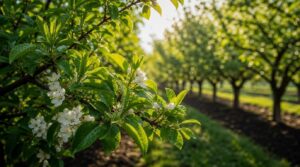
Nitrogen is the first nutrient your fruit tree reaches for when spring kicks in. Without enough of it, your tree can’t build the leafy canopy it needs to capture sunlight and fuel the season ahead. Here’s what you need to know about nitrogen and how it shapes early growth.
Getting the timing and balance right matters more than most gardeners realize, which is why an organic fruit tree care guide can help you avoid common nitrogen mistakes before they cost you a season.
Early Leaf and Shoot Growth
When spring arrives and buds begin to swell, your fruit tree kicks into one of its most demanding phases. Leaf primordia development happens fast — tiny leaf structures push outward from the shoot tip within days of bud break, racing to capture sunlight. Studies indicate that canopy light interception strongly influences early leaf expansion.
- New shoots elongate most rapidly during the first four to six weeks after emergence
- Nitrogen availability directly speeds up how quickly those first fully expanded leaves appear
- Warm, sunny days combined with consistent soil moisture drive the strongest canopy expansion dynamics
That early flush of growth sets the tone for the entire season.
Young Tree N-P-K Ratios
Once that early canopy flush starts, what you feed your young tree really matters.
For most young trees, a starter fertilizer ratio around 3-1-2 N-P-K gives enough nitrogen to drive shoot growth without overwhelming the roots. A balanced fertilizer like a 6-12-6 or 4-3-6 works well too, depending on your soil NPK guidance from a spring soil test.
Signs of Nitrogen Deficiency
Knowing the right N-P-K ratio gets you halfway there — the other half is catching problems early. When nitrogen runs low, your tree will tell you. Watch for these three warning signs:
- Leaf yellowing starting at tips and older leaves
- Stunted growth with short, sparse new shoots
- Reduced fruit size and slower color development
Phosphorus for Roots and Blooms

Phosphorus doesn’t get as much attention as nitrogen, but it’s doing some of the most important work underground and in the canopy. It drives root establishment, helps flowers form, and pushes fruit set along at just the right moments. Here’s what you need to know about using phosphorus the right way.
Planting-time Phosphorus Benefits
Timing phosphorus right can make or break how well a young fruit tree settles in. When you apply phosphorus at planting time, it’s immediately available where roots are actively exploring new soil. This matters because nutrient mobility in soil is limited — phosphorus doesn’t travel far, so placing it close during furrow application puts it exactly where early roots need it most.
| Planting-Time Phosphorus Benefit | Why It Matters |
|---|---|
| Promotes early root growth | Helps roots establish quickly after transplanting |
| Boosts ATP energy transfer | Accelerates initial shoot development |
| Improves mycorrhizal associations | Increases phosphorus uptake efficiency |
| Reduces phosphorus tie-up | Keeps P accessible in the critical first 4–6 weeks |
| Promotes future flowering | Builds the root foundation for fruit set |
Soil pH interaction also plays a role — ideal pH between 6.0–6.5 keeps phosphorus soluble and accessible. Outside that range, P binds to soil minerals and becomes harder for roots to reach, no matter how much fertilizer you’ve added.
Stronger Root Development
Phosphorus is the quiet engine behind deep root growth. Once it’s in the soil near young roots, it pulls those roots downward and outward, building a sturdy foundation before any fruit ever forms.
Lateral root expansion follows naturally, giving the tree more ground to explore for water and nutrients. A stronger root network now means a more resilient, productive tree later.
Better Flowering and Fruit Set
Once roots take hold, phosphorus shifts its attention upward — straight to the blooms. It drives energy transfer for flower development, helping ovules form properly and giving pollen the viability it needs to do its job.
Strong pollen viability also depends on root health — so watch for signs of overwatering in your summer garden before moisture stress quietly undermines the whole process.
When phosphorus is balanced alongside zinc and boron, fruit set improves noticeably, because those nutrients work together to support healthy pollen tube growth and reduce blossom drop.
High-phosphorus Soil Caution
Too much of a good thing can quietly undo all your hard work.
If your soil already tests high in phosphorus, skip additional P fertilizer — excess phosphorus locks out iron and zinc, triggering yellowing leaves and poor fruit color.
It can also leach into nearby waterways after heavy rain. Always let soil test results guide every application.
Potassium, Calcium, and Magnesium Roles
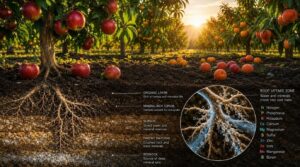
Nitrogen and phosphorus often get all the attention, but potassium, calcium, and magnesium are doing some of the most important work behind the scenes. Without the right balance of these three, you’ll notice it in your fruit quality, your tree’s resilience, and even the color of your leaves. Here’s what each one actually does for your trees.
Fruit Size and Sweetness
Potassium is the nutrient that quietly shapes how sweet and satisfying your fruit tastes at harvest. It drives sugar concentration in the flesh, boosting Fruit Brix — the measure of dissolved sugars — so your apples or peaches actually reward the wait.
Here’s what drives that size-sweet balance:
- Potassium moves sugars from leaves into developing fruit
- Sunlight impact raises photosynthesis, feeding more sugar into each piece
- Harvest timing matters — later picks often taste noticeably sweeter
- Larger fruit can dilute sugars, lowering Brix per bite
- Balanced NPK ratio prevents nitrogen from redirecting energy away from fruit
Keep potassium steady, time your harvest right, and your fruit quality will speak for itself.
Disease and Drought Support
When drought hits, your trees are already fighting on two fronts — water stress and disease pressure at the same time.
Balanced potassium levels help strengthen canopy tissue, so trees hold up better under dry conditions. Pair that with drought resistant rootstock, and you’re building real resilience from the ground up.
Good soil microbial health, supported by beneficial microorganisms, also boosts natural disease suppression when stress peaks.
Calcium for Firmer Fruit
Calcium is quietly one of the most powerful nutrients for fruit quality. It binds with pectin inside cell walls — a process called calcium-pectin binding — creating a firm, resilient structure that holds up from harvest through storage. Get calcium right, and your fruit can be 5 to 20 percent firmer, depending on the variety.
Calcium binds with pectin in cell walls, making fruit up to 20 percent firmer from harvest through storage
Calcium application timing matters enormously. Apply it at visible fruit set and through early fruit development, when cell walls are still forming. Foliar sprays using chelated calcium work well during hot, high-evaporation periods when uptake from roots slows down. Crushed eggshells worked into the soil around the drip line also deliver a steady, gentle calcium boost over time.
One thing worth knowing: calcium moves through the xylem, not the phloem, so calcium transport dynamics depend almost entirely on consistent watering and healthy root activity. Irregular irrigation cuts delivery off fast. For postharvest quality, a calcium chloride dip or spray after picking helps maintain firmness and slows softening during storage — a simple step that extends marketable life noticeably.
Magnesium for Chlorophyll Health
While calcium firms up the fruit, magnesium keeps the engine running. It sits at the center of every chlorophyll molecule, and without enough of it, leaf color fades fast.
You’ll notice interveinal chlorosis on older leaves first — yellowing between the veins while the veins stay green.
Keep soil pH between 6.0 and 7.0, and apply magnesium sulfate as a foliar spray during active growth to restore color quickly.
Micronutrients That Prevent Deficiencies
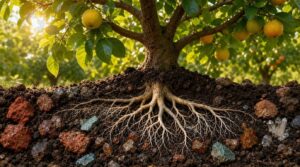
Macronutrients get most of the attention, but micronutrients are what keep your fruit trees from quietly struggling. Even a small gap in iron, zinc, boron, manganese, or copper can throw off leaf color, fruit set, and overall tree health. Here’s what each one does and why it matters.
Iron for Green Leaves
When leaves start turning yellow between the veins while the veins stay green, that’s iron chlorosis telling you something’s off. Iron drives chlorophyll production, so without enough of it, leaf color fades fast.
In high-pH soils, iron locks up and roots can’t reach it — that’s where chelated iron spray shines, keeping iron available for steady foliar feeding and reliable green growth.
Zinc for New Growth
Zinc is the quiet force behind every burst of new growth. It drives zinc enzyme activation — powering over 300 enzymes that handle protein and cell division in young shoots.
When soil zinc availability drops, especially in high-pH soils, young leaves distort, and growth stalls. Zinc foliar sprays fix this fast, delivering zinc directly to expanding tissue.
Boron for Fruit Set
Think of boron as the matchmaker for your fruit trees — without it, pollen tube formation stalls, and fruit set drops fast.
A deficiency shows up as poor flowering, misshapen fruit, and brittle new shoots.
Time your boron foliar sprays at pre-bloom, keep rates between 0.5–2 lb/acre, and always run soil testing first to avoid toxicity.
Manganese for Fruit Color
Manganese quietly drives fruit skin color by fueling anthocyanin synthesis — the pigment process behind those rich reds and purples you want at harvest.
- Promotes color development stage during fruit ripening
- A manganese foliar spray works best in high-pH soils
- Low manganese causes uneven color and leaf chlorosis
- Manganese sulfate is the go-to source for fast uptake
Run soil testing first, then apply as needed.
Copper for Enzyme Support
Copper doesn’t get much attention, but your fruit trees genuinely can’t function without it. Copper Enzyme Activation powers cytochrome c oxidase, which drives energy production inside every cell. It also fuels Lysyl Oxidase Activity, keeping wood and tissue firm.
Without enough copper, micronutrient deficiencies show up as leaf chlorosis and weak growth.
Copper fungicides conveniently deliver both disease control and nutrition at once.
Top Fruit Tree Fertilizer Products
With so many fertilizers on shelves, picking the right one for your fruit trees doesn’t have to feel like a guessing game. A few solid products stand out for their balance of nutrients, ease of use, and reliable results. Here are five worth knowing about.
1. Farmer’s Secret Fruit Tree Booster Fertilizer
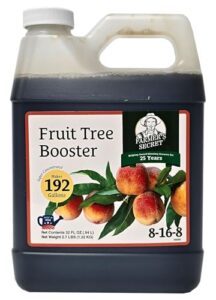
If you want a liquid fertilizer that works fast without a complicated routine, Farmer’s Secret Fruit Tree Booster is worth a close look.
It’s super-concentrated, so you only need one teaspoon per gallon of water, applied weekly after dormancy ends.
The high phosphorus content targets root development right when trees need it most — during that early push from bud break to first bloom.
It works as a soil drench or foliar spray, and it’s beginner-friendly from the start.
| Best For | Home gardeners and small orchard owners who want an easy, fast-acting liquid fertilizer to give their fruit trees a strong start after dormancy. |
|---|---|
| NPK Ratio | High Phosphorus |
| Product Form | Liquid Concentrate |
| Target Trees | Fruit Trees |
| Application Method | Soil Drench or Foliar |
| Package Size | 32 fl oz |
| Fruit Development | Yes |
| Additional Features |
|
- Super-concentrated formula means one small bottle goes a long way — just one teaspoon per gallon, once a week
- High phosphorus content gives roots a real boost right at the start of the growing season, which sets trees up for better fruit down the line
- Flexible application — works as a soil drench, foliar spray, or through your existing irrigation setup
- Weekly applications add up in time and effort compared to just tossing down a slow-release granular fertilizer
- Get the dilution wrong and you risk burning roots or leaves — there’s no real margin for error
- It won’t replace a pest or disease management plan, so you’ll still need to handle those problems separately
2. Ironite Plus Shrub Tree Fertilizer
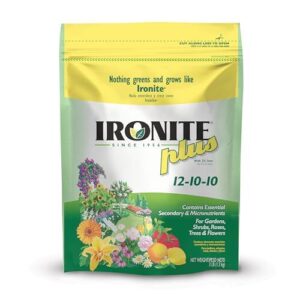
If your fruit trees are showing yellowed leaves, Ironite Plus might be exactly what they need. This granular fertilizer carries a 12-10-10 NPK ratio plus 2% iron — a combination that remedies pale foliage while supporting steady root and canopy growth.
Spread it around the drip line and water it in well. The iron works alongside chelated zinc and manganese to restore that deep, healthy green color most fruit trees thrive on.
| Best For | Gardeners dealing with yellowing trees, shrubs, or vegetable beds who want a fast-acting fix that also supports long-term root and fruit development. |
|---|---|
| NPK Ratio | 12-10-10 |
| Product Form | Granules |
| Target Trees | Shrubs & Trees |
| Application Method | Soil Surface |
| Package Size | 48 oz (3 lb) |
| Fruit Development | Yes |
| Additional Features |
|
- The 12-10-10 NPK ratio plus 2% iron tackles yellowing leaves quickly while still feeding roots and boosting flower and fruit production
- Works across a wide range of plants — fruit trees, azaleas, hollies, citrus, and veggie gardens all benefit from one product
- Helps plants hold up better through drought and rough weather, so your garden stays healthier with less babying
- Outdoor use only — won’t work for houseplants or any hydroponic setup
- You have to follow the label closely; too much and you risk nutrient burn, which creates a whole new problem
- Doesn’t do anything for pest issues, disease, or pH imbalances, so you may still need extra products depending on what’s going on in your soil
3. Miracle Gro Fruit Citrus Plant Food Spikes
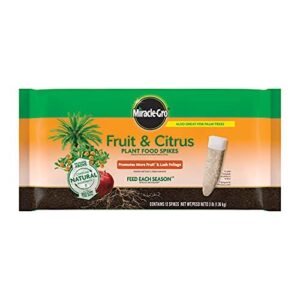
If you want a low-fuss option that still gets results, Miracle-Gro Fruit & Citrus Spikes are worth keeping in your shed. Each spike carries a 10-15-15 N-P-K ratio, meaning more phosphorus and potassium than nitrogen — exactly what fruiting trees need for better yields and stronger roots.
Just drive them into the soil at the dripline each spring and fall, water well, and you’re done.
The pack includes 12 pre-measured spikes, so there’s no measuring or mixing involved.
| Best For | Home gardeners who want a simple, no-mess way to feed fruit, citrus, avocado, or palm trees twice a year without any mixing or measuring. |
|---|---|
| NPK Ratio | 10-15-15 |
| Product Form | Spikes |
| Target Trees | Fruit & Citrus Trees |
| Application Method | Soil Insertion |
| Package Size | 3 lb (12 spikes) |
| Fruit Development | Yes |
| Additional Features |
|
- Slow-release formula means one application feeds your tree all season — no weekly trips back to the garden
- The 10-15-15 ratio is tuned for fruiting trees, so you’re getting more of what actually drives bigger harvests and healthier roots
- Pre-measured spikes take the guesswork out completely — just push them in at the dripline and you’re done
- Hard or rocky soil can snap the spikes before they’re fully seated, which is frustrating and wasteful
- The N-P-K ratio won’t suit every soil type, so if your soil is already phosphorus-heavy, you could throw things off balance
- Not a good fit for young trees or anything with shallow roots — placement needs to be at least 3 feet from the trunk
4. Espoma Organic Tree Tone Fertilizer
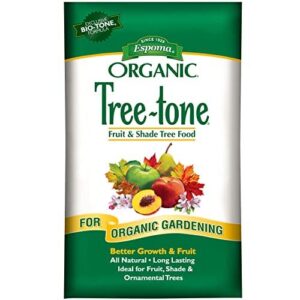
If you’re going organic, Espoma Tree-Tone is a solid choice for fruit trees. Its 6-3-2 N-P-K ratio with 5% calcium mirrors what most fruit trees actually need — steady nitrogen for canopy growth, modest phosphorus, and calcium to firm up your harvest.
The Bio-Tone microbes in the formula work quietly in the soil, improving root health over time. Slow-release action means nutrients feed your tree for 4–6 weeks after watering, without burning roots.
| Best For | Organic gardeners growing fruit, nut, or ornamental trees who want a slow-release, set-it-and-forget-it fertilizer without synthetic chemicals. |
|---|---|
| NPK Ratio | 6-3-2 |
| Product Form | Granules |
| Target Trees | Fruit & Ornamental Trees |
| Application Method | Drip Line |
| Package Size | 36 lb |
| Fruit Development | Yes |
| Additional Features |
|
- Certified organic with Bio-Tone microbes that build long-term root and soil health
- Slow-release formula feeds trees for 4–6 weeks, so you’re not out there reapplying every few weeks
- Works across a wide range of trees — apples, peaches, oaks, ornamentals, you name it
- It smells. Bad. Fair warning before you open the bag.
- Big trees need a lot of it — a large oak can eat through 150 pounds, which gets expensive fast
- Don’t expect quick results; visible improvement can take weeks or even months
5. Espoma Organic Tree Tone Fertilizer for Trees
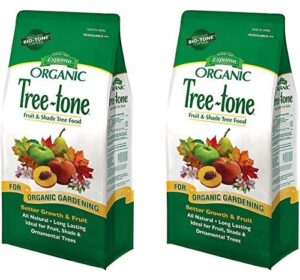
The two-pack gives you 8 lb of Tree-Tone for under $22 — enough to cover one or two mid-sized trees through a full season.
Apply the granules from the trunk edge to the drip line, water thoroughly, and the slow‑release formula starts feeding within days. No mixing, no guesswork.
The Bio-Tone microbes keep working between feedings, quietly building healthier soil beneath the surface. For organic growers, it’s a straightforward, dependable option.
| Best For | Home gardeners and organic growers who want a simple, no-fuss way to feed shade, fruit, or ornamental trees without synthetic chemicals. |
|---|---|
| NPK Ratio | 6-3-2 |
| Product Form | Granules |
| Target Trees | Fruit & Ornamental Trees |
| Application Method | Drip Line |
| Package Size | 8 lb (2 bags) |
| Fruit Development | Yes |
| Additional Features |
|
- USDA-certified organic with Bio-Tone microbes that keep improving your soil long after application
- Ready-to-use granules — just spread and water, no mixing or measuring needed
- Covers fruit and ornamental trees alike, with calcium built in for stronger growth
- Smells pretty strong out of the bag — think manure, not flowers
- Granules can draw pets or wildlife if you don’t mulch over them
- Pricier per pound than bulk fertilizers, and it’s trees only — won’t work for your lawn or garden beds
Feeding Timing and Application Tips
Knowing what to feed your fruit trees is only half the battle — when and how you feed them matters just as much. Get the timing wrong, and even the best fertilizer won’t do much good. Here’s what you need to know to get every application right.
Spring Feeding Schedule
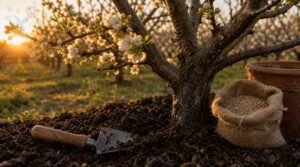
As soon as buds begin to swell in early spring, that’s your cue to start feeding.
Apply a balanced slow-release fertilizer aligned with your tree’s growth stage, and run a soil test first to confirm what’s actually needed.
Work in compost around the drip line every four to six weeks to keep nutrients flowing steadily through the season.
Stop Nitrogen by Midsummer
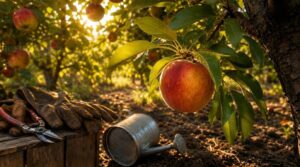
Once your trees are actively setting fruit, it’s time to stop nitrogen applications — ideally by late June or early July.
Continuing past that window pushes leafy growth instead of ripening, leaving your harvest short and your branches soft heading into fall.
Think of it as redirecting the tree’s energy exactly where it belongs.
Soil Tests and PH
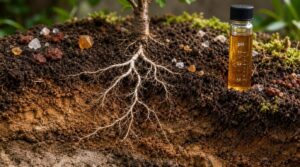
Knowing when and how much to feed your trees starts with one step most gardeners skip: soil pH testing. A quick lab test tells you whether your soil sits in the ideal 6.0–6.5 range where nutrients release properly.
Outside that window, iron, zinc, and manganese become harder for roots to absorb — no matter how much fertilizer you apply.
Compost and Mulch Support
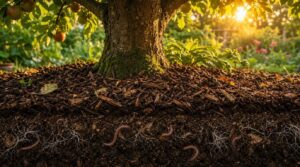
Adding compost and mulch around your trees is one of the quietest ways to build long-term soil health. Together, they do three things that fertilizer alone can’t:
- Release nutrients slowly as organic matter breaks down over weeks
- Retain soil moisture by reducing evaporation around the drip line
- Support soil biology by feeding beneficial fungi, bacteria, and earthworms
Spread a 2–4 inch mulch layer from the trunk edge outward, keeping it a few inches back from the bark to prevent rot.
Correct Dosage by Age
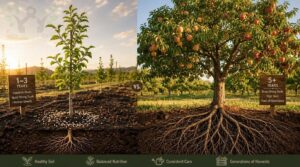
Getting the dose right comes down to one thing: your tree’s age. Young trees aged 1–3 need just 20–40 grams of actual nitrogen per year, split across 2–4 light applications.
As trees mature past age 5, potassium climbs to 0.60–1.20 g per liter every six weeks.
Match your nutrients to the growth stage, and you’ll avoid both deficiency and burn.
Frequently Asked Questions (FAQs)
Can fruit trees be fertilized during winter dormancy?
Yes, but it’s a double-edged sword. Winter Soil Temperature slows root uptake, so fertilizer timing matters. Stick to low-nitrogen, slow-release options applied late winter, just before dormancy breaks, for safe seasonal nutrient management.
How does climate affect fruit tree fertilizer needs?
Climate shapes how and when your trees absorb nutrients. Rainfall leaching risk, drought, and temperature all shift what your trees need and when they need it most.
Can over-fertilizing reduce a fruit trees lifespan?
More fertilizer doesn’t always mean a healthier tree — sometimes it’s the fastest way to shorten its life. Overfertilize consistently, and you risk soil acidification, root damage, and long-term tree longevity decline.
Should young and mature trees share the same schedule?
No, they shouldn’t. Young trees need lighter, more frequent feeding to build roots and canopy. Mature trees shift toward maintenance. Adjust rates and timing by age for the best results.
Conclusion
Your trees don’t ask for much—just the right nutrients at the right time. Skip nitrogen too late in the season, and they’ll reward you with soft wood that struggles through winter. Forget potassium, and fruit stays small and bland.
The best nutrients for fruit tree growth aren’t a secret; they’re a system. Feed consistently, test your soil, and adjust as your trees respond. Give them what they need, and they’ll give you a full harvest.
- https://agrilifeextension.tamu.edu/library/gardening/essential-nutrients-for-plants
- https://blogs.ifas.ufl.edu/miamidadeco/2024/05/16/fertilizing-fruit-trees
- https://treefruit.wsu.edu/orchard-management/soils-nutrition/fruit-tree-nutrition
- https://www.nature.com/articles/s41598-025-17645-3
- https://stbiologicals.com/the-critical-role-of-sulfur-in-plant-growth