
This site is supported by our readers. We may earn a commission, at no cost to you, if you purchase through links.
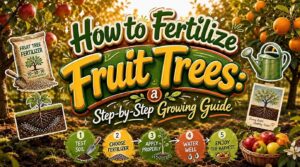
Most fruit trees fail not from neglect, but from good intentions applied at the wrong moment. A handful of granules scattered too early, too late, or in the wrong place can push a tree toward lush foliage at the expense of the fruit you planted it for. Timing, soil chemistry, and root biology all intersect in ways that catch even experienced gardeners off guard.
Understanding how to fertilize fruit trees means reading the tree itself—its shoot growth, leaf color, and trunk size—not just following a bag’s general instructions. The steps ahead give you a precise, measurable approach that removes the guesswork.
Table Of Contents
- Key Takeaways
- Fertilize Fruit Trees in Early Spring
- Test Soil Before Adding Fertilizer
- Choose The Right Fruit Tree Fertilizer
- Calculate The Correct Fertilizer Amount
- Apply Fertilizer Around The Root Zone
- Fix Common Fertilizing Problems
- Frequently Asked Questions (FAQs)
- What month should you start fertilizing fruit trees?
- What is the best time to fertilize fruit trees?
- Is 10-10-10 fertilizer good for apple trees?
- What fertilizer is best for fruit trees?
- When should I fertilize my Trees?
- When is the best time to fertilize fruit trees?
- Should you fertilize fruit trees in the winter?
- How do you fertilize fruit trees for a big harvest?
- In what month should you fertilize your fruit trees?
- How do you apply 10-10-10 fertilizer to fruit trees?
- Conclusion
Key Takeaways
- Timing your fertilizer application to coincide with bud swell in early spring — when soil hits 50°F and no frost is imminent — makes the difference between nutrients that feed fruit and nutrients that feed weeds.
- Always run a soil test before reaching for any fertilizer, since matching your NPK formula to actual deficiencies prevents the most common mistake: pushing lush foliage at the cost of the harvest.
- Place granules 12–18 inches away from the trunk and spread outward to the drip line, because that’s where feeder roots actually live and where nutrients can be absorbed.
- Stop all nitrogen by mid-July without exception — late applications delay dormancy, invite frost damage, and shift your tree’s energy away from ripening fruit.
Fertilize Fruit Trees in Early Spring
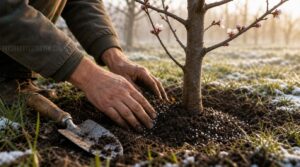
Timing is everything for fertilizing fruit trees, and early spring is where it all begins. Get it right, and you set your trees up for a full season of strong growth and better fruit.
Pairing spring fertilizing with solid winter fruit tree care practices means your trees hit the ground running when the season starts.
Here’s what you need to know about the timing windows that matter most.
Best Timing Before Bud Swell
Before you open a bag of fertilizer, your tree gives you a signal worth watching: bud swell. Time your application using these five checkpoints:
- Soil Temperature Threshold reaches 50°F (10°C)
- Daylength Cues show noticeably longer days
- Daytime highs consistently exceed 40–50°F
- Moisture Management Timing confirms evenly moist, not saturated, soil
- Weather Forecast Alignment shows no imminent frost
Nail these, and your early spring fertilizer timing for fruit trees lands exactly when early season growth can actually use it. Maintaining the optimal temperature range promotes bud swell.
Fertilizing 4–6 Weeks Before Bloom
Once bud swell begins, your 4–6‑week prebloom window is open. Apply a phosphorus-forward formula like 5-10-5, focusing on root zone aeration and prebloom soil moisture to move nutrients down effectively. Nutrient release timing matters here — balanced organic fertilizer breaks down gradually, matching tree demand.
| Timing | Action |
|---|---|
| 6 weeks before bloom | Run a soil test |
| 4–5 weeks before bloom | Apply balanced organic fertilizer |
| 3 weeks before bloom | Water deeply into root zone |
| 1–2 weeks before bloom | Consider leaf tissue sampling |
When to Apply a Light Summer Feeding
After prebloom feeding wraps up, your next decision point arrives about 4–6 weeks post-bloom — the post-bloom window when shoot growth tells you whether a light summer feeding makes sense. Watch for nectar flow decline and weak extension growth as your cues.
Apply a dilute feeding only when daytime temperatures stay consistently above 20°C, and monitor weather patterns closely before committing.
Why to Stop Nitrogen by Mid-July
Once you’ve decided whether a light summer feed is warranted, the next hard rule is this: stop all nitrogen applications by mid-July.
Here’s why that date matters:
- Frost Damage Risk rises when late nitrogen pushes tender new growth that can’t harden before winter
- Nitrate Leaching Prevention becomes critical as autumn rains drive unused nitrogen into groundwater
- Disease Susceptibility Reduction depends on timely dormancy initiation, which excess nitrogen actively delays
- Fruit Color Enhancement improves when the tree shifts energy toward ripening rather than leaf production
Adjusting Timing by Climate and Tree Growth
Climate shapes fertilizer timing for fruit trees more than the calendar does. Warmer winters trigger budburst shifts and chill requirement changes that can move bud swell days earlier — or later — depending on your site.
Microclimate effects like frost pockets or elevation delay timing further.
Juvenile growth sensitivity also matters: younger trees with developing roots flush later, so adjust your seasonal fertilization schedule to match what the tree is actually doing, not the date.
Test Soil Before Adding Fertilizer
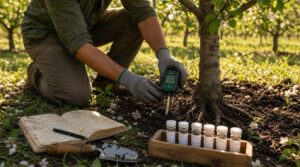
Before you open a bag of fertilizer, it’s worth knowing what your soil actually needs. Guessing can lead to overfeeding, deficiencies, or fruit trees that grow a lot of leaves and very little fruit.
These are the key things to check before you add anything to the ground.
Why Soil Testing Prevents Over-fertilizing
Think of a soil test as your blueprint before you build. Without one, you’re guessing — and guessing leads to fertilizer overapplication, nutrient leaching, and wasted money.
Precision soil management starts with data-driven fertilization: knowing exactly what’s already in the ground.
Targeted nutrient application and budgeting nutrient inputs to actual deficits keep your trees productive without pushing excess nitrogen into shoots instead of fruit.
Key Nutrients to Check: Nitrogen, Phosphorus, Potassium
Three nutrients do most of the heavy lifting in your soil test: nitrogen, phosphorus, and potassium.
Each plays a distinct role in tree health—deficiencies in any one can trigger the yellowing or necrotic spots described in this fruit tree nutrient deficiency and stress reduction guide.
Nitrogen drives shoot growth and chlorophyll production; phosphorus strengthens roots and enhances fruit set; potassium regulates water balance and improves fruit quality.
Seasonal nutrient monitoring of your NPK ratio, combined with foliar nutrient analysis and micronutrient screening, gives you the full picture of root uptake efficiency before you apply anything.
Soil PH and Nutrient Availability
Soil pH sits at the center of soil testing and nutrient management — it controls what your trees can actually absorb. A pH between 6.0 and 7.0 maximizes soil nutrient availability across most macronutrients and micronutrients.
Alkaline phosphorus lockup occurs above 7.5, while acidic iron toxicity becomes a real risk below 5.5. Understanding micronutrient solubility helps guide the right soil amendment and soil pH adjustment before you fertilize.
Using Annual Shoot Growth as a Fertility Clue
annual shoot growth is one of the most reliable seasonal vigor indicators you have — no lab required. young apple and pear trees should push 18–30 inches annually; mature trees, 12–18 inches. Anything shorter signals a fertility gap worth addressing.
Track these shoot length benchmarks each year for smarter growth nutrient adjustments:
- Measure 20 representative shoots per tree for accurate growth trend analysis
- Record lengths consistently to support sound record keeping practices
- Compare results against nitrogen guidelines to fine-tune fertilizer timing for fruit trees
Choose The Right Fruit Tree Fertilizer

Not every fertilizer works the same way, and picking the wrong one can do more harm than good. The label tells you a lot once you know what you’re looking at.
what to think about before you buy anything.
What N-P-K Numbers Mean
Every fertilizer bag displays three numbers — that’s your NPK ratio, and understanding NPK ratios on fertilizer labels is the foundation of smart fruit tree care. This label reading guide tells you the percent weight breakdown of nitrogen, phosphorus, and potassium, in that order.
Nitrogen feeds growth, phosphorus helps roots and flowering, and potassium strengthens fruit quality — a nutrient function overview that shapes every formula selection decision you’ll make.
Balanced Fertilizers Like 10-10-10
A balanced fertilizer like 10-10-10 supplies equal parts nitrogen, phosphorus, and potassium — straightforward fruit tree nutrition without guessing. Before reaching for it, run a soil test; it confirms whether balanced NPK actually fits your trees’ needs.
Here’s when it works well:
- Young trees needing general establishment support
- Soils testing low across multiple nutrients
- Growers prioritizing cost efficiency and simplicity
- Situations where slow-release options improve environmental impact
Fruit species compatibility varies, so verify micronutrient synergy before setting fertilizer application rates.
Bloom-supporting Formulas Like 5-10-10
When a balanced fertilizer isn’t quite the right fit for flowering season, a 5-10-10 formula steps in.
The lower nitrogen management keeps leafy growth suppressed — think of it as Leaf Suppression Tactics in action.
Meanwhile, the Phosphorus Surge drives flower bud development, and the Potassium Pulse strengthens fruit set.
Apply 4–6 weeks before bloom for Bloom Timing Precision.
Stone fruits especially respond well when soil phosphorus tests are low.
Organic Options: Compost, Manure, Feather Meal, Soybean Meal
If synthetic formulas aren’t your style, organic fertilizer options give your trees a gentler, longer-lasting feed.
- Compost blending improves soil structure and delivers a slow nitrogen release — around 1–2% N — with a real soil microbial boost.
- SupR Green chicken manure supplies higher nitrogen than most plant-based amendments, supporting early canopy development.
- Feather meal timing matters: apply it once soil temperatures warm in spring, since microbes need heat to break down its 12–15% nitrogen.
- Soybean meal benefits include steady nitrogen release — roughly 6–7% N — plus trace minerals that support balanced growth.
- Manure pathogen control requires composting or aging before application to eliminate weed seeds and harmful bacteria.
Fast-acting Nitrogen Sources Like Blood Meal
Blood meal takes nitrogen delivery to another level compared to feather meal or soybean meal. With 12–15% nitrogen by weight, it’s one of the most concentrated organic fertilizer options available. Release Timing is fast — trees often show green-up within one to three weeks.
| Factor | Blood Meal Detail |
|---|---|
| Moisture Dependency | Requires consistent soil moisture to activate |
| Temperature Influence | Works best when soils are warm and microbially active |
| Application Safety | Follow labeled rates; overapplication risks leaf burn |
| Organic Certification | Approved for certified organic orchard programs |
Apply it in early spring for targeted nitrogen management for fruit trees, and don’t use it late in the season.
Micronutrient Amendments for Specific Deficiencies
When macronutrients aren’t enough, trace minerals fill the gaps.
Zinc foliar sprays at 0.5–2.0 g/L correct zinc deficiency within one to two weeks. Iron chelate applications work faster than ferrous sulfate in alkaline soils, reversing iron deficiency chlorosis in new growth.
Use boron split applications over several weeks to avoid leaf burn. Manganese soil amendments and copper disease resistance treatments round out a complete micronutrient supplementation plan.
Calculate The Correct Fertilizer Amount
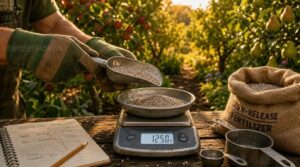
Getting the amount right matters just as much as picking the right fertilizer. Too little, and your trees underperform; too much, and you’re pushing leafy growth at the expense of fruit.
Here’s how to calculate exactly what your trees need.
Measuring Trunk Diameter Accurately
Trunk diameter drives your fertilizer dosage, so measuring it right matters.
Follow the DBH Measurement Protocol: wrap a flexible tape around the trunk at 4.5 feet above ground — that’s your girth — then divide by 3.14 to get diameter.
For accuracy, use tape placement techniques on smooth bark, take three readings, and average them.
Laser diameter tools and photogrammetry accuracy work well too, but a tape gets the job done.
Applying Nitrogen by Trunk Size
Once you have your trunk diameter, the math is straightforward. Apply between 0.10 and 0.25 lb of actual nitrogen per inch of trunk diameter — your fertilizer application rate stays within that window based on Trunk Health Monitoring and Seasonal Rate Scaling.
Nitrogen Source Choice affects uptake speed, so factor that into your Application Safety Guidelines.
Micronutrient Synergy matters too; nitrogen recommendations for established fruit trees work best when trace elements aren’t limiting absorption.
These fertilizer guidelines based on tree age and size keep growth balanced.
Fertilizer Rates for Young Fruit Trees
Young trees have modest but precise nutrient requirements — too much nitrogen early on pushes leafy growth before roots can support it. Follow fertilizer rates based on tree age, starting with Starter Blend Ratios using low-nitrogen formulas.
Early Growth Nutrition should target slow, steady development.
Keep Seasonal Rate Adjustments conservative, skip the first year entirely, and align Micronutrient Needs with Growth Rate Targets as the tree establishes.
Fertilizer Rates for Mature Fruit Trees
Mature trees follow a different set of rules than young ones.
Base your fertilizer application rates on trunk diameter — roughly 0.1 to 0.2 pounds of actual nitrogen per inch, capped at 1–2 pounds annually. Rate Scaling Factors, like canopy density ratio, soil richness, and climate-adjusted doses, all shape your multi-year planning.
Nutrient release timing matters: split applications support steady growth without pushing excessive foliage.
When Pruning Reduces Fertilizer Needs
Heavy pruning changes your fertilizer math. When you remove more than 20% of the canopy, the root-to-leaf ratio shifts — roots now serve fewer leaves, so nutrient demand drops noticeably.
Canopy size impact and pruning timing effects are real: dwarf tree efficiency improves further post-prune. Factor this into your nitrogen management in fruit trees before applying anything.
Avoiding Excessive Nitrogen and Leafy Growth
Too much nitrogen doesn’t just feed your tree — it can tip the balance toward leaf growth at the expense of fruit. Controlled Release Formulas help moderate that risk by spreading nitrogen slowly. For balanced feeding, keep these in mind:
- Pause nitrogen after fruit set to favor vegetative growth vs fruit production.
- Limit foliar nitrogen applications during active shoot periods.
- Pair canopy management strategies with slow-release nitrogen for consistent results.
Apply Fertilizer Around The Root Zone
fertilizer to the right place matters just as much as choosing the right product. Fruit trees feed through their outer roots, not at the trunk, so where you apply makes all the difference.
Here’s what to know about placing fertilizer where it actually does the work.
Where Fruit Tree Feeder Roots Grow
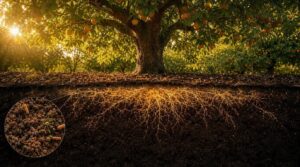
Most of a fruit tree’s feeder roots concentrate in the top 6 to 12 inches of soil — that’s your root zone’s sweet spot for nutrient uptake. These roots spread outward toward the canopy edge roots and drip line, where root development is most active.
Species root depth varies, and mulch impact is real: heavy layers can shift root establishment deeper.
Think of the drip line as your target.
Keeping Fertilizer Away From The Trunk
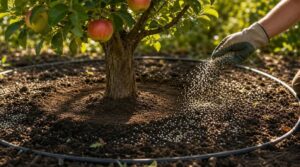
Now that you know where feeder roots concentrate, placement matters just as much as timing.
Keep all granules 12–18 inches from the bark — this Trunk Buffer Zone prevents salt burn and phytotoxicity. Use Drip Line Placement as your guide for root zone feeding strategies:
- Start 12 inches from the trunk.
- Spread evenly toward the dripline.
- Follow the Residue Rinse Protocol — wash any spilled granules off bark within an hour.
- Monitor Soil Zone Sampling points for fertilizer burn prevention.
Spreading Granular Fertilizer Under The Canopy
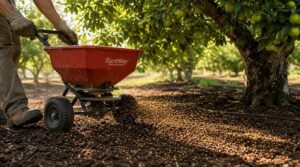
With your buffer zone set, run a calibration test strip before spreading to confirm your spreader’s output rate.
Choose granules sized for your spreader’s flow, and remove mulch in the application zone — the mulch removal zone ensures direct soil contact.
Use a spreader wind shield on breezy days, then broadcast fertilizer in an even coverage pattern from trunk to drip line.
Placing Phosphorus and Potassium Near The Drip Line
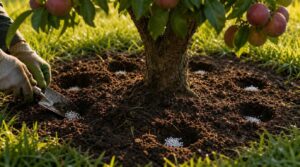
Unlike nitrogen, phosphorus and potassium don’t travel far through soil on their own — so placement depth and root zone targeting matter. Place these nutrients near the drip line, where feeder roots are most active, to improve nutrient mobility and minimize leaching prevention issues.
- Dig holes 4–8 inches deep at the drip line
- Space them 12–18 inches apart to avoid salt accumulation
- Keep all fertilizer application methods at least 18 inches from the trunk
Using Liquid Fertilizer or Drip Irrigation
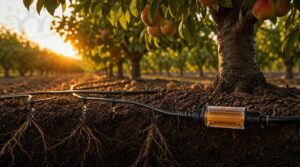
Drip irrigation fertilization gives you precise root zone feeding strategies that granular products can’t match. Liquid fertilizer moves directly to the dripline through an in-line injector — but injector calibration and solution mixing ratios matter.
Keep water pH between 6.0–6.5 to prevent nutrient precipitation, and follow a consistent system flush schedule. EC monitoring helps you catch salt buildup before it damages roots.
Watering Fertilizer Into The Soil
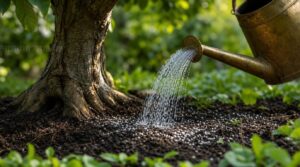
Watering granular fertilizer into the soil isn’t optional — it’s what actually puts nutrients where roots can use them.
Follow these steps:
- Pre-wet soil to 6–8 inches, for soil moisture pre-wet before placing fertilizer
- Apply a gentle post-application rinse after spreading granules
- Make sure uniform nutrient distribution across the entire root zone
- Practice avoiding puddle formation near the trunk
- Monitor drip irrigation fertilization flow for consistent coverage
Fix Common Fertilizing Problems
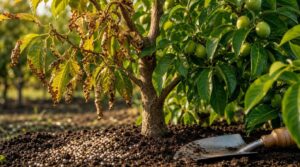
Even when you do everything right, fruit trees sometimes push back with yellowing leaves, scorched edges, or a whole lot of leafy growth and barely any fruit. These are signs that fertilizing program needs a small correction, not a complete overhaul.
Here are the most common problems and how to fix them.
Yellow Leaves From Nitrogen Deficiency
Yellow leaves on older growth are your tree’s first distress signal. This yellowing progression — pale lime fading to full yellow while stems stay green — means nitrogen reallocation is underway: the tree is pulling nutrients from mature leaves to feed new shoots.
Soil leaching impact, mulch carbon tie-up, and high pH limitation all reduce nitrogen availability.
A soil test confirms the cause before you start fertilizing fruit trees.
Purple or Reddish Leaves From Phosphorus Deficiency
Purple or reddish coloring that starts at the leaf base and spreads inward is a textbook sign of phosphorus deficiency. Because phosphorus is a mobile nutrient, older leaf symptoms appear first — the tree pulls phosphorus from mature leaves to support new growth.
Soil pH influence matters here: pH below 5.5 locks phosphorus out entirely.
Run a phosphorus soil test before applying any phosphorus recommendations for established fruit trees.
Scorched Leaf Edges From Potassium Deficiency
Scorched leaf edges are one of the clearest nutrient deficiencies you’ll spot — brown, crisp margins on older leaves, often paired with leaf yellowing, while the center stays green.
That’s potassium mobility effects at work: your tree strips potassium from older leaves first.
Edge scorch diagnosis checklist:
- Run a potassium soil test level to confirm low availability
- Check for high pH limitation or soil sodium interference blocking uptake
- Apply mulch moisture management to stabilize root zone conditions
Too Much Foliage and Not Enough Fruit
Sometimes the problem isn’t what’s missing — it’s what you’ve overdone. Too much nitrogen throws off hormonal regulation, pushing your tree into leafy overdrive while fruit set balance collapses.
Dense canopies block light penetration to inner spurs, and flowering stalls.
Rethink your nitrogen management in fruit trees: adjust fertilizer timing, scale back inputs, and consider canopy thinning or training system design to restore balance.
Fertilizer Burn From Overapplication
Overapplication is just as damaging as neglect. Dumping too much fertilizer at once triggers salt accumulation in the soil, which leads to root desiccation — roots lose their ability to absorb water even in moist soil.
Over-fertilizing fruit trees is not generosity — it is salt stress in disguise, robbing roots of the water they need
Watch for these foliar burn symptoms:
- Leaf margins turn amber or dark brown while midleaf stays green
- Edges become crunchy and may detach from the blade
- New shoots stall or fail to elongate
- Older leaves yellow first, progressing toward new growth
- Fruit drops early or shrivels unexpectedly
Leaching strategies help — flush the root zone with 1–2 inches of water weekly. Microbial decline follows prolonged salt stress, slowing nutrient cycling long after the initial burn. Preventing fertilizer overapplication starts with accurate fertilizer application rates, split-dose application methods and rates, and careful nitrogen management before problems appear.
Correcting Nutrient Problems Safely Over Time
Recovery isn’t instant — think of Progressive Nutrient Balancing as retraining your soil one season at a time. Retest soil every 12–18 months and adjust Seasonal Soil Amendments accordingly.
| Deficiency | Corrective Approach | Timeline |
|---|---|---|
| Nitrogen | Slow-release nitrogen, blood meal | 4–6 weeks |
| Phosphorus | Balanced organic fertilizer, bone meal | 1–2 seasons |
| Potassium | Langbeinite, wood ash | 6–12 weeks |
| Micronutrients | Micronutrient supplementation via chelated iron, Azomite | 2–4 weeks |
| General imbalance | Leaf Tissue Testing + targeted fertilizer application rates | Ongoing |
Targeted Root Feeding delivers amendments directly where uptake happens. Pair that with Long-Term Soil Health practices — compost, cover crops, consistent soil test cycles — and gradual correction outperforms any quick fix.
Frequently Asked Questions (FAQs)
What month should you start fertilizing fruit trees?
Start fertilizing in early spring, usually February to April depending on your climate zone.
Watch for early growth indicators like bud swell — that’s your soil temperature cue that roots are ready to absorb nutrients.
What is the best time to fertilize fruit trees?
Think of fertilizing like catching a train — timing matters more than effort.
Early spring, just before bud swell, is your window, guided by sap flow, soil temperature, and historical bloom patterns.
Is 10-10-10 fertilizer good for apple trees?
10-10-10 is a solid balanced fertilizer for apple trees, delivering equal nitrogen, phosphorus, and potassium to support steady growth.
Though mature trees often respond better to a lower-nitrogen blend.
What fertilizer is best for fruit trees?
A balanced 10-10-10 fertilizer works well for most fruit trees in early spring.
However, matching the formula to your tree’s age and growth stage matters more than any single product.
When should I fertilize my Trees?
Fertilize your fruit trees in early spring, just as early leafing begins — usually 4–6 weeks before bloom. Avoid late summer fertilization, and skip dormant-season applications entirely.
When is the best time to fertilize fruit trees?
Apply pre‑bloom nitrogen 4–6 weeks before bud swell, and add a late‑spring boost after fruit set.
Stop all nitrogen by mid‑July to avoid frost‑risk damage.
Should you fertilize fruit trees in the winter?
Winter fertilizing is rarely necessary, but if you do feed, choose slow-release formulas to minimize winter injury risk.
Frost-safe timing, root zone insulation, and moisture management keep nitrogen leaching risk low.
How do you fertilize fruit trees for a big harvest?
Start with precise seasonal nutrient cycling in early spring and apply the right N-P-K ratio based on tree age.
Stop nitrogen by mid-July, as consistent timing is your most effective harvest boost strategy.
In what month should you fertilize your fruit trees?
For most climates, early spring — think March through April bud swell — is your prime window. A light June summer feeding works if growth stalls, but stop all nitrogen by mid-July.
How do you apply 10-10-10 fertilizer to fruit trees?
Apply 10-10-10 by spreading granules evenly from 12 inches out to the dripline, never against the trunk. Use roughly 1 pound per inch of trunk diameter, then water thoroughly.
Conclusion
Research shows that properly fertilized fruit trees can yield up to 30% more fruit than those fed on guesswork alone. That number isn’t accidental—it reflects what happens when timing, soil chemistry, and root biology work together instead of against each other.
Learning how to fertilize fruit trees is really learning how to listen to the tree. Follow what it tells you through its leaves, growth, and trunk, and the harvest takes care of itself.