
This site is supported by our readers. We may earn a commission, at no cost to you, if you purchase through links.

A single raised bed can replace a semester’s worth of worksheets. When children measure lumber, calculate soil volume, and track a spinach seedling from seed to salad, math and science stop being subjects—they become tools.
Raised garden beds for homeschool families offer something most curriculum packages can’t: a living classroom that changes every week. You get full control over what grows, how it’s built, and what your kids learn from it.
This guide walks you through every step, from choosing a safe location to cooking your first harvest.
Table Of Contents
Key Takeaways
- A single raised bed turns everyday tasks like measuring soil and tracking seedlings into real math and science lessons your kids actually care about.
- Safe materials matter—untreated cedar and rounded corner brackets keep the build durable, chemical-free, and kid-friendly from day one.
- Rotating kids through garden jobs like sowing, watering, and composting builds responsibility while covering core curriculum goals at the same time.
- Harvest time opens the door to budgeting, cooking, and life-cycle journals, so the learning doesn’t stop when the growing does.
Plan Your Homeschool Garden Bed
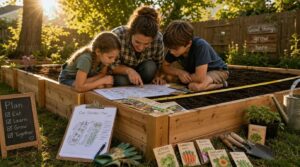
A good plan—and for homeschool families, that plan does double duty. Before you buy materials or break ground, a few key decisions will shape how well your kids learn and grow alongside their plants.
Here’s what to think through first.
Choose Kid-safe Locations
Choose level ground in a traffic-free zone, away from driveways and busy paths. This ensures safety and stability for your garden bed.
For full guidance on spacing, surface transitions, and turning room, accessible raised garden bed design for seniors covers exactly what to plan for before you break ground.
Good sightline supervision from a kitchen window allows you to monitor kids while they dig. Keep a water source nearby for quick rinse-offs, and prioritize a spot with natural shade to protect young gardeners during hot days.
Match Beds to Ages
Once you’ve secured a safe spot, match the bed size to your child. Younger kids thrive with lower, child-sized gardening tools and beds they can reach across easily — garden accessibility matters more than aesthetics.
Adjustable rails and modular frame options let the setup grow with them. Age-appropriate height keeps little ones comfortable, turning your kids’ garden community into a hands-on school gardening program they’ll actually love.
Set Learning Goals
Now that the bed fits your child, build a garden curriculum around what they should actually learn. Use student-friendly language and SMART objectives — "students identify three plant parts" beats "learn about plants" every time.
Observable outcomes and clear assessment criteria turn hands-on learning into real evidence of growth.
Goal alignment with your homeschool schedule keeps educational gardening consistent, not chaotic.
Plan Weekly Garden Lessons
With your learning goals locked in, structure them into a weekly rhythm. Assign each session a garden curriculum theme — soil health in raised beds one week, plant life cycles the next. Build in pre-lesson prompts, hands-on learning, and student reflection time.
Thematic lesson sequencing, literacy integration through journals, assessment rubrics, and parent partnerships through weekly newsletters keep educational gardening consistent and purposeful.
Incorporating a seed spacing activity helps students understand proper planting distances.
Create Student Garden Jobs
Rotate students through five core roles — sowing, watering, weeding, harvesting, and compost integration — using a Responsibility Chart that doubles as your garden maintenance schedule.
Younger kids tackle seed packing; older students own soil testing and irrigation. Earn Skill Badges and lead with Student Leadership moments.
Close each week with Reflection Prompts to reinforce learning.
School gardening programs like Kids Garden Community offer free job rotation templates worth bookmarking.
Choose Safe Raised Bed Materials
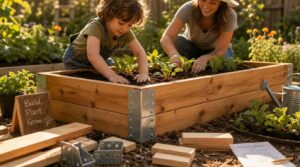
The materials you build with matter more than most people expect, especially when kids are involved. Getting this part right means your bed will be safe, sturdy, and built to last through years of digging, planting, and learning.
Here’s what to look for.
Untreated Cedar Boards
Untreated cedar is one of the smartest choices for raised garden beds in school gardening programs. Its natural rot resistance comes from built-in oils — no chemicals needed, which keeps soil safe for edible crops.
Rot-resistant cedar and 2×6 finished cedar boards are tool-friendly cutting projects kids can help with.
Sustainable sourcing and a simple cleaning routine ensure DIY garden construction remains strong for years.
Galvanized Metal Panels
Galvanized steel brings serious durability to DIY garden construction. The zinc coating provides corrosion resistance that lasts decades outdoors — and when kids inevitably scratch a panel, the zinc sacrificially protects the steel underneath. Choose corrugated profile options for added strength.
Use appropriate installation fasteners and touch up any cut edges.
For school gardening programs, metal side panels and metal end panels hold up season after season with minimal maintenance tips needed.
Rounded Corner Brackets
Sharp corners have no place in a kids’ garden. Rounded corner brackets — especially powder-coated aluminum corner brackets — keep your raised garden bed easy to assemble and safe for little hands. Look for a minimum 3-inch radius, solid load capacity ratings, and finish options that resist rust.
Compatibility guidelines from KidsGardening and DIY woodworking communities recommend pre-drilled mounting hardware for fast, reliable installation.
Child-height Bed Designs
The right bed height changes everything. Garden ergonomics matter even for kids — and KidsGardening research backs this up. A bed that fits the child means less frustration and more focus.
Five designs worth knowing:
- Low Profile Safety beds sit 8–12 inches high for toddlers
- Montessori Floor Layout keeps beds at ground level for full independence
- Convertible Growth Frames adjust height as children grow
- Mini Cabin Storage adds built-in cubbies at reach level
- Under-Bed Learning zones double as child-sized gardening tool storage
Easy to assemble and built around little learners.
Safe Cutting Tools
Building raised garden beds requires cutting boards, trimming liner, and driving screws — so tool choice matters. Child-safe cutters with retractable blades and blade guarding keep fingers away from exposed edges. Rounded tips prevent accidental pokes, while ergonomic grips give small hands real control.
For assembly, a drill and a rubber mallet handle most joints, and tool-free assembly options work well for younger builders.
Build Beds With Learning Activities
Building the bed is where the real classroom magic happens. Every cut, measurement, and assembly step can double as a hands-on lesson in math, science, or problem-solving.
Here’s how to make the build itself part of the curriculum.
Measure Bed Dimensions
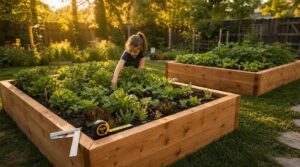
Before you cut a single board, getting your garden bed dimensions right sets everything up for success.
- Keep bed width at 4 by 8 feet — ideal size for small arms to reach the center
- Follow length guidelines: 8 feet max prevents overreach
- Respect height limits: 15 inches deep works for most crops; a shallow 10-inch soil depth suits roots like lettuce
- Maintain safety walkways with 24-inch width clearance between beds
- Apply smart room layout principles so that your garden bed dimensions never block movement
Calculate Soil Volume
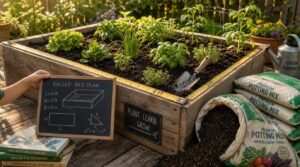
Once your garden bed dimensions are locked in, the math becomes your next lesson. Use the Volume Formula: V = L × W × D (all in feet). For example, a 4 × 8 ft bed with 12-inch soil depth requires 32 cubic feet of soil. Always add 10–15% for compaction adjustment, as soil settles over time.
| Bed Size | Soil Depth | Cubic Feet |
|---|---|---|
| 4 × 4 ft | 12 in | 16 cu ft |
| 4 × 8 ft | 12 in | 32 cu ft |
| 4 × 8 ft | 8 in | ~21 cu ft |
Assemble Simple Frames
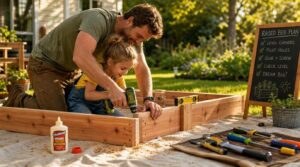
Secure each corner joint with two-inch screws and apply wood glue before driving fasteners.
- Use pilot holes to prevent splitting
- Practice leveling techniques at each corner with a bubble level
- Follow tool safety practices with guarded, kid-friendly tools
Support rail placement along the bottom prevents sagging.
Add Drainage Features
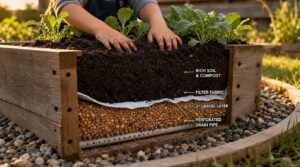
Once your frame is level and secure, it’s time to ensure reliable drainage—critical for preventing crop loss from waterlogged soil. Begin with a Gravel Base Layer: coarse gravel laid 2–3 inches deep at the bottom creates a reservoir that draws excess water away from roots. Protect Perforated Pipe Systems from sediment clogging by layering filter fabric above the gravel. These subsurface components form the foundation of an effective drainage system.
Incorporate Weep Hole Design by adding openings low on side panels to enable lateral soil drainage. Pair this with Surface Swale Integration—a trench around the bed’s perimeter to redirect heavy rainfall away from the structure. Always secure access points with Child-safe Drain Covers to maintain safety without compromising functionality.
| Drainage Feature | Function | Kid-friendly Tip |
|---|---|---|
| Gravel Base Layer | Prevents waterlogging at roots | Let kids pour and spread gravel |
| Perforated Pipe Systems | Moves excess water to outlet | Count pipe holes as a math activity |
| Weep Hole Design | Allows lateral soil drainage | Mark holes with colored chalk |
| Surface Swale Integration | Redirects surface runoff | Trace water flow paths on a map |
Complete the system with a raised bed soil mix composed of 60% topsoil and 40% compost. This blend optimizes soil moisture retention while ensuring efficient soil drainage when paired with the layered infrastructure. Together, these elements create a resilient environment for plant health.
Compare Bed Alternatives
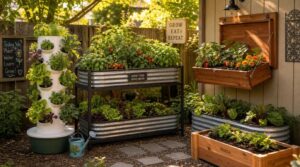
Not every family has room for a traditional raised bed—and that’s where bed alternatives open up your options. Bunk-style or loft designs optimize space efficiency through vertical integration, freeing floor area for lessons.
Wall-mounted fold-down beds offer mobility options for quick reconfiguration.
Weigh your cost comparison carefully: DIY vs. premade kits shifts material cost estimation, and planning for future expandability prioritizes rot-resistant cedar and metal corrosion protection.
Fill Beds for Healthy Growth

Good soil is where the real magic starts. What you put in your raised bed determines how well your plants grow — and how much your kids actually learn from tending them.
Here’s what to add, test, and monitor for a thriving homeschool garden.
Compost-rich Soil Mix
Think of your raised garden beds as a living classroom — and compost is the best teacher in it. The right Organic Matter Ratio transforms lifeless dirt into a system that feeds your plants through steady Nutrient Release Timing and Microbial Activity Enhancement.
Compost transforms lifeless dirt into a living classroom where plants and children grow together
Build your mix using these Compost Application Guidelines:
- 60% topsoil + 40% compost for balanced soil fertility
- Add 10% perlite for Soil Structure Improvement and aeration
- Use mature compost only — immature batches can harm seedlings
- Layer 2–4 inches as your base soil amendment
Worm Castings Experiment
Add worm castings to your raised garden beds and watch the difference unfold. Just 1–2 cups per planting hole gives seedlings a Germination Boost through heightened Microbial Activity and gentle Nutrient Release. Following standard application rates of 10–20% keeps soil fertility balanced without overloading roots.
It’s hands-on organic gardening and horticultural education rolled into one simple, repeatable experiment your kids can track all season.
Mulch for Moisture
Mulch is your raised garden beds’ best moisture manager. A 2-inch layer of organic mulch cuts evaporation, moderates soil temperature, and suppresses weeds — all solid horticultural education in action. For garden bed maintenance, choose wisely:
- Organic Mulch Types – wood chips, straw, or compost
- Inorganic Mulch Options – landscape fabric or black plastic
- Mulch Depth – 2–4 inches works best
- Mulch Application Timing and Mulch Maintenance Tips – apply after watering; replenish each season
Drip Irrigation Basics
Drip irrigation systems do the heavy lifting so your students can focus on observing, not overwatering. A simple setup — mainline design, pressure regulator, backflow preventer, and emitters — cuts water use by 25–30% compared to sprinklers.
| Component | Purpose |
|---|---|
| Pressure regulator | Keeps flow safe for emitters |
| Filter maintenance | Prevents clogging monthly |
| Backflow preventer | Protects your water supply |
| Emitter spacing | Targets roots directly |
Weekly Moisture Checks
Healthy soil thrives at 40 to 60 percent moisture. Once a week, have students press a finger into the bed, then confirm the reading with a plant moisture meter. This consistent monitoring ensures accuracy and engages students in hands-on learning.
Log all data—soil percentage, rainfall, temperature—in your Moisture Log Templates. This practice transforms observations into actionable Weather Correlation data. Review the numbers collectively to refine your irrigation schedule, turning overwatering prevention into a habit rather than guesswork.
Grow Lessons From Harvests

The real magic of a raised bed shows up at harvest time—and so does the learning.
Every vegetable pulled from the soil opens a door to science, math, money skills, and even cooking.
Here’s what to do with your kids once the growing gets going.
Beginner-friendly Vegetables
Start simple, and you’ll be harvesting in weeks. Fast-growing greens like spinach and arugula are ready in 21 to 45 days — perfect for keeping kids engaged.
Simple root crops like radishes provide quick salad leaves, and beginner beans thrive with basic soil composition and drainage for raised beds.
Easy tomato starters and vegetable gardening in raised garden beds, along with garden bed construction, round out a confident first season.
Plant Life-cycle Journals
Once your kids know what grows, it’s time to track how it grows. Life-cycle journals turn raised garden beds into a living outdoor classroom.
Each entry uses Data Recording Sheets and Growth Chart Templates to log height, leaf color, and stage.
Stage Reflection Prompts and Weather Correlation notes deepen student engagement, making hands-on learning stick far beyond the planting schedule.
Pest Observation Walks
After journaling plant stages, shift your students’ attention to what’s moving through the bed. Pest Observation Walks build real Insect Identification skills — kids map Entry Points, log Damage Signature details, and track Seasonal Pest Trends over time. Observation Journaling ties it all together.
Good garden bed ventilation and soil erosion prevention also naturally reduce pest pressure, making pest control in raised beds far more manageable.
Seed Budgeting Practice
Once your students know what’s living in the bed, they’re ready to understand what it costs to grow there. Seed budgeting practice turns the garden into a real math classroom.
- Use per-bed costing to assign each crop a clear dollar value
- Apply germination adjustment so students buy enough seeds for a full stand
- Compare bulk seed purchasing against single packets to find the better deal
- Keep a student seed journal tracking spend, germination, and results
- Introduce seed saving economics — saved seeds lower next season’s costs considerably
Garden-to-table Cooking
Harvesting from your raised garden beds doesn’t stop at the soil. Plan meals around what’s ready — that’s Seasonal Harvest Planning in action.
Set up Cooking Safety Stations with child-height counters and kid-friendly knives, then put Flavor Preservation Techniques to work: quick sautés, roasting, and Herb Infused Dressings straight from the garden.
Kid-Friendly Recipes turn every harvest into a hands-on lesson worth savoring.
Frequently Asked Questions (FAQs)
What is an alternative to raised beds?
You don’t need a single board or bolt to grow a thriving garden. Container Gardens, In Ground Planting, Straw Bale Beds, Gabion Structures, and Upcycled Pallet Beds all work beautifully.
Which vegetables grow best in cold climates?
Kale’s frost resistance makes it a top pick—it survives down to 0°F. Spinach’s light-frost tolerance keeps harvests going.
Pea’s early maturity suits cool windows.
Carrot’s sweetening in cold and Brussels sprouts’ flavor both improve after a chill.
How do you store garden beds during winter months?
Cover beds with frost cloth, layer 3–4 inches of mulch insulation, and monitor soil moisture weekly.
A cold frame extends the season.
Rot-resistant cedar and stainless steel hardware guarantee garden bed longevity through winter.
Are raised beds suitable for apartment balconies or patios?
Yes, raised garden beds work well on balconies and patios. Check weight limits first and confirm proper balcony drainage to ensure structural safety and functionality.
Choose compact bed shapes, heat-resistant materials, and modular layouts for flexible, weatherproof growing. This approach optimizes space while adapting to environmental conditions.
Conclusion
Imagine a nine-year-old who once dreaded math now calculating exactly how many carrot seeds fit in her row—without being asked. That shift happens naturally when raised garden beds for homeschool families replace passive learning with real stakes. She’s not practicing fractions; she’s protecting her harvest.
Every bed you build becomes a classroom that grows with your child. Plant the first seed, and watch what follows—in the soil and in them.
- https://durablegreenbed.com/raised-garden-beds-schools/?srsltid=AfmBOoqY3gAORZjpmkkxsTQsGb1tawjNKF_nc6tlAyOc52QeiD9V3UqA
- https://ourkiwihomeschool.com/incorporate-homesteading-into-homeschool/
- https://nutrientsforlife.org/learning-garden-7-raised-beds/
- https://joegardener.com/top-5-raised-bed-benefits/
- http://learninprogress.blogspot.com/2016/06/building-raised-bed-garden-in-library.html