This site is supported by our readers. We may earn a commission, at no cost to you, if you purchase through links.
A 4×4 raised bed holds roughly 12 cubic feet of growing space—enough to produce a season’s worth of lettuce, herbs, and cherry tomatoes from a single patio corner.
Many gardeners assume limited square footage means limited harvests, but the math works differently in raised beds. Soil depth, smart layouts, and the right materials transform productivity, turning compact areas into high-yield gardens.
Whether on a narrow balcony, rooftop, or walled urban courtyard, these beds outperform traditional ground plots three times their size.
Designs, materials, and planting strategies prove that small spaces can deliver abundant, thriving harvests.
Table Of Contents
- Key Takeaways
- Best Small-Space Raised Bed Layouts
- Top 10 Raised Garden Bed Picks
- 1. Fiwithy Black Raised Garden Bed Cart
- 2. Vegepod Large Self Watering Raised Bed
- 3. Giantex Wood Raised Bed with Trellis
- 4. Keter Wood Look Outdoor Raised Garden Bed
- 5. Yaheetech Wooden Raised Garden Bed with Shelf
- 6. Gardzen Heavy Duty Fabric Grow Bag
- 7. Plant Plot Galvanized Metal Garden Bed
- 8. RealSteel Durable Garden Plant Markers
- 9. Xuwzenkl Fiberglass Garden Hoops
- 10. Sprimden Square Raised Garden Bed
- Choose Durable Raised Bed Materials
- Prepare Soil and Drainage
- Grow More in Less Space
- Frequently Asked Questions (FAQs)
- Conclusion
Key Takeaways
- A 4×4 raised bed with 12 inches of quality soil mix can outproduce a traditional ground plot three times its size, so don’t let a tight patio hold you back.
- Matching your bed material to your goals matters — cedar, galvanized steel, and fabric grow bags each offer distinct advantages, from longevity to portability.
- Smart space techniques like square-foot planting grids, vertical trellises, and compact crop choices (e.g., dwarf tomatoes, radishes, bush cucumbers) maximize yield in minimal space.
- Nail the basics — compost-rich soil, proper drainage, and appropriate crop depth — to preempt the three most common raised-bed mistakes.
Best Small-Space Raised Bed Layouts
Getting the layout right is half the battle in a small garden. The way you arrange your beds determines how much you can grow, how easily you can reach every plant, and how well the whole space actually works.
A smart layout starts with knowing your plants — these vegetable garden planning tips can help you map out spacing and placement before you dig a single hole.
Here are five layouts worth considering.
4×4 Starter Bed Design
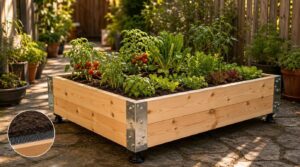
A 4×4 starter bed is the sweet spot for compact raised beds — big enough to grow real food, yet small enough to reach every corner without stepping inside. Construct yours with 2×6 pine boards, reinforced with metal L-brackets for structural integrity, and equipped with adjustable feet to level uneven ground. Additional features include a water seal coating inside, a rodent guard mesh base, and lid integration to protect soil between seasons. Ensure the bed receives six hours of direct sunlight daily to maximize yield.
- 48×48-inch footprint fits patios, side yards, and tight corners
- Metal L-brackets keep corners rigid and square
- Adjustable plastic feet prevent moisture wicking from below
- Hardware cloth bottom doubles as a rodent guard
- A 60/40 raised bed soil mix fills 12 inches deep for most vegetables
Consistent sunlight exposure is critical for healthy plant growth and abundant harvests.
Wall-side Narrow Beds
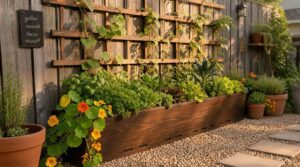
Once your 4×4 bed is thriving, a wall-side narrow bed opens up every forgotten fence line. Width Optimization starts at 28–30 inches — a slimmer footprint that still lets you reach the center easily. Height Ergonomics land around 30–34 inches, countertop-level comfort.
Built-in Drain Slots, Modular Adjustability, and a Wall-Mounted Trellis make this Narrow Series a smart, compact design for serious small space gardening and space-efficient landscaping.
Balcony Corner Layouts

Corner spaces are the hidden gems of balcony gardening. Tuck L-shaped planters into a 90-degree bend, and suddenly you’ve got corner seating, compact raised beds, and a vertical trellis climbing 6 feet — all within 4 square meters.
Add storage boxes underneath and ambient lighting along the railing. L-shaped corner beds make modular gardening feel easy, turning a forgotten nook into a fully productive small-space gardening zone.
Pathway Spacing Tips
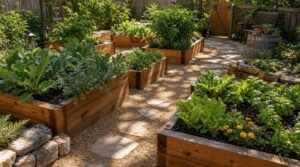
Once your L-shaped corners are sorted, the paths between your compact raised beds deserve just as much thought. Poor aisle width standards turn garden layout planning into a frustrating shuffle. Here’s what works:
- Keep main aisles 24–30 inches wide for comfortable movement
- Allow 28-inch central aisles for reaching both sides of a 4×4 bed
- Use edge barrier options like pavers or stepping stones to protect soil
- Choose surface material selection carefully — compacted gravel or mulch beats loose stone
- Keep slope gradient limits under 5% for safe, easy garden accessibility
Smart spacing is space-efficient landscaping in action.
Rooftop Bed Placement
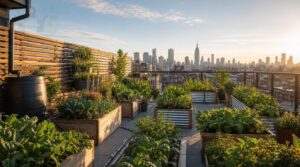
Taking your garden to the rooftop opens up serious growing potential — but smart planning comes first. Align beds using proper sunlight orientation to catch morning light, and employ windbreak positioning to shield plants from gusts.
Run load calculations before installation and choose lightweight portable beds to protect the structure.
Set up rainwater capture with safety barriers along all edges, ensuring solid weather protection.
Top 10 Raised Garden Bed Picks
Finding the right raised bed for a small space comes down to matching size, material, and features to how you actually garden.
These ten picks cover a solid range of styles, from mobile carts to galvanized metal to fabric grow bags, so something useful no matter your setup. Here’s what made the cut.
1. Fiwithy Black Raised Garden Bed Cart
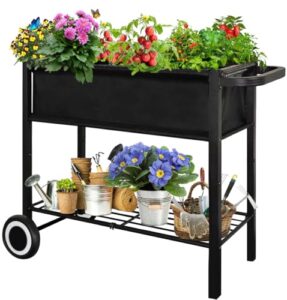
Think of it as a garden on wheels — the Fiwithy Black Raised Garden Bed Cart brings your plants to you, not the other way around.
Its powder-coated steel frame holds a vinyl planting box measuring 31 in × 13 in × 9 in, sitting 31 in off the ground, allowing you to tend to crops without bending.
Two large wheels and an ergonomic handle enable effortless movement to chase sunlight across a balcony or deck.
Three drainage holes prevent waterlogging, while its robust design supports up to 400 lb—ideal for herbs, lettuce, or compact vegetables.
| Best For | Gardeners with back or knee pain, balcony growers, and anyone who wants the flexibility to move their garden around without bending down to tend it. |
|---|---|
| Material | Powder-coated steel + vinyl fabric |
| Assembly | Hardware + screwdriver required |
| Drainage | 3 drainage holes |
| Mobility | 2 wheels + handle |
| Use Case | Vegetables, herbs, flowers |
| Weather Resistance | Moderate – fabric may fade or tear |
| Additional Features |
|
- Stands 31 inches tall so you can garden without crouching — your back will thank you
- Wheels and a handle make it easy to chase sunlight or duck into shade on patios, decks, or rooftops
- Holds up to 400 lb, giving you plenty of room for herbs, veggies, or small flowers
- The vinyl planting box can fade or tear over time, especially in hot or humid spots
- Assembly takes some patience and may need pliers to get the buckles properly secured
- Once it’s fully loaded with soil and plants, those wheels aren’t quite as helpful as you’d hope
2. Vegepod Large Self Watering Raised Bed
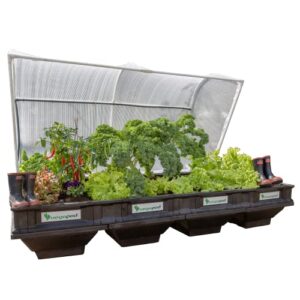
If you’ve ever forgotten to water your garden for a week, the Vegepod Large might just be your new best friend. Its built-in wicking reservoir pulls moisture up to the root zone, keeping soil consistently moist — and in peak summer, a full reservoir lasts up to three weeks without a refill.
The mesh Vegecover canopy blocks pests and softens harsh sun, while zipper panels let you reach in without removing it entirely.
At 78.7 in × 39.4 in with a 40 in stand height, it sits at a comfortable working level.
Assembly takes under 30 minutes, no tools needed.
| Best For | Gardeners with back or mobility issues, forgetful waterers, or anyone dealing with pests and unpredictable weather who wants a low-maintenance setup that actually delivers. |
|---|---|
| Material | Iron frame + polypropylene |
| Assembly | ~20 minutes, minimal tools |
| Drainage | Self-watering wicking reservoir |
| Mobility | Caster-equipped stand |
| Use Case | Vegetables, herbs |
| Weather Resistance | High – storm-tested, 5-year warranty |
| Additional Features |
|
- The self-watering wicking system keeps soil moist for weeks at a time, so you’re not tied to a daily watering routine
- The Vegecover canopy does real work — blocking pests, softening harsh sun, and extending your growing season without much effort
- At waist height with casters underneath, it’s easy on your back and you can roll it wherever the light (or weather) suits you best
- At $549, it’s a serious upfront investment that’s hard to justify if you’re just dabbling in gardening
- Once it’s filled with soil, it’s extremely heavy — moving it becomes a two-person job, and soft ground like grass or dirt may not hold it steady
- The self-watering system only works well if it’s set up correctly; get it wrong and you risk overwatering, which can quietly damage your plants before you notice
3. Giantex Wood Raised Bed with Trellis
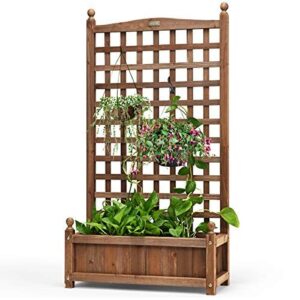
Two jobs, one footprint — that’s the Giantex Wood Raised Bed with Trellis. The solid fir frame measures 11 in. deep × 25 in. wide × 48 in. tall, offering a compact planting box below and a built-in climbing structure above.
Grow herbs or shallow-rooted flowers in the box, then train beans or ornamental vines up the arc-shaped trellis. Drainage holes prevent soggy roots, while mortise-and-tenon joints ensure a sturdy frame.
Note: Fir isn’t cedar, so sealing it yearly significantly extends its lifespan.
| Best For | Balcony gardeners and small-space growers who want to grow herbs, flowers, or climbing plants without taking up much ground space. |
|---|---|
| Material | Solid fir wood |
| Assembly | Pre-drilled, DIY kit |
| Drainage | 2 drainage holes |
| Mobility | Lightweight, relocatable |
| Use Case | Herbs, flowers, small vegetables |
| Weather Resistance | Low – untreated wood, prone to rot |
| Additional Features |
|
- The built-in trellis doubles your growing space vertically, so you get way more out of a tiny footprint.
- Drainage holes and a solid fir frame keep things functional and sturdy for everyday outdoor use.
- Lightweight and easy to move around, which is great for rearranging your setup between seasons.
- The shallow depth isn’t going to work for tomatoes, carrots, or anything with serious roots.
- Fir isn’t naturally weather-resistant, so skipping the yearly seal coat will shorten its life fast.
- It can tip over in strong wind or on uneven surfaces, so placement really matters.
4. Keter Wood Look Outdoor Raised Garden Bed
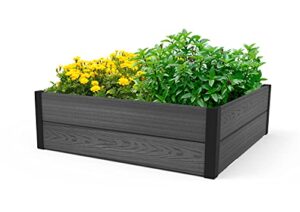
Wood that never rots — that’s the quiet promise of the Keter Wood Look Outdoor Raised Garden Bed.
Its Evotech composite resin panels snap together in about five minutes, no tools needed. The 48 × 48-inch footprint provides a full 16 sq ft of planting space, while the 12.6-inch depth accommodates most herbs, greens, and root vegetables.
The bed withstands temperatures down to –25°F without warping or fading. Clean it once a season, and you’re done.
| Best For | Gardeners who want the look of a wood raised bed without the rot, warping, or seasonal upkeep that comes with it. |
|---|---|
| Material | Composite resin (Evotech) |
| Assembly | Tool-free, ~5 minutes |
| Drainage | Open base |
| Mobility | Stationary |
| Use Case | Vegetables, herbs, flowers, succulents |
| Weather Resistance | High – survives to -25°F |
| Additional Features |
|
- Snaps together in about five minutes — no tools, no frustration
- Tough enough to handle –25°F winters without cracking or fading
- The wood-grain finish looks great without ever needing to be stained or sealed
- No internal metal reinforcement, so it may feel a little less sturdy than it looks
- A few buyers ran into trouble with corner fasteners and found the assembly instructions lacking
- At 12.6 inches deep, it’s deeper than some people expect — worth factoring in before you fill it with soil
5. Yaheetech Wooden Raised Garden Bed with Shelf
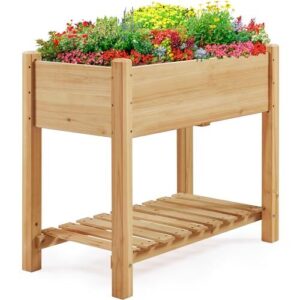
Here’s a bed that pulls double duty — growing space up top, storage shelf down below. The Yaheetech Wooden Raised Garden Bed measures 34 in L × 18 in W × 30 in H, putting your planting surface right at waist height. That 29.5-inch elevation means no more hunching over.
The lower shelf keeps trowels, pots, and soil bags within arm’s reach while you work.
It’s built from smooth fir wood with reinforced base bars for stability.
Just add an exterior sealant — the wood isn’t pre-treated for heavy weather exposure.
| Best For | Gardeners with back or knee pain who want a comfortable, stand-up planting setup on a patio, balcony, or backyard. |
|---|---|
| Material | Solid fir wood |
| Assembly | Hardware + instructions included |
| Drainage | No built-in liner |
| Mobility | Stationary |
| Use Case | Vegetables, herbs, flowers |
| Weather Resistance | Low – requires external sealant |
| Additional Features |
|
- Waist-height design at 29.5 inches takes the strain off your back and knees while you garden
- Built-in lower shelf keeps tools and supplies right where you need them — no more walking back and forth
- Smooth fir wood with reinforced base bars makes it sturdy and easy to assemble with a friend
- Wood isn’t weather-treated, so you’ll need to apply an exterior sealant before leaving it outside long-term
- No drainage liner included, meaning you’ll have to sort that out yourself to avoid water pooling at the bottom
- Some users have run into minor wood splits or misaligned pre-drilled holes during assembly, which can require a bit of extra fiddling
6. Gardzen Heavy Duty Fabric Grow Bag
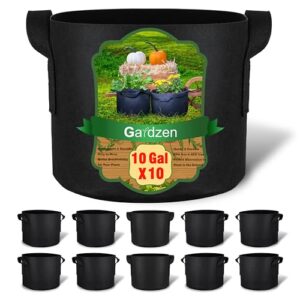
The Gardzen Heavy Duty Fabric Grow Bag offers 10 gallons of growing space in a 16-inch-wide, 12-inch-deep container, requiring no tools or assembly.
The 300 g/m² BPA-free fabric ensures optimal plant health by breathing, draining fast, and air-pruning roots to prevent root-bound conditions.
X-stitched straps provide robust lifting strength, while the foldable design allows you to store it flat in a drawer when the season ends.
Each pack includes 10 bags, combining durability with space-saving convenience.
| Best For | Home gardeners who want a flexible, reusable container for growing vegetables like tomatoes, peppers, or herbs on patios, decks, or in raised-bed setups. |
|---|---|
| Material | Non-woven fabric (BPA-free) |
| Assembly | No assembly required |
| Drainage | High-permeability fabric |
| Mobility | Lightweight, portable |
| Use Case | Tomatoes, peppers, herbs, vegetables |
| Weather Resistance | Moderate – UV degradation over time |
| Additional Features |
|
- Air-pruning design stops roots from circling, which means healthier, more productive plants
- Reinforced X-stitched handles make it easy to move heavy, fully-loaded bags without worrying about tears
- Folds flat when empty, so storing all 10 bags takes almost no space between seasons
- The porous fabric dries out faster than a solid pot, so you’ll likely need to water more often
- Not a great fit for large plants or trees that need more than 10 gallons of root space
- Can break down over time if left out in harsh sun or rough weather season after season
7. Plant Plot Galvanized Metal Garden Bed
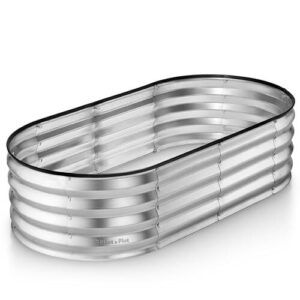
If fabric grow bags feel a little too casual for your setup, the Plant & Plot Galvanized Metal Garden Bed steps things up without emptying your wallet. At just $27.97, this 4 ft × 2 ft × 1 ft bed is built from 0.6 mm zinc-coated galvanized steel that shrugs off rain, heat, and seasonal wear.
The patented tool-free design snaps together in about 20 minutes, with no drilling required .
Its open base drains freely and lets roots reach native soil — perfect for herbs, lettuce, and bush beans.
Every purchase also funds community garden projects.
| Best For | Beginners, renters, or small-space gardeners who want a quick, affordable way to grow herbs, greens, or flowers without a big commitment. |
|---|---|
| Material | Galvanized steel |
| Assembly | Tool-free, ~20 minutes |
| Drainage | Open base |
| Mobility | Stationary |
| Use Case | Vegetables, herbs, flowers |
| Weather Resistance | Moderate – galvanized, coating may chip |
| Additional Features |
|
- Snaps together in about 20 minutes with no tools needed — great if you hate assembly
- Galvanized steel holds up through rain and heat without rusting out on you
- At $27.97, it’s hard to beat the price for a metal raised bed that actually looks decent
- One foot of depth isn’t enough for carrots, potatoes, or anything with serious roots
- The thin steel panels can dent if you’re not careful with them
- No liner included, so you’ll need to grab some landscape fabric to keep soil from slipping out the base
8. RealSteel Durable Garden Plant Markers
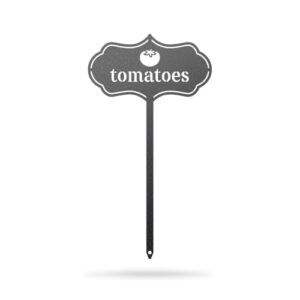
Once your bed is planted and labeled in your head, you’ll want something that keeps track of it all season long. RealSteel markers are laser-cut from US-made steel, powder-coated black, and built to stay legible through rain, heat, and repeated watering cycles. Each marker sits on an 8-inch stake — tall enough to read above mulch — and the 6 × 3.5-inch sign remains rust-free and fade-proof for multiple growing seasons.
At $8.99 each, they’re a sharp, practical upgrade from plastic sticks that crack by midsummer.
| Best For | Gardeners who want long-lasting, good-looking markers that can handle real outdoor conditions season after season. |
|---|---|
| Material | Powder-coated steel |
| Assembly | No assembly required |
| Drainage | N/A – stake product |
| Mobility | Stake-mounted |
| Use Case | Plant identification/labeling |
| Weather Resistance | High – powder-coated, 5-year warranty |
| Additional Features |
|
- Built from US-made steel with a powder-coated finish that won’t rust, fade, or bend
- The 8-inch stake keeps labels visible above mulch and holds firm in wind and rain
- 40 design options make it easy to label just about anything growing in your garden
- At $8.99 plus $2.99 shipping per marker, costs add up fast if you’re labeling a large garden
- Only comes in black, which can be tough to read against dark foliage or soil
- The 3.5-inch sign height means taller plants may eventually hide the label entirely
9. Xuwzenkl Fiberglass Garden Hoops
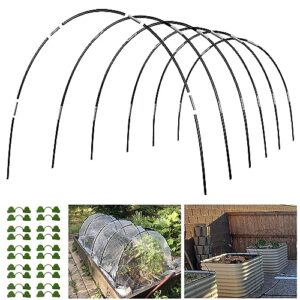
Once your plants are labeled, protecting them is the next move. The Xuwzenkl kit provides 30 fiberglass hoops, 25 metal connectors, and 20 clips — everything needed to build a low tunnel over beds up to 2 feet wide. The hoops bend without snapping and stay stable from -20 to 60°C, ensuring resilience against early spring frosts and summer heat waves.
Note that covers are sold separately, and winds above 35 mph can stress the frame.
| Best For | Hobbyist gardeners who want a quick, affordable way to protect small raised beds from frost or heat without committing to a permanent structure. |
|---|---|
| Material | Fiberglass + plastic coating |
| Assembly | Bend-and-lock DIY |
| Drainage | N/A – hoop framework |
| Mobility | Removable hoops |
| Use Case | Row cover support framework |
| Weather Resistance | Low – breaks in strong wind or snow |
| Additional Features |
|
- 30 hoops, 25 connectors, and 20 clips give you plenty of pieces to cover a good stretch of garden bed
- Fiberglass core with plastic coating means no splinters and no rust, even after a wet season
- Super lightweight and easy to set up — you can have a full tunnel going in minutes
- Strong winds (35 mph and up) or a heavy snow load can break the hoops, so don’t count on them in rough weather
- Covers, netting, and shade cloth aren’t included, so factor in that extra cost before buying
- Moving them around a lot tends to loosen the connections, which gets frustrating fast
10. Sprimden Square Raised Garden Bed
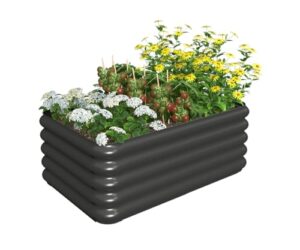
The Sprimden Square Raised Garden Bed is a smart pick if you want something compact and genuinely fuss-free. Built from rust-proof polypropylene with steel tension cables, it snaps together in about 10 minutes — no tools, no frustration.
The standard 3 ft × 3 ft × 1 ft footprint slides neatly into balcony corners or patio edges without eating up walkway space.
It supports herbs, leafy greens, and shallow-rooted vegetables well, though skip it for tomatoes or squash — heavier crops can stress the snap-fit pins over time.
| Best For | Renters, balcony gardeners, or anyone who wants a no-tools raised bed they can set up fast and move around without much hassle. |
|---|---|
| Material | Polypropylene (PP) plastic |
| Assembly | Tool-free snap-fit, ~10 minutes |
| Drainage | Open base |
| Mobility | Lightweight, relocatable |
| Use Case | Herbs, small vegetables, flowers |
| Weather Resistance | Moderate – UV-resistant PP, pins may crack |
| Additional Features |
|
- Snaps together in about 10 minutes with no tools — just push the pins into place and you’re done
- Rust-proof polypropylene holds up through rain, snow, and sun without corroding or fading badly
- Modular sizing means you can combine multiple beds to build out a bigger layout as your garden grows
- The snap-fit pins can be finicky — if they don’t align just right, you risk cracking them under pressure
- Feels noticeably less solid than a metal bed, and heavy soil loads can cause the sides to bow over time
- Fixed panel sizes mean no flexibility to tweak the footprint, and it may shift around on hard surfaces without some extra anchoring
Choose Durable Raised Bed Materials
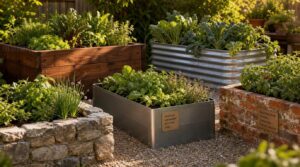
The material you build with shapes how long your bed lasts, how it withstands weather, and what it costs you over time.
Some options hold up for decades, while others are better suited for a single season or a tight budget.
Here’s a look at five materials worth knowing before you build or buy.
Cedar for Long Life
Cedar is the quiet workhorse of small yard gardening. Thanks to natural thujaplicin oils, untreated cedar raised beds offer serious rot resistance — lasting 20 to 40 years with a simple sealant schedule every two to four years.
Cedar raised beds resist rot naturally for up to 40 years, making them the quiet workhorse of small-space gardening
Dimensional stability ensures no warping or cracking, maintaining structural integrity over time.
Cedar also ages beautifully through patina aging, developing a weathered charm. Its sustainable harvesting practices further solidify its reputation as an environmentally smart pick for material durability.
Galvanized Metal Beds
If you want something that outlasts almost everything else in your yard, a rust-resistant galvanized steel bed is hard to beat. The zinc coating longevity alone — protecting steel for 20 to 30+ years — makes it a genuinely smart investment for space-efficient landscaping.
Here’s what makes a galvanized round garden bed kit worth it:
- Welded corner strength locks panels rigid under heavy, damp soil loads
- Open base drainage lets roots breathe and excess water escape freely
- Adjustable leg system levels your compact raised bed on uneven ground
- Seasonal maintenance tips are simple — rinse, inspect, touch up chipped edges with zinc-rich paint
Budget Softwood Options
Budget-friendly garden solutions don’t have to mean flimsy. Cost-effective pine tops the list—lightweight, easy to cut, and it accepts finishes like sealants or exterior paint with no fuss.
Reclaimed pallet wood keeps costs near-zero for DIY garden beds and small raised beds alike.
Pressure-treated options extend lifespan to 7–15 years. A simple DIY frame can be built in an afternoon.
Composite Wood Benefits
Composite wood is one of the smartest picks for small raised garden beds. Built from recycled plastics and wood fibers, it represents a true eco-friendly production, which is a win.
Its moisture barrier prevents water from warping panels, while UV resistance ensures it maintains a sharp appearance for years.
Low maintenance gardening is the reward: cleaning requires only soap and water. Easy installation with snap-fit edges makes it a compact garden solution worth trying.
Fabric Grow Bag Uses
Fabric grow bags punch well above their weight for small spaces. These lightweight, portable beds flex around your schedule and your square footage.
- Root Air Pruning naturally trims roots, building denser, more productive systems
- High Drainage through breathable fabric and drainage holes prevents root rot fast
- Compaction Prevention keeps oxygen flowing to roots all season
- Portable Relocation lets you chase sunlight or dodge frost easily
Adaptable crops — herbs, greens, even fruiting trees — thrive in fabric containers and grow bag raised beds alike.
Prepare Soil and Drainage
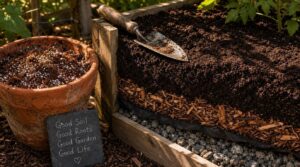
Good soil doesn’t just happen — you build it on purpose. Before you drop a single seed, smart choices about depth, mix, and drainage will determine how well everything grows.
Here’s what you need to set your bed up right.
Soil Depth by Crop
Not every crop needs the same depth — and getting this right saves you wasted soil and stunted plants.
| Crop Type | Soil Depth Needed |
|---|---|
| Shallow Root Needs (lettuce, basil) | 6–8 inches |
| Medium Root Zones (carrots, onions) | 12–18 inches |
| Legume Bed Depth (bush beans) | 12–16 inches |
| Deep Root Depths (tomatoes, peppers) | 18–24 inches |
| Storage Crop Depth (potatoes, parsnips) | 18–24 inches |
Match your soil volume and bed height to what you’re growing. Tomatoes, basil aside, need a depth of 30cm or more for strong roots.
Compost-rich Planting Mix
Once you’ve matched depth to your crops, the next win is what goes inside that bed. A good soil mix starts with compost, peat, and garden soil in roughly equal thirds — that’s your nutrient-rich soil foundation.
- Use 50–70% compost for strong microbial activity
- Keep compost ratios balanced for low salinity
- Add humic benefits through finished, dark compost
- Practice seasonal topdressing 2–3 times yearly
That soil amendment approach builds structure fast.
Gravel Drainage Layer
Good soil mix gets you halfway there — but water management seals the deal. A 2–4 inch drainage layer of crushed stone, expanded clay, or angular gravel keeps roots from sitting in stagnant water. Lay a geotextile barrier first to stop soil fines from clogging your gravel. Proper pipe slope and compaction method matter too.
| Gravel Type | Layer Thickness | Best Use |
|---|---|---|
| Crushed stone | 3–4 inches | Heavy clay soils |
| Expanded clay | 2–3 inches | Lightweight containers |
| Pea gravel | 4 inches | Long-term drainage |
| Angular gravel | 3–4 inches | Standard raised beds |
| Mixed aggregate | 2–4 inches | Multi-season gardens |
Mulch for Water Savings
Once your drainage layer is set, mulching locks in that hard work. Organic mulch — bark, straw, or wood chips — cuts surface evaporation by up to 70%. That means fewer watering trips and healthier roots.
- Apply 2–3 inches evenly across small raised garden beds
- Keep a 2-inch gap around stems to prevent rot
- Pair mulch drip integration with drip irrigation for maximum water conservation
Soil Volume Calculation
Before you buy a single bag of garden soil mix, run the numbers. For rectangular raised garden beds, multiply length × width × depth — keeping units consistent. Convert to cubic feet or cubic yards when purchasing. Beds with uneven bases require depth averaging across several points.
Irregular shapes demand estimation by breaking the layout into simpler sections. Aim for a depth of 30 cm or more to ensure roots truly thrive.
Grow More in Less Space
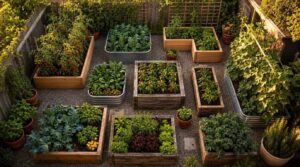
A small bed doesn’t have to mean a small harvest. With the right techniques, even a 4×4 patch can produce more than you’d expect.
Here are five strategies to help you squeeze every bit of potential out of your space.
Square-foot Planting Grids
Think of your bed as a tiny farm with a blueprint. Square farming divides your raised bed into 1-foot squares, each assigned by plant size—one tomato, four lettuce heads, or sixteen baby carrots per square.
Use Square Marking Techniques with string or wood slats to organize the layout. Practice Northward Plant Placement for taller crops to ensure optimal sunlight exposure.
Follow Mixed-Size Planting with Grid Crop Rotation each season to maintain soil health and maximize yield.
Vertical Trellis Crops
Once you go vertical, your raised beds open up a whole new dimension of growing. A wall trellis system or arched trellis system turns climbing crops into space-saving powerhouses:
- Tomatoes — Use tomato trellis tips to train single stems upward, freeing ground space below.
- Cucumbers — A cucumber arch system keeps fruit clean and rot-free.
- Pole beans — Pole bean climbing yields 2–3× more pods per plant.
Add pepper support stakes and metal frame string trellis lines for a complete vertical garden setup.
Tiered Raised Bed Ideas
Stack your growing space like a pro. A three tier vertical garden planter gives each level a purpose — herbs up top, root veggies below.
Use adjustable leg heights to keep tiers level on uneven surfaces. Tiered drip zones deliver water exactly where each crop needs it.
Add integrated seating along the edges, and try companion tier planting or seasonal tier rotation for smarter, compact garden solutions.
Compact Vegetable Choices
Not every vegetable earns its place in small raised garden beds — so pick crops that punch above their weight. Compact Leafy Greens like spinach and arugula thrive in shallow beds, while Mini Root Crops like radishes mature in just 25 days.
Dwarf Tomato Varieties and Bush Cucumbers fit tight layouts beautifully.
Herb Microgreens — think basil and fast-cut microgreens — deliver harvests in weeks, making every square foot count in your compact garden solutions.
Self-watering Irrigation Tips
Self-watering raised beds do the heavy lifting while you’re away. Size your reservoir to match your crop’s thirst — leafy greens need less, tomatoes need more. Cotton or synthetic wick material pulls moisture steadily into the root zone, so soil moisture monitoring becomes almost automatic.
Watch your water level indicator, refill every few days, and let overflow prevention outlets handle the rest.
Frequently Asked Questions (FAQs)
What are three mistakes to avoid when gardening with raised beds?
Three common mistakes trip up even enthusiastic gardeners: bad soil mix without compost, inadequate drainage causing root rot, and plant overcrowding that starves crops of light and airflow.
Wrong bed material degrades fast, too.
Should raised garden beds be in sun or shade?
Shade feels safe, but most vegetables need 6–8 hours of direct sunlight daily. A sunny spot drives faster growth, better yields, and warmer soil for stronger roots.
How do I protect raised beds from pests and animals?
Barrier fencing, netting covers, and mulch barriers block most pests.
Motion deterrents scare off birds and deer.
Companion repellents like garlic discourage insects naturally, keeping your pest control simple and effective.
How do I winterize a raised garden bed properly?
Clear out debris, top-dress with compost, and apply a 2–4 inch protective mulch layer. Drain irrigation lines, inspect your bed’s structure for rot, and you’re set for spring.
Conclusion
Your patio isn’t too small—it’s just waiting for the right setup. Raised garden beds for small spaces transform tight corners, narrow balconies, and forgotten rooftops into productive ground.
Choose materials wisely: cedar for durability, galvanized metal for longevity, or fabric bags for flexibility. Each option adapts to spatial constraints while ensuring resilience.
Layer compost-rich soil, plant vertically, and grid your space strategically. These techniques maximize growth potential in limited areas.
What begins as a modest patch of boards and dirt quietly evolves into something worth harvesting from, season after season.
- https://joegardener.com/podcast/raised-bed-gardening-pt-2/
- https://extension.unh.edu/blog/2024/04/how-utilize-raised-beds-small-space-gardening
- https://beautifuleatsandthings.com/small-space-container-gardening-for-beginners/
- https://landguardgarden.com/blogs/gardening-tips-and-tricks/raised-garden-bed-sizes-which-one-to-choose?srsltid=AfmBOoownA072saPMV5J_DRpkEEFV6-i0lkrXsaup51RfX1ELc_Efh9-
- https://fieldreport.caes.uga.edu/publications/C1027-4/raised-garden-bed-dimensions/