
This site is supported by our readers. We may earn a commission, at no cost to you, if you purchase through links.
Pesticide use in U.S. home gardens has climbed steadily for decades, yet aphid populations have grown resistant to many common chemical sprays. This arms race has a quieter alternative—one that’s been working in fields and kitchen gardens for centuries. Certain plants produce compounds that actively repel insects, confuse pests before they land, or summon predators that hunt them.
Basil releases linalool near tomatoes, sending aphids elsewhere, while French marigold roots poison nematodes living in the soil below. These aren’t folk remedies—they’re plant chemistry doing targeted work. The right natural pest control combinations can protect crops without a single synthetic ingredient.
Such combinations are more precise than most gardeners realize, leveraging specific interactions between plants to create resilient ecosystems.
Table Of Contents
Key Takeaways
- Basil, marigolds, and thyme use real plant chemistry — linalool, alpha-terthienyl, and thymol — to repel aphids, kill soil nematodes, and deter cabbage worms without any synthetic spray.
- Flowers like dill, cilantro, and borage don’t just look good; they pull in ladybugs, hoverflies, and parasitoid wasps that actively hunt the pests damaging your crops.
- Trap crops like nasturtiums and mustard greens intercept pests before they reach your vegetables, with mustard’s glucosinolates even fumigating soil pathogens when tilled under within 24 hours.
- Companion planting works best as a layered system — rotating pairs across beds every season and combining scent barriers, insectary plants, and soil defenders creates resilience that a single spray never can.
Best Pest-Repelling Plant Pairings

Some plant pairings do more than share garden space — they actively protect each other from the insects that cause the most damage. The combinations below rely on scent, chemistry, and biology rather than sprays or traps.
For a deeper look at which pairings actually work, herb companion planting combinations breaks down the science behind scent, chemistry, and natural pest control.
Start with any one of these five, and you’ll notice the difference by mid-season.
Tomatoes With Basil
Pair basil and tomatoes together, and you’re running one of the most reliable companion planting combinations in the garden. Basil releases linalool and eugenol, oils that repel aphids, thrips, and whiteflies — a form of biological pest control that requires no spraying.
Its shallow roots won’t compete with tomatoes, and the dense planting delivers weed suppression, soil moisture retention, airflow improvement, and a genuine flavor boost at harvest timing.
The combination also creates a sweet tart umami balance that enhances the overall flavor.
Carrots With Onions
Basil complements tomatoes beautifully, but carrots and onions solve a different problem.
Onions release sulfurous compounds that disrupt carrot fly navigation — solid pest deterrence without a single spray. This companion planting duo also delivers real nutrient synergy in the soil.
- Pest Repellent Plants: Onion scent confuses carrot flies
- Soil Health: Rotating this pair annually prevents pathogen buildup
- Culinary Pairing: Together they form a classic flavor base for roasts and braises
Beans With Potatoes
Onions handle carrot flies, while beans and potatoes tackle pests from the ground up.
Bush beans are nitrogen-fixing legumes—they pull atmospheric nitrogen from the air and feed it directly to potato roots, boosting yield synergy across the bed.
Their dense canopy aids moisture synchronization and pest dilution, keeping Colorado potato beetles and cucumber beetles off balance through integrated pest management.
Corn With Climbing Beans
Beans and potatoes work from the ground up — and climbing beans take that teamwork even higher when paired with corn. This classic duo exemplifies companion planting at its most efficient.
- Nitrogen fixation feeds corn naturally, cutting fertilizer needs
- Weed suppression improves as beans’ canopy shades the soil between stalks
- Yield synergy increases through complementary growth habits and nutrients
- Moisture conservation stays strong with less exposed bare soil
- Trellis alternatives disappear — cornstalks do the job themselves
Cabbage With Thyme
Thyme does double duty in your garden — it’s one of the most practical companion planting allies for cabbage crops. Its aromatic compounds suppress cabbage worms and whiteflies naturally, delivering real biological control without sprays.
You also gain flavor enhancement and nutrient synergy at harvest time, as thyme’s thymol-rich oils complement cabbage’s mild sweetness perfectly.
| Benefit | How It Works | Practical Tip |
|---|---|---|
| Natural pest control | Volatile oils deter cabbage worms | Plant 6–8 inches from cabbage heads |
| Texture retention | No added moisture disrupts leaf structure | Quick sauté with olive oil and thyme |
| Meal pairings | Earthy thyme brightens cabbage and thyme dishes | Pair with roasted pork or potatoes |
Herbs That Protect Vegetables
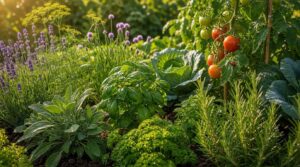
Herbs do more than flavor your food — they quietly run pest control on the side. Their volatile oils, strong scents, and root compounds create a kind of invisible barrier that many insects simply won’t cross.
Herbs don’t just flavor your food — their oils and scents build an invisible barrier insects won’t cross
Here are five herbs worth placing strategically around your vegetable beds.
Rosemary Near Brassicas
Rosemary acts as a living aromatic barrier when planted near brassicas, offering a low-effort, high-reward strategy that organic gardening champions. Its volatile oils deter cabbage moths and aphids upon contact with the air, while both plants thrive in well-drained, slightly acidic soil—a natural compatibility that simplifies care.
Why rosemary works beside brassicas:
- Pest Deterrence — Strong terpenes confuse and repel cabbage moths and aphids.
- Aromatic Barrier — Scent compounds mask brassica odors that attract pests.
- Shade Benefits — Tall, spreading growth reduces pest colonization on lower leaves.
- Drought Tolerance — Rosemary withstands dry spells without competing heavily for moisture.
- Companion Planting Synergy — Shared soil preferences make combined care simple.
Lavender Garden Borders
Lavender borders pull double duty — they create a fragrant scent barrier while deterring moths, flies, and mosquitoes from neighboring vegetables.
Beyond pest control, lavender pairs beautifully with many other blooms covered in this guide to flowers that thrive alongside vegetables.
Space plants 12–18 inches apart along a Fragrance Pathway, then add a 2–4 inches Mulch Layer to lock in moisture.
| Lavender Border Factor | Recommendation |
|---|---|
| Plant Spacing | 12–18 inches apart |
| Drainage Mix | Gravel or sand added |
| Mulch Layer | 2–4 inches deep |
| Pruning Schedule | Post-bloom annually |
| Insectary Role | Attracts beneficial insects |
Container-grown Mint
Mint is a natural pest control powerhouse — its menthol vapors repel ants, aphids, cabbage moths, and flea beetles.
Container lighting requirements: aim for 4–6 hours of direct sun daily. Use a light potting mix with compost, and don’t skip variety selection — peppermint hits hardest on insects.
Time your harvest before flowering for peak oil strength. In winter, move pots indoors to a bright window.
Sage Around Cabbage Crops
Sage is a quiet workhorse in companion planting — its volatile oils confuse cabbage moths before they even land. Plant it 18–24 inches from your cabbage, windward side, so the scent drifts where it counts.
- Space plants 12–18 inches apart as a border
- Use living sage mulch to stabilize soil temperature
- Harvest leaves regularly to refresh pest-repelling oils
- Combine with thyme for stronger natural pest control
Lemon Balm Near Tomatoes
Lemon balm pulls double duty beside your tomatoes. Its citrus scent masks the plant’s aroma, delivering real hornworm deterrence before damage starts.
The shallow root system ensures shallow root harmony—no competition below ground. Above ground, it acts as a pollinator magnet, drawing beneficial insects that handle aphid suppression naturally.
It even creates microclimate humidity that slows fungal spread. This classic companion planting approach requires zero chemicals.
Flowers That Recruit Beneficial Insects

Some flowers do more than look good — they pull in the right insects to fight pests for you.
Lady beetles, hoverflies, parasitoid wasps, and ground beetles all need specific blooms to find food, shelter, and a reason to stick around.
Here are five flowers worth planting if you want nature doing more of the heavy lifting.
Dill for Lady Beetles
Dill is one of the most reliable insectary plants you can add to your garden. Its umbrella-shaped umbels offer easy umbel nectar access for ladybugs, drawing them directly to aphid hotspots.
For best planting time, sow early spring so plants flower when aphid pressure peaks. Strategic dill spacing—roughly 12 inches apart—keeps beneficial insects moving freely between dill companion crops like beans and tomatoes.
Practice post-harvest flower retention by leaving bolted stems standing.
Cilantro for Hoverflies
Cilantro pulls its weight differently than dill — let it bolt, and you reveal its real value. Cilantro flowering timing matters: once those white umbels open in early to mid-season, hoverfly attraction cues kick in fast.
Adults scout nearby plants for aphid colonies, then lay eggs right there. Space cilantro every 10 inches through Brassica rows for steady nectar-rich cilantro variety coverage.
Borage for Parasitoid Wasps
Borage takes companion planting one step further than cilantro. Its blue blooms deliver generous Nectar Rewards that activate Scent Guidance pathways, pulling parasitoid wasps into your garden within two to four weeks of planting. That’s your Early Season Support window — right when pest pressure builds. Plant it in an insectary patch for maximum Vertical Architecture effect.
Borage benefits for beneficial insects:
- Sustains wasp Fecundity Enhancement through continuous nectar from spring to early autumn
- Guides predatory wasps toward pest-hosting plants via strong floral scent cues
- Creates tiered Vertical Architecture that helps beneficial insects locate hosts across multiple plant levels
Sunflowers for Predatory Wasps
Sunflowers do something borage can’t match — their towering heads create a warm microclimate benefits zone that keeps predatory wasps active even on cooler mornings.
Focus on Variety Selection: tall Helianthus annuus cultivars deliver the most nectar volume per bloom. Cluster Planting near pest-prone beds and Succession Planting to align Nectar Timing with late-summer pest surges optimize effectiveness.
Your insectary patch becomes a genuine floral resource planting hub, transforming the garden into a sustainable pest management ecosystem.
Marigolds for Ground Beetles
Few flowers pull double duty like marigolds — they do not just repel pests, they recruit ground beetles (Carabidae) that hunt soil-dwelling insects between crop rows.
Border Habitat Design using Tagetes patula at 15–20 cm spacing creates Beetle Corridors linking hedgerows to vegetable beds.
Varietal Diversity extends Seasonal Bloom Timing, while Soil Moisture Management through mulching keeps beneficial predators active.
That’s companion planting and biological pest management working in sync.
Trap Crops and Soil Defenders
Some plants don’t just repel pests — they lure them away or quietly neutralize them underground before damage even starts. These trap crops and soil defenders work two very different angles, but both protect your garden without a drop of pesticide.
Here are five combinations worth adding to your planting plan.
Nasturtiums Near Cucumbers
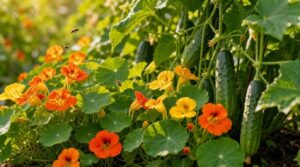
Nasturtiums are one of the hardest-working trap crops you can add to your cucumber bed. Their aromatic defense zone disrupts aphid and cucumber beetle feeding within a 1–2 feet radius, and edge planting design keeps shading minimal while maximizing coverage.
- Space nasturtiums 6–12 inches from cucumber stems
- Continuous bloom cycle sustains beneficial insects like hoverflies all season
- Harvest pairing gives you edible flowers alongside cucumbers
- Nutrient sharing stays balanced — shallow roots won’t compete underground
Radishes Beside Cucumber Rows

Radishes and cucumbers are a quiet power couple in the companion planting world. Planted 2–4 inches from cucumber rows, radishes deliver soil aeration through taproot action, early shade provision for shallow roots, and root exudate disruption that confuses cucumber beetles.
They mature in 25–30 days, giving you a clean organic matter boost when pulled. Watch harvest timing carefully — clear them before vines sprawl.
Alyssum Before Beans

Sweet alyssum is a low-key overachiever in organic pest control. Tuck it between broad bean rows using Alyssum Row Placement at 40–60 cm spacing, and watch the results unfold:
- Alyssum Predator Boost — hoverflies and ladybirds arrive earlier, cutting black bean aphid populations by up to 40%
- Alyssum Moisture Management — dense ground cover suppresses weeds and retains soil moisture
- Alyssum Yield Savings — reduced pest pressure means fewer pesticide inputs and comparable yields
This plant companion synergy earns its spot through Alyssum Flower Longevity, blooming continuously from spring through early summer to sustain beneficial insects all season.
French Marigolds for Nematodes

Few soil threats are as sneaky as root-knot nematodes — they attack underground, leaving you guessing why your tomatoes are struggling.
French marigolds fight back through Root Exudate Chemistry: their roots release alpha-terthienyl, a potent plant allelochemical that disrupts nematode development directly in the soil. This natural allelopathy reduces Meloidogyne populations without chemicals.
| Factor | Recommendation | Why It Matters |
|---|---|---|
| Cultivar Selection | Tagetes patula types | Strongest alpha-terthienyl output |
| Planting Density | 15–20 cm apart | Maximizes root zone overlap |
| Solarization Integration | Solarize before planting | Boosts allelochemical effectiveness |
Maintain Soil Moisture Management by keeping beds evenly moist — waterlogged soil dilutes plant allelochemicals and weakens results.
Mustard Greens as Biofumigants

Mustard greens act as a natural reset button for your soil. Chopping and incorporating the biomass within 24 hours activates glucosinolate, triggering allyl isothiocyanate fumigation that eliminates nematodes and fungal pathogens.
Maintain soil temperatures between 15–25°C and ensure a shallow incorporation depth of 5–15 cm for optimal diffusion.
Add crop rotation scheduling to prevent pest adaptation and support long-term soil health improvement.
Top 6 Natural Pest Control Garden Items
Good plant combinations do the heavy lifting, but the right products make it easier to get started and stay consistent. Whether you’re planting marigolds for nematode control or tracking what’s working in your beds, having the right tools on hand matters.
Here are six items worth adding to your natural pest control toolkit.
1. Benchmark Sunflower Vase Bouquet

Few garden additions pull double duty quite like the top-tier Sunflower Vase Bouquet. You get 10 fresh-cut yellow sunflowers shipped in bud stage, so they open 2–3 days after arrival and stay vibrant longer. A glass vase and flower food are included, making setup straightforward.
At $31.95, it’s a practical way to bring sunflower biology indoors — supporting pollinator awareness while brightening any space.
Just add water, trim stems an inch, and keep them out of direct sunlight.
| Best For | Anyone looking for a cheerful, ready-to-gift bouquet for birthdays, Mother’s Day, or just a pick-me-up — no floral arranging experience needed. |
|---|---|
| Price | $31.95 |
| Primary Use | Gifting |
| Indoor Suitable | Yes |
| Organic/Natural | No |
| Quantity | 10 stems + vase |
| Beginner Friendly | Yes |
| Additional Features |
|
- Ships in bud stage, so the flowers last longer once they arrive and open up over a couple of days
- Comes with a glass vase and flower food — everything’s included, no extra shopping required
- The hidden gift message feature (peel-back label) adds a personal touch without bulky gift packaging
- The vase arrives empty, so the recipient has to set everything up themselves right away
- Heat during shipping can cause wilting, and there’s no guarantee of how the box gets handled or oriented
- A few buyers have reported early wilting or gnats after delivery, which can be a letdown at $31.95
2. Botius Artificial Grape Leaf Garland
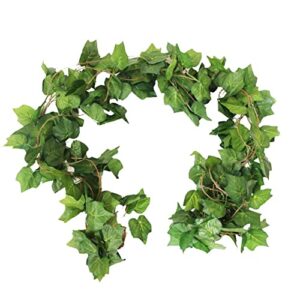
Botius Artificial Grape Leaf Garland offers 38 feet of lush green coverage across five 7.5-foot strands, each carrying 36 silk leaves. Drape it along trellises or arches to fill visual gaps where living vines haven’t filled in yet. At $12.99, it’s genuinely useful for staging garden structures before real plants establish.
The plastic stems carry a noticeable initial odor, so air the garland out for a day or two first.
| Best For | Anyone who wants quick, affordable greenery for weddings, parties, or home décor without waiting for real plants to grow in. |
|---|---|
| Price | $12.99 |
| Primary Use | Décor |
| Indoor Suitable | Yes |
| Organic/Natural | No |
| Quantity | 5 strands (~38 ft) |
| Beginner Friendly | Yes |
| Additional Features |
|
- 38 feet of coverage for just $12.99 — hard to beat for staging arches, trellises, or railings on a budget.
- Pre-shaped leaves mean you can drape and go — no fussing with wire or cutting required.
- Reviewers say it holds up for years outdoors when secured properly, so it’s not a one-season throwaway.
- Fresh out of the box, the plastic smell is pretty strong — plan on airing it out a day or two before use.
- Leaves can pop off when you move or reposition it, so you may need to glue them down for anything permanent.
- No internal wire means you can’t really sculpt or shape it — what you see is pretty much what you get.
3. Outsidepride French Marigold Seed Mix

Unlike artificial garlands, these seeds get to work underground. The Outsidepride French Marigold Seed Mix packs roughly 1,000 heirloom seeds per packet — enough to line entire vegetable beds.
French marigolds release alpha-terthienyl from their roots, which kills up to 70% of root-knot nematodes in surrounding soil.
Plants stay compact at 7–12 inches, fit neatly into borders or containers, and bloom continuously from spring through fall.
Germination runs 5–20 days at 68–76°F, so sow a few weeks after your last frost date.
| Best For | Vegetable gardeners and beginners who want a low-maintenance, pollinator-friendly border plant that does double duty as a natural pest deterrent. |
|---|---|
| Price | ~$5.99 |
| Primary Use | Garden planting |
| Indoor Suitable | Yes |
| Organic/Natural | Yes, heirloom GMO-free |
| Quantity | ~1,000 seeds |
| Beginner Friendly | Yes |
| Additional Features |
|
- Compact, continuous bloomers that fit borders, containers, or window boxes without taking over your space
- Natural nematode fighter — roots actively suppress soil pests, making them great companions for tomatoes and other vegetables
- Heirloom, GMO-free seeds with roughly 1,000 per packet, giving you plenty to fill beds or share with neighbors
- Germination rates can be hit or miss — some gardeners see strong sprouting while others report near-zero results
- Color options are limited to orange, yellow, and red, so it’s not the pick if you’re going for a softer or mixed-color palette
- Needs full sun to perform well; don’t expect much from them in shady spots or low-light indoor setups
4. Seed Needs Garlic Chive Seeds
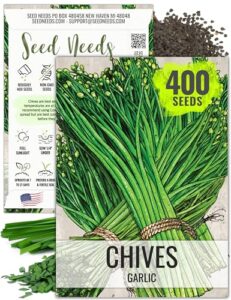
While marigolds work below the soil, garlic chives earn their place above it. Seed Needs Garlic Chive Seeds (Allium tuberosum) gives you around 200 non-GMO, open-pollinated seeds for $3.69 — a small investment for a plant that repels aphids and Japanese beetles with its sulfur-based scent.
Sow seeds ¼ inch deep at 60–70°F soil temperature, and expect germination in 7–14 days.
Plants reach 18 inches, produce ornamental white summer flowers, and double as a fresh kitchen herb year-round.
| Best For | Home cooks and gardeners who want a dual-purpose plant that looks good, keeps pests away, and keeps the kitchen stocked with fresh herbs all year. |
|---|---|
| Price | $3.69 |
| Primary Use | Garden planting |
| Indoor Suitable | Yes |
| Organic/Natural | Yes, non-GMO heirloom |
| Quantity | ~200 seeds |
| Beginner Friendly | Yes |
| Additional Features |
|
- Great value — around 200 seeds for under $4, with plenty left over to save or share
- Pulls double duty as a kitchen herb and an ornamental plant with pretty white summer flowers
- Naturally repels aphids and Japanese beetles, so it earns its spot in any garden bed
- Germination can be hit or miss — some growers see sprouts fast, others get nothing
- It’s an annual, so you’ll need to re-sow every season once winter hits
- Extreme heat (100°F) can stall growth, so hot climates need extra attention to soil moisture and shade
5. Incas Organic Chrysanthemum Tea
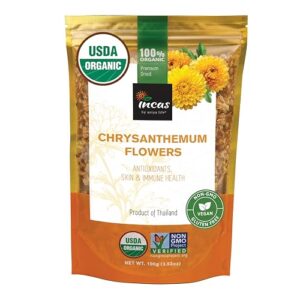
Chrysanthemums don’t just look good — they work hard in the soil. Incas Organic Chrysanthemum Tea offers 100 g of whole dried flowers, USDA-certified organic and sourced from northern Thailand, with no additives or preservatives.
Brew about 20 buds in 250–350 ml of hot water for a calming, caffeine-free tea rich in antioxidants, potassium, and magnesium. Enhance the flavor with honey or goji berries.
This practical dual-use plant serves as both a pest deterrent in the garden and herbal support in your cup.
| Best For | Anyone who wants a clean, caffeine-free herbal tea — especially those sensitive to caffeine, into natural wellness, or looking for a light daily ritual. |
|---|---|
| Price | $14.99 |
| Primary Use | Herbal tea |
| Indoor Suitable | Yes |
| Organic/Natural | Yes, USDA organic |
| Quantity | 3.53 oz (100g) |
| Beginner Friendly | Yes |
| Additional Features |
|
- USDA-organic and non-GMO verified, so you know exactly what you’re getting — no fillers, no surprises.
- Naturally caffeine-free with antioxidants, potassium, and magnesium, making it a solid swap for evening drinks.
- Versatile — works hot or iced, and pairs nicely with honey or goji berries if you want a little extra flavor.
- Pricier than most chrysanthemum teas on the market, which might give budget-conscious shoppers pause.
- Flower color, aroma, and intensity can vary batch to batch, so the experience isn’t always consistent.
- The flavor runs strong — use too many buds and it tips into bitter territory pretty quickly.
6. Gardening Log Book and Planner
Tracking companion plantings, pest outbreaks, and harvest dates across an entire season is harder than it sounds — and that’s exactly where this 169-page Gardening Log Book earns its place. At $9.99, it includes 50 plant-specific log spreads, monthly planners, a companion planting chart, and grid pages for bed design.
You can document basil placements near tomatoes, note marigold effectiveness against nematodes, and plan next season’s trap crops without losing data between notebooks.
| Best For | Hobbyist gardeners who want one tidy spot to track plants, plan seasons, and manage supplies without juggling loose notes. |
|---|---|
| Price | $9.99 |
| Primary Use | Garden planning |
| Indoor Suitable | Yes |
| Organic/Natural | No |
| Quantity | 169 pages |
| Beginner Friendly | Yes |
| Additional Features |
|
- Covers almost everything in one book — plant logs, monthly planners, companion planting chart, and grid pages for bed layouts
- At $9.99, it’s an easy buy for the organization it offers
- Compact enough to toss in a bag and bring out to the garden
- Paper feels thin and print quality looks a bit pixelated, so it’s not built to last through rough handling
- Only 50 plant log pages — bigger gardens will hit that ceiling fast
- Calendar pages are year-specific, meaning you’ll need a new one each season
Frequently Asked Questions (FAQs)
Can companion planting replace chemical pesticides entirely?
Companion planting considerably reduces pest pressure, but it rarely eliminates the need for pesticides entirely.
Think of it as your first line of defense — one that works best when combined with good garden hygiene.
Which plant combinations work best in containers?
Even a single pot can become a powerhouse — try tomatoes with basil, carrots with onions, or cabbage with thyme.
Each pairing pulls double duty: boosting growth while quietly pushing pests away.
How do you rotate companion plants each season?
Rotate companion pairs to a different bed each season and do not return them to the same spot for at least three years.
That simple rule breaks pest cycles before they take hold.
Do pest-repelling plants work in shaded gardens?
Yes, several pest-repelling plants thrive in shade. Mint, lemon balm, and sweet woodruff all tolerate low light while still emitting the aromatic compounds that deter mosquitoes, aphids, and crawling insects.
Can these combinations attract unwanted wildlife or pests?
Nasturtiums draw aphids on purpose, but unmanaged trap crops become pest sources.
Dense plantings shelter slugs and small mammals, so weekly monitoring keeps problems from escalating.
Conclusion
It’s no coincidence that the most resilient gardens rarely rely on a single defense. Every natural pest control plant combination described here mirrors how ecosystems actually function—layered, interdependent, and self-reinforcing. Basil confuses aphids, marigolds poison nematodes below ground, and dill calls in the predators that finish the job.
Build these partnerships deliberately, and your garden stops reacting to pest pressure. Instead, it prevents it before the damage begins.
- https://journeywithjill.net/gardening/2019/02/26/companion-planting-pest-control/
- https://www.friendsofnoyespark.org/news/what-is-companion-planting-how-does-it-work-examples
- https://gardenandgun.com/five-companion-plants-to-eliminate-garden-pests
- https://countrycomfortfarma.com/f/companion-planting-why-marigolds-and-basil-are-our-secret-we
- https://www.projectnoah.org/spottings/1296056418