
This site is supported by our readers. We may earn a commission, at no cost to you, if you purchase through links.

Most gardeners write off their beds the moment temperatures dip below freezing. That’s a costly mistake — and one you don’t have to make.
A well-placed cloche can hold temperatures 8–12°C above ambient levels, turning a killing frost into a manageable inconvenience. Kale, parsnips, spinach, and a handful of other cold-tolerant crops don’t just survive under that protection — they actively thrive, with some root vegetables converting starches to sugars in response to the cold, improving their flavor.
Knowing what vegetables survive frost under cloches is half the equation. The other half is understanding which cloches work best, and how to manage them so your plants don’t cook on a sunny morning after surviving the night.
Table Of Contents
- Key Takeaways
- Frost-Hardy Vegetables Survive Under Cloches
- Best Leafy Greens for Frost
- Root Vegetables That Handle Frost
- Cloches That Protect Vegetables Best
- Keeping Cloches Safe in Frost
- Frequently Asked Questions (FAQs)
- Which vegetables need to be covered in a frost?
- What vegetables will die-back after a light frost?
- Can cold weather crops survive a frost?
- Can vegetables survive a frost?
- What vegetables grow best in a cold frame?
- Can broccoli take a light frost?
- Do cloches work effectively on sloped or raised beds?
- When should cloches be permanently removed after winter ends?
- Conclusion
Key Takeaways
- Cloches raise temperatures 8–12°C above ambient, converting a killing frost into manageable conditions for cold-tolerant crops like kale, spinach, and root vegetables.
- Frost actually improves certain crops — parsnips and carrots convert starch to sugar in cold conditions, deepening their flavor rather than diminishing it.
- Choosing the right cloche type matters: glass bell cloches suit individual plants, while low tunnels and cold frames scale protection across entire beds with varying levels of thermal retention.
- Proper cloche management — venting by mid-morning, mulching roots 2–3 inches deep, and harvesting quickly to minimize heat loss — is just as critical as the cover itself.
Frost-Hardy Vegetables Survive Under Cloches

Not every vegetable waves the white flag when frost arrives — the right varieties hold their ground remarkably well under cloches.
Pairing them with cool-weather gardening techniques can push your harvest window even further into the cold months.
Knowing which crops to reach for makes the difference between a bare winter garden and one that keeps producing through February. Here’s a look at the frost-hardy vegetables that earn their place under cover.
Kale and Collards
Kale and collards rank among the most cold-hardy crops you can grow under cloches, surviving temperatures that would kill most greens.
- Lacinato and Siberian kale thrive beneath low tunnels
- Both deliver vitamins A, C, and K in meaningful amounts
- Cut-and-come-again harvesting extends yields through winter
- Collards’ mild, earthy flavor suits long braises
These plants are notable for their high sulforaphane levels which may offer anticancer properties.
Harvest outer leaves to keep plants productive.
Spinach Varieties
Spinach picks up where kale leaves off in cold-weather versatility. Winter Bloomsdale and Giant Winter survive below 15°F under cloches, while savoy types like Bloomsdale Long Standing offer firmer leaves that hold up well in soups and sautés. Flat leaf varieties suit raw salads but handle frost less reliably. All deliver vitamins A, C, and K in meaningful amounts.
| Variety | Key Trait |
|---|---|
| Winter Bloomsdale | Survives below 15°F |
| Giant Winter | Strong cold tolerance |
| Tyee | Bolt-resistant semi-savoy |
| Bloomsdale Long Standing | Rich flavor, savoy texture |
| Space | Fast-growing flat leaf |
Mache and Claytonia
These two winter greens occupy a quiet but valuable corner of the cold-season garden. Mache and Claytonia both survive hard frosts below 20°F in well-drained soil, with cloches extending their harvest window well into February.
Mache delivers a soft, nutty sweetness; Claytonia counters with a clean, mildly salty note. Broadcast Claytonia’s fine seeds directly onto prepared soil, pressing lightly — no burying needed.
Arugula and Mustard Greens
Where mache offers quiet sweetness, arugula delivers peppery heat — ‘Surrey’ and ‘Astro’ yield harvests through February under cloches. Mustard greens cut sharper, with a raw horseradish bite. Both grow fast:
- Arugula ready in 25–40 days
- Mustard greens in 40–60 days
- High in vitamins A, C, and K
- Flea beetles need row cover control
- Finish pizzas or salads with either green
Carrots and Parsnips
Root vegetables are the quiet workhorses of the frost garden. Carrots and parsnips withstand temperatures between 12°F and 25°F, and a hard frost actually sweetens parsnips — their starch converts to sugar, deepening that nutty, caramelized flavor.
Beets share this cold-weather magic too — for a deeper look at timing your harvest, seasonal root vegetable care tips can help you nail that perfect post-frost sweetness.
Frost sweetens parsnips — converting starch to sugar and deepening their nutty, caramelized flavor
Both need loose, stone-free soil to form straight taproots. Don’t wash them before storage; moisture accelerates spoilage faster than cold ever will.
Best Leafy Greens for Frost
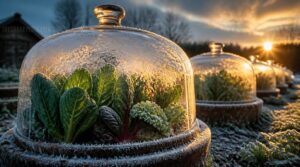
Not every green holds up when temperatures drop hard, but a handful of leafy crops are built for exactly that kind of pressure. Under cloches, the right varieties don’t just survive — they keep producing through conditions that would finish off most garden plants. Here’s what’s worth growing when frost is part of your forecast.
Lacinato Kale
Lacinato kale is built for cold. Its blue-green, pebbled leaves stay tender through repeated frosts, and flavor actually deepens after temperatures dip — that mild, nutty earthiness sharpens into something more intense. Under a cloche, it thrives well into winter.
Harvest outer leaves progressively from the bottom, leaving the central stem intact. Young leaves at 30–45 days deliver the best texture for raw preparations.
Winter Spinach
Winter spinach rarely gets the credit it deserves. Varieties like Giant Winter and ‘Tyee’ tolerate temperatures down to 20°F, and their savoyed, crinkled leaves hold up far better under light frost than smooth-leaf types.
Cold weather concentrates sugars inside the leaves, producing a noticeably sweeter flavor.
Top five reasons to grow winter spinach under cloches:
- Survives hard frosts with minimal protection
- Savoyed leaves resist ice damage better
- Sow late summer for spring harvest
- Harvest outer leaves to extend yield
- Cloche cover maintains above-freezing daytime temps
Cold-hardy Lettuce
Lettuce might seem too delicate for frost, but cold-hardy varieties like Winter Density and Arctic King form compact rosettes with thickened cuticles and lignified leaf veins that physically resist ice formation. Elevated sugar concentrations act as natural antifreeze inside leaf tissues, keeping them tender rather than damaged.
Under a cloche, Rouge d’Hiver and Merveille des Quatre Saisons stay harvestable well into late autumn.
Swiss Chard
Swiss chard’s rainbow-colored stalks — red, yellow, orange, white — make it one of the most visually striking winter greens you can grow under a cloche.
- Dense in vitamin K, reaching 700–900 mcg per 100g raw
- Tolerates light frosts with minimal protection needed
- Stems and leaves cook separately for contrasting textures
- Monitor closely for aphid pressure in humid, enclosed conditions
A cloche keeps it productive well into the cold months.
Asian Greens
Asian greens rank among the most cold-hardy crops for cloche cultivation. Bok choy’s mild sweetness matures in 45–55 days; tatsoi’s dense rosette stands up to hard frost.
| Green | Cloche Advantage |
|---|---|
| Bok choy | Mild, sweet; 45–55-day harvest |
| Napa cabbage | Fall harvest; ferments into kimchi |
| Mizuna | Peppery; brightens winter salads |
| Tatsoi | Rosette form; cold-tolerant |
| Komatsuna | Crunchy stems; frost-tolerant |
Row covers sustain the microclimate reliably.
Root Vegetables That Handle Frost

Root vegetables are quietly one of the most frost-resilient groups in the garden, with several varieties handling temperatures well below freezing without losing quality. Under cloches, they gain just enough extra warmth to extend well into the colder months.
Here’s a look at the specific roots worth growing when frost is on the forecast.
Carrots
Carrots tolerate temperatures as low as 12°F, making them reliable candidates for cloche protection well into winter. A medium carrot delivers around 25 calories, beta carotene for eye health, and nearly 2 grams of dietary fiber.
- Withstand 12–25°F under cover
- Orange, purple, yellow, and red varieties available
- Store in damp sand post-harvest
- Roast or eat raw
- Support immune function via vitamin A
Parsnips
Like carrots, parsnips tolerate temperatures between 12°F and 25°F, making them natural candidates for cloche protection. What sets them apart is their sugar conversion after frost — cold temperatures trigger starch-to-sugar conversion in the taproot, intensifying sweetness considerably.
A 100-gram serving delivers 4.9 grams of fiber, and parsnip purees carry astonishing nutritional density. Overwintering them in the ground, covered, rewards patience.
Turnips
Turnips withstand temperatures between 12°F and 25°F, making them well-suited to cloche coverage through hard frost periods. At 28 calories per 100 grams with 21mg of vitamin C and 1.8g of fiber, they earn their garden space.
- Hakurei varieties taste sweet raw
- Purple top suits roasting or pickling
- Golden turnips offer milder yellow flesh
- Harvest greens early for vitamin K
Beets
Beets tolerate temperatures down to about 25°F and respond well to cloche coverage during hard frost. Sandy loam at pH 6.0–7.0 maximizes sugar content.
Their roots concentrate betalain antioxidants and dietary nitrates that convert to nitric oxide, supporting vascular health. Don’t overlook the greens — they carry vitamins A, C, and K, and hold up well sautéed.
Radishes
Radishes sprint to harvest in 20–30 days, making them one of the fastest root crops you can cycle under cloches before hard frost arrives. Their glucosinolate-driven spice intensifies slightly in cold soil — not unpleasantly, just sharper.
Don’t discard the greens; they’re edible, peppery, and nutritious. Successive sowings every 10–14 days keep supply steady well into late autumn.
Cloches That Protect Vegetables Best
Not every cloche does the same job, and choosing the right one can make the difference between a thriving winter harvest and a frost-damaged disappointment. Each type offers a different level of warmth, convenience, and coverage depending on what you’re growing and how much space you’re protecting. Here are the five options worth knowing.
Glass Garden Cloches

Glass bell cloches are the best option for individual plant protection, transmitting light more broadly across the spectrum than plastic alternatives. Borosilicate and soda-lime glass both trap radiant heat effectively, warming soil several degrees above ambient on clear days.
Condensation on the inner surface signals humidity buildup — vent by 10:30 AM to prevent fungal issues without sacrificing accumulated warmth.
Plastic Bottle Cloches

A repurposed 1–2 liter PET bottle, bottom removed, slipped over a seedling, does the same job as purpose-built glass at zero cost. The walls transmit roughly 90% of visible light, so photosynthesis continues normally.
Remove the cap on bright mornings to prevent heat buildup, and bury the base slightly to stop wind from lifting it off.
Row Cover Cloches

Spunbonded polyester or polypropylene fabric draped over hoops creates a breathable frost shield that transmits 70–95% of available light — enough that you won’t need to uncover plants on bright days. A single layer adds 2–6°C overnight, keeping tender crops above freezing, while the weave itself acts as a physical pest barrier, blocking insects without chemicals.
Seal edges with soil or clips to cut drafts.
Low Tunnel Covers
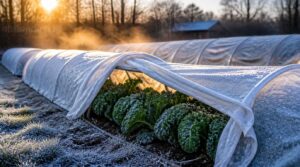
Low tunnels push row cover logic further. Spun fabric or perforated plastic over semi-circular hoops holds temperatures 8–12°C above ambient, carrying kale and spinach through genuine freezes.
- Multi-layer configurations combine fabric and plastic for deeper frost protection
- Fabric weight governs warmth — heavier grades hold more heat
- Switch to insect netting in mild spells to block pests
Vent by mid-morning.
Cold Frame Protection

A cold frame is basically a miniature greenhouse rooted to the ground. Its sloped glazed lid — glass for longevity, polycarbonate for impact resistance — traps solar heat while thermal mass containers like dark-painted water jugs release warmth overnight.
Fit automatic vent openers to prevent midday overheating, insulate the exterior with straw bales, and cold-hardy crops stay productive well into winter without constant supervision.
Keeping Cloches Safe in Frost
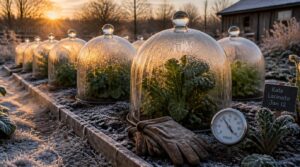
Getting your cloches in place is only half the job — keeping them working through frost takes a few deliberate habits. Temperature, moisture, and timing all play into whether your plants thrive or struggle overnight. Here’s what to stay on top of once your covers are down.
Venting on Sunny Mornings
On bright winter mornings, vent cloches gradually within 15–30 minutes after sunrise to prevent heat shock from spiking internal temperatures 6–12°C above outside air.
Open vents to roughly 20–40 percent height on the sunny side, allowing warm air to escape while controlling internal humidity and preventing fungal growth on tender leaves. Reseal by late morning to lock in warmth for frost protection.
Mulching Vegetable Roots
Venting controls the air — mulch protects the ground. A 2–3 inch layer of straw or compost around root crops like carrots and parsnips reduces frost penetration and cuts soil moisture loss by up to 60 percent.
Apply these materials in order of effectiveness:
- Straw — light, airy, minimal compaction
- Compost — feeds soil structure while insulating
- Bark mulch — stabilizes moisture around beets
- Wood chips — moderates temperature swings overnight
Keep mulch clear of crowns to prevent rot.
Preventing Excess Condensation
Mulch seals the soil — but condensation threatens from above. When humidity inside a cloche exceeds 60 percent, dew point approaches cold surface temperatures, triggering droplet formation that fosters fungal disease.
Install a vapour barrier along interior panel edges and apply anti-condensation coatings to glass or plastic. Place a hygrometer nearby. Vent by 10:30 AM on clear mornings to flush moisture before temperatures fall again.
Harvesting Without Heat Loss
Once condensation is managed, your next challenge is harvesting without collapsing the microclimate you’ve built. Every second the cloche stays open, accumulated warmth escapes rapidly.
Harvest in the cool morning hours, handle leaves gently to preserve cell structure, then reseal covers immediately. For winter greens like kale and mache, cut outer leaves only — the crown stays protected, and the cloche restores temperature within minutes.
Frequently Asked Questions (FAQs)
Which vegetables need to be covered in a frost?
Not every plant in your garden is quietly tough. Frost-sensitive crops like lettuce, spinach, arugula, and Asian greens need cover once overnight temperatures threaten to drop below freezing — cold hardy crops like kale can wait a little longer.
What vegetables will die-back after a light frost?
Basil, peppers, tomatoes, and cucumbers die back after even a light frost. Beans and corn suffer cell rupture in pods. These frost-tender vegetables can’t recover once temperatures drop below 32°F.
Can cold weather crops survive a frost?
Yes, cold-hardy crops can survive frost, especially when sheltered by cloches. Varieties acclimated to cold develop cellular tolerance that resists ice crystal damage, allowing continuous growth through temperatures well below freezing.
Can vegetables survive a frost?
Many vegetables do survive frost — kale, spinach, and root crops like carrots have built-in cold weather toughness, tolerating temperatures as low as 12°F when conditions are right.
What vegetables grow best in a cold frame?
Spinach, kale, mache, and arugula thrive best in a cold frame, along with carrots and radishes. These crops tolerate near-freezing temperatures while continuing to produce through winter.
Can broccoli take a light frost?
Broccoli can withstand light frosts down to 26°F without significant damage, especially when heads are still developing. A cloche placed over plants in late afternoon gives enough warmth to protect florets through the night.
Do cloches work effectively on sloped or raised beds?
Cloches work well on both, though each terrain has quirks. Raised beds warm faster but need careful venting on sunny days. Sloped beds concentrate heat on the upper side, so anchor cloches firmly against wind lift.
When should cloches be permanently removed after winter ends?
Like a winter coat you finally shed when morning air no longer bites, remove cloches permanently once nighttime lows stay above 5°C for a full week and three consecutive frost-free nights confirm winter’s hold has broken.
Conclusion
The coldest gardeners are often the most rewarded. There’s real truth in the old saying: fortune favors the prepared. Knowing what vegetables survive frost under cloches isn’t just useful trivia — it’s the difference between a bare winter garden and a productive one.
Kale sweetens, parsnips deepen, spinach endures. Your cloche isn’t a last resort; it’s a precision tool. Use it deliberately, vent it faithfully, and winter stops being a threat worth fearing.
- https://www.growveg.com/guides/3-ways-to-insulate-your-plants-against-spring-frosts
- https://www.theseasonalhomestead.com/top-15-cold-tolerant-vegetables-for-fall-amp-winter-gardening
- https://extension.illinois.edu/blogs/ilriverhort/2018-03-26-time-your-vegetable-plantings-cold-hardiness
- https://homestead-honey.com/10-ways-to-protect-plants-from-frost-and-extend-your-harvest
- https://extension.oregonstate.edu/news/plant-cold-hardy-vegetables-now-spring-harvest