This site is supported by our readers. We may earn a commission, at no cost to you, if you purchase through links.
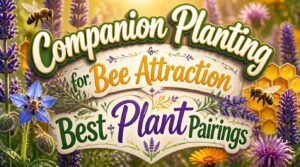
A single bee can visit up to 5,000 flowers in one day—yet most gardens hand her almost nothing worth stopping for. That gap between what bees need and what we plant is a major reason for declining pollinator populations, and it’s one gardeners can quietly close without rethinking the entire yard.
Companion planting for bee attraction works differently than simply scattering wildflowers. The right pairings do double duty: they draw pollinators where your food crops need them most while building the kind of layered, season-long forage that sustains colonies rather than just passing bees through.
The plant combinations ahead range from classic herb borders to vegetable pairings backed by measurable yield data—practical choices that work with how bees actually forage.
Table Of Contents
Key Takeaways
- Strategic pairings like borage with strawberries and sunflowers with squash don’t just attract bees — they measurably boost your harvest by directing pollinators exactly where crops need them most.
- A season-long foraging chain, anchored by early crocuses, midseason lavender, and autumn asters, sustains whole colonies rather than offering passing bees a single fleeting stop.
- Flower shape and color aren’t incidental — open daisy forms, tubular blooms, and UV-visible blue and purple petals each serve different bee species, so mixing them broadens who your garden feeds.
- Attracting bees means nothing if your practices drive them away: untreated seeds, chemical-free pest management, shallow water sources, and undisturbed nesting soil complete the system your plants alone can’t build.
Best Companion Plants for Bees
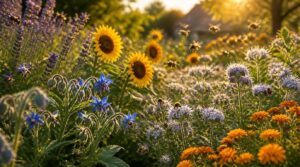
Some plant pairings do more than share space — they actively draw bees in and keep them coming back. Choosing the right companions makes your garden work smarter, turning it into a reliable foraging ground that helps pollinator health season after season.
Pairing the right herbs together amplifies these benefits even further — these herb companion planting combinations show exactly which plants work best side by side to attract and sustain pollinators all season long.
Here are five pairings worth building your garden around.
Lavender and Rosemary
Few plants pull double duty as elegantly as lavender and rosemary. Both Mediterranean natives thrive in full sun with well-drained soil, making them natural companions in any pollinator-friendly bed.
Lavender’s purple spikes draw bees from early summer onward, while rosemary’s blue blooms bridge the spring gap. Plant them together, and you’ve built a drought-tolerant, fragrant foraging station bees won’t overlook. Both species feature nectar-rich flowers that attract bees and butterflies.
Bee Balm and Basil
Bee balm and basil share a rare talent for working a crowd. Both thrive in full sun with well-drained soil, making companion planting straightforward. Their aromatic foliage draws bees chemically, directing pollinators toward neighboring vegetables.
- Bee balm’s nectar-rich whorls attract bees through midsummer
- Basil deters pests near tomatoes and peppers
- Together, they sustain garden biodiversity across the season
Borage and Strawberries
Where bee balm works through summer, borage takes pollinator support a step further by directly boosting your harvest. Intercropped borage can increase strawberry yields by 32–35% by weight, thanks to higher pollinator visitation rates.
Space borage patches 1–2 meters apart along rows to create a pollinator corridor without shading fruit. The edible flowers are a welcome bonus alongside your berries.
Yarrow and Vegetables
Yarrow brings a quieter kind of magic to the vegetable garden. Its flat composite flower heads give bees an easy landing pad, drawing honeybees and solitary species steadily from late spring through early autumn.
Plant it as a border along tomato or pepper beds to create nectar corridors, attract beneficial predatory insects, and let its deep roots improve soil moisture retention nearby.
Sunflowers and Squash
Sunflowers pull mason bees and honeybees to your squash patch right when blossoms need pollinating most.
- Plant sunflowers on the west edge to cast afternoon shade and reduce squash leaf scorch
- Space both crops 3–4 feet apart to limit root competition
- Mulch around both plants to hold shared soil moisture
- Use tall sunflower stems as a natural windbreak for trailing vines
- Let continuous blooms attract beneficial insects that cross-pollinate squash flowers
Seasonal Bloom Pairings
Bees don’t visit your garden on a fixed schedule — they follow the blooms, and so should your planting plan.
A well-timed sequence of companion plants keeps nectar flowing from the first thaw through the final frost, giving colonies what they need all season long. Here are the key seasonal pairings to build that continuous foraging rhythm.
Early Spring Nectar Sources
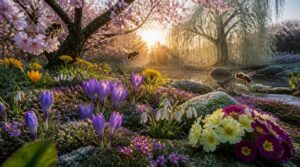
Spring doesn’t wait — and neither should your garden. Dandelions, snowdrops, and crocuses deliver critical nectar before most ornamentals even stir, giving emerging colonies essential fuel.
Pairing these early bloomers with season-long performers like mint creates a near-continuous forage corridor — explore a full guide to herbs that attract and sustain pollinators to build a garden that never leaves your bees hungry.
Willows near damp ground and early fruit tree blossoms like cherry and plum extend that window further. Even compact urban patches planted with primroses or creeping thyme can anchor a meaningful early-season nectar corridor for local pollinators.
Midseason Bee Favorites
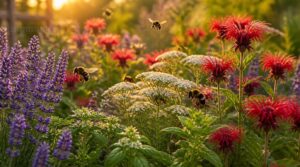
Midsummer nectar peaks arrive as early bloomers fade, and your garden needs to keep pace. Lavender, bee balm, and rosemary drive midseason forage continuity, supporting long-tongued bee forage and pollen load nutrition.
Top four for herb patch diversity:
- Lavender — weeks of dense nectar
- Bee balm — bright blooms, continuous foraging
- Yarrow — bridges mid and late season pollen
- Basil — lightweight, diverse nectar
Late-season Pollen Plants
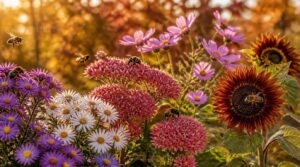
As autumn closes in, late-season pollen plants become a lifeline for colonies building their winter reserves. Asters, sedum, and cosmos keep pollen flowing when most blooms have faded.
| Plant | Bloom Period |
|---|---|
| Asters | September–October |
| Sedum ‘Autumn Joy’ | Late summer–fall |
| Cosmos | August–October |
| Sunflower varieties | Early autumn |
Cluster late bloomers in dedicated patches to concentrate fall forage and reduce bee travel during critical autumn pollen succession.
Continuous Bloom Planning
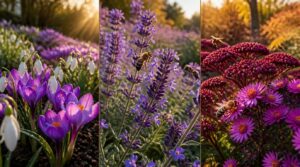
Mapping bloom windows across the season prevents gaps that leave bees without forage. Sowing root dates tied to your last frost keeps bloom times aligned.
Plan overlapping flower cycles using these four anchor points:
- Crocuses and snowdrops for early spring nectar
- Lavender and catmint through midseason
- Asters and sedum into fall
- Update your yearly calendar to reflect zone-specific frost dates
Native Flower Timing
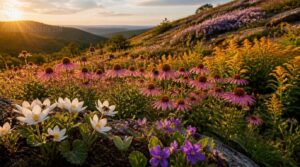
Native plants don’t follow a single clock — growing degree days and photoperiod work together to trigger bloom, not just the calendar date. Southeast natives open several weeks earlier than their northern counterparts, and urban heat islands can push timing even further.
| Native Plant | Bloom Trigger | Bloom Season |
|---|---|---|
| Bloodroot | Soil warmth ~10°C | Early spring |
| Wild violet | Dappled light cue | Late winter–spring |
| Prairie coneflower | Long photoperiod | Late spring |
| Mountain aster | Elevation stagger | Late summer |
| Coastal goldenrod | Mild winters | Late summer–fall |
Soil moisture shapes bloom density — adequate spring rainfall produces larger, longer-lasting flowers that sustain pollinators through peak foraging periods.
Bee-Friendly Flower Shapes
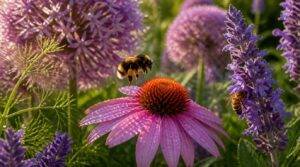
Not all flowers speak the same language to bees, and shape plays a bigger role in attraction than most gardeners realize.
The way a bloom is built — wide and open, narrow and tubular, or packed in dense clusters — determines which bees can access it and how efficiently they forage. Here are the flower forms worth knowing when you’re designing with pollinators in mind.
Open Daisy-like Blooms
Few flower shapes invite bees as reliably as the open daisy-like bloom, where flat ray petals surround a dense central disk floret cluster — basically a built-in landing platform.
Three reasons these composite head structures support pollinator-friendly plants:
- Accessible nectar rewards short-tongued bees immediately
- Bicolor petal varieties attract attention across greater distances
- Clustered planting amplifies visual cues for foraging bees
Plant cosmos or sunflowers alongside vegetables to make the most of flower nectar accessibility.
Tubular Nectar Flowers
Where daisy-like blooms offer open landing platforms, tubular flowers demand a different kind of visitor — one equipped with the right proboscis length to reach deep nectar stores.
| Tubular Plant | Preferred Pollinator |
|---|---|
| Foxglove | Long-tongued bumblebees |
| Salvia | Hawkmoths |
| Honeysuckle | Hummingbirds |
| Snapdragon | Bumblebees |
| Penstemon | Native long-tongued bees |
Nocturnal nectar release in some species draws moths after dark, extending pollination well beyond daylight hours.
Fragrant Herb Blossoms
Scent does much of the heavy lifting here. While shape guides bees to a bloom, fragrance is what stops them mid-flight. Lavender, thyme, and rosemary produce nectar-rich spikes that signal pollinators chemically, drawing them from surprising distances.
Mint family plants like catmint bloom prolifically, though containment prevents sprawl. Harvest basil and thyme stems regularly — it extends flowering and keeps your kitchen stocked too.
Blue and Purple Flowers
Bees see the world differently than we do — ultraviolet nectar guides invisible to humans light up blue and purple petals like runway markers. That’s why lavender, salvia, and verbena consistently outperform other colors in attracting pollinators.
Bees see ultraviolet nectar guides on blue and purple petals that are invisible to the human eye
Anthocyanin pigment variations explain the range from pale lilac to deep violet. Pair these blooms with yellows for maximum complementary color contrast, and you’ll double their visual pull.
Clustered Planting Patches
Grouping nectar-rich blooms into defined patches transforms scattered plants into unmissable foraging destinations. A cluster of 4–12 plants covering 1–3 square meters creates the edge effect bees respond to instinctively.
Five principles for effective patch design:
- Target 1–3 square meters per patch
- Layer plants by height for vertical structure
- Soften patch edges for natural transitions
- Rotate patches every 2–3 years
- Deadhead regularly to extend bloom continuity
Vegetable Garden Companion Combos
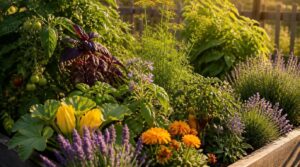
Your vegetable garden can do double duty — feeding your table while pulling in pollinators — when you choose the right plant pairings.
Certain companion combos work especially well at attracting bees while protecting your crops from common pests. Here are five vegetable garden pairings worth trying this season.
Tomatoes With Marigolds
Few pairings work as hard as tomatoes and marigolds. French marigolds release root exudates that suppress nematodes, protecting tomato roots at the soil level while their strong scent masks the odors that draw aphids and whiteflies above ground.
They also attract hoverflies and small bees, boosting fruit set. Plant them at bed edges — they’ll earn their place.
Cucumbers With Nasturtiums
Plant nasturtiums 12–18 inches from cucumber rows, where their bright blooms act as a trap crop, luring aphids and cucumber beetles away from your vines. Their orange and red flowers also guide bees directly toward cucumbers.
- Diverts aphids with preferred feeding targets
- Attracts bees that cross-pollinate cucumber flowers
- Blooms early, extending pollinator presence
- Edible flowers garnish cucumber summer salads
Brassicas With Dill
Dill is a quiet powerhouse in the brassica bed. Its volatile oils confuse cabbage moths during egg-laying, while attracting parasitic wasps that hunt caterpillars before damage spreads. Sow dill 15–18 inches from broccoli or kale stems, staggering sowings every two to three weeks to keep the scent barrier active.
The feathery foliage also contrasts beautifully against broad brassica leaves, drawing beneficial insects deeper into your garden.
Beans With Alyssum
Sweet alyssum earns its place between bean rows by doing two jobs at once: attracting hoverflies and ladybirds that cut aphid pressure, and lifting broad bean pod weight by up to 15%.
- Space alyssum 60–80 cm between rows for best insect access
- Bloom timing aligns with bean flowering for continuous nectar
- Improved predator-to-aphid ratios reduce damage without chemicals
Peppers With Basil
Basil and peppers share more than a raised bed — they share a language. Basil’s aromatic scent compounds act as chemical signals that guide pollinators directly toward your pepper blooms, increasing pollinator visitation rates across the bed.
Both crops need at least six hours of sunlight, so their shared needs make companion planting here a breeze.
Pollinator-Safe Garden Practices
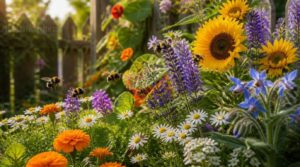
Growing bee-friendly plants is only half the equation — how you manage your garden matters just as much. A few mindful habits can make your space genuinely safe and welcoming for the pollinators you’re working so hard to attract. Here’s what to put into practice.
Choose Untreated Seeds
Seeds coated with fungicides or insecticides introduce chemicals into your soil before a single leaf appears. Choosing untreated alternatives keeps that chemistry out entirely.
Look for:
- Heirloom or open-pollinated varieties with natural disease resistance
- Seeds stored in airtight, cool containers to maintain viability
- Labels confirming no synthetic coatings or treatments
Germination may be slightly slower, but healthy soil biology compensates.
Avoid Chemical Pesticides
Untreated seeds are just the first step — what you spray afterward matters just as much. Chemical pesticides don’t distinguish between pests and pollinators, which means a single application can disrupt an entire foraging cycle.
Lean instead on integrated pest management: combine beneficial insect introduction, physical barrier methods, and microbial agents like Bacillus thuringiensis to handle outbreaks without chemical exposure.
Add Shallow Water
Pesticides aren’t the only threat to bee health — dehydration during hot spells quietly takes its toll too.
A shallow water dish, kept between one and three inches deep, gives bees a safe place to drink without drowning. Place it within 15 meters of your flowering plants, add a flat stone for landing, and refill it weekly using rainwater.
Leave Nesting Habitat
Water keeps bees hydrated, but where they sleep matters just as much.
Solitary bees — which make up most wild species — nest in bare soil, hollow stems, and woody debris rather than hives. Leave a patch of loose, well-drained soil undisturbed, retain some leaf litter, and link these spots to your flowering beds through small habitat connectivity corridors so bees travel safely between nesting and foraging.
Deadhead for More Blooms
Removing spent blooms before they set seed redirects a plant’s energy back into flower production, giving pollinators a longer, richer foraging window. Deadhead cosmos, zinnias, and salvia regularly to encourage repeat nectar-rich blooms throughout summer.
This simple habit extends each plant’s flowering cycle by weeks, making your companion planting more productive and your garden more reliably attractive to bees.
Frequently Asked Questions (FAQs)
What are the best companion plants to attract pollinators?
Lavender, borage, and bee balm top the list, drawing bees through rich nectar rewards and strong scent signals. Sunflowers and marigolds add visual target size, making your garden impossible for pollinators to miss.
What to plant near bee hives?
A single herb garden near your hive can create a nectar corridor so rich that bees will barely need to travel. Plant rosemary, bee balm, and basil within close foraging distance to sustain nectar-rich blooms all season.
Do companion plants improve soil health for bees?
Yes — companion plants actively improve soil health.
Legumes fix atmospheric nitrogen, while deep-rooted herbs aerate soil and diverse plantings boost microbial diversity, all supporting the nutrient-rich, moisture-stable conditions that help flowering plants thrive for bees.
Can container gardens effectively support bee populations?
Roman gardeners already knew it — a single pot of herbs near the door draws bees reliably. Container nectar density from lavender, bee balm, and yarrow sustains foraging bees, turning small spaces into essential urban pollinator corridors.
How does climate zone affect companion planting choices?
Climate zone shapes which plants thrive and when they bloom. Temperate seasonal continuity suits lavender and bee balm, while arid zone irrigation favors drought-tolerant thyme.
Cold climates need fast-finishing annuals; tropical gardens reward hardy perennials.
Conclusion
Think of your garden as a hive itself—every plant a worker, every pairing a purposeful act. Companion planting for bee attraction isn’t decoration; it’s infrastructure.
Lavender anchors the rosemary. Borage feeds the strawberry bed. Each deliberate combination builds a living system that sustains colonies long after the season peaks.
You’re not just growing food. You’re holding a thread in an ecological web that’s quietly fraying—and choosing, plant by plant, to mend it.
- https://deeproots.org/companion-planting-for-urban-food-production
- https://zamzows.com/blogs/lawn-garden/supercharge-your-garden-with-strategic-companion-planting-tips-tricks-and-techniques
- https://thecottagepeach.substack.com/p/companion-planting-for-a-thriving
- https://www.attainable-sustainable.net/companion-planting
- https://northerngardener.org/plant-herbs-for-pollinators