
This site is supported by our readers. We may earn a commission, at no cost to you, if you purchase through links.

Depleted soil doesn’t announce itself dramatically. It just quietly stops cooperating — yields shrink, plants struggle, and the garden that once thrived starts to feel like a losing battle.
Most gardeners respond by adding more fertilizer. That buys time, but it doesn’t fix the root problem. Soil depletion runs deeper than a nutrient shortage; it’s a breakdown in the living system beneath your feet — the structure, biology, and mineral cycling that healthy soil depends on.
The good news? Certain plants do the repair work for you. Fixing depleted soil with companion planting works because the right plant combinations actively rebuild what’s missing — pulling minerals from deep layers, locking in nitrogen, breaking up compaction, and shielding the surface from moisture loss. You just have to know which plants to use, and where to put them.
Table Of Contents
- Key Takeaways
- Test Soil Before Planting
- Add Nitrogen-Fixing Companions
- Mine Minerals With Deep Roots
- Rebuild Structure and Moisture
- Protect Soil With Living Systems
- Frequently Asked Questions (FAQs)
- What companion plants improve soil?
- Can you enrich soil that’s already been used?
- How long does depleted soil take to recover?
- Can companion planting work in raised beds?
- Which companion plants tolerate drought conditions best?
- Do companion planting benefits carry over to next season?
- Can container gardens benefit from companion planting strategies?
- Conclusion
Key Takeaways
- Test your soil first — knowing its texture, pH, and nutrient gaps tells you exactly which companion plants will do the most repair work.
- Nitrogen-fixing plants like beans, peas, clover, and vetch build fertility naturally, so you can skip the synthetic fertilizers and feed your soil from within.
- Deep-rooted plants like daikon radish, comfrey, and dandelions act as mineral pumps, pulling nutrients up from layers your crops can’t reach on their own.
- Protective companions like marigolds, nasturtiums, and polyculture mixes keep pests, disease, and soil stress in check — so your garden starts defending itself.
Test Soil Before Planting

Before you plant a single seed, the soil needs to tell you what it’s working with. Think of this step as listening before you speak — what’s missing, what’s packed down, what’s off balance. Here’s what to check first.
A vegetable planting and care guide can help you decode what your soil’s telling you and take the right steps before anything goes in the ground.
Check Soil Texture
Texture tells you everything. Sandy soil drains fast but dries out quickly. Clay holds water well but can suffocate roots.
Start with a jar test — shake soil and water together, then wait 24 hours. Three layers appear: sand, silt, clay. Use a texture triangle to name your soil type and plan your amendments with confidence. Understanding the three primary particles helps you determine your soil’s moisture and air holding capacity.
Measure Soil PH
Once you know your soil’s texture, pH becomes your next clue. Soil pH controls which nutrients your plants can actually absorb. Even a well-amended bed fails if the pH is off.
Composite sampling across several spots gives you a truer picture. Aim for 6–8 inches deep. Then use a calibrated digital meter for readings accurate to 0.01 pH units — far better than test strips.
Identify Nutrient Gaps
pH tells you one part of the story. Nutrient gaps tell the rest.
Watch your plants closely. Pale yellowing leaves signal nitrogen shortage. Purplish seedlings point to phosphorus uptake problems. Scorched leaf edges reveal potassium deficiency markers.
Three gaps worth testing for first:
- Nitrogen — below 10–20 mg/kg slows growth fast
- Phosphorus — under 15 mg/kg stunts roots
- Potassium — below 100 mg/kg weakens fruiting crops
Map Sun Exposure
Nutrient gaps show what’s missing underground. But sun exposure shapes what can grow above it.
Walk your garden at morning, noon, and afternoon. Note which beds get full direct sun and which sit in shade. South-facing spots stay warmest year-round. Seasonal shifts matter too — a bed that’s sunny in June may lose hours by October. A simple color-coded map keeps companion planting placement accurate.
Mark Compacted Areas
Pooled water after rain is your first clue. Compacted soil can’t drain fast enough, so water just sits.
Look for these signs:
- Surface crusting after rainfall
- Stunted seedling emergence in patches
- Penetration resistance exceeding 2.5 MPa at 10 cm
- Bulk density above 1.4 g/cm³
Map these zones before planting. That’s where soil structure improvement matters most.
Pairing this with a solid crop rotation and vegetable garden planning guide helps you cycle peppers through improved beds season after season.
Add Nitrogen-Fixing Companions
Nitrogen is the engine behind leafy, vigorous growth — and the right companion plants can build it right in your soil.
Certain plants form a natural partnership with soil bacteria, pulling nitrogen from the air and locking it into the ground where your crops can use it. Here are the best nitrogen-fixing pairings to put to work in your garden.
Beans With Corn

Beans and corn are nature’s original power couple. Beans climb the corn stalks for vertical support, while their roots quietly fix atmospheric nitrogen into the soil below.
This symbiotic relationship feeds the corn’s heavy appetite without synthetic fertilizers. The Traditional Three Sisters system proves it — intercropping these two in staggered rows optimizes space and builds soil health season after season.
Peas Near Leafy Greens
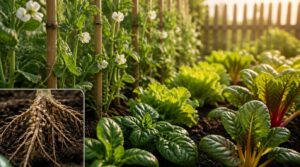
Peas pull nitrogen from the air and deposit it where your leafy greens need it most — the root zone.
Plant them wisely:
- Put peas on the north side to shade greens from afternoon heat
- Space rows 12 inches apart for airflow
- Sow peas first, then transplant greens two weeks later
That extended harvest window keeps your greens producing longer without bolting.
Clover Living Mulch

Clover does double duty. Rhizobium bacteria feeds nitrogen into the soil while a dense mat smothers weeds. White clover can cut soil evaporation by 30%.
| Benefit | Result |
|---|---|
| Nitrogen fixation | Builds soil fertility |
| Weed suppression | Reduces competition |
| Evaporation control | Retains moisture |
| Biomass decomposition | Releases nutrients slowly |
Sow it between crop rows. Mow it low, let the living mulch earn its place.
Cowpeas With Peppers

Cowpeas pull double duty in a pepper bed. They fix atmospheric nitrogen, feeding the soil while shading pepper roots from scorching heat. That soil temperature buffer keeps peppers productive longer.
Plant cowpeas first. Once they hit their first true leaves, transplant peppers nearby. This successional planting strategy optimizes space and timing. Beneficial insects follow the cowpeas — and quietly handle your aphid problem.
Vetch Before Heavy Feeders

Vetch is a powerhouse green manure that loads the soil before your heavy feeders arrive.
- Drill seed ¼ to ½ inch deep
- Let biomass build for several weeks
- Terminate before flowering
- Chop and drop or incorporate
That timing unlocks 60–120 kg of nitrogen per hectare. Tomatoes and corn thrive on what vetch leaves behind.
Mine Minerals With Deep Roots

Some plants do more than grow — they pull hidden minerals up from deep in the earth and bring them to where your crops can actually use them. Think of them as natural pumps, drawing nutrients from layers your garden tools can’t reach. Here are the best mineral-mining companions to start working into your soil.
Some plants act as natural pumps, pulling hidden minerals from deep earth up to where your crops can use them
Comfrey Chop-and-Drop
Cutting comfrey down to the crown every 2–4 weeks gives you a steady stream of mineral-rich mulch all season.
Lay chopped leaves 2–3 inches thick around your plants, but keep them back from stems to prevent rot. As the material breaks down, it releases potassium, phosphorus, and calcium — feeding roots slowly without overwhelming them.
Dandelion Nutrient Cycling
Comfrey works at the surface, but dandelions go deeper. Their deep taproots reach 1–2 feet down, mining calcium, potassium, and magnesium from subsoil layers your other plants can’t touch.
Here’s what dandelions do for your soil:
- Mine micronutrients like zinc and iron
- Transfer minerals vertically to topsoil
- Release nutrients slowly as they decompose
- Support microbial phosphorus cycling
- Indicate subsoil nutrient status through leaf color
Don’t pull them — chop them.
Yarrow for Trace Minerals
Dandelions mine the deep layers, but yarrow works differently. Its roots reach into subsoil mineral bands and pull up potassium, calcium, and iron — then store them in its leaves.
Chop it down and leave it. As yarrow decomposes, it releases trace minerals slowly into the topsoil where shallow roots can actually use them. Think of it as a quiet, steady mineral drip your soil keeps drawing from.
Borage for Soil Support
Yarrow drips minerals slowly — borage floods them in. Its deep taproot pulls up iron, magnesium, and zinc, concentrating them in thick leaves your soil can use fast.
Chop it down and leave it. The residue decomposes quickly, feeding rhizosphere microbes and improving crumb structure. It also shades the ground, cutting surface evaporation while roots quietly loosen compacted layers beneath.
Nettles as Green Mulch
Laying nettles flat turns a common weed into a green manure powerhouse. They release nitrogen, potassium, and calcium into topsoil within four to six weeks, feeding your soil while they break down.
Apply clippings 2–5 centimeters thick. That layer suppresses weeds and cuts evaporation. Decomposing nettle mulch also wakes up soil microbes, accelerating organic matter turnover right where your roots need it most.
Rebuild Structure and Moisture

Loose, broken soil can’t hold water — and that makes everything harder for your plants. The good news is that the right companions can fix both problems at once. Here are five plants that rebuild your soil’s structure and help it hold moisture where it counts.
Daikon for Compaction
Daikon radish is nature’s own subsoiler. Its deep taproot pushes past one meter, fracturing compacted layers without a single pass of machinery.
When the root decays, it leaves vertical root channels — hollow corridors that improve soil porosity, support microbial life, and keep water moving downward. Those channels persist through multiple seasons, giving your next crop a head start in loose, breathable ground.
Turnips as Soil Breakers
Turnips work quietly but effectively. Their deep taproot drills down through tight, compacted layers, opening vertical aeration channels that let air and water reach struggling roots below.
As turnips decompose, those channels become root macro-pores — permanent pathways that improve soil porosity season after season. They also pull subsoil nutrients upward, depositing minerals where your next crop can actually use them.
Squash for Soil Shade
Squash pulls double duty in a shaded bed. Its broad canopy leaves act like a living umbrella, dropping soil temperatures by up to 10°F and slowing moisture loss where it matters most.
Shade-tolerant cultivars like yellow crookneck still set fruit reliably under dappled light. Train vining types up a trellis to chase sunlit pockets and make the most of your garden space without sacrificing yield.
Clover to Reduce Evaporation
White clover works like a living blanket across your soil. Its dense leaf layer blocks direct sun, cutting surface evaporation by up to 30% and keeping moisture where roots need it.
That means fewer trips to the hose on hot days. Clover also fixes nitrogen as it grows, quietly feeding the soil while it protects it.
Mixed Roots for Drainage
Think of your soil as a layered system, not a single slab. Shallow roots build micro-pore networks near the surface, while deep taproots punch through compaction below, forming biopore channels that guide water downward after rain.
When roots decay, they leave permanent pathways. Root stratification through intercropping connects surface moisture to subsoil reserves, improving aeration and drainage across the entire profile.
Protect Soil With Living Systems

The best soil protection doesn’t come from a bottle — it comes from the plants growing right alongside your crops. Nature already has a system for keeping pests, disease, and soil stress in check, and companion planting lets you tap into it. Here are five living strategies that do the heavy lifting for you.
Marigolds for Nematodes
Marigolds do quiet, powerful work underground. Their roots release alpha-terthienyl, a compound that disrupts nematode physiology and halts development — especially in root-knot and lesion species.
French marigolds (Tagetes patula) outperform African varieties here. Plant them in grids or perimeter rows for continuous root exudate coverage. That steady chemical presence can cut nematode pressure by up to 90%, protecting your vegetables season-long.
Nasturtiums as Trap Crops
Where marigolds work underground, nasturtiums handle threats above the soil. They act as a decoy, pulling aphids and cucumber beetles away from your main crops.
Plant 6–9 nasturtiums per meter along bed edges, upwind from vulnerable plants. Pests arrive first — and stay. Lady beetles follow, turning your trap zone into a natural predation hub. Rotate yearly so pests don’t settle in.
Basil Near Tomatoes
Nasturtiums lure pests in, but basil keeps them confused.
Plant basil 6–12 inches from tomatoes. Its volatile oils scramble the scent signals aphids, whiteflies, and hornworms rely on to find their host. Pest pressure drops noticeably in shared beds.
Basil also moderates soil temperature around shallow tomato roots and helps retain moisture — a quiet but real yield boost.
Flowers for Beneficial Insects
Basil controls confusion, but flowers manage recruitment.
Plant cosmos, sweet alyssum, or phacelia nearby to draw hoverflies and parasitic wasps — insects that hunt pests for you. Blues and purples attract the widest range. Stagger bloom times so something’s always flowering. Continuous nectar keeps beneficials on-site when pest pressure peaks, turning your garden into a self-managing environment.
Polycultures Reduce Disease
Grow different plants side by side and you break the chain. Pathogen lifecycle disruption happens naturally when incompatible hosts surround each disease target. Microbiome competition patterns do the rest underground.
Three ways polyculture systems shield your crops:
- Host pattern effects confuse and scatter spores
- Microclimate humidity control lowers leaf wetness
- Beneficial insect networks hunt pests continuously
Biodiversity is your defense.
Frequently Asked Questions (FAQs)
What companion plants improve soil?
Some plants pull nitrogen from the air. Others mine deep minerals or crowd out pests. Legumes, comfrey, marigolds, and daikon radish each quietly rebuild what depleted soil has lost — one root at a time.
Can you enrich soil that’s already been used?
Yes — depleted soil can recover. Revitalizing tired plots starts with what you plant next. The right companions rebuild nutrient cycles, restore organic matter, and begin healing exhausted ground one season at a time.
How long does depleted soil take to recover?
Some soils bounce back fast. Others take years. Microbial activity stirs within 3–6 months. Soil structure visibly improves after 1–2 seasons. Full ecological recovery — biodiversity, earthworms, mycorrhizal networks — can take 5–10 years.
Can companion planting work in raised beds?
Raised beds are actually ideal for companion planting. You control the soil, drainage, and spacing from the start. Intensive bed layering lets you pair nitrogen fixers, deep miners, and pest defenders in one compact, productive space.
Which companion plants tolerate drought conditions best?
Drought-tolerant legumes like cowpeas and clover thrive with little water once established. Rosemary, thyme, and yarrow handle dry spells well. They fix nutrients, retain soil moisture, and support pollinators — all while surviving heat.
Do companion planting benefits carry over to next season?
The benefits don’t stop at harvest. Residual nitrogen from legumes feeds your next crop. Microbial communities keep cycling nutrients. Pest pressure drops season after season. Your soil builds strength — quietly, steadily, year by year.
Can container gardens benefit from companion planting strategies?
Yes, container gardens absolutely benefit from companion planting. Even in limited root space, pairing legumes with leafy greens boosts nutrient availability.
Clover as living mulch cuts evaporation. Small pots become stable micro-ecosystems with the right combinations.
Conclusion
Imagine handing depleted ground a second chance — roots threading downward, leaves catching light, life quietly returning where nothing would grow. That’s what fixing depleted soil with companion planting actually looks like in practice.
The plants do the heavy lifting. You just arrange them well. Nitrogen builds. Structure returns. Minerals cycle back up from deep layers where synthetic inputs never reach. Your soil remembers how to work. You only need to give it the right partners.
- https://hgic.clemson.edu/plant-partners-5-benefits-of-companion-planting
- https://www.gardenia.net/guide/nitrogen-fixing-plants-to-enrich-soil
- https://vlsci.com/blog/cover-crops
- https://ucanr.edu/blog/uc-master-gardeners-san-mateo-san-francisco-counties/article/better-together-new-science
- https://www.foodforest.garden/2017/06/08/are-dynamic-accumulators-a-thing