This site is supported by our readers. We may earn a commission, at no cost to you, if you purchase through links.

A fruit tree that looks "fine" can still be running on empty. The leaves green up each spring, a few blossoms open, and fruit appears—but the harvest is small, the growth sluggish, and something feels off. Most gardeners blame the weather or the variety, never thinking to look at the soil.
Nutrient deficiencies rarely announce themselves loudly. They show up as leaves that yellow too early, shoots that barely extend past your thumb, or fruit that drops before you get a chance to pick it. Knowing the signs your fruit trees need more fertilizer means you catch the problem before it costs you a full season.
Table Of Contents
Key Takeaways
- Yellowing leaves, stunted shoots, and sparse blossoms are your tree’s way of flagging a nutrient problem before it wipes out your whole harvest.
- A soil test is the one step you can’t skip—it tells you exactly what’s missing and stops you from adding fertilizer that your tree doesn’t need.
- Soil pH controls whether your tree can actually use the nutrients you’re feeding it, so get that dialed in before you reach for the fertilizer bag.
- Small fruit, premature drop, and bitter pit aren’t bad luck—they’re late-stage signs of deficiencies that were quietly building for seasons.
Yellowing Leaves and Small Foliage
Your tree’s leaves are usually the first place trouble shows up. When something’s off with nutrition, the foliage changes in ways that are hard to miss once you know what to look for. Here are the key leaf symptoms that point to a fertilizer problem.
Yellowing leaves often signal nitrogen loss, while purple tints point to phosphorus gaps—both covered in this guide to spotting nutrient deficiency signs in garden plants.
Older Leaves Yellow Early
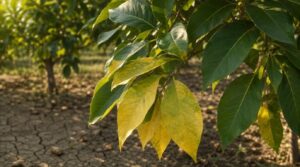
When older leaves start yellowing early in spring or summer, nitrogen deficiency is usually the first suspect. Unlike natural leaf aging, this yellowing appears abruptly on lower foliage while new growth stays green a little longer. Consulting resources on the full range of yellow leaf causes can guide accurate diagnosis.
Watch for these patterns to narrow the cause:
- Nitrogen deficiency signs: older leaves yellow while upper canopy stays green initially
- Potassium margin yellowing: leaf edges brown and scorch before spreading inward
- Magnesium interveinal chlorosis: yellowing appears between leaf veins on older leaves first
- Iron availability issues: often triggered by high soil pH locking out iron uptake
- Water stress impact: drought or overwatering mimics deficiency, accelerating leaf yellowing
A soil test quickly separates nutrient problems from watering issues, so don’t skip it. Once you know what’s missing, a balanced fertilizer or slow-release fertilizer can restore healthy color without guessing.
Canopy-wide Pale Leaves
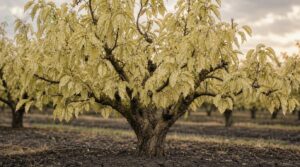
When nitrogen deficiency spreads beyond a few older leaves and washes out the entire crown, you’re dealing with something more serious. Canopy-wide pale leaves signal that chlorophyll production has dropped across the board.
A soil test will confirm whether low nitrogen, iron, or magnesium is driving it, since each nutrient follows different mobility patterns through the tree.
Narrow or Dwarfed Leaves
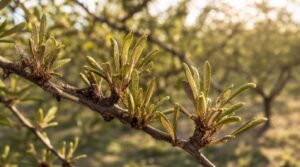
Pale leaves across the canopy are one thing, but when the leaves themselves shrink and narrow, that’s a different warning sign.
Zinc deficiency is usually the culprit in stone fruits, producing distinctly slender, dwarfed foliage with shorter internodes.
Phosphorus deficiency slows leaf expansion too.
A balanced, slow-release fertilizer corrects most nutrient imbalances before the next flush of growth.
Yearly Leaf Size Decline
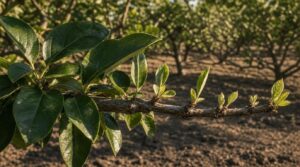
When leaves get a little smaller each year, it’s easy to miss — until you compare photos from three seasons back. Annual leaf area shrinks quietly, with leaf length reduction and leaf width decrease adding up over time.
- Canopy gaps widen as leaf biomass loss compounds
- Canopy density trends thin out noticeably by midsummer
- Smaller leaves reduce overall photosynthetic output
- Nutrient deficiency accelerates the decline season after season
A balanced fertilizer applied consistently helps reverse this pattern.
Chlorosis With Stunted Leaves
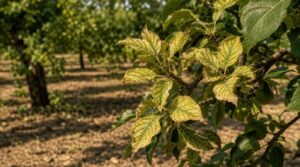
When yellowing hits alongside noticeably smaller, stunted leaves, you’re likely dealing with a combination of leaf chlorosis and nutrient deficiency — not just one missing element.
Fixing both issues often starts with the soil itself — choosing a nutrient-rich mix for herb growing can restore color and vigor without the guesswork.
Iron deficiency diagnosis often reveals poor leaf vein contrast, where tissue between veins fades while veins stay green. Check soil pH adjustment first, since high pH locks out iron.
Root oxygen deprivation from compacted soil makes it worse.
Nutrient balance testing confirms the full picture.
Weak Growth and Sparse Canopies
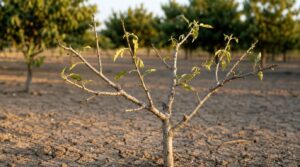
When a fruit tree isn’t getting enough nutrients, the structure tells the story before anything else does. You’ll start to notice the tree just isn’t keeping up — shoots stay short, branches feel fragile, and the canopy looks thin no matter the season. Here are the key growth symptoms to watch for.
Short Annual Shoot Growth
Short annual shoots tell a quiet story. On a well-fed tree, new shoots extend 6–8 cm each season, producing dense growth units with healthy buds.
When nutrients run low, that extension shrinks — sometimes to just 2–3 cm. Higher light intensity normally accelerates elongation, but poor nutrition overrides that advantage, leaving your canopy thin and struggling to renew itself.
No Trunk Diameter Increase
Trunk growth is easy to overlook — until you realize the tree hasn’t changed much in years. When cambial activity slows due to poor nutrient uptake, the trunk simply stops widening.
Disrupted carbohydrate allocation and hormonal balance redirect energy to the canopy instead. Soil compaction makes it worse by limiting root uptake.
A balanced fertilizer program can restore that steady, measurable growth.
Poor Lateral Branch Spread
A sparse, lopsided canopy is one of the clearest signs of nutrient deficiency you’ll notice from across the yard. When lateral branches stop extending, the tree can’t build the structure it needs to support a full fruit load.
Poor nutrient distribution is usually the cause:
- Phosphorus shortage limits cell division in growing branch tips
- Root system health declines, reducing uptake of nutrients that fuel lateral growth
- Water management practices affect how efficiently those nutrients move through the tree
Consistent fertilizing restores tree vigor and lateral spread.
Few New Spring Leaves
When spring arrives and your fruit tree barely wakes up, that’s a red flag worth paying attention to. Delayed bud break and reduced leaf emergence often point directly to nutrient deficiencies, especially nitrogen shortages that limit the energy needed for new growth.
| Spring Leaf Sign | Likely Cause |
|---|---|
| Few new buds opening | Nitrogen deficiency |
| Pale, sparse flush | Micronutrient shortage |
Consistent fertilizing corrects this fast.
Brittle or Weak Branches
Branches that snap under light pressure are telling you something. Brittle branches often stem from calcium or potassium deficiency, both of which weaken cell walls and reduce wood firmness.
Co-dominant stem problems and poor crotch angle management add mechanical stress on top of that.
Drought makes it worse. Regular soil testing and balanced fertilizer application keep your tree’s structure sound.
Poor Bloom and Fruit Set
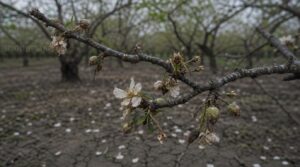
Bloom time is when nutrient gaps become impossible to ignore. A tree running low on key minerals — especially boron and copper — often struggles to flower well and set fruit. Here are the signs to watch for.
Fewer Blossoms Than Usual
When a fruit tree isn’t getting enough nutrients, fewer blossoms are one of the earliest signs. Boron and copper shortages directly limit blossom set, and poor root health reduces nutrient uptake right when nutrient timing matters most.
If your tree produced noticeably fewer flowers this season compared to a healthy tree nearby, that gap is worth taking seriously.
Blossom Drop or Blast
Blossom drop happens when buds form, but abort before fruit can set. Boron shortage is a common driver, weakening blossom tissue so flowers collapse early.
Excess nitrogen during bloom also shifts the tree’s energy toward leafy growth, leaving blossoms starved.
If blossoms are falling in clusters rather than opening, check your nutrient timing before assuming weather is the only culprit.
Weak Pollination Response
Even when blossoms stay on the tree, they don’t always set fruit. Weak pollination response is often the missing link — and nutrient imbalances play a direct role.
- Pollen viability drops when trees face heat stress or low soil fertility
- Pollinator diversity falls near monocultures, cutting effective pollen transfer
- Poor irrigation management during bloom weakens flower viability
- Nectar availability shrinks when nutrient supply is imbalanced
- Pollen limitation increases when organic matter amendment is neglected
Poor Seed Development
Weak pollination sets the stage, but poor seed development can quietly follow. When nutrient allocation breaks down during seed formation, embryo abortion rates rise, and seed size shrinks. Seed coat defects leave seeds vulnerable before they ever mature.
Balanced nutrient supply and soil fertility management — especially organic matter amendment — keep pollination timing and embryo development on track.
Light Fruit Production
Even a well-tended tree can fall short when canopy light management breaks down. Poor sunlight penetration reduces photosynthesis, limiting the carbohydrates your tree needs for a full crop.
Nutrient imbalances compound the problem — without balanced fertilizer and sound soil fertility management, fruit production stays light.
Check for signs that your tree is in need of fertilizer before assuming light is the only culprit.
Small or Damaged Fruit
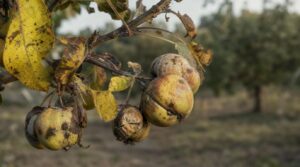
When nutrient deficiencies go unaddressed long enough, the fruit itself starts showing the damage. You might notice problems at harvest that weren’t there in previous seasons. Here are the key signs to watch for.
Undersized Fruit at Harvest
Small fruit at harvest is one of the clearest signs of poor nutrient uptake or nutrient imbalances during the growing season. When trees can’t access enough nitrogen, phosphorus, or key micronutrients, developing fruit simply runs out of fuel.
- Crop load management matters — too many fruits split limited resources
- Water stress impact shrinks cells during the rapid fruit-fill stage
- Rootstock selection affects how efficiently nutrients reach developing fruit
- Balanced fertilizer or slow-release fertilizer promotes steady fruit production
Premature Fruit Drop
Fruit that falls before it’s ready is a red flag worth taking seriously. Nutrient imbalance impact hits hardest during early fruit development, when calcium transport issues and boron deficiency effects disrupt cell division. Poor fertilizer application timing starves developing fruitlets right when they need fuel most.
| Drop Cause | Fix |
|---|---|
| Low soil nutrients | Soil test, then amend |
| Poor fruit set | Adjust fruit load management |
| Boron deficiency effects | Foliar boron spray in spring |
Bitter Pit in Apples
Bitter pit doesn’t announce itself at harvest — it shows up weeks later in cold storage, leaving sunken brown pits and corky flesh under the skin. This is a calcium distribution problem, not a pathogen. Uneven xylem flow starves fruit cells, weakening membranes until they collapse. High nitrogen levels make it worse by redirecting calcium toward shoots instead of fruit.
Bitter pit hides in cold storage, a calcium problem masked by nitrogen stealing nutrients from fruit to feed shoots
Crop load management helps — thin your apples early so calcium isn’t diluted across too many fruits. Preharvest calcium sprays can reduce risk if timed correctly during fruit fill. Choosing less susceptible cultivars and keeping irrigation consistent also makes a real difference.
Corky Stone Fruit Interiors
Cut open a peach and find a woody, gritty core, and you’re looking at corky interior damage. This happens when cell development near the stone breaks down during fruit maturation, often tied to imbalances in calcium balance, boron levels, or inconsistent moisture management. Soil testing helps you catch these nutrient gaps before harvest timing becomes your only option left.
- Test soil annually for calcium, boron, and magnesium levels
- Irrigate consistently to prevent moisture stress during fruit fill
- Avoid excess nitrogen late in the season
- Apply boron foliar sprays during early fruit development
- Choose resistant cultivars with uniform mesocarp development
Cracking or Misshapen Fruit
Cracking fruit is often the orchard’s way of telling you something broke down long before the harvest.
Calcium deficiency weakens the cell walls in the skin, so when flesh expands faster than the cuticle can stretch, it splits.
Excess nitrogen speeds internal growth, making the problem worse.
Consistent irrigation scheduling and timely boron applications help your fruit hold its shape.
Confirm Fertilizer Needs First
Before you reach for the fertilizer bag, it’s worth making sure that’s actually what your tree needs. A few simple checks can save you time, money, and the risk of doing more harm than good. Here’s what to look at first.
Check Soil PH Levels
Before you reach for a fertilizer bag, check your soil pH first. It controls how well your tree can actually absorb nutrients. The ideal pH range is 6.0 to 6.5 for most fruit trees. Outside that window, even a well-fed tree can show yellow leaves and weak growth.
- Use pH test strips for a quick read, or a calibrated digital meter for precision
- Collect soil from 4–8 inches deep under the canopy, at multiple spots
- Low pH can lock out calcium; high pH limits iron availability
- Adjust gradually — sulfur lowers pH, lime raises it — then recheck after 6–12 weeks
Test Soil Nutrients
Once you know your pH is in range, the next step is a proper soil test. This tells you exactly what nutrients are present — and what’s missing. A thorough soil test measures macronutrients like nitrogen, phosphorus, and potassium, plus micronutrients such as zinc, iron, and boron. Collect samples from 0–12 inches deep across the root zone, mixing several subsamples together.
Lab reports sort results into deficient, adequate, or excess, then suggest species-specific application rates based on your soil type and organic matter content.
Compare Healthy Tree Growth
Soil test results mean more when you have something to compare them against. Look at annual shoot growth — healthy fruit trees usually add 12–18 inches of new growth each season.
If yours are gaining only a few inches, that’s a red flag. Check trunk diameter increases, canopy spread, and whether new spring leaves are appearing in normal numbers.
Slow or stagnant growth across all these indicators usually confirms a nutrition gap.
Rule Out Drought Stress
Before blaming poor nutrition, make sure drought stress isn’t the real culprit — the symptoms overlap more than you’d think. Soil moisture sensors at 8–12 inch depths tell you quickly whether roots are actually getting enough water.
If leaf turgor stays firm and stomatal conductance reads near normal, drought is off the table, and fertilizer becomes the logical next step.
Avoid Excess Nitrogen
More fertilizer isn’t always the answer — sometimes too much nitrogen is the problem. Soil nitrate levels above 20 mg per liter signal excess, not deficiency.
Watch for lush foliage with poor fruit set, a classic growth-vs-fruiting tradeoff.
Use slow-release fertilizers and split applications timed to growth stages, and add organic matter to keep nitrogen cycling steadily without surges.
Frequently Asked Questions (FAQs)
When is the best time to fertilize fruit trees?
The best time to fertilize fruit trees is just before bud break in early spring. A slow-release fertilizer applied then feeds your tree steadily as new growth emerges.
Can mulching reduce how often I fertilize?
Yes, mulching can reduce how often you fertilize. Organic mulch breaks down gradually, feeding nutrients into the soil and improving nutrient cycling naturally over time.
Do container fruit trees need more frequent feeding?
Container fruit trees do need more frequent feeding. Limited root volume means nutrients deplete faster, especially with regular watering leaching them out. Aim for consistent, balanced feeds every few weeks during the growing season.
Are organic fertilizers better than synthetic for fruit trees?
Both have a place. Organics build soil microbial activity slowly, while synthetics act fast. For long-term tree health, organics win. For quick fixes, synthetics help.
How does tree age affect fertilizer requirements?
Young tree nitrogen needs are higher — support that early growth. As trees mature, 1–2 lb per 1,000 sq ft annually is enough to maintain health without forcing excess growth.
Conclusion
Your trees have been trying to leaf you a message all along. The signs that fruit trees need more fertilizer are rarely dramatic—they’re quiet, steady, and easy to dismiss as bad luck or bad weather.
But yellowing leaves, stubby shoots, sparse blossoms, and undersized fruit are the tree’s way of asking for more.
Test your soil before you reach for the fertilizer bag, and you’ll feed with confidence rather than guesswork.
- https://treefruit.wsu.edu/orchard-management/soils-nutrition/fruit-tree-nutrition
- https://www.woodlandtree.com/terrans-tips/posts/how-to-tell-
- https://orchardpeople.com/episode-64-when-to-fertilize-fruit-trees
- https://growingfruit.org/t/help-with-first-year-trees-nutrient-deficiency/12139
- https://www.rhs.org.uk/prevention-protection/nutrient-deficiencies