
This site is supported by our readers. We may earn a commission, at no cost to you, if you purchase through links.
Most fruit trees won’t tell you they’re hungry until it’s too late—dropped blossoms, hollow fruit, or a harvest that disappoints. The roots don’t shout; they just stop performing.
Nitrogen, phosphorus, potassium, calcium, and a handful of micronutrients each play a specific role at a specific time, and missing that window costs you a season.
Matching right fruit tree fertilizers for year‑round harvesting means feeding roots before buds break, supporting fruit set after bloom, and preparing trees before winter even arrives. Timing and technique matter as much as the product itself.
Table Of Contents
- Key Takeaways
- Fertilizer Basics for Year-Round Harvests
- Test Soil Before Feeding Trees
- Choose The Right Fruit Fertilizer
- Feed Trees by Season
- Match Fertilizer to Tree Needs
- Apply Fertilizer Like a Grower
- Prevent Fertilizer Problems Early
- Frequently Asked Questions (FAQs)
- What fertilizer does a fruit tree need?
- When should you fertilize fruit trees?
- How do you fertilize a fruit tree?
- How much fertilizer do apple trees need?
- Do you need to fertilize fruit trees every year?
- Can fruit trees be fertilized during drought conditions?
- How does mulching interact with fertilizer effectiveness?
- Should container-grown fruit trees be fertilized differently?
- How do cover crops affect orchard soil fertility?
- Conclusion
Key Takeaways
- Test your soil before feeding—knowing your pH and nutrient gaps lets every dollar of fertilizer actually work.
- Time your feedings to match the tree’s growth stages: nitrogen before bud break, phosphorus at bloom, potassium and calcium as fruit develops, and nothing heavy after midsummer.
- Match your fertilizer type to the situation—slow-release organics for steady long-term health, synthetics for fast deficiency fixes, and compost to build the soil your trees live in.
- Apply fertilizer at the dripline, water it in deep, and keep it away from the trunk—placement matters as much as what’s in the bag.
Fertilizer Basics for Year-Round Harvests
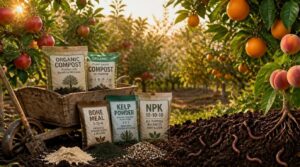
Think of fertilizer as your tree’s yearly meal plan — get it right, and everything from roots to fruit falls into place. Each nutrient plays a specific role, and knowing what does what puts you in control of your harvest. Here’s what your fruit trees actually need to thrive all year long.
A good starting point is preparing your soil for a fruit garden — because the right foundation makes every nutrient you add work harder.
Nitrogen for Leafy Growth
Nitrogen is the engine behind healthy, green leaves. It fuels chlorophyll production, giving leaves their color and boosting photosynthetic capacity. It also drives amino acid synthesis, building the proteins that push new leaf tissue outward. Adequate nitrogen boosts Rubisco, the key photosynthetic enzyme, as highlighted by nitrogen’s impact on Rubisco. Here’s what balanced nitrogen does for your trees:
- Expands leaf area index for better light capture
- Boosts rapid cell division in young shoots
- Improves nitrogen uptake efficiency through active root zones
- Prevents the pale, yellowing foliage that signals nitrogen deficiency
Too much, though, and you’ll get lush leaves but fewer fruits.
Phosphorus for Blossoms
Once your leaves fill in, phosphorus steps in for blossoms. It drives ATP energy transfer, fueling bud differentiation and nucleic acid synthesis for cell division. Phosphorus availability enhances pollen tube growth, preventing blossom abortion and boosting fruit set. Deficiency shows up as purple leaves and stunted buds now.
| Role | Effect | Result |
|---|---|---|
| ATP | Bud growth | Abundant blossoms |
| Pollen | Fertilization | Fruit set |
Potassium for Sweeter Fruit
Once blossoms set, potassium steps right in to sweeten your harvest.
It activates sucrose synthase, powering sugar metabolism enzymes for richer sucrose during fruit development now.
- Sugar boost: phloem loading efficiency speeds sugars to ripening fruit.
- Sweet pulp: aim for 1.5% fruit pulp concentration for peak sweetness.
- Steady flow: osmotic sugar transport prevents potassium deficiency, lifting fruit quality and yield.
Calcium for Stronger Fruit
Calcium follows potassium’s lead, building cell wall integrity as fruit develops. It forms calcium pectate, preventing bitter pit in apples and pears.
Calcium moves through xylem, so calcium translocation dynamics favor early fruit growth—foliar spray benefits help here. Watch magnesium nutrient competition, since too much calcium blocks magnesium uptake, affecting plant nutrition, fruit quality, and tree health.
| Calcium Benefit | How It Works | Result |
|---|---|---|
| Firmer fruit | Binds pectin in cell walls | Less bitter pit |
| Stronger peel | Reinforces cuticle layers | Fewer cracks |
| Longer storage | Maintains cell turgor | Slower spoilage |
| Better uptake | Travels through xylem early | Stronger fruit start |
Micronutrients for Healthy Trees
Most fruit trees fail quietly — not from hunger, but from trace element deficiencies nobody notices in time.
Most fruit trees don’t fail from hunger — they fail from trace deficiencies nobody notices in time
Iron drives chlorophyll synthesis, keeping leaves green and photosynthesis running. Zinc activates key enzymes and promotes fruit set. Manganese assists the water-splitting step in photosynthesis. Boron fuels new tissue development, and copper protects reproductive health. Don’t overlook micronutrients — they’re small in dose, big in impact.
Test Soil Before Feeding Trees
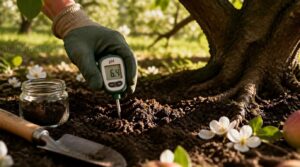
Before you open a single bag of fertilizer, your soil deserves a closer look. What’s already in the ground — and how acidic or alkaline it is — shapes everything your trees can absorb. Here’s what to check first.
Check Orchard Nutrient Levels
Think of a soil test as your orchard’s report card. Before you pour a single granule, collect samples from multiple spots across your orchard and mix them together.
This gives you one representative picture of what’s actually happening underground. A standard lab turns results around in 1–2 weeks, revealing whether nitrogen, phosphorus, potassium, or key micronutrients are deficient, normal, or excessive.
Once you have those results, you can match your fertilizer choice to exactly what’s missing — this breakdown of organic vs. synthetic fruit tree fertilizer options explains when fast-acting synthetics make more sense for urgent deficiencies.
Target PH 6.0–7.0
Once your report card is in hand, the next move is checking where your pH lands. Soil pH between 6.0 and 7.0 is the sweet spot for most fruit trees.
Inside that window, nutrients like nitrogen, phosphorus, and potassium stay readily available. Use a calibrated soil pH meter or reliable test strips for quick on-site confirmation.
Fix Alkaline Soil Issues
Alkaline soil above pH 7.5 locks out iron, zinc, and manganese — your trees starve even when you’re feeding them.
Elemental sulfur fixes this gradually, dropping pH over three to six months.
For faster micronutrient access, apply chelated iron or manganese directly to the root zone. Use acidifying irrigation water near pH 6.5, and mulch with pine needles to release organic acids steadily.
Adjust Sandy Soil Feeding
Sandy soil drains fast — nutrients vanish before roots can absorb them. That’s why frequent light feeding works better than heavy doses.
Apply liquid fertilizers every one to two weeks during the growing season.
For longer coverage, use polymer-coated slow-release granules that meter nutrients over months.
Mix in compost or biochar to boost organic matter, slow leaching, and keep your soil fertile between feedings.
Improve Compacted Clay Soil
Clay soil is a slow, stubborn beast — it holds water, resists roots, and locks out nutrients.
Start with core aeration to break compaction and open air pathways. Then top-dress with compost to rebuild structure.
Gypsum helps clay particles flocculate without shifting your pH.
For serious drainage problems, consider a raised bed with a sandy loam mix.
Choose The Right Fruit Fertilizer
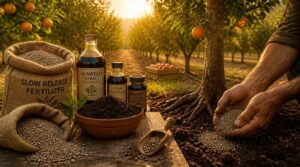
Not all fertilizers work the same way, and picking the wrong one can set your trees back. The good news is there’s a type that fits every situation, whether you need slow-release nourishment or a fast fix. Here are the main options worth knowing.
Organic Slow-release Blends
Organic slow-release blends are the quiet workhorses of a healthy orchard. Products like Jobe’s Organic (3-5-5) and Dr. Earth (5-5-2) rely on microbial breakdown to deliver nutrients gradually.
Biopolymer coatings extend feeding across 8–16 weeks. Biochar improves nutrient retention, while humic acids boost solubility.
Look for OMRI certification — it confirms the blend meets true organic standards.
Synthetic Quick-correction Options
Sometimes you need results fast. When a tree shows clear deficiency signs, synthetic quick-correction fertilizers close the gap in days, not weeks.
These water-soluble drenches push phosphorus or potassium directly into the root zone within 5–10 days. They also carry chelated micronutrients that bypass alkaline soil binding. Don’t overdo it — excess synthetic salts stress trees and can trigger fruit drop.
Compost and Aged Manure
Quick fixes have their place, but compost and aged manure build long-term soil health.
- Adds organic matter for better structure
- Boosts soil microbial health and activity
- Improves water retention benefits in sandy soil
- Raises cation exchange capacity for nutrient holding
- Aging reduces pathogens before application
This steady soil amendment boosts nutrient release rates that match organic fertilizer’s slow feeding style.
Liquid Fish and Seaweed
Compost builds soil over months. For a faster boost, try liquid fertilizer like fish emulsion and seaweed extract.
Fish emulsion delivers organic nitrogen sources through fish amino acids, greening leaves fast. Seaweed extract brings seaweed biostimulants plus potassium, boron, and zinc for micronutrient delivery.
Foliar feeding speeds nutrient uptake. A leaf spray often shows results quicker than soil drenches. Always dilute before spraying.
Species-specific Fertilizer Formulas
Your tree species each need a balanced NPK ratio. Citrus likes early nitrogen, then potassium for rind and juice. Apples want potassium at bloom. Stone fruit needs calcium near harvest, pome fruit wants spring boron, grapevines balance calcium and magnesium.
Crop-specific fertilizer selection drives nutrient management:
- Match NPK to species
- Time feeding to growth stage
- Improve fruit yield over time
Feed Trees by Season
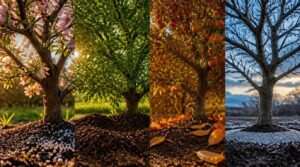
Your fruit trees follow a calendar, and your fertilizer should too. Each season asks for something different, from spring growth to fall root building. Here’s how to time your feedings right, season by season.
Early Spring Main Feeding
Early spring is your big feeding window. Apply a balanced fertilizer 2–4 weeks before the last frost to fuel early root stimulation and bud development.
Nitrogen kicks off leafy growth, phosphorus boosts blossom density near the dripline, and potassium maintains cell turgor.
Don’t skip a soil testing kit—pH 6.0–7.0 keeps nutrients available for pollen germination and spring nutrient timing.
After-bloom Fruit Support
Once petals drop, fruit set kicks into high gear for fruit yield improvement.
Calcium fruit set support and phosphorus timing now drive fruit development and sizing.
- Use calcium sprays to prevent bitter pit
- Time phosphorus for peak fruit development
- Add post-bloom micronutrients like zinc and boron
- Pair irrigation with fertilizer for nutrient uptake
- Support return bloom potential with balanced NPK
Summer Feeding Limits
Summer heat changes the rules. Stop nitrogen after July — late feeding pushes tender new growth that frost will punish.
Too much protein mid-summer also raises metabolic heat and cuts feed efficiency.
Watch for leaf wilting or scorch; those are your early warnings.
Keep irrigation steady so nutrients actually reach the roots without causing runoff or burn.
Post-harvest Fall Nutrients
Once the last fruit is picked, your tree still has work to do. Fall is when it banks nutrients for next spring.
Reduce nitrogen now. Shift focus to potassium — it drives fall carbohydrate translocation into roots and buds. Add calcium to strengthen cell walls and prevent bitter pit. Apply boron and zinc together to support nutrient remobilization enzymes and bud storage. Use controlled-release blends to limit autumn leaching during heavy rains.
Winter Mulching Instead
Winter is no time to fertilize. Dormant trees can’t absorb nutrients — applications just leach away or burn roots. Instead, mulch the root zone.
Spread 2–4 inches of wood chips or straw around the drip line. This regulates soil temperature, cuts moisture loss by up to 30%, suppresses winter weeds, and slowly feeds the soil as organic matter breaks down. Keep mulch 2–3 inches from the trunk.
Match Fertilizer to Tree Needs
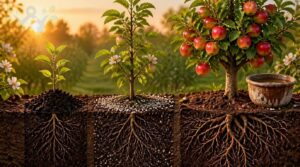
Not every fruit tree needs the same feeding plan. A newly planted sapling has different demands than a mature apple tree or a compact dwarf rootstock. Here’s how to match your approach to where your tree actually is right now.
Newly Planted Fruit Trees
When you first plant a fruit tree, hold back on heavy feeding. Start with ½ cup of balanced organic fertilizer spread within a 2-foot radius. Wait 4–6 weeks after planting before feeding at all, letting the roots settle first.
Keep the graft union above soil level and water deeply every 7–10 days to support early root establishment.
Young Productive Trees
Once your tree hits years two and three, it’s ready to put on a show. Balanced NPK feeding becomes your main lever. Aim for 1 cup per year of age, split between spring and fall. Young trees dedicate over 60 percent of absorbed nitrogen to leaves, so don’t overdo it.
Mature Orchard Trees
By year four and beyond, your trees are in their stride. Mature orchard trees need 0.6 to 1.0 pounds of nitrogen annually, split between spring and fall.
A wide root zone means nutrients travel far, so spread granular fertilizer at the drip line. Target balanced NPK to support canopy light interception, steady fruit brix levels, and firm harvests.
Dwarf Rootstock Feeding
Dwarf rootstocks play by different rules. Their shallow, dense root zones absorb nutrients quickly but can’t buffer excess.
That’s why small, frequent applications beat one large seasonal dump. Aim for monthly feeding during active growth.
Use a balanced NPK formula and keep rates moderate — roughly half what a standard tree needs — to avoid root burn and runoff.
Stone Fruit Potassium Needs
Peaches and nectarines are potassium-hungry crops. Potassium drives sugar transport, pushing sweetness deep into the flesh during rapid fruit development. It also firms the skin, reducing cracking in susceptible varieties.
Apply potassium at fruit set, when uptake peaks. On sandy soils, leaching risks are real — split applications help. Watch the calcium-potassium balance: too much potassium blocks calcium, hurting fruit quality.
Apply Fertilizer Like a Grower
Knowing what to feed your trees is half the battle — the other half is where and how you apply it. Get the placement wrong and even the best fertilizer won’t reach the roots that matter. Here’s how growers actually do it.
Feed Around The Dripline
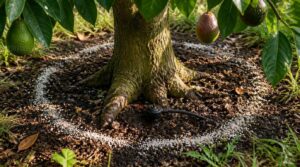
Think of the dripline as your tree’s sweet spot. Feeder root zones cluster right beneath the canopy edge — that’s exactly where fertilizer belongs.
Spread granules in a ring along that outer circle, roughly 6–12 inches from the drip line. Position emitters at soil level there too.
Then water deeply to carry nutrients straight into the root zone.
Keep Away From Trunks
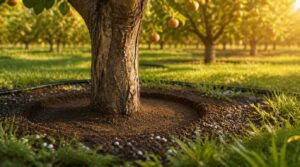
One mistake can quietly set your tree back years. Never apply fertilizer within 12 inches of the trunk — bark burn happens fast, and damaged tissue invites rot and disease.
Here’s what trunk-zone protection actually looks like:
- Keep a clear ring around the trunk, free of granules
- Never pile mulch directly against bark — it traps moisture
- Avoid irrigation runoff channeled toward the trunk base
- Inspect bark after feeding for reddening or cracking
- Always direct fertilizer toward the outer root zone
Salt accumulation near the trunk is a silent killer. It injures feeder tissue, weakens bark, and creates new pathways for fungi.
Water Nutrients Deeply
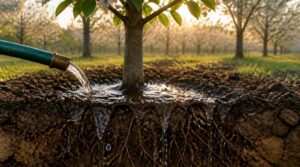
Water is the delivery system for every nutrient you apply. Without enough moisture, fertilizer just sits in the soil, waiting.
Deep watering after feeding drives dissolved nutrients — nitrogen, potassium, calcium — down through mass flow to where feeder roots actually live, beyond the top 12 inches. Aim for slow, steady irrigation that soaks in rather than runs off.
Place Phosphorus in Holes
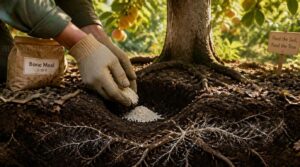
Phosphorus doesn’t move much once it hits the soil. That’s why surface-spreading it rarely works — you need to get it below the root zone.
Dig holes 6–8 inches deep around the dripline, spaced 12–18 inches apart. Drop in your phosphorus P source — bone meal works well — then backfill. Mycorrhizal fungi will do the rest, pulling nutrients directly to developing roots.
Top-dress With Compost
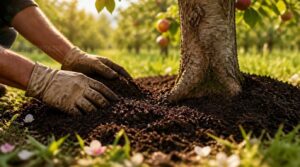
Compost is the quiet workhorse of orchard management. Spread a 3–5 cm layer over the root zone, keeping it clear of the trunk. This builds soil structure improvement gradually, boosts microbial activity, and locks in moisture. Use finished, dark-smelling compost only. Water after applying.
| Benefit | What It Does |
|---|---|
| Moisture retention | Reduces watering frequency |
| Nutrient release | Feeds roots over months |
| Microbial boost | Activates soil life |
| Structure improvement | Loosens compacted ground |
Prevent Fertilizer Problems Early
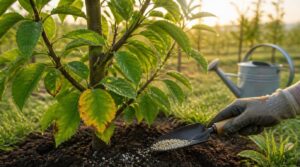
Even with good timing and the right product, small mistakes can quietly derail your harvest. Knowing what to watch for makes the difference between a thriving tree and one that’s struggling without a clear reason. These are the most common fertilizer problems — and how to fix them fast.
Avoid Too Much Nitrogen
Too much nitrogen is one of the easiest mistakes to make. It pushes trees into excessive foliage growth while starving fruit development.
You’ll get big, lush leaves — but smaller harvests. Keep a balanced N-to-K ratio to redirect energy toward fruit sizing. Avoid late-season applications; that new growth won’t harden before frost hits.
Your roots suffer too — nitrogen excess shifts resources away from root development.
Watch for Leaf Scorch
Excess nitrogen can set the stage for leaf scorch. Lush, fast-growing foliage loses moisture quickly under heat and wind — and leaf edge browning follows.
Scorch isn’t a disease. It’s a stress response. Hot afternoons, dry soil, and strong winds all pull moisture faster than roots can replace it. Mulch the dripline and water deeply to reduce this risk.
Identify Yellowing Leaves
Leaf scorch browns the edges. Yellowing tells a different story — and the pattern matters.
Uniform yellow on older leaves means nitrogen is running low. New growth stalls. Interveinal yellowing on new leaves points to iron deficiency, often triggered by high soil pH. If veins stay green while the leaf turns yellow, that’s magnesium chlorosis.
Patchy yellow margins signal potassium deficiency.
Correct Zinc Deficiency
Yellowing told you about nitrogen and iron. Small yellow leaves with rosetting point to zinc.
Zinc deficiency stunts new shoots, shrinks fruit, and hurts fruit development. Here’s how to fix it:
- Apply zinc sulfate at 10–30 lbs per acre for soil correction
- Use chelated zinc in alkaline soils for better nutrient uptake efficiency
- Time foliar sprays 7–14 days before flowering for fast results
- Watch phosphorus levels — excess phosphorus blocks zinc absorption
- Encourage mycorrhizal fungi to boost mycorrhizal zinc uptake naturally
Reduce Runoff and Waste
Every fertilizer you apply carries a risk — some of it won’t reach your trees. Rain washes nutrients into streams through fertilizer runoff and fertilizer leaching, harming local ecosystems.
| Practice | Benefit |
|---|---|
| Slow-release fertilizers | Cut leaching by feeding gradually |
| Drip irrigation | Delivers nutrients directly to roots |
| Vegetated buffer strips | Reduce nutrient runoff by up to 40% |
Small steps protect your soil and the environment.
Frequently Asked Questions (FAQs)
What fertilizer does a fruit tree need?
Fruit trees are hungry work — NPK ratios form the foundation. Nitrogen builds leaves, phosphorus drives blossoms, and potassium sweetens fruit. Add micronutrients like zinc and iron for full tree health.
When should you fertilize fruit trees?
Start fertilizing 2–4 weeks before the last frost. Watch for bud swelling as your cue. Avoid feeding after midsummer — late nitrogen invites frost damage on tender new growth.
How do you fertilize a fruit tree?
Spread fertilizer at the drip line, not against the trunk. Water it in deeply after. This moves NPK into the root zone and prevents soil salt buildup.
How much fertilizer do apple trees need?
Apple trees’ appetite varies by age. Young trees need ½ cup of balanced fertilizer. Mature trees need 2–4 cups annually. Dose nitrogen at 10 lb per trunk-diameter inch, never exceeding 1 lb total.
Do you need to fertilize fruit trees every year?
Yes, most fruit trees need annual fertilization. Younger trees especially benefit from consistent feeding. Mature trees may only need it every two years, guided by soil test results and tree vigor.
Can fruit trees be fertilized during drought conditions?
Drought doesn’t mean you stop feeding. Water first, always. Prime the root zone with deep irrigation, then apply liquid or slow-release fertilizer for safer uptake with far less salt stress risk.
How does mulching interact with fertilizer effectiveness?
Mulch is a silent workhorse beneath your trees. It retains soil moisture, slowing nitrogen volatilization and supporting moisture-driven diffusion toward roots. Organic matter feeds microbes that boost cation exchange, unlocking nutrients your fertilizer delivers.
Should container-grown fruit trees be fertilized differently?
Container-grown fruit trees need a different fertilization schedule. Limited soil volume means nutrients deplete fast. Pot nutrient lockout and substrate salt buildup are real risks. Use liquid feeding more frequently than you would in-ground.
How do cover crops affect orchard soil fertility?
Cover crops pull nitrogen from the air and push organic matter into the soil. Microbial diversity surges, nutrient cycling speeds up, and water infiltration improves by up to 40 percent.
Conclusion
Every season holds a quiet test. Feed too late, and the tree fails you silently—blossoms drop, fruit thins, and harvest shrinks before you even notice.
But when you match the right fruit tree fertilizers for year‑round harvesting to each growth stage, something shifts. Yields climb. Fruit fills out. Trees stop struggling and start producing consistently.
The real difference isn’t luck—it’s timing, soil knowledge, and nutrients delivered long before the tree ever signals a need.
- https://blogs.ifas.ufl.edu/miamidadeco/2024/05/16/fertilizing-fruit-trees
- https://growingfruit.org/t/best-avocado-fertilizer/64092
- https://www.cdfa.ca.gov/is/ffldrs/frep/FertilizationGuidelines/Avocado.html
- https://getgrowingwithnutrien.ag/micronutrients
- https://www.sound.ag/blog/micronutrients-small-but-mighty