This site is supported by our readers. We may earn a commission, at no cost to you, if you purchase through links.
Watch a squash plant grow next to borage, and you’ll see something wonderful happen: hoverflies and native bees arrive within days, drawn by those star-shaped blue blooms, and stick around to pollinate everything nearby. That’s the quiet power behind smart plant partnerships—one species does the heavy lifting of attracting beneficial insects while its neighbor reaps the rewards.
Your garden can work this way too, season after season, without a single drop of pesticide.
Below, you’ll find pollinator friendly companion planting combinations organized by vegetable, herb, and bloom time, so you can build a garden that hums with life from the first spring bee to the last fall aster.
Table Of Contents
Key Takeaways
- Pairing vegetables with flowering companions like basil, borage, dill, nasturtiums, and marigolds attracts pollinators while naturally deterring pests, reducing the need for pesticides.
- Maintaining continuous bloom from early spring through late fall—using plants like hellebores, sunflowers, goldenrod, and asters—keeps pollinators fed year‑round and prevents nectar gaps.
- Native plants are especially effective for supporting local pollinators because they’ve co‑evolved with regional bees, butterflies, and hummingbirds, offering more reliable results than non‑native species.
- Thoughtful garden design—clustering plants in odd numbers, adding shallow water sources, layering plant heights, and avoiding synthetic pesticides—creates a safer, more effective habitat for pollinators.
Best Pollinator Companion Planting Combinations
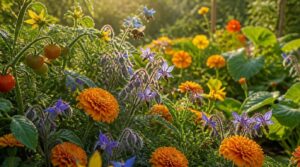
Pairing vegetables with the right flowering companions does more than tidy up your garden beds; it builds a working relationship between your food crops and the pollinators that make them thrive. Some combinations have earned their reputation through generations of gardeners noticing what actually works, from pest deterrence to better fruit set.
If you’re ready to put this into practice, this guide to pollinator-friendly vegetable garden companion plants breaks down which flowers pair best with specific crops for maximum benefit.
Here are five tried-and-true pairings worth adding to your own plot this season.
Tomatoes With Basil
If there’s a classic starter pairing for companion planting, it’s basil with tomatoes: basil repels aphids and whiteflies, while its blooms feed honeybees. Shared soil needs (full sun, drainage) simplify care, and staggered harvest timing keeps herbs fresh all season.
Some gardeners swear by flavor enhancement science, too—plus, the compact combo makes for lovely visual bed aesthetics.
vitamin C in tomatoes can boost iron absorption from basil, a combined benefit highlighted by vitamin C enhances iron.
Squash With Borage
Sprawling squash vines welcome a companion that punches above its weight: borage draws pollinators in droves, boosting visitation rates while its deep roots loosen soil for root system collaboration.
- Deters hornworms naturally
- Decomposing leaves enrich soil nutrients
- Star-shaped blooms are edible, cucumber-flavored additions to salads
This pairing exemplifies pollinator-friendly companion planting—nectar-rich, low-fuss, and genuinely productive.
Cucumbers With Dill
Where borage works underground, dill works overhead: sown two to four weeks before transplanting, its yellow umbels summon hoverflies and lady beetles that keep aphids in check while supporting pollination.
Beyond the trellis, this classic kitchen pairing shines too—thin-sliced, salted, and dressed in yogurt, dill’s bright note complements cucumber’s crunch, best enjoyed within 24 hours for peak freshness.
Brassicas With Nasturtiums
Kale and broccoli get their own bodyguard in nasturtiums, which act as a trap crop, luring aphids and cabbage moths away while their blooms summon hoverflies and lady beetles.
- Watch pests vanish from tender kale leaves
- Trust vines to hold soil moisture through heat spells
- Welcome bees drawn to cheerful orange blossoms
- Feel your garden’s biodiversity flourish naturally
- Enjoy fewer sprays, more peace of mind
Beans With Marigolds
Once your beans start climbing, tuck French marigolds along the trellis for real pest deterrence—their compounds discourage Mexican bean beetles. Keep 12–18 inches between plants to improve spacing and protect the soil microbiome.
Marigolds also draw hoverflies and lady beetles, boosting beneficial insect attraction.
It’s simple, organic gardening at its most rewarding.
Flower Companions That Attract Pollinators
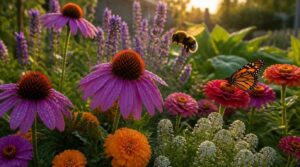
While vegetables feed your family, flowers feed the pollinators that make those harvests possible in the first place. The right blooms keep bees, butterflies, and other visitors fed from the first warm days of spring right through the last blooms of fall.
Here are five flower companions worth finding room for in your garden.
Sunflowers for Late Nectar
When August heat drains other blooms dry, sunflowers keep pouring on the charm—their broad disks deliver concentrated nectar sugar right when honeybees need late-season stores.
Nectar flows heaviest in morning hours, so plant where soil moisture stays consistent. Choose staggered variety timing, from early to late cultivars, and you’ll stretch this important nectar source clear into October.
Pair this companion vegetable with a few reliable bloomers from this guide to pollinator-friendly flowers to keep bees visiting your garden all season long.
Lavender for Native Bees
Where sunflowers shout, lavender whispers—its scent drifting on hot air currents to guide solitary bees toward those nectar-rich spikes. Choose Lavandula angustifolia for reliable cultivar selection, since its tubular blooms suit both short and long bee proboscis lengths.
Nectar sugar concentration stays high through summer, and the fragrance doubles as beneficial predator attraction, drawing wasps that keep pest populations in check naturally.
Coneflowers for Butterflies
That prominent central cone isn’t just decorative—it’s a landing platform built for monarchs and swallowtails, guiding them via UV petal patterns invisible to us.
- Drought-tolerant nectar keeps flowing through dry spells
- Native Echinacea varieties suit local pollinators best
- Nectar sugar concentration hits 25-40%
- Weeks-long blooms mean repeat butterfly visits
Cluster them for a true pollinator-friendly garden showpiece.
Zinnias for Continuous Blooms
Want a cutting garden that never quits? Zinnias deliver, blooming 6-8 weeks after sowing.
Succession sowing every 2-3 weeks keeps fresh blooms coming. Choose Profusion or California Giant varieties—they rebloom vigorously after cutting.
Deadheading spent flowers triggers regrowth, while consistent soil moisture prevents flowering delays. Space plants 12-18 inches apart, cut mornings for peak vase life, and watch pollinators flock in.
Cosmos for Summer Bridges
Cosmos bridges the gap when early bloomers fade, standing 3-6 feet tall with airy foliage that adds vertical accent to any border. Their flat, daisy-like faces serve as ideal pollinator landing platforms.
Sow directly after frost, space 12-18 inches apart, and deadhead regularly for continuous nectar supply. Pair with zinnias and dill for succession blooms—pollinators will thank you, and pests mostly steer clear.
Herb Pairings for Pollinator Gardens
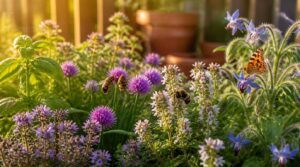
Herbs earn their keep in a pollinator garden twice over, feeding your kitchen and your local bee population in equal measure. You don’t need a separate flower bed to invite pollinators in; your herb rows can do that work themselves once you let a few plants flower.
Here are five herbs worth tucking into your garden plan, each one drawing in a different set of beneficial visitors.
Dill for Hoverflies
Once cucumber transplants go in, tuck dill nearby; its flat umbels give hoverflies easy landing spots for nectar and pollen.
Dill’s foliage draws aphids too, feeding the aphid predator cycles—hoverfly larvae depend on.
From midsummer through early fall, dill bridges nectar gaps while boosting natural pest control—a small but mighty ally in pollinator-friendly companion planting.
Basil for Honeybees
Let that dill keep working while you tuck basil nearby—once it bolts, its blooms offer honeybees quality nectar and protein-rich pollen for brood nutrition.
Flowering hits mid-to-late summer, so plant 3–5 basil in full sun to boost visibility.
Bonus: basil-influenced honey often carries subtle herbal notes, enriching bee forage continuity alongside your other pollinator plantings.
Thyme for Small Bees
Thyme rewards the smallest garden visitors—mason bees and other tiny foragers rely on its steady nectar concentration through mid-to-late summer.
Grow creeping thyme in rock gardens or sunny, well-drained beds; its low mats and terpene-rich blooms make landing easy.
Common and lemon thyme extend bloom windows further, keeping small bee foraging active well into early autumn alongside your other nectar-rich companions.
Mint in Containers
Keep mint contained—its runners spread fast, so managing root growth in pots protects nearby beds while still feeding pollinators. Use 12-inch-deep containers with well-draining soil.
- Ideal pot depth: 12+ inches, 12–18" wide
- Soil drainage: add perlite, pH 6.0–7.0
- Group pots to build humidity microclimates
Propagate via stem cuttings for easy expansion—smart companion planting for any pollinator-friendly garden.
Cilantro for Beneficial Insects
When cilantro bolts, don’t panic—that flush of tiny blooms becomes a nectar bridge for ladybugs, hoverflies, and parasitic wasps.
| Bolting Stage | Beneficial Insects Attracted |
|---|---|
| Early flower | Hoverflies, lacewings |
| Peak umbels | Parasitic wasps |
| Full bloom | Ladybugs |
| Late bloom | Predatory mix |
| Seed set | Residual foraging |
Plant near cucurbits for aphid and beetle suppression—true insectary companion planting.
Seasonal Bloom Pairings to Plant
Timing matters just as much as plant choice when you’re feeding pollinators all year long. A garden that blooms nonstop from March through November keeps bees and butterflies coming back, season after season. Here’s how to build that unbroken chain of nectar, one pairing at a time.
Early Spring Nectar Sources
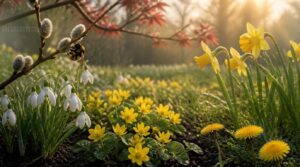
Snowdrop forage and willow catkins break winter’s fast first, feeding bees before your soil even fully thaws.
Daffodil nectar follows close behind, reliable and rich for those first foraging flights.
Maple blossoms add a brief but valuable pulse of forage on warmer days.
Don’t overlook groundcover pollination, either—dandelions and celandine fill gaps, keeping this early nectar chain unbroken.
Midsummer Bloom Bridges
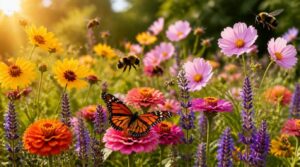
Once the July heat settles in, your garden needs a true nectar corridor—Coreopsis, Zinnias, and Cosmos keep canopy connectivity strong. Lavender and salvia stretch bloom succession into late summer, sustaining peak activity for native bees.
This diversity of foragers—bees, butterflies, hoverflies—thrives on continuous bloom. Deadheading and steady watering are simple midseason maintenance strategies that keep this bridge unbroken.
Late Fall Forage Plants
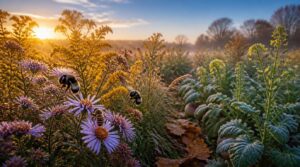
Ever wonder where pollinators stock up before winter locks everything down? Goldenrod and aster seed heads become important late-season pollen plants, while brassica blooms left to flower support foragers even as flowering phenology shifts.
- Turnips and radish for quick cover
- Oats and rye grass mixtures
- Brassica protein levels near 19–23%
- Dry matter yields up to 3,500 kg/ha
- Timed harvests preserving pollinator winter reserves
Frost-Tolerant Flower Partners
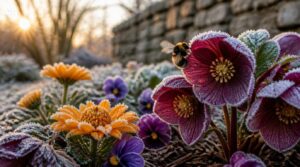
Hellebores and calendula shrug off hard frosts, delivering nectar right when few other blooms dare open.
| Plant | Frost Tolerance | Bloom Window |
|---|---|---|
| Hellebore | Hard frost | Late winter |
| Calendula | Light frost | Early spring |
| Viola | Subfreezing | Early spring |
South-facing walls and mulched beds stabilize soil temperature, giving these frost-resilient perennials the microclimate protection they need for early nectar production.
Overlapping Bloom Windows
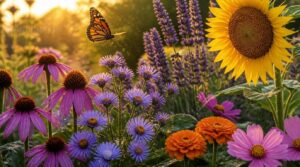
Think of your garden as a relay race, where one bloom passes the nectar baton before another fades. That’s the heart of overlapping bloom windows: pairing backbone plants with fillers so flowering periods intersect for 10-14 days minimum.
A garden is a relay race, each bloom passing the nectar baton before the last one fades
- Coneflower fading into aster
- Lavender meeting sunflower
- Zinnia bridging cosmos
This staggering reduces forage gaps, helps succession planting strength, and keeps nectar pulses steady through shifting microclimates.
Native Companion Plants for Pollinators
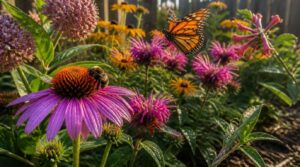
While non-native flowers offer plenty of nectar, native species have co‑evolved with your local pollinators, making them especially efficient at supporting bees, butterflies, and hummingbirds in your region.
Choosing plants that belong to your specific local environment means less guesswork and more reliable results, since these species already thrive in your soil and climate.
Here’s where to start when building out your native plant lineup.
Local Bee Favorites
Ask any beekeeper what their bees prize most, and you’ll hear about regional nectar profiles—honey flavor shifts with local bloom cycles. Native asters and clovers sustain bees late-season, while flowering currants and viburnums fuel early spring foraging.
Don’t overlook ground cover: low, undisturbed patches shelter ground-nesting bees near their burrows, rounding out a landscape built on bloom variety.
Butterfly Host Plants
Nectar draws adults in, but Monarch Milkweed Care keeps them breeding—caterpillars eat nothing else. Round out your Swallowtail Herb Gardens with dill, parsley, and fennel, plus violets for fritillaries.
Prioritizing Native Host Selection over ornamentals ensures reliable Larval Food Availability, turning your beds into genuine pollinator habitat where bees and butterflies both thrive through the seasonal bloom.
Hummingbird Nectar Flowers
Coral honeysuckle and crossvine deliver the tubular flower selection hummingbirds crave, with rapid nectar replenishment rates keeping feeders busy all day. Train crossvine up an arbor for vertical nectar corridors, and let cardinal flower’s crimson spikes fuel migration support through wet borders.
Petunias fill gaps as high-energy forage between blooms—together, they’re reliable hummingbird attractants for any pollinator-friendly companion planting plan.
Native Perennial Borders
Once hummingbirds have their tubular fuel stops, give bees and butterflies a permanent home base. Native perennial borders build year-round structure through soil enrichment, native grasses, and staggered bloom times.
- Echinacea backbone
- Rudbeckia mid-layer
- Aster late nectar
- Grass texture backdrop
- Divide clumps every 3-5 years
Layer flowering perennials for seasonal bloom succession—your best pollinator-friendly companion planting foundation.
Region-Specific Plant Choices
Since Saxony’s continental climate swings between cold winters and warm summers, choose plants proven for Saxony climate adaptation: little bluestem grass, coneflowers, and daisies.
Match them to your soil—sandy loam drains fast, clay holds moisture—checking regional pH levels (6.0–7.0 suits most native forbs).
Mix grasses with wildflowers for authentic Saxony meadow mimicry, creating resilient, nectar-rich borders true to your specific plot.
Pollinator-Friendly Layout and Care Tips
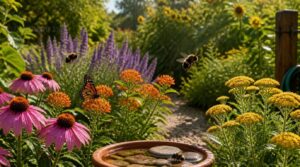
Choosing the right plants is only half the job; how you arrange and tend them matters just as much. Your layout decisions, from spacing to water access, shape how safely and effectively pollinators can move through your garden. Here are five practical tips to help you design a space that works with nature, not against it.
Plant in Odd Clusters
Ever notice how a lone flower gets lost, but three together stop you in your tracks? Plant in clusters of three or five to create visual rhythm and layered texture. This mimics natural microhabitat stability, mixing heights and blooms.
- Boosts pollinator visibility
- Balances color balance
- Reduces weed intrusion
- Encourages staggering bloom times
Repeat this companion planting motif for a truly pollinator-friendly garden.
Add Shallow Water
Watching a mason bee dip its head into a puddle reminds you that thirst matters as much as nectar.
Keep water depths between 1–2 inches for safe hydration stations, adding a few flat stones as landing pads. Toss in a small aquatic plant or aerating pebble to prevent stagnation—this curbs mosquito breeding while keeping your pollinator-friendly garden buzzing with life.
Avoid Synthetic Pesticides
One spray at the wrong hour can undo weeks of careful nectar planning. Choose biopesticides like neem or garlic extracts, and always spray at dusk after pollinators settle.
- Monitor pest thresholds before treating
- Favor botanical extracts over synthetics
- Release beneficial insects like ladybugs
- Nurture organic soil health
- Skip broad-spectrum sprays entirely
Your garden’s buzz depends on restraint as much as design.
Create Layered Plantings
Think of your garden in stories, not rows. A canopy shade level like sunflowers gives dappled cover for understory herb layers—dill, thyme—while groundcover nectar mats (creeping thyme, clover) fill the base.
This vertical tiering creates multi-height nectar corridors, letting bees and butterflies forage at every level, staggering bloom times naturally as different layers peak in sequence throughout the season.
Separate Antagonistic Plants
Not every plant makes a good neighbor, and some downright sabotage each other underground. Allelopathic root exudates from alliums can suppress bean growth, while nightshades risk potato tomato blight spreading between beds.
Keep brassicas away from strawberries to ease nutrient competition, and rotate crops yearly. Thoughtful spatial bed design limits soil microbial shifts, keeping antagonist pairings from undermining your pollinator plan.
Frequently Asked Questions (FAQs)
How long until companion planting improves pollinator activity?
Patience pays off here: expect visible activity within four to twelve weeks, though warmer springs speed things up. Annual bloomers pull bees in fast, while perennials need two to three months before reaching their true pollinator-drawing potential.
Can pollinator plants thrive in containers on balconies?
Absolutely — with ideal pot volume (5+ gallons), solid drainage requirements, and 6-8 hours of sunlight exposure, container gardens support zinnias, cosmos, and lavender beautifully, turning any balcony into a thriving pollinator planting plan.
How do I keep pests off vulnerable flower companions?
Lean on physical barrier methods like fine mesh netting for flea beetles, pair vulnerable blooms with pest-repellent herbs such as basil and dill, and let hoverflies and lacewings handle biological pest control naturally.
Conclusion
A single hedgerow of mixed blooms can boost pollinator visits by nearly 300 percent, and that’s the quiet magic these pairings reveal. Every borage-and-squash duo, every dill patch beside your cucumbers, builds toward one goal: pollinator friendly companion planting combinations that turn a plain vegetable bed into a living network.
Start small, tuck marigolds between your beans, and watch the bees find you.
Your garden becomes a refuge, one bloom, one season, one grateful pollinator at a time.
- https://www.gooseberrygardens.ca/post/companion-planting-for-the-veggie-garden
- https://extension.okstate.edu/articles/2023/pollinators_in_veggie_garden
- https://www.almanac.com/companion-planting-guide-vegetables
- https://www.superseeds.com/blogs/know-your-roots/the-ultimate-companion-planting-guide-part-2-pollinators
- https://kellogggarden.com/blog/gardening/flower-gardening/creating-a-pollinator-garden-top-plants-to-entice-pollinators