This site is supported by our readers. We may earn a commission, at no cost to you, if you purchase through links.
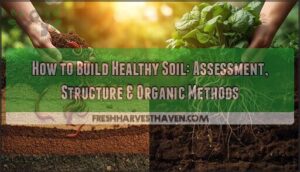
Your garden’s foundation lies beneath your feet, yet most people overlook the six inches that determine whether plants thrive or merely survive. Building healthy soil isn’t about dumping fertilizer on dirt—it’s about creating a living ecosystem where billions of microorganisms work alongside mineral particles and organic matter to feed your plants naturally.
The difference between vibrant gardens and disappointing harvests often comes down to soil texture, structure, and fertility, three elements you can assess and improve with straightforward techniques.
Whether you’re working with stubborn clay that puddles after rain or sandy ground that drains too fast, you can transform problematic soil into a thriving foundation that sustains abundant growth season after season.
Table Of Contents
- Key Takeaways
- Assessing Your Soil’s Health
- Improving Soil Structure and Aeration
- Boosting Soil Fertility Organically
- Sustainable Practices for Healthy Soil
- Top 10 Products for Building Healthy Soil
- 1. Microbial Biopesticides Formulation Guide
- 2. Dunkin Original Blend Coffee
- 3. Landscape Loc Mulch And Rock Binder
- 4. Miracle Gro Organic Mulch
- 5. Gardening Log Book Planner
- 6. Live Edible Herb Assortment Plants
- 7. The Andersons Organic Soil Amendment
- 8. Espoma Organic Rock Phosphate Fertilizer
- 9. Espoma Organic Plant Food
- 10. Organic Fish Emulsion Fertilizer
- Frequently Asked Questions (FAQs)
- How to make your soil more healthy?
- What are the 5 principles of soil health?
- What can I put in my soil to make it better?
- Can you turn bad soil into good soil?
- What do you put into the soil to make it healthy?
- How can we improve the health of soil?
- How do you turn bad soil into good soil?
- How long does it take to build healthy soil?
- What can I add to soil to make it healthy?
- How does weather impact soil health?
- Conclusion
Key Takeaways
- Healthy soil depends on three foundational elements—texture, structure, and fertility—which you can assess through simple home tests like the soil ribbon test or professional lab analysis that reveals pH, nutrient levels, and organic matter content.
- Improving soil structure requires reducing compaction through deep-rooted cover crops and minimal tillage, while incorporating 2-3 inches of organic matter (compost, leaf mold, or well-rotted manure) mixed 8-12 inches deep creates the aggregate stability plants need for robust root growth.
- Organic fertility-building strategies like crop rotation, companion planting, and strategic mulching work together to suppress weeds, prevent erosion, and support the billions of beneficial microorganisms that drive natural nutrient cycling in your garden.
- Transforming problem soil into a thriving foundation typically takes 1-3 years of consistent organic matter additions, cover cropping, and protective practices that rebuild soil biology and establish resilient growing conditions season after season.
Assessing Your Soil’s Health

Before you can improve your soil, you need to know what you’re working with. Think of this as getting a baseline health check for your garden—you wouldn’t start a treatment plan without understanding the problem first.
A good soil test will tell you which nutrients and amendments to add in spring so you’re not guessing what your garden actually needs.
Let’s walk through the essential steps to evaluate your soil’s texture, composition, and overall condition so you can make informed decisions about what it needs.
Understanding these soil fundamentals will also help you recognize when and how sustainable harvesting practices protect long-term soil health in your garden.
Determining Soil Texture at Home
You don’t need fancy equipment to assess your soil’s texture—just your hands and a bit of water. Start by collecting a small handful from 6–8 inches below the surface, then moisten it to a workable consistency. The soil ribbon test helps you determine whether you’re working with sand, silt, or clay by forming a ribbon between your fingers.
If your soil forms a stable ribbon longer than an inch, you likely have clay-heavy soil—check out this guide to understanding soil composition for tips on managing different textures.
- Sandy soils crumble easily and feel gritty, forming ribbons less than 2 cm long
- Silty textures create smooth balls with moderate ribbons between 2–4 cm
- Clay-rich soils produce persistent ribbons exceeding 4 cm and feel sticky
- The banked pin test adds verification by measuring resistance when pressing soil into cracks
- Repeat texture estimation at multiple garden locations to account for natural variability
Conducting Professional Soil Tests
While home tests give you texture clues, professional soil testing reveals the complete story of your soil’s health. Accredited labs follow rigorous quality protocols to measure soil pH, nutrient levels, and buffering capacity with precision you can’t achieve at home.
If you’re starting out or want to track seasonal changes without the expense, here’s a practical guide to testing your garden soil pH using simple home methods.
You’ll receive results in 5–10 business days, along with customized recommendations for amendments.
Proper sample handling—collecting representative samples, mixing thoroughly, and labeling correctly—ensures reliable test interpretation every time.
Analyzing Soil Composition and Structure
Once you have your lab results in hand, it’s time to decode what they mean for your garden. Soil particle size determines drainage—sand drains fast, clay holds tight.
Organic matter content fuels soil biology and boosts cation exchange capacity, helping your soil hold nutrients where roots can reach them.
Check aggregate stability and soil density measurement to gauge compaction. Together, these metrics paint a complete picture of soil composition, soil structure, and overall soil health.
Identifying Common Soil Problems
Your soil might be telling you something’s wrong—you just need to know how to listen. Stunted growth often signals nutrient deficiency or pH imbalance, while puddles point to compaction issues that damage soil structure. Bare patches suggest soil erosion, and wilting plants can mean poor drainage or soil pollution.
Testing soil pH and checking for soil compaction helps you diagnose problems before they threaten your garden’s soil health.
Improving Soil Structure and Aeration
Once you’ve assessed your soil, the next step is to improve its physical structure so air, water, and roots can move through it easily. The texture of your soil—whether it’s sandy, silty, or clay-heavy—plays a major role in how well your plants will grow.
You can find a full breakdown of soil improvement techniques to match your garden’s specific texture and drainage needs.
Let’s look at practical ways to identify your soil type, reduce compaction, balance drainage and moisture, and build structure with organic matter.
Identifying Sand, Silt, and Clay Soils
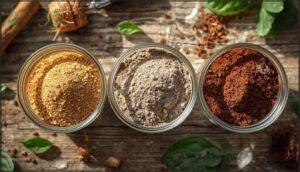
Knowing whether you’re working with sand, silt, or clay transforms how you care for your garden. A simple feel test reveals the truth: sandy soils feel gritty between your fingers, silty textures feel smooth like flour, and clay feels sticky when moist.
For precise soil texture analysis, try these methods:
- Perform the ribbon test by pinching moist soil—longer ribbons indicate higher clay identification
- Conduct a jar test to observe particle size separation and silt composition layers
- Check drainage speed for sand assessment clues
- Squeeze a handful to gauge soil structure stability
- Send samples for professional soil science testing when accuracy matters most
Reducing Soil Compaction Naturally

Compacted soil chokes the life out of plant roots, blocking air, water, and nutrients from reaching where they’re needed most. Using cover crop methods can help alleviate this issue by reducing soil compaction.
| Natural Remedy | How It Works | Best For |
|---|---|---|
| Deep-rooted cover crops | Break up hardpan layers while adding organic matter | Severe compaction prevention |
| Regular mulching | Protects soil structure from raindrop impact | Maintaining soil health |
| Adding compost | Feeds soil biota that create pore spaces | Improving soil aeration |
| Reduced foot traffic | Prevents compression of soil particles | Long-term root growth support |
| Biological tillage | Earthworms and microbes naturally loosen soil | Gentle, ongoing improvement |
Enhancing Drainage and Water Retention
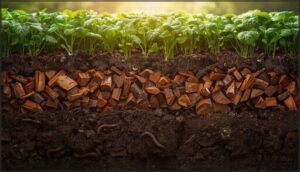
When water pools on the surface or drains away too quickly, your plants suffer. Balancing drainage systems with moisture conservation requires attention to soil porosity, aggregate stability, and water infiltration rates. Here’s how to achieve healthy soil structure:
- Build soil health with organic matter – increases water-holding capacity while improving drainage through stable aggregates
- Apply 2-4 inches of mulching – reduces evaporation by up to 70%, supporting water conservation
- Test drainage rates – helps identify whether amendments are needed for ideal balance
Incorporating Organic Matter
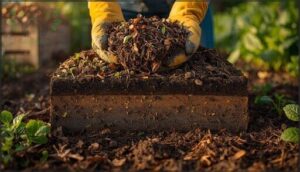
Think of organic matter as your soil’s powerhouse—it fuels everything from carbon sequestration to thriving soil biota. When you mix in compost, well-rotted manure, or cover cropping residues, you’re reducing bulk density and boosting microbial activity.
Organic matter is your soil’s powerhouse—fueling carbon storage, microbial life, and everything plants need to thrive
Regular composting and mulching feed microbe management systems naturally, while organic amendments like compost tea deliver nutrients and beneficial organisms.
Apply 2-3 inches mixed 8-12 inches deep for gardens, adjusting rates based on your soil’s texture.
Boosting Soil Fertility Organically
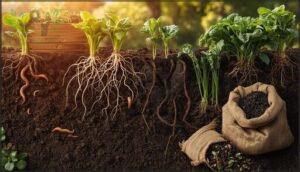
Once you’ve improved your soil’s structure, the next step is building long-term fertility without synthetic chemicals. Organic methods work with nature’s systems to create soil that feeds your plants season after season.
Here’s how to boost fertility naturally through compost, cover crops, and strategic amendments.
Benefits of Compost and Leaf Mold
When you add compost or leaf mold to your garden, you’re doing more than improving soil structure—you’re feeding billions of beneficial microorganisms that drive nutrient cycling. These organic matter-rich amendments boost water holding capacity, supply slow-release plant nutrients, and promote aggregate formation that creates the sponge-like texture healthy soil needs.
Composting kitchen scraps and mulching with leaves transforms your soil ecosystem from the ground up.
Using Green Manure and Cover Crops
Green manure and cover cropping transform bare ground into a living nitrogen factory. When you plant legumes like vetch or clover, their roots fix atmospheric nitrogen—supplying 20 to 40 kilograms per hectare for your next crop rotation.
Non-leguminous covers like rye build soil structure and slash erosion by up to 90 percent, while incorporating all that organic matter feeds your soil’s microbial workforce year-round.
Selecting and Applying Organic Amendments
Cover crops prime the soil, but choosing the right organic amendments takes you further. Start with a soil test to pinpoint what you actually need—compost and well-rotted manure deliver slow-release nutrients and microbial life, while rock phosphate targets phosphorus gaps in acidic ground. Fish emulsion and compost tea offer quick boosts when plants are actively growing, though you’ll apply them more often than solid organic matter.
- Match organic fertilizers to your soil test results instead of guessing what’s missing
- Layer compost and natural mulches to feed microbe boosters year-round
- Apply mineral amendments like rock phosphate during soil prep for long-term availability
- Use liquid natural fertilizers during peak growth when plants demand immediate nutrition
- Time applications to avoid heavy rain or drought for maximum soil health improvement
Application Rates for Different Garden Types
Once you know which organic mixtures to apply, garden fertilizers and soil amendments work best at specific compost ratios for each space.
Vegetable gardens thrive with 1–2 inches of compost worked into the top 6–8 inches, while ornamental beds benefit from 2–3 inches mixed deeper to boost nutrient levels.
Lawns need lighter applications—just 1–2 pounds of natural fertilizers per 1,000 square feet maintains garden soil without overwhelming turf roots.
Sustainable Practices for Healthy Soil
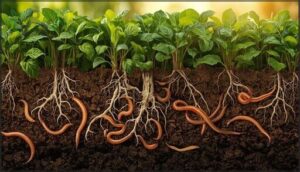
Building healthy soil isn’t just about what you add—it’s about how you manage your garden over time. The right long-term practices protect soil structure, support beneficial organisms, and keep nutrients cycling naturally.
Let’s look at four sustainable strategies that work together to maintain vibrant, productive soil year after year.
Crop Rotation and Companion Planting
Rotating crops year to year transforms your garden into a resilient system that naturally controls pests and enriches soil health. When you swap heavy feeders like tomatoes with nitrogen-fixing legumes or companion plant basil near peppers, you’re creating organic strategies that reduce pest pressure by up to 40% while building soil diversity.
Cover crops and thoughtful farm rotation protect organic matter, turning simple crop planning into powerful pest management.
Mulching for Moisture and Erosion Control
Beyond rotation, applying 2–3 inches of organic mulching materials shields your soil from raindrop impact and slows water runoff, cutting erosion while boosting water retention. Coarser wood chips work best on slopes for erosion control, while shredded leaves distribute moisture evenly across beds.
- Choose weed-free straw or compost to avoid introducing unwanted seeds
- Keep mulch a few inches from plant stems to prevent rot
- Replenish your mulch layer annually as organic matter decomposes
- Combine mulching with cover crops for year-round soil conservation and improved soil health
Supporting Soil Microbial Life
Building a thriving underground ecosystem starts with feeding beneficial microorganisms through regular compost additions. These decomposers make up 1–2% of your soil’s organic carbon and drive nutrient cycling. Mycorrhizal fungi extend networks that boost phosphorus uptake and drought tolerance, while higher soil respiration signals active microbial biomass breaking down organic matter into plant-available nutrients.
| Microbial Function | How to Support It |
|---|---|
| Fungal networks for nutrient exchange | Inoculate transplants with mycorrhizae |
| Soil respiration and microbial activity | Add compost rich in microbe diversity |
| Nutrient cycling by bacteria | Maintain consistent moisture levels |
| Enzyme production for decomposition | Minimize tilling to preserve soil biology |
| Carbon storage in microbial biomass | Layer organic mulch annually |
Minimizing Soil Disturbance
With no-till farming and reduced tillage, you’ll protect soil structure and preserve the microorganisms that drive nutrient cycling. Permanent beds prevent soil compaction while broadforks gently aerate without inverting layers.
Surface mulching moderates temperature and shields biology from disruption. These eco-friendly methods maintain soil health through minimal disturbance—a cornerstone of soil conservation that keeps beneficial networks intact beneath your feet.
Top 10 Products for Building Healthy Soil
Building healthy soil doesn’t require guesswork when you have the right products in your corner. From microbial inoculants that jumpstart your soil’s living ecosystem to organic amendments that feed both plants and beneficial organisms, these tools can speed up your soil-building journey.
Here are ten products that support the natural processes we’ve covered, helping you create thriving soil with less trial and error.
1. Microbial Biopesticides Formulation Guide
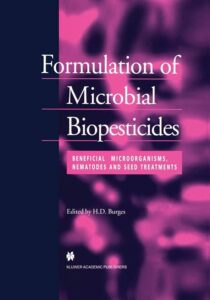
Ever wondered how you can utilize living microbes for safe, effective pest control in your soil? The Microbial Biopesticides Formulation Guide is your go-to resource for understanding Microbe Strains, Biopesticide Formulation, and Efficacy Metrics.
You’ll learn how Beneficial Microorganisms are selected, protected for Microbial Viability, and applied using proven Pest Control Methods.
With practical insights into Soil Biology and Microorganisms, this guide helps you boost Microbial activity and support healthy Soil Microbiology—making your soil a thriving ecosystem.
| Best For | Professionals and researchers in agriculture, microbiology, and pest management who need a detailed reference on microbial biopesticide formulation. |
|---|---|
| Item Form | Book/Print |
| Primary Use | Reference/Education |
| Organic/Natural | N/A |
| Weight/Volume | 424 pages |
| Price Range | $254.21 |
| Application Method | Reading |
| Additional Features |
|
- Covers everything from microbial strain selection to formulation and application.
- Written by leading experts with comprehensive chapters and helpful appendices.
- Useful for both academic research and commercial agrochemical development.
- Too technical for beginners or casual readers.
- Only available in English, which limits accessibility for non-English speakers.
- High price and older publication date may be a drawback for some buyers.
2. Dunkin Original Blend Coffee

Did you know your morning coffee can do double duty in the garden? Used grounds from Dunkin Original Blend Coffee make a smart organic matter addition when composted properly.
Their modest nitrogen content—around 0.3% to 0.4%—feeds microorganisms as they break down, fostering a microbe-friendly environment. You’ll want to mix them into your compost pile rather than applying thick layers directly, since fresh grounds can compact and affect soil pH management.
When integrated thoughtfully, coffee grounds benefits include improved aeration and gradual nutrient release that genuinely fosters soil health.
| Best For | Home gardeners who want to enrich their compost with an accessible organic material that adds nitrogen and improves soil structure over time. |
|---|---|
| Item Form | Ground |
| Primary Use | Beverage |
| Organic/Natural | No |
| Weight/Volume | 30 oz |
| Price Range | Mid-range |
| Application Method | Brewing |
| Additional Features |
|
- Adds modest nitrogen (0.3–0.4%) and trace minerals like potassium and magnesium to support gradual microbial activity in compost
- Improves soil aeration and water infiltration when mixed into compost or mulch layers thanks to its porous structure
- Provides a practical way to recycle used coffee grounds while building healthier soil through slow nutrient release
- Fresh grounds applied in thick layers can compact into a dense mat that blocks seed germination and retains too much moisture
- High-rate applications may create localized acidity issues and nutrient imbalances if not integrated into a broader soil plan
- Works best as a composted supplement rather than a standalone amendment, requiring extra steps for optimal results
3. Landscape Loc Mulch And Rock Binder
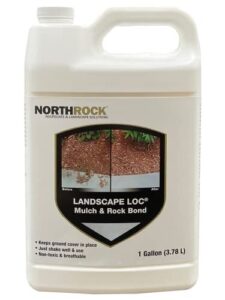
While Landscape Loc Mulch And Rock Binder won’t contribute organic matter or composting benefits to your soil, it plays a strategic role in erosion control and landscape maintenance.
This liquid solution provides mulch adhesion and rock binding to keep decorative surfaces in place during heavy rainfall, supporting broader soil conservation efforts.
It covers 250-750 square feet per gallon, goes on white but dries clear, and creates a permeable layer that allows water infiltration while reducing particle movement—a practical tool for soil stabilization in ornamental beds.
| Best For | Homeowners and landscapers who want to lock down mulch, gravel, or decorative rock in high-erosion areas without constant reapplication or cleanup after storms. |
|---|---|
| Item Form | Liquid |
| Primary Use | Landscape Stabilization |
| Organic/Natural | Non-toxic |
| Weight/Volume | 1 gallon |
| Price Range | Mid-range |
| Application Method | Spraying |
| Additional Features |
|
- Premixed and ready to use right out of the container, so you don’t need to measure or mix anything before applying it to your landscape beds.
- Dries clear and stays permeable, which means water can still reach plant roots while the binder keeps your mulch or rock from washing away.
- Non-toxic formula that’s safe around kids, pets, and plants, making it a low-risk option for residential gardens and high-traffic outdoor spaces.
- Coverage varies widely from 250 to 750 square feet per gallon depending on your material and application method, so you might need more product than expected for larger areas.
- Doesn’t work well with rubber mulch or in spots with heavy foot traffic or deep gravel layers, which limits where you can actually use it effectively.
- Can clog pump sprayers during application, often requiring an electric paint sprayer instead, which adds extra equipment cost and hassle.
4. Miracle Gro Organic Mulch
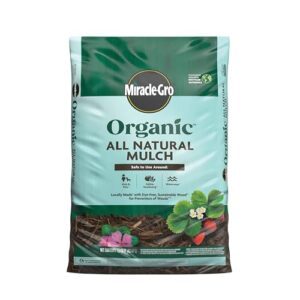
Miracle Gro Organic All Natural Mulch brings together weed suppression and soil enrichment in one dye-free wood product. This OMRI-listed option blocks sunlight to prevent weed germination while moderating soil temperature and conserving moisture between waterings.
Made from recycled green waste, it breaks down gradually to add organic matter that feeds beneficial soil microbes.
Apply a 3-inch layer around trees, shrubs, and vegetables—keeping it a few inches from trunks and stems. Each 1.5 cubic foot bag covers about 6 square feet, supporting your organic gardening methods with locally sourced, sustainable materials.
| Best For | Organic gardeners who want locally made, chemical-free mulch that blocks weeds while improving soil health around vegetables, flowers, and landscape plants. |
|---|---|
| Item Form | Granule |
| Primary Use | Mulch/Weed Control |
| Organic/Natural | OMRI Listed |
| Weight/Volume | 1.5 cu. ft. |
| Price Range | Budget |
| Application Method | Spreading |
| Additional Features |
|
- Blocks sunlight to prevent weeds and keeps soil moisture stable between waterings
- OMRI-listed and dye-free, so it’s safe around edible gardens, kids, and pets
- Made from recycled green waste and manufactured locally, cutting down on transportation impact
- Can’t be used around seedlings or underdeveloped plants until they’re established
- May develop white fungus on the surface as it breaks down naturally
- Small 1.5 cu. ft. bags cover only about 6 sq. ft., so larger areas need multiple bags
5. Gardening Log Book Planner
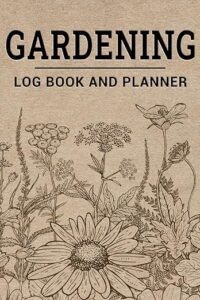
Tracking your soil testing results, fertilizer applications, and compost additions over time reveals patterns that transform guesswork into precision. A 169-page gardening log book helps you record pH levels every three to five years, map crop rotation schedules, and monitor organic matter improvements across different beds.
With dedicated sections for water management, seasonal checklists, and amendment logs, you’ll document exactly which soil-building strategies work best in your unique conditions—building a tailored reference that grows more valuable each season.
| Best For | Gardeners who want to track soil health metrics, crop rotations, and amendment applications over multiple seasons to build a personalized reference for improving their garden’s productivity. |
|---|---|
| Item Form | Book/Print |
| Primary Use | Garden Planning |
| Organic/Natural | N/A |
| Weight/Volume | 169 pages |
| Price Range | Budget |
| Application Method | Writing/Recording |
| Additional Features |
|
- Comprehensive 169-page format with specialized sections for soil testing results, nutrient tracking, irrigation logs, and composting records that help you identify what actually works in your soil
- Includes practical tools like a companion planting chart, seasonal checklists, and year-at-a-glance pages that make it easy to plan crop rotations and prevent soil depletion
- Simple plant watering tracker and 100 pages of guided prompts help you maintain consistent records without overwhelming complexity
- Paper and print quality may disappoint some users who expect higher-grade materials for long-term record keeping
- Physical format means you can’t quickly search past entries or generate reports the way digital tools allow
- Layout may not fit every gardening style, and some users might find it too bulky to carry between garden beds
6. Live Edible Herb Assortment Plants

A hand-selected assortment of six live edible herb plants—like lemon verbena, eucalyptus, and mint—feeds your garden soil while putting fresh flavors at your fingertips.
These aromatic plant benefits extend underground, where herb roots release organic compounds that stimulate soil microbes and build microorganism-rich zones around each plant.
For best herb container care, use well-drained potting mixes combining real compost with sand, water when the top inch dries, and apply organic herb fertilizers at half-strength to support steady growth without overwhelming your garden soil with excess nutrients.
| Best For | Home cooks and beginner gardeners who want fresh culinary herbs on hand while improving their container soil with living roots. |
|---|---|
| Item Form | Live Plant |
| Primary Use | Culinary Herbs |
| Organic/Natural | Yes |
| Weight/Volume | 8 ounces |
| Price Range | Mid-range |
| Application Method | Planting |
| Additional Features |
|
- Six ready-to-use aromatic varieties give you instant access to cooking herbs like mint and lemon balm without starting from seed.
- Herb roots feed beneficial microbes in your potting mix, creating healthier soil biology that supports long-term plant growth.
- Flexible placement indoors or outdoors lets you grow fresh herbs year-round in whatever space you have available.
- Plants sometimes arrive stressed from shipping, with occasional fungus or damage that requires immediate trimming and recovery care.
- Packaging with plastic wrap and rubber bands isn’t always protective enough during transit, leading to bent stems or broken leaves.
- The price feels steep to some buyers given the small plant size and the extra work needed to establish them in larger containers.
7. The Andersons Organic Soil Amendment
While fresh herbs build surface-level soil health, The Andersons HumiChar Organic Soil Amendment works deeper—combining humic acid with pecan shell biochar to create a porous carbon structure that boosts soil microbes and holds moisture like a sponge.
This dual-action organic amendment nourishes beneficial microorganisms, improves nutrient availability, and enhances carbon sequestration in your garden soil.
Apply one to four pounds per 1,000 square feet, water it in, and watch the dispersible granules move past thatch into your root zone without tilling—a smart soil conservation technique for long-term garden soil management.
| Best For | Gardeners and lawn owners looking to build long-term soil health through organic carbon and microbial support rather than quick-fix fertilizers. |
|---|---|
| Item Form | Granule |
| Primary Use | Soil Amendment |
| Organic/Natural | OMRI Listed |
| Weight/Volume | 12 pounds |
| Price Range | $49.88 |
| Application Method | Spreading |
| Additional Features |
|
- Dispersible granules break down on contact with water and move into soil without tilling or raking, making application fast and clean on lawns, beds, and around trees.
- Combines humic acid for immediate microbial food with biochar’s porous structure for lasting water retention and nutrient holding, especially helpful in sandy or compacted clay soils.
- OMRI-listed organic amendment that’s safe around kids and pets, doesn’t alter pH, and reduces reliance on synthetic fertilizers when used regularly.
- At around $50 for 12,000 square feet of coverage, treating large properties or reapplying every few weeks adds up quickly compared to conventional fertilizers.
- Not available for sale in California or Oregon due to regulatory restrictions, limiting access for West Coast gardeners.
- Results build over time with repeated use—it’s a soil-building tool, not a quick green-up product, so patience and multiple applications are needed to see full benefits.
8. Espoma Organic Rock Phosphate Fertilizer
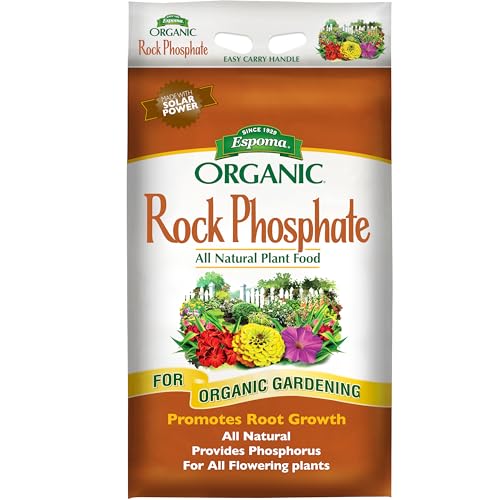
When your soil test reveals phosphorus deficiency, Espoma Organic Rock Phosphate delivers a slow-release natural nutrient boost that fosters strong root development and abundant blooms. This 0-3-0 pelletized fertilizer releases phosphorus gradually as it weathers, building soil fertility over multiple seasons without the runoff risks of water-soluble synthetic options.
Mix about five cups per 100 square feet into your garden beds, or blend four teaspoons into each planting hole—the calcium and trace minerals naturally present in this mined rock also improve soil structure as beneficial microbes break it down.
| Best For | Organic gardeners with phosphorus-deficient soils who want to strengthen root systems and increase flowering without the environmental risks of fast-acting synthetic fertilizers. |
|---|---|
| Item Form | Pellets |
| Primary Use | Plant Fertilizer |
| Organic/Natural | Organic |
| Weight/Volume | 28 pounds |
| Price Range | Mid-range |
| Application Method | Spreading |
| Additional Features |
|
- Slow-release formula builds soil phosphorus reserves over several seasons, reducing the need for frequent reapplication and lowering leaching risk compared to water-soluble options.
- Pelletized form minimizes dust during handling and makes measuring easy—just use cups or teaspoons instead of a scale.
- Adds calcium and trace minerals alongside phosphorus, improving soil structure and cation balance as microbes break down the rock.
- Works best in acidic to neutral soils—high-pH alkaline soils limit phosphorus release, so a soil test is essential before buying.
- Results take time since the mineral dissolves gradually, making it a poor choice if you need an immediate nutrient fix.
- Some customers report dirty or damaged packaging on delivery, though the product itself remains effective.
9. Espoma Organic Plant Food
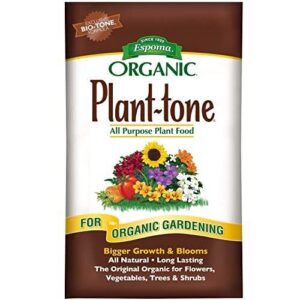
With a gentle 5-3-3 nutrient ratio enhanced by Bio-tone beneficial microbes, Espoma Plant Food nourishes flowers, vegetables, trees, and shrubs while feeding the soil ecosystem beneath them.
This all-purpose organic fertilizer blends natural amendments—bone meal, alfalfa, greensand—that release plant nutrients gradually without burning roots or leaching into waterways.
Sprinkle one cup around each established plant monthly during the growing season, or mix one part fertilizer to twenty-five parts potting soil for containers, supporting vigorous growth while building organic matter and nurturing soil microbes that cycle nutrients naturally.
| Best For | Gardeners who want an all-purpose organic fertilizer that feeds both plants and soil without the risk of root burn or chemical runoff. |
|---|---|
| Item Form | Bagged |
| Primary Use | Plant Fertilizer |
| Organic/Natural | Organic |
| Weight/Volume | 36 pounds |
| Price Range | $44.49 |
| Application Method | Spreading |
| Additional Features |
|
- Slow-release 5-3-3 formula with Bio-tone microbes builds healthy soil while nourishing flowers, vegetables, trees, and shrubs
- Won’t burn plants when used as directed and has a low salt index that’s safer during dry spells or slight overapplication
- Made from recycled organic materials like bone meal and manure, keeping waste out of waterways while supporting environmentally safe gardening
- Strong organic smell from natural ingredients may be noticeable during application, though it fades relatively quickly
- Higher price point at $44.49 for 36 pounds compared to some synthetic alternatives available at other retailers
- Requires careful dosing instructions when used around children and pets despite being non-toxic when applied correctly
10. Organic Fish Emulsion Fertilizer
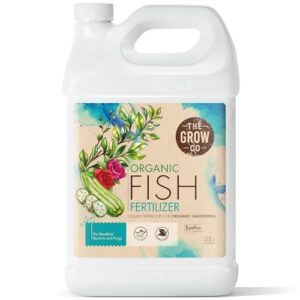
Cold-pressed from sustainable fish byproducts, this liquid nitrogen source delivers a 2-3-1 NPK ratio that feeds both plants and the soil microbe populations breaking down organic matter beneath them.
Though the fishy smell attracts curious pets and wildlife, diluted applications every two to four weeks supply protein-rich substrate for beneficial microorganisms while providing readily available plant nutrients for vegetables, flowers, and fruits.
Use it as a soil drench or foliar spray to support vigorous growth, increased yields, and the thriving microbial communities revealed in any thorough soil test of organically managed gardens.
| Best For | Organic gardeners who want a sustainable nitrogen boost for vegetables and flowers and don’t mind the strong fish smell that comes with it. |
|---|---|
| Item Form | Liquid |
| Primary Use | Plant Fertilizer |
| Organic/Natural | Organic |
| Weight/Volume | 128 fl oz |
| Price Range | Mid-range |
| Application Method | Dilute & Apply |
| Additional Features |
|
- Cold-pressed formula retains nutrients and feeds beneficial soil microbes, building healthier garden ecosystems over time
- Works as both a soil drench and foliar spray, giving you flexibility in how you apply it throughout the growing season
- The 2-3-1 NPK ratio provides steady nitrogen for vigorous growth and better yields without overwhelming your plants
- Strong fishy odor attracts raccoons, cats, dogs, and other animals, which can be a real nuisance in residential gardens
- Requires careful dilution and timing to avoid over-fertilizing, so it’s not quite as foolproof as some alternatives
- Some fish emulsion products can contain trace heavy metals like mercury, so check for organic certification and third-party testing
Frequently Asked Questions (FAQs)
How to make your soil more healthy?
Your garden’s underground ecosystem thrives when you add organic matter like compost and mulch, minimize digging, plant cover crops, and protect against soil erosion—these practices boost soil microbes while improving carbon sequestration naturally.
By adopting soil health practices, gardeners can create a more resilient and sustainable garden ecosystem.
What are the 5 principles of soil health?
The more you protect it, the stronger it becomes.
The five principles of soil health are: soil armor, minimal disturbance, crop diversity, living roots year-round, and livestock integration—each nurturing soil biology and organic matter.
What can I put in my soil to make it better?
You can add compost, organic matter, worm castings, and mulch to enrich your soil.
Cover crops, organic fertilizers, compost tea, microbial inoculants, and soil conditioners also boost fertility and support beneficial organisms.
Can you turn bad soil into good soil?
Yes, you absolutely can transform degraded soil through soil remediation and organic amendments. Microbe restoration, nutrient cycling, and erosion control rebuild structure over time.
Healthy soil requires patience, but soil conservation techniques and organic matter work wonders.
What do you put into the soil to make it healthy?
Organic matter like compost, natural mulches, and leaf mold form the foundation.
Soil amendments including microbe inoculants, compost tea, and organic fertilizers boost nutrient levels while feeding beneficial microorganisms that create thriving underground ecosystems.
How can we improve the health of soil?
You’ll improve soil health through consistent organic matter additions, reduced tillage, diverse cover crops, and strategic nutrient management.
These practices strengthen soil biology, boost carbon sequestration, minimize erosion, and support vigorous nutrient cycling for thriving plants.
How do you turn bad soil into good soil?
Think of degraded soil as a dormant ecosystem waiting to wake up.
You’ll rebuild it through organic amendments, cover crops, and compost that restore soil biology, boost nutrient cycling, and improve structure over time.
How long does it take to build healthy soil?
Soil regeneration usually takes one to three years, depending on your starting conditions and methods.
Active organic matter additions and minimal disturbance accelerate microbe growth, establishing nutrient cycling and ecosystem balance for thriving soil biology.
What can I add to soil to make it healthy?
You’re not reinventing the wheel here—compost, organic matter, mulch, cover crops, and organic fertilizers work wonders.
Add compost tea, manure amendments, soil conditioners, and microbe boosters to invigorate your garden’s foundation.
How does weather impact soil health?
Weather patterns directly shape soil health through rainfall impact and drought effects. Heavy rains accelerate soil erosion, while prolonged droughts deplete moisture reserves.
Climate change intensifies these challenges, making water conservation and soil science understanding essential for protecting your garden’s foundation.
Conclusion
Patience, persistence, and practical observation transform average gardens into productive ecosystems. Building healthy soil requires commitment to ongoing assessment and organic enrichment, yet the rewards multiply season after season.
Your plants will develop stronger root systems, resist pests more effectively, and produce more abundant harvests. Start with one amendment, one cover crop, or one compost pile today.
The living community beneath your garden beds will respond to your care with resilience you can measure in every thriving plant.