This site is supported by our readers. We may earn a commission, at no cost to you, if you purchase through links.
A single apple tree can produce over 400 pounds of fruit in a season, but most backyard trees yield less than half that amount. The difference often comes down to soil nutrients—or the lack of them.
Most homeowners plant fruit trees with high hopes, then watch them struggle year after year with pale leaves, sparse blossoms, and disappointing harvests. Your tree isn’t failing; it’s starving.
Fruit tree fertilization tips aren’t about dumping chemicals on roots and hoping for the best. They’re about reading what your tree tells you, understanding which nutrients drive flowering versus fruiting, and timing applications to match the tree’s natural rhythm. Get the balance right, and you’ll see stronger branches, better fruit set, and yields that finally match your expectations.
Table Of Contents
- Why Fertilize Fruit Trees?
- Key Nutrients Fruit Trees Need
- Assessing Your Tree’s Fertilizer Needs
- Best Fertilizer Types for Fruit Trees
- Fertilization Timing Through The Year
- How to Apply Fertilizer Correctly
- Special Tips for Young and Mature Trees
- Avoiding Common Fertilization Mistakes
- Optimizing Soil for Fertilization
- Sustainable and Organic Fertilization Practices
- Frequently Asked Questions (FAQs)
- What is the best way to fertilize fruit trees?
- What does baking soda do for fruit trees?
- What are common fruit tree fertilizer mistakes?
- What month should I fertilize fruit trees?
- What fertilizers work best for citrus trees?
- How do container fruit trees differ in feeding?
- Can coffee grounds benefit fruit tree health?
- Should newly grafted trees receive special fertilization?
- How does mulching affect fertilizer application schedules?
- Can mulching impact fruit tree fertilization results?
- Conclusion
Why Fertilize Fruit Trees?
Fertilizing your fruit trees isn’t just about making them bigger—it’s about creating the conditions they need to produce abundant, flavorful fruit year after year.
If you’re not sure where to start, this guide on how to fertilize fruit trees walks you through soil testing, timing, and application methods that actually work.
Without the right nutrients at the right times, even healthy-looking trees can struggle with poor yields, weak branches, and fruit that never reaches its full potential. Here’s what proper fertilization does for your trees.
Benefits for Growth and Yield
Proper fruit tree fertilization transforms your orchard from struggling to thriving. When you match nutrient uptake to growth patterns, you’ll see measurable improvements in tree vigor and harvest quality:
- Enhanced leaf area promotes greater photosynthesis and faster canopy development in early season growth.
- Increased fruit set leads to higher fruit numbers per tree when nutrient demand is met.
- Stronger branch growth reinforces larger fruit loads without excessive limb breakage.
- Improved root expansion boosts water uptake and nutrient access during dry spells.
Healthy soil structure is essential for ideal fruit production, as outlined in this guide to.
Role in Fruit Quality
Nutrient uptake shapes everything from fruit sugar content to aroma intensity. When you provide balanced NPK ratio through proper nutrient management, you’ll notice flavor enhancement as sugar-to-acid balance improves and pigment levels deepen.
The ripening process accelerates evenly, boosting quality factors like flesh firmness and skin brightness. Strategic fruit tree fertilization directly influences fruit production outcomes—sweeter, more colorful harvests that command premium prices and deliver exceptional eating experiences.
The impact of nutrients on cherry tomato flavor quality demonstrates how closely fertilization practices can shape fruit taste, nutrition, and market value.
Impact on Tree Health
Beyond sweetness and color, fertilization shields your tree from stress that triggers fruit drop and leaf disorders. Balanced fruit tree nutrition fuels cambial growth, building thicker trunks and stronger branches that resist storms.
You’re also feeding root health—those deep networks that pull water during droughts. Proper nutrient management keeps tree health vigorous, fending off pests and diseases before they take hold.
Key Nutrients Fruit Trees Need

Think of fertilizer as a balanced diet for your tree—without the right nutrients, even the healthiest rootstock won’t deliver a great harvest.
Fruit trees depend on a mix of major and minor nutrients, each playing a specific role in growth, fruiting, and long-term resilience. Let’s break down what your trees actually need and how those needs shift depending on the type you’re growing.
Nitrogen, Phosphorus, Potassium
Think of nitrogen, phosphorus, and potassium as your tree’s core diet—the NPK on every fertilizer bag. Nitrogen drives leafy growth and photosynthesis, phosphorus strengthens roots and flowering, while potassium boosts fruit quality and stress tolerance.
Balanced fertilizer ratios like 10-10-10 work well for general maintenance, but soil pH and macronutrient roles shift based on your tree’s age and fruiting stage.
Essential Micronutrients
Your tree’s health depends on more than macronutrients—micronutrients play essential supporting roles.
Iron prevents yellowing leaves and facilitates photosynthesis, while zinc benefits shoot development and fruit set.
Copper functions in enzyme activity and disease resistance, and manganese importance shows up in chlorophyll production.
These trace elements may be small players in your fertilization program, but iron deficiency or missing minerals can stall growth fast.
How Needs Change by Tree Type
Fast-growing peaches and pears demand more nitrogen than slow-growing citrus, while stone fruit trees show higher early-season nutrient uptake rates than pome fruits.
Root depth analysis reveals that deeply rooted apples access nutrients differently than shallow-rooted types, so you’ll adjust fertilization based on tree size variations and climate adaptations. Heavy fruit yield factors also drive phosphorus and potassium needs during fruit fill.
Assessing Your Tree’s Fertilizer Needs
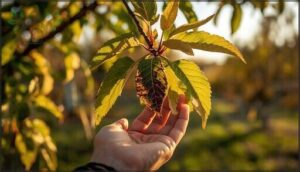
You don’t need a soil test to know when your tree is crying out for help. The tree itself will show you what’s missing through visible clues in its leaves, branches, and overall growth pattern.
Let’s walk through the telltale signs that reveal exactly what your fruit tree needs.
Visual Signs of Deficiency
Your fruit tree’s leaves, bark, and fruit tell a story long before a soil test confirms trouble. Uniform pale green or yellow leaves usually point to nitrogen deficits, while bright yellow leaves with dark green veins signal iron issues in high-pH soils.
Watch for fruit deformities like corky, misshapen apples—classic signs of boron shortage. Bark symptoms such as raised pimples or dieback also reveal canopy issues tied to nutrient deficiencies. Catching these visual cues early lets you adjust fertilization and tree nutrition before problems spiral.
Evaluating Shoot and Leaf Growth
Healthy shoot elongation and leaf expansion rates reveal whether your nutrient management hits the mark. During peak growth, you should see 2 to 5 new leaves emerge weekly, with shoots extending 15 to 30 percent in the first month after bud break.
Key indicators to track:
- Internode length between leaf nodes—longer spacing signals vigorous growth
- Leaf area reaching 60 to 90 percent of mature size within 2 to 4 weeks
- Branching patterns showing balanced canopy development
- Leaf senescence timing—early yellowing flags deficiencies
- Overall tree growth compared to previous seasons
Pair these observations with a soil test for complete tree nutrition insight.
Best Fertilizer Types for Fruit Trees
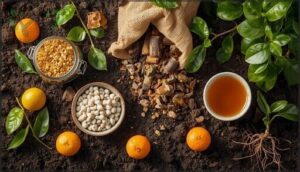
Once you’ve identified what your trees need, you can choose the right fertilizer to deliver those nutrients. Your options range from fast-acting synthetic blends to slow-release organic materials, each with distinct advantages depending on your soil conditions and growing goals.
Here’s a breakdown of the main fertilizer types that work well for fruit trees.
Balanced Synthetic Fertilizers
When you’re looking for reliable fertilization, balanced synthetic blends deliver precise nutrient balance your trees can count on. These fertilizer types feature customized NPK ratios—nitrogen, phosphorus, and potassium—that match fruit tree needs throughout the season.
Many formulations also include secondary nutrients and address micronutrient needs like iron and zinc, preventing hidden deficiencies that slow growth and reduce yields.
Organic Options (Compost, Manure, Bone Meal)
Organic fertilizers build soil health while nourishing your trees—think of them as a long-term investment in your orchard. Compost, manure, and bone meal release nutrients slowly, preventing burn and supporting beneficial microbes that boost root systems and overall soil quality.
- Compost benefits: Apply 1 to 2 inches around drip lines for balanced nutrients and improved moisture retention
- Manure types: Use aged cow, horse, or poultry manure at 2 to 4 cubic feet per tree annually
- Bone meal uses: High in phosphorus for root development, lasts several months to a year
- Organic matter: Enhances soil structure, drainage, and water-holding capacity over time
- Soil amendments: Pair with soil tests to tailor applications and maintain long-term orchard vigor
Micronutrient Boosters
Even with strong macronutrients, your trees may show pale leaves or poor color—that’s where micronutrient boosters come in.
These trace-element formulas deliver iron, zinc, manganese, and boron through foliar sprays or soil drenches, correcting deficiencies and boosting yields. Apply them every two to six weeks during active growth for rapid nutrient uptake that keeps foliage vibrant and fruit quality high.
Fertilization Timing Through The Year
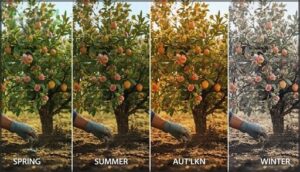
Timing your fertilizer applications isn’t just about randomly feeding your trees—it’s about matching nutrients to what your tree actually needs at each stage of the year.
You’ll get the best results when you work with your tree’s natural growth cycles, from spring’s explosive new growth to fall’s quiet preparation for winter. Here’s how to time your fertilization through the seasons for healthier trees and better harvests.
Spring Applications for Growth
You’ll get the best results when you apply spring fertilizers just as buds begin to swell and shoots emerge.
Fertilization timing matters because early applications support rapid foliage development and strong tree growth during critical growth stages. Focus on nitrogen to fuel leaf expansion, and prepare soil with compost to boost nutrient uptake.
Water thoroughly after fertilization so nutrients reach active roots.
Summer Feeding for Fruit Development
Summer nutrient boost shifts your focus from foliage to fruit size management. Apply moderate potassium and reduced nitrogen in early to mid summer to improve fruit development timing and support sweetness and firmness.
These warm weather strategies improve fruit production and yield without pushing excessive leafy growth. Consistent moisture paired with seasonal fertilizer adjustments helps maintain tree nutrition and health during peak fruiting, with nutrient management and fertility customized to your tree’s bearing load.
Fall and Late Winter Strategies
As temperatures drop, your fall preparation shifts toward root storage rather than shoot growth. Apply a phosphorus and potassium rich balanced fertilizer after leaf drop to build winter reserves and support soil readiness for spring.
- Test soil pH now to adjust nutrient timing before ground freezes
- Avoid high nitrogen to prevent frost damaged tender growth
- Water lightly post application to move nutrients into the root zone
Late winter care focuses on baseline soil testing and light micronutrient boosts if deficiencies appear, setting the stage for healthy tree nutrition and health when growth resumes.
How to Apply Fertilizer Correctly
Getting the fertilizer to your tree is half the battle—doing it right makes all the difference. You can’t just dump nutrients at the trunk and hope for the best, since application method, placement, and follow-up care all affect how well your tree absorbs what you’re giving it.
Let’s walk through the practical steps that’ll help you apply fertilizer like a pro.
Calculating Proper Amounts
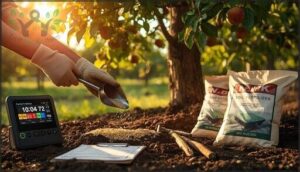
Think of fertilizer calculations as fine-tuning a recipe—precision matters. Start with soil testing and tree analysis to identify actual needs.
Use nutrient ratios from your soil test, then determine application rates by dividing the needed Nitrogen, Phosphorus, and Potassium by the percentages on your fertilizer label. Adjust fertilization based on your tree’s age, canopy size, and recent growth patterns.
Granular Vs. Liquid Fertilizer
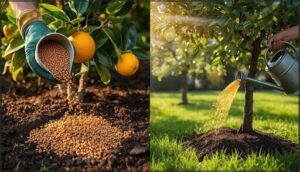
Between granular and liquid fertilizer, you’ll find different nutrient release speeds and application methods. Granular fertilizer forms dissolve slowly as soil moisture activates them, feeding your fruit trees steadily for weeks.
Liquid fertilizer delivers nutrients almost immediately but requires more frequent fertilization. Choose granular for long-term soil interaction and fertilizer efficiency, liquid when you need quick correction.
Topdressing and Foliar Feeding
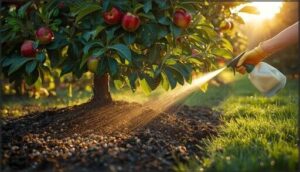
Beyond soil application, topdressing methods and foliar spray offer precise nutrient management for fruit trees. Topdressing adds fertilizer on the surface near roots for steady nutrient uptake during the growing season, while foliar feeding delivers dilute solutions directly to leaves for rapid correction.
Apply foliar spray on mild, calm mornings to boost micronutrients like iron or zinc when leaf analysis reveals deficiencies.
Watering After Application
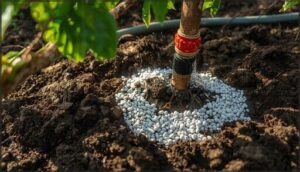
Irrigation after fertilization is more than routine watering—it activates nutrient uptake and prevents root burn. The window between application and irrigation depends on soil type, product form, and weather conditions, so timing your water delivery directly affects fertilizer performance.
- Granular fertilizer needs water within 24 hours to move nutrients into the soil where roots can absorb them.
- Liquid treatments require 2 hours of drying time before you irrigate to prevent washing away surface applications.
- Sandy soils demand shorter watering intervals but lighter amounts to keep nutrients in the root zone.
- Clay soils hold moisture longer, so wait before irrigating to avoid nutrient leaching and runoff.
Proper post-application irrigation methods guarantee your fruit tree fertilizer reaches active roots without waste. Check soil moisture before watering—if the top two inches feel dry, apply moderate irrigation using drip lines or soaker hoses that deliver water slowly. In hot weather, delay watering slightly to let granules settle, then irrigate during cooler morning hours. Always follow product labels for specific water timing guidance, and record your fertilization and soil management schedule to perfect tree care practices each season.
Special Tips for Young and Mature Trees

Young fruit trees and established ones don’t share the same nutritional game plan. A first-year sapling needs gentle care to establish roots without overwhelming its system, while a mature tree demands different timing and amounts to keep producing quality fruit.
Here’s how to adjust your approach based on your tree’s stage of life.
First-Year Fertilization Guidelines
Newly planted fruit trees need a gentle approach to first year feeding. Start with a balanced fertilizer—equal nitrogen, phosphorus, and potassium ratios—when buds swell in early spring.
Apply about half to one cup per inch of trunk diameter around the drip line, staying six inches from the stem. This careful fruit tree fertilization strategy promotes young tree care without overwhelming tender roots or delaying fruit production.
Building Strong Root Systems
Deep soaking encourages root depth beyond the topsoil, where moisture stays more stable. Well-drained soil creates the aeration your tree’s feeder roots crave while preventing rot.
Add organic matter to boost microbial balance, which unlocks nitrogen and other nutrients for better uptake. Consistent moisture—not waterlogging—helps roots explore wider volumes, improving water retention.
Mulch around the trunk to stabilize soil quality and support steady tree growth during fruit tree fertilization.
Adjusting for Mature Trees
Once your tree has settled in, shift from frequent root zone fertilization to deeper, less frequent applications that reach established roots without causing nutrient burn. Here’s your mature tree care playbook:
- Target the drip line where active roots cluster, not the trunk base
- Cut back nitrogen to prevent weak shoot growth and stress
- Run a soil test every 2–3 years to fine-tune foliar feeding and soil conditioning strategies
Avoiding Common Fertilization Mistakes
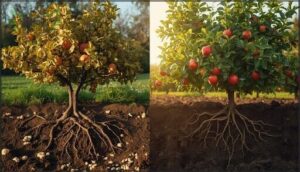
Even experienced growers can slip up when feeding fruit trees, and those mistakes often cost you time, money, and a healthy harvest.
The line between too much and too little isn’t always obvious, and timing matters more than most people realize. Let’s walk through the most common fertilization errors so you can sidestep them and keep your trees thriving.
Over-Fertilization Risks
Unfortunately, over-fertilization can backfire quickly—nutrient toxicity burns leaf margins, weakens branches, and triggers excessive foliage at the expense of fruit.
Fertilizer overuse also degrades soil structure, pollutes nearby water, and harms beneficial microbes. When you fertilize beyond what your tree needs, you’re risking tree damage and environmental impact while wasting money on unnecessary fertility.
Proper nutrient management protects both your investment and the ecosystem.
Under-Fertilization Effects
While over-feeding harms, skimping on nutrients is just as damaging. Under-fertilization starves your tree, causing yield reduction of 15 to 40 percent and fruit deformation from poor cell expansion.
You’ll also see:
- Nutrient imbalance that blocks calcium and micronutrient uptake
- Soil degradation as organic matter and microbial activity decline
- Tree decline marked by weak branches, pale leaves, and disease susceptibility
Proper fruit tree fertilization reverses these losses.
When Not to Fertilize
Just as bad as under-feeding is fertilizing at the wrong moment. Don’t fertilize during dormant periods when cold slows root activity—you’ll waste nutrients and risk frost damage on tender new growth.
Skip fertilization in high soil salinity zones, after transplanting for four to six weeks, or when trees show drought stress. A soil test confirms whether your fertilizer timing and soil fertility levels actually support healthy growth.
Optimizing Soil for Fertilization
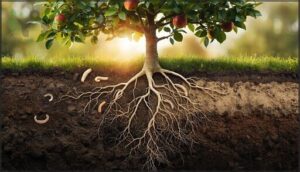
Even the best fertilizer won’t do much good if your soil can’t deliver those nutrients to your tree’s roots. The foundation of effective fertilization starts below ground, where pH, structure, and organic content work together to make nutrients available.
Let’s look at three key ways to improve your soil so your fertilizer investment pays off.
Ideal Soil PH for Fruit Trees
Most fruit trees flourish when soil pH sits between 6.0 and 7.0—slightly acidic to neutral. Soil pH testing reveals exactly where you stand, and that matters because nutrient availability hinges on pH levels.
Apples, pears, and peaches all thrive near 6.5, while citrus and stone fruits lean toward 6.0 to 6.5 for ideal fruit tree species health and soil fertility.
Improving Soil Structure
Healthy root zones depend on good soil structure, and you can improve it with simple soil management practices:
- Add compost annually to feed soil biota that bind particles into stable aggregates
- Minimize tilling to preserve porosity and prevent collapse of existing aggregates
- Mulch around trees to protect surface layers and support microbial activity
- Plant cover crops between rows to boost soil health and break up compacted zones
Better soil aggregation means roots breathe easier and nutrients move efficiently.
Enhancing With Organic Matter
Rich soil begins with organic matter—your secret weapon for vibrant fruit trees. Layer well-aged compost around drip lines to slowly release nitrogen and boost soil carbon storage.
Green manure and compost tea add beneficial microbes, while mulch application conserves moisture and feeds roots year-round. These organic gardening methods transform tired soil into a thriving ecosystem that promotes healthy growth without synthetic fruit tree fertilizer.
Sustainable and Organic Fertilization Practices
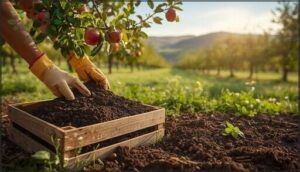
You don’t have to sacrifice tree health to protect the environment. Sustainable fertilization practices work with nature instead of against it, building resilient soil that feeds your trees for years to come.
Let’s look at three practical ways to fertilize responsibly without compromising your harvest.
Eco-Friendly Fertilizer Choices
You can nourish your trees while protecting the planet by choosing Organic Fertilizer made from sustainable practices.
Eco-Friendly options like Organic Compost, bone meal, and seaweed extract deliver steady nutrients without harsh chemicals:
- Composted manure releases 1-3% nitrogen slowly
- Bone meal promotes root development with phosphorus
- Seaweed extract boosts micronutrients naturally
- Green manures fix nitrogen and build soil
These Natural Amendments promote Sustainable Gardening Practices that improve long-term soil health.
Reducing Chemical Use
You can slash chemical dependence by combining smart strategies that protect both your trees and the environment. Organic Mulching suppresses weeds by 20 percent, while Soil Solarization reduces pests without fumigation.
Integrated Pest Management targets specific threats using beneficial insects and traps, cutting broad-spectrum pesticide use dramatically. These Sustainable Gardening Practices support Soil Health through thoughtful Nutrient Management and Fertility planning, advancing Chemical Reduction and strengthening your commitment to Organic Gardening.
Promoting Soil Health Long-Term
Think of your soil as a living savings account—each deposit of compost or cover crop compounds over time. Long-Term Sustainability Practices through Organic Matter Enhancement drive Soil Microbe Balance and steady Nutrient Cycling Strategies.
Treat your soil like a savings account—every addition of compost or cover crop builds long-term fertility and microbial balance
- Mulch regularly to boost water retention and microbial habitat
- Rotate cover crops to improve Soil Structure and fix nitrogen
- Test annually, adjusting Nutrient Management based on real data
These Sustainable Gardening habits build lasting Soil Health and Fertilization success.
Frequently Asked Questions (FAQs)
What is the best way to fertilize fruit trees?
Most gardeners overthink fertilization schedules when the answer’s simpler: spread balanced fertilizer under your tree’s canopy to the drip line each spring, water thoroughly, and let soil conditioning plus proper nitrogen, phosphorus, and potassium ratios do the work.
What does baking soda do for fruit trees?
Baking soda works as a natural pesticide and fungal disease preventative when sprayed on leaves, creating a protective film that slows powdery mildew.
It doesn’t replace fertilization or improve soil quality directly.
What are common fruit tree fertilizer mistakes?
Fertilizer overuse raises soil salinity by 30 percent, damaging roots and reducing water uptake.
Application errors—wrong timing, nutrient imbalance, or poor fertilization techniques—weaken fruit tree care and compromise yields through soil pollution.
What month should I fertilize fruit trees?
Early spring wins the fertilization calendar—apply just before buds swell, usually March through April in most climates.
This nutrient timing aligns with growth cycles, letting roots absorb what they need before flowering begins.
What fertilizers work best for citrus trees?
Citrus trees thrive on balanced fertilizers with nitrogen, phosphorus, and potassium ratios like 10-2-12, plus micronutrient supplements including iron and zinc.
Organic options like compost and bone meal also support steady fruit production.
How do container fruit trees differ in feeding?
Picture a potted apple tree on your patio—its roots are trapped, and container soil runs out of fuel fast.
You’ll need to fertilize more often than in-ground trees to beat nutrient depletion.
Can coffee grounds benefit fruit tree health?
Yes, coffee grounds benefit fruit trees by adding nitrogen for leaf growth, improving soil structure, and supplying trace phosphorus and potassium—but use them as a supplement alongside balanced fertilizers, not as your sole nutrition source.
Should newly grafted trees receive special fertilization?
Absolutely—grafted trees need gentle fertilization strategies focused on root establishment and graft union care.
Light nitrogen and potassium support nutrient uptake without stressing tender junctions, while soil conditioning builds long-term fertility for fruit production and yield.
How does mulching affect fertilizer application schedules?
Mulch slows soil warming in spring, which delays active root uptake—shift your fertilization to mid-spring rather than early.
The mulch layer also moderates moisture, improving nutrient availability and reducing leaching losses.
Can mulching impact fruit tree fertilization results?
You’re probably wondering how much that thick layer around your trees actually matters.
It does—mulch slows nutrient release, moderates soil temperature, suppresses weeds, and boosts root activity, transforming fertilization results completely.
Conclusion
Feed the soil, and the soil feeds the tree—that successful harvest principle drives every successful harvest. Your fruit tree fertilization tips boil down to three priorities: match nutrients to growth stage, time applications with the tree’s natural cycles, and watch what your tree tells you.
Skip the guesswork, soil test regularly, and adjust your approach as branches mature. The difference between a struggling tree and one loaded with fruit often comes down to giving it exactly what it needs, when it needs it most.
- https://www.facebook.com/NewVineyardMaine
- https://plantscience.psu.edu/directory/rmc7
- https://learn.orchardpeople.com/about-susan
- https://groworganic.com/blogs/articles/when-and-how-to-fertilize-your-fruit-trees
- https://pnwhandbooks.org/plantdisease/pathogen-articles/nonpathogenic-phenomena/key-nutrient-deficiencies-deciduous-fruit