This site is supported by our readers. We may earn a commission, at no cost to you, if you purchase through links.

Growing table grapes outdoors isn’t some mystical art reserved for Mediterranean hillsides and sprawling commercial vineyards. You can coax clusters of sweet, sun-warmed fruit from your own backyard with the right cultivar and a few strategic moves.
The difference between a struggling vine and one that pumps out 20 pounds of grapes each season comes down to matching your climate to cold-hardy rootstocks, understanding how temperate zones deliver those essential 1,200–2,400 growing degree days, and setting up infrastructure that won’t buckle under load.
You’ll need to think like a viticulturist from day one—selecting disease-resistant varieties that slash fungicide dependency, installing trellises that optimize light interception, and timing your harvest when sugar levels hit that magic 18–22 Brix range.
Master these fundamentals, and you’ll transform bare ground into a productive grapevine system that rewards you for years.
Table Of Contents
Key Takeaways
- Matching your cultivar to climate conditions—including hardiness zones, growing degree days (1,200–2,400), and frost-free periods—determines whether your vines thrive or struggle from day one.
- Disease-resistant varieties paired with proper airflow, sunlight exposure (6–8 hours daily), and well-draining soil at pH 6.0–6.8 slash fungicide dependency by up to 40% while boosting fruit quality.
- Strategic trellis design, precise vine spacing (6–8 feet apart), and aggressive winter pruning (removing 60–70% of last season’s growth) channel energy into sweeter clusters and can increase yields by 40%.
- Harvest timing based on texture, seed maturity, and sugar levels (18–22 Brix)—not just color—separates mediocre fruit from peak-flavor grapes worth the two-to-three-year wait after planting.
Choosing The Best Table Grape Varieties
Selecting the right table grape variety puts you in control of your harvest from day one. Your climate, taste preferences, and tolerance for disease pressure will steer you toward cultivars that thrive rather than struggle.
Here’s what you need to weigh before committing a single vine to the ground.
Climate and Regional Suitability
Before committing to any grapevine, you’ll want to match your regional climate with the cultivar’s hardiness profile. Temperature extremes, frost windows, and sunlight patterns dictate which varieties thrive and which struggle in your soil.
- Temperate zones with 1,200–2,400 growing degree days support long ripening cycles, while frost-free stretches of 150–180 days boost fruit set.
- Mediterranean climates deliver hot, dry summers ideal for uniform veraison, minimizing disease pressure and maximizing drainage.
- Continental interiors face winterkill risk below 14°F; hardy rootstocks cut that danger by 30–60% and preserve soil moisture through freeze-thaw cycles.
Weather patterns and consistent sunlight exposure shape berry size, sugar concentration, and overall grapevine vigor—choose accordingly.
Taste and Texture Preferences
Once your climate aligns, flavor profiles and texture analysis become your freedom ticket. Consumer preferences consistently rank sweetness first—78% demand it—yet mouthfeel variability matters too.
Firm flesh hitting 0.80–1.20 kgf puncturing resistance keeps post-harvest crunch alive, while sugar content around 16–18 °Brix delivers that pop.
Concord brings bold juice notes, Niagara offers floral hints, and Flame Seedless balances crisp bite with quick ripening—choose what fires up your palate.
Disease Resistance and Hardiness
Your vines won’t thrive if fungal disease or frost knocks them out. Powdery mildew resistance cuts fungicide use by 40%, while Botrytis resistance slashes post-harvest decay by up to 30%. Cold hardiness separates survivors from casualties—some cultivars tolerate -15°C, others wilt below -3°C.
- Rootstock selection boosts survival 68% to 92% in tough soils
- Disease management starts with resistant breeding lines
- Grapevine care hinges on matching cultivar to your microclimate
Understanding AP study resources can help with overall plant resilience.
Popular Varieties for Outdoor Growing
Once you’ve locked in disease-resistant stock, nail down which grape varieties actually deliver. Thompson Seedless leads global production—over 1.5 million tons annually—while Concord claims 7% of U.S. home gardens for its rugged disease tolerance.
Cardinal and Himrod excel in scorching summers, and Red Globe offers large-berry appeal.
Emerald Seedless and Sugraone dominate 10–12% of North American nursery listings, proving their accessibility for backyard growers chasing freedom from grocery-store monotony.
Preparing The Ideal Planting Site
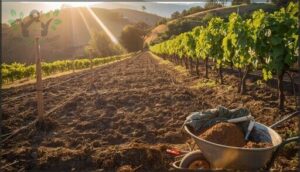
Your grapevines won’t forgive a poorly chosen site, so take the time to get this right from the start.
The difference between a struggling vine and one that cranks out sweet, juicy clusters comes down to sunlight, soil structure, and smart layout decisions.
Here’s what you need to evaluate before the first shovel hits the ground.
Sunlight and Airflow Requirements
You’ll need 6–8 hours of direct sunlight daily to realize your grapevine’s full potential—more sun means sweeter fruit and faster ripening. Position your backyard planting where morning rays reach the canopy early, then guarantee steady airflow around canes to slash disease pressure by up to 50%.
Good air circulation dries dew quickly and keeps foliage healthy, while trellising opens the canopy for peak light penetration and wind protection.
Soil Type, Drainage, and PH
Beneath every vigorous vine lies soil that drains freely, holds enough moisture, and sits at the right pH levels. A Soil Test revealing pH 6.0–6.8 unlocks peak nutrient availability and keeps your roots oxygenated. Loamy textures with balanced clay, silt, and sand dominate ideal Soil Composition across temperate zones:
- Target pH 6.0–6.5 for best table-grape yield
- Check Water Table depth stays below 90 cm
- Confirm infiltration rates exceed 2 cm/h
- Mix coarse sand or grit into dense clay
- Add 2–4% Organic Matter to boost water-holding capacity
Poor Drainage invites root rot—upgrade with Drainage Systems or raised beds if you spot standing water.
Amending Soil for Grapevines
Soil science is your secret weapon—think of Soil Preparation as tuning an engine before a race. Start with Soil pH Management; aim for 6.0–6.5.
Boost Organic Matter to ignite Microbial Activity and drainage. Nutrient Balancing is key: composted manure or grape marc delivers slow-release nutrients.
Fertilizer Selection follows soil tests, targeting calcium, magnesium, and potassium for resilient, productive grapevine roots.
Laying Out Your Vineyard or Garden Space
Vineyard Design transforms chaos into controlled abundance. Space Optimization starts with row-to-row intervals of 2.5–3.5 meters—that sweet spot reduces disease pressure by up to 30% while allowing sunlight to penetrate deep into your canopy. Within-row Trellis Planning demands 0.9–1.2 meter vine spacing for ideal airflow.
- Orient rows east–west to make the most of fruit exposure and boost color development by 10–15%
- Allocate 3–4 meter access lanes between blocks for efficient pruning and harvest operations
- Plan high-density systems at 1,100–2,000 vines per hectare, matching rootstock vigor to your Backyard or commercial Garden Space
Proper Garden Layout in your Vineyard blueprint dictates whether you’re wrestling tangled canes or harvesting premium clusters—choose wisely from the start.
Planting Grapevines Outdoors
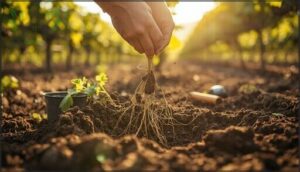
Once your site is ready, it’s time to get vines in the ground—but timing and technique matter more than you might think. The way you plant depends on your climate, whether you’re working with bare-root or potted stock, and how you handle those critical first hours after planting.
Let’s walk through the essentials so your grapevines establish strong roots and set you up for years of reliable harvests.
Best Planting Times by Climate
Timing your planting right breaks the cycle of guesswork and sets you free to grow grapes with confidence. In Mediterranean climate zones, target late winter to early spring—February through March—when soil temperatures climb above 50°F. Cool continental regions demand patience: wait until early spring after frost dates pass. Subtropical growers can plant after the last freeze, locking in a full season for establishment.
Regional timing and planting schedules aligned with your zone secure grapevine success outdoors. Understanding the importance of strategic planning and research networks can also improve your grape growing experience.
Planting Bare-Root Vs. Container Grapevines
Choosing between bare-root and container grapevines shapes your planting costs, root establishment speed, and vine hardiness from day one. Bare-root stock costs 15–40% less and pushes roots deeper, boosting drought tolerance by 18–32% during establishment—but demands 20–40% more irrigation early on.
Container growing offers higher first-year survival in tough soil moisture conditions. Nursery selection and pruning strategies vary, so match your choice to your site and budget.
Proper Planting Depth and Spacing
Once you’ve picked your planting stock, you’ll set the stage for root formation and vine spacing with your planting depth. Position the graft union 2–3 inches below soil level in grafted table grapes to encourage strong growth patterns.
Space vines 6–8 feet apart for vigorous cultivars, or tighten to 4–6 feet for compact types—giving your grapevines room to thrive without crowding.
Watering Immediately After Planting
After planting, your drip irrigation system becomes the lifeline for root development. Water deeply within 48 hours to settle soil around roots—soil moisture can drop 20–40% in that first week, triggering water stress before you notice.
A 2–3 inch mulch layer locks in moisture and cuts evaporation by roughly 25–30%, giving your watering plan room to breathe while young vines establish themselves.
Installing Trellises and Support Structures
Your grapevines need a solid framework to climb, fruit, and thrive for years to come. Without proper support, vines sprawl across the ground, invite disease, and produce disappointing harvests.
Let’s break down the trellis systems that actually work, how to space your vines for maximum yield, and the early training moves that set your vineyard up for success.
Trellis Types and Construction Basics
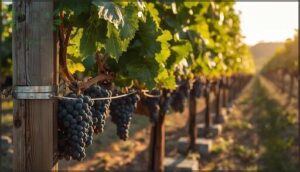
Your trellis design determines whether your grapevine thrives or just survives. Overhead wire systems boost fruit yield by 8–12%, while horizontal configurations improve light interception up to 25%.
Use high-tensile galvanized steel wire—it resists sagging under 60–80 kg loads—and composite posts with concrete footings for durability.
Stainless steel fittings slash maintenance costs by 22% over time, freeing you to focus on pruning and vine training instead of backyard repairs.
Proper Vine Spacing and Wire Heights

Once your trellis design stands solid, wire tension and post spacing lock in your success. Set lower fruiting wires at 28–36 inches, upper wires at 54–72 inches—this layered trellis design accommodates vigorous table grapes and streamlines grapevine pruning.
Space vines 6–8 feet apart to boost canopy management and airflow. Posts every 8–12 feet maintain tension under heavy fruit loads, giving you freedom to prune fearlessly.
Training Young Vines to Supports
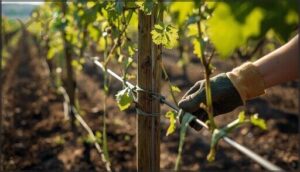
As first-year shoots reach 10–12 inches, you’ll secure them to the central wire with loose ties—this vine pruning and wire training approach cuts shoot-length variability by 10–20 cm. Lock each grapevine to horizontal braces at 50–60 cm above ground, boosting bud-break consistency by 12–18%.
Adjust ties every four to six weeks to maintain firm trellis contact and drive cordon management forward.
Essential Care for Healthy Grapevines
Once your vines are in the ground and supported, the real work begins. Your grapevines need consistent attention to water, nutrients, and pruning if you want a harvest worth celebrating.
Here’s how to keep your vines thriving from spring through dormancy.
Watering Schedules and Techniques
Drip irrigation is your best ally when growing grapes at home—delivering 0.5 to 1 inch of water weekly while slashing waste by up to 40%.
Monitor soil moisture to avoid overwatering, and use smart irrigation scheduling based on evapotranspiration rates to boost water efficiency.
Deep, infrequent watering builds resilient roots, and adding mulch locks in moisture while stabilizing temperatures.
Fertilizing for Growth and Fruit Production
Balanced nutrition fuels explosive growth and sweeter fruit—give your vines what they truly need. Split 20–40 g nitrogen per mature vine across the season, pair it with 0.5–1.0 g phosphorus and 2–4 g potassium, and watch yields climb.
- Soil testing annually keeps nutrient balance dialed in for your grape variety
- Foliar sprays correct iron or zinc deficiencies fast in high-pH soil
- Compost builds organic matter and slow-releases fertility season-long
- Fertigation through drip lines maximizes uptake with zero runoff
- Micronutrients like calcium prevent berry cracking and boost plant care outcomes
Mulching and Weed Management
A thick blanket of straw or wood chips cuts weed emergence by 60–80% and drops soil temperature 2–6°C during peak heat. Lay 5–7 cm of organic mulching around each vine, holding back 2–5 cm from the trunk to dodge crown rot.
You’ll slash irrigation needs by 10–20%, boost soil life, and reclaim hours from hand weeding—pure rebellion against wasted effort.
Pruning for Shape and Productivity
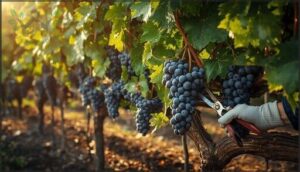
Pruning techniques decide whether your grapevine sprawls into tangled chaos or channels energy into plump, sweet clusters. Remove 60–70% of last season’s growth during winter dormancy, when temperatures hold above -5°C, to lift fruit yield by up to 40%.
Prune away 60–70% of last season’s growth during winter dormancy to channel your vine’s energy into sweeter, heavier clusters
Retain 8–12 buds per vine for steady harvest optimization, balancing leaf area and cluster weight.
Clean pruning tools between cuts to slash disease risk by 20–30%.
Managing Pests, Diseases, and Harvest Timing
Growing healthy grapevines is only half the battle—you’ll also need to outsmart the pests and diseases that can sabotage your harvest before you get a single bite. Knowing what to watch for and when to act keeps your fruit protected without relying on heavy chemicals.
Let’s cover the most common threats you’ll face and how to tell when those clusters are finally ready to pick.
Common Grape Pests and Organic Controls
Your grapevine faces an army of threats—powdery mildew, leafhoppers, and spider mites top the list. Organic sprays like sulfur work wonders when applied every 10–14 days during warm, wet spells.
Scout weekly to catch pest invasions early, then deploy beneficial insects like predatory mites or parasitoid wasps. Biocontrol methods slash damage by up to 60% while keeping your organic farming credentials intact.
Recognizing and Preventing Major Diseases
Beyond pest management, you’ll need sharp eyes for fungal invaders that can wipe out 40% of your crop overnight. Watch for downy mildew’s oily leaf spots and powdery mildew’s white coating—both thrive in humidity.
Beat them with three battle-tested tactics:
- Space vines wide to slash mildew severity by 25–40%
- Remove mummified berries to cut overwintering inoculum by 50–70%
- Deploy weather-based fungicide timing to reduce total applications by 15–25%
Disease resistance starts with vineyard hygiene and smart variety selection.
Signs of Ripeness and Harvesting Tips
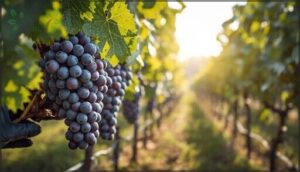
Once disease prevention is dialed in, harvest timing makes or breaks your fruit quality. Taste-test daily when berries soften and slip from the cluster—that’s sugar accumulation hitting 18–22 Brix, your sweet spot.
Full color misleads; crunch a seed to confirm ripeness testing. Harvesting grapes too early drops sweetness by 2–4 Brix, so trust texture over calendar dates for peak table grape flavor.
Frequently Asked Questions (FAQs)
Can grapes grow in containers or pots?
Yes, you can grow grapes in containers—a breakthrough for small garden rebels with limited space. Choose dwarf grape varieties, use well-draining container soil, and manage water carefully. Root pruning every few years maintains vigor in pots.
How long until first harvest after planting?
You’ll taste your first clusters in about two to three years after planting grapevines.
Harvest timing depends on rootstock selection, climate factors, vine vigor, and fruit set—patient growers reap sweeter rewards.
Do grapevines need cross-pollination to fruit?
Most table grape varieties are self-fertile, so you won’t need multiple vines for fruit set. Pollen transfer happens within each grapevine, ensuring reliable grape fertility without cross-pollination from another variety.
Can you transplant established grapevines successfully?
You can successfully relocate mature grapevines during dormancy, though expect root pruning and transplant shock.
Careful post-transplant care and vine hardening boost survival rates to 60–85%, with fruiting resuming within one to three years.
What causes grapes to split on the vine?
Berry split causes include water stress followed by rapid irrigation—soil moisture swings trigger 15–25% more splitting. Climate factors like post-veraison rainfall above 20 mm worsen it.
Skin strength and irrigation patterns matter most.
Conclusion
Purposeful planning pays dividends when growing table grapes outdoors—you’ve seen how variety selection, site prep, and disciplined pruning separate thriving vines from disappointing duds. Your success hinges on executing each phase with intention: matching rootstock to zone, building trellises that won’t sag under harvest weight, and monitoring Brix levels until fruit reaches peak sweetness.
Apply these field-tested principles consistently, and you’ll harvest clusters that justify every hour spent training canes and managing canopy. The vineyard you envision starts now.
- https://www.sciencedirect.com/science/article/pii/S0749208123000268
- https://www.sjsu.edu/writingcenter/docs/handouts/Methodology.pdf
- https://wr1ter.com/business-research-topics
- https://www.rhs.org.uk/fruit/grapes/rod-and-spur-pruning-system
- https://ipm.ucanr.edu/PMG/GARDEN/FRUIT/CULTURAL/grtrainprune.html