
This site is supported by our readers. We may earn a commission, at no cost to you, if you purchase through links.
Every farmer knows the sting of a harvest that comes too early or too late—grain shriveled by drought, fruit bruised by over-ripeness, profits slipping through your fingers. Timing isn’t just a matter of gut feeling; it’s a science shaped by weather swings, genetics, and the silent signals crops send as they mature.
Understanding crop maturity for harvest isn’t just about watching the calendar—it’s about reading every cue nature offers, from kernel moisture to shifting leaf color. When you get it right, you achieve higher yields, better quality, and a shelf life that keeps buyers coming back.
Table Of Contents
- Key Takeaways
- Defining Crop Maturity for Harvest
- Key Factors Influencing Crop Maturity
- Types of Harvest Maturity Indices
- Physical Methods for Assessing Maturity
- Chemical and Physiological Assessment Techniques
- Technological Tools for Maturity Detection
- Harvest Scheduling and Prediction Strategies
- Impact of Crop Maturity on Postharvest Quality
- Best Practices for Optimizing Harvest Timing
- Frequently Asked Questions (FAQs)
- Conclusion
Key Takeaways
- Harvest timing hinges on distinguishing physiological maturity (maximum dry weight at 25-35% moisture in corn) from harvest maturity (safe handling moisture), with delays causing yield losses up to 13% and quality degradation through mycotoxin risks and mechanical damage.
- Effective maturity assessment requires integrating multiple methods—physical indicators like color and firmness, chemical measurements of sugar-to-acid ratios and dry matter, and technological tools like near-infrared spectroscopy—to achieve prediction accuracy above 80% and narrow harvest windows to just 3-5 days.
- Environmental factors including temperature (measured as growing degree days), water availability, and sunlight directly control maturity timing more reliably than calendar dates, with heat stress above 30°C forcing premature ripening and deficit irrigation compressing grain-filling periods by weeks.
- Proper harvest maturity directly determines postharvest outcomes, with correctly timed harvests extending shelf life by 7-14 days, reducing storage losses from 20% to under 1%, and preserving the flavor balance and appearance that drive consumer acceptance and premium pricing.
Defining Crop Maturity for Harvest
Getting the harvest timing right starts with knowing what crop maturity actually means and why it matters. You’ll often hear terms like “physiological maturity” and “harvest maturity” used interchangeably, but they’re not quite the same thing.
Understanding these distinctions, along with how timing affects your yield and quality, gives you the foundation for making better harvest decisions.
Crop Maturity Versus Physiological Maturity
When you’re planning your harvest, understanding that crop maturity and physiological maturity aren’t the same thing gives you real control. Physiological maturity marks when seeds reach maximum dry weight—corn at 25-35% moisture, soybeans at 55-65%. Harvest maturity comes later, once moisture drops to safe levels for handling.
This difference matters because harvesting too early cuts yield, while waiting optimizes both seed viability and crop development timing. Several factors, including access to grain drying, influence harvest decisions.
Importance of Proper Harvest Timing
You can’t afford to guess when it comes to harvest timing. Multi-year corn trials revealed yield losses around 13% from October to December, with nearly 90% of damage occurring after mid-November. Proper harvest maturity decisions preserve yield, maintain quality, and assure safety by reducing mycotoxin risks.
Economic impact extends beyond field losses—delayed harvesting under wet conditions compromises grain safety and resource efficiency throughout your entire supply chain. Higher plant populations can also lead to yield decline if there’s a delayed corn harvest.
Impact on Crop Yield and Quality
Harvest timing directly shapes both yield and harvest quality outcomes in your fields. Maturity stage effects reach far beyond simple tonnage—delayed wheat harvests can cost you up to 900 kg per hectare, while rice suffers losses between 9.8% and 24.4% from just a 10-day delay. Agricultural productivity hinges on recognizing these best harvesting time windows.
- Corn loses approximately 2 bushels per acre for each moisture point when harvest is delayed
- Immature crop issues include elevated mold growth, yeast contamination, and dangerous nitrate toxicity risks
- Overmature rice at 60 days post-heading drops to 66.3% yield
- Best timing benefits include excellent sugar content and extended shelf life in fruit crops
- Timely cultivar selection and sowing increase global crop yields by 12%
Key Factors Influencing Crop Maturity

Crop maturity doesn’t happen in a vacuum. Your harvest window is shaped by a complex interplay of environmental forces, genetic programming, and growing conditions that vary from field to field.
Understanding these factors helps you anticipate maturity patterns and make informed decisions about when to harvest.
Temperature and Climate Effects
Temperature acts as the master conductor of crop development, orchestrating when your crops reach maturity. You’ll find that thermal time—measured in growing degree days—determines maturity far more reliably than calendar dates.
Optimum ranges vary by crop: maize thrives at 20–22 °C, while wheat prefers 12–22 °C. Heat stress above 30 °C shortens grain filling and forces premature maturity.
Climate change is shifting maturity dates unpredictably, compressing growing periods and reshaping harvest windows across regions.
Rainfall and Irrigation Impact
Water stress shapes when your crops mature more than you might expect. Deficit irrigation and irregular rainfall patterns compress maturity duration, pushing plants to early ripening under suboptimal conditions.
In barley, drought at 30% field capacity shortened grain filling to just 38 days versus well-watered plots. Irrigation scheduling directly controls phenology—70% water supply accelerates maturity while sacrificing yield.
Sunlight and Photosynthesis
When canopy photosynthesis operates efficiently, you capture more incoming solar energy—currently just 1–2% converts to biomass in wheat and maize. Light intensity during grain filling boosts growth rates, while photoperiod control triggers flowering timing, shifting maturity windows by weeks.
Environmental factors like fluctuating sunlight reduce photosynthetic efficiency unless your crop tolerates rapid shade transitions. Biomass accumulation, driven by local climate and photosynthesis, determines final harvest readiness.
Genetic and Varietal Differences
Genetic factors—maturity genes, earliness genes, and hybrid selection—govern how quickly your crop reaches harvest readiness. Genotype interactions with environmental factors shift maturity windows: some soybean varieties differ by several weeks, while maize hybrids span 19 calendar days under identical conditions.
Harvest moisture also varies by genetics, with certain cultivars drying faster in-field, reducing costs and enabling earlier harvest within your crop maturity window.
Soil and Environmental Conditions
Your soil conditions—pH, moisture, temperature, nutrients, and physical properties—shape maturity as much as genetics. Soil pH between 6.0 and 6.8 optimizes nutrient availability, while acidic soils below 5.0 release toxic aluminum. Compacted soils can slash corn yield by 50%, restricting roots.
Environmental impact on crops intensifies under climate change, making soil monitoring essential. Factors affecting crop maturity converge in the soil-plant interface you manage daily.
Types of Harvest Maturity Indices
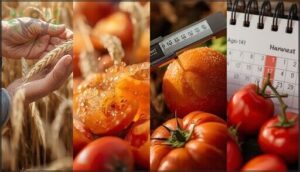
Determining when to harvest isn’t a guessing game—it relies on specific, measurable indicators that tell you when your crop has reached the right stage. These harvest maturity indices fall into several categories, each offering a different lens through which you can evaluate readiness.
Understanding the main types helps you choose the right assessment approach for your specific crop and market needs.
Physical Maturity Indicators
Physical parameters you can see and touch form the foundation of field-level maturity assessment. These indicators include:
- Color changes from green to yellow or red in tomatoes, apples, and citrus, signaling ripening
- Shape and size thresholds, such as mango shoulder fullness or banana finger roundness at 90–95% final diameter
- Firmness and texture measured by penetrometer, with apples harvested at 6–8 kg-force for best shelf life
Ground spots on watermelons and peduncle drying in pumpkins also guide your harvest decisions.
Chemical Maturity Indices
Chemical changes inside the fruit tell you what your eyes can’t see. You’ll measure sugar content and acidity levels to determine harvest readiness—for example, avocados reach 6.7–10.2% total soluble solids (TSC) at commercial maturity, while mangos climb from 5% to 16% TSC when ripe.
Starch evaluation, dry matter, and oil content assessments complete your chemical toolkit for precision harvest decisions.
Physiological and Chronological Parameters
Beyond what you can measure in a lab, your crops follow internal clocks governed by thermal time and physiological indicators. You’ll track crop maturity through:
- Growing degree-days accumulated since planting—corn needs roughly 1,768 GDD to flowering
- Kernel moisture dropping from 30–35% at physiological maturity to harvest-ready levels
- Black layer formation marking maximum dry weight in grain corn
- Chronological age combined with heat units for precision timing
- Chlorophyll degradation signaling maturity stages of fruits
These physiological markers outperform calendar dates for predicting when your crop reaches true maturity.
Crop-specific Maturity Benchmarks
Each crop demands its own harvest maturity indices. You’ll harvest corn grain when moisture drops from 25–35% at black layer to below 25% for storage. Wheat quality peaks at 16–18% moisture with test weights near 60 lb/bushel. Rice yield maximizes at 24–26% moisture, while soybean splitting risk drops at 13–15%. Cotton bolls signal readiness when 60–80% open—these crop-specific models outperform generic timing every time.
Physical Methods for Assessing Maturity
Physical methods offer you straightforward, hands-on ways to judge crop maturity right in the field. These techniques rely on observable changes in appearance and texture that signal readiness for harvest.
Let’s look at the most practical physical assessment methods you can use.
Visual Inspection (color, Size, Shape)

At harvest, your first maturity index comes through your eyes. Color changes signal ripening—tomatoes reaching a peel lightness below 50 on the CIELab scale ripen uniformly, while coffee fruits shift from green to positive red values.
You’ll also assess size thresholds and shape analysis: bananas lose angularity, peppers fill to blocky forms.
Color uniformity links directly to internal quality, helping you improve harvest maturity through visual standardization.
Surface Texture and Firmness Evaluation

After judging color and shape, you’ll evaluate firmness and surface texture—two maturity determination methods that reveal storage potential.
Apples destined for long-term storage require flesh firmness at or above 15 pounds-force, while short-term fruit can drop to 13 pounds-force.
Modern robotic grippers with sensor calibration now predict firmness non-destructively with over 80% accuracy, enabling texture standardization across your harvest maturity workflow and improving ripeness indicators for every market.
Ground Spot and External Cues

For vine crops like watermelons and melons, the ground spot where fruit rests on soil offers reliable maturity determination signals you shouldn’t overlook. As harvest maturity approaches, watch for these external cues:
- Ground spot color transitions from pale white to buttery yellow
- Rind color changes from glossy bright green to duller, lighter tones
- Vine tendril cues show browning or drying near the fruit
- Shape size indicators confirm cultivar-typical dimensions
- Surface integrity cues reveal tough, damage-resistant skin
These color changes collectively guide your harvest timing decisions.
Chemical and Physiological Assessment Techniques

While physical cues like color and firmness give you surface-level information, chemical and physiological tests reveal what’s happening inside your crops. These methods measure the internal compounds and metabolic processes that signal true maturity, offering precision you can’t get from visual inspection alone.
Below are the key techniques that help you determine the best harvest window based on your crop’s internal chemistry and physiology.
Sugar Content and Sugar-to-acid Ratio
Measuring sweetness alone won’t tell you if fruit is ready to pick. You need to evaluate both sugar content (SSC or Brix levels) and titratable acidity (TA) to gauge sensory maturity role in flavor development.
For apples, harvest generally occurs around 13 °Brix, while table grapes demand near 20 °Brix and sugar-to-acid ratios exceeding 20:1 to guarantee consumer satisfaction and marketability.
Starch and Dry Matter Evaluation
Why measure starch if sweetness already tells the story? Because starch conversion dynamics reveal how far fruit has progressed toward peak eating quality.
You’ll use iodine staining or near-infrared spectroscopy as measurement techniques to track starch content in apples—harvest at indices of 3–5 for long storage—while dry matter thresholds near 16% in kiwifruit guarantee adequate sweetness.
Both chemical methods of maturity assessment directly influence storage impact and shelf life.
Acidity and PH Measurements
Organic acids decline as fruit ripens, so tracking pH and titratable acidity (TA) gives you precise chemical changes that signal readiness. You’ll measure pH with calibrated meters and TA by titration—wine grapes target pH 3.1–3.5 and TA of 6–8 g/L, while tomatoes aim for 0.4–0.9% citric acid.
These acidity measurements relate directly to sugar content and flavor balance, defining maturity targets across crops.
Respiration Rate and Ethylene Production
Climacteric fruits like tomatoes and bananas show a respiratory surge during ripening, while nonclimacteric fruits such as citrus and strawberries decline steadily. Small-fruited tomato cultivars produce roughly four times more ethylene than large types.
You’ll track respiration rate and ethylene production to pinpoint harvest maturity indices. Respiration benchmarks combined with maturity modeling guide your timing, especially for ethylene-sensitive crops where even low exposure accelerates spoilage.
Technological Tools for Maturity Detection
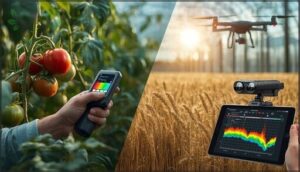
Technology has transformed how you assess crop readiness, moving far beyond simple observation and manual testing. Modern tools now deliver precise, objective data that removes much of the guesswork from harvest decisions.
The following methods represent the most practical and reliable technologies available for detecting maturity in the field and packinghouse.
Near-infrared Spectroscopy Applications
Near-infrared spectroscopy has transformed how you determine harvest maturity without damaging your crops. This nondestructive method measures chemical parameters through light absorption, enabling rapid NIR quality assessment across thousands of samples.
Consider these practical applications:
- Portable NIR sensors deliver in-field predictions of sugar content, dry matter, and acidity within seconds.
- Moisture monitoring through hyperspectral imaging tracks water content during critical maturity stages.
- Chemometric models using machine learning convert spectral data into accurate maturity predictions.
- Preharvest measurements guide best harvest timing for improved postharvest management.
- Remote sensing integration with weather data enhances maturity determination methods across large fields.
You’ll find portable devices particularly valuable, as they allow repeated measurements on the same plants over time.
Optical Sorting Systems and Sensors
Beyond lab-based spectroscopy, optical sorting systems bring nondestructive testing methods directly into your packinghouse. These platforms use spectral analysis—combining visible, multispectral, and near-infrared cameras—to evaluate maturity, detect defects, and grade thousands of items per hour.
Modern lines achieve sorting accuracy above 95% and process over 10 tons hourly, improving economic performance through reduced labor and waste.
Data analytics from each sort inform your harvest scheduling and quality trends.
Remote Sensing and Drone Monitoring
Remote sensing applications in agriculture now extend maturity monitoring from the packinghouse to the field itself. UAV phenotyping with multispectral cameras captures spectral indices—NDVI, SAVI, and red-edge features—that explain up to 80% of yield variability at late reproductive stages.
These 3D metrics track canopy height, senescence, and grain filling, supporting data integration with weather models to improve harvest timing and logistics across entire farms.
Electronic Firmness Testers
While drones track fields from above, you can assess individual fruit firmness on the ground using electronic systems designed for non-destructive testing. Modern penetrometers and mechanical testing devices measure deformation resistance with tester accuracy near ±0.5 units, giving you objective harvest decisions.
These tools deliver operational advantages over manual methods—standardized contact times, digital records, and repeatability under 6% variation—helping you pinpoint the firmness thresholds your market demands without damaging product.
Harvest Scheduling and Prediction Strategies
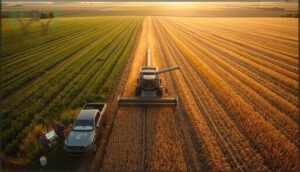
Once you know when your crop reaches maturity, the next challenge is organizing the harvest itself. Proper scheduling ensures you handle each field at the right time, coordinate labor and equipment, and avoid costly delays or quality losses.
The following strategies help you plan harvest timing with greater accuracy and efficiency.
Using Maturity Indices for Scheduling
Think of harvest scheduling as setting the tempo for your entire operation—miss a beat, and everything slips. Using the right harvest maturity indices, you can:
- Fine-tune index selection for each crop.
- Leverage scheduling software for labor optimization.
- Align harvest dates with storage impact.
- Meet regulatory compliance standards.
- Apply maturity determination methods for consistent quality.
Predictive Modeling for Optimal Harvest Dates
Machine learning and degree-day models now let you predict best harvest dates with real precision. AI harvest prediction tools analyze satellite imagery and field data to forecast maturity determination windows weeks ahead.
Crop-specific prediction models—like ElasticNet for shallots or GDD frameworks for sweetpotato—achieve impressive accuracy by coupling crop model data with remote sensing.
Probabilistic forecasts even give you likelihood ranges, so you’re not left guessing when conditions shift.
Integrating Weather and Crop Data
Combining real-time weather streams with crop models sharpens your predictive accuracy—crop simulation frameworks driven by temperature, radiation, and rainfall can forecast key phenology stages with agreement indices reaching 0.96. Data fusion isn’t just buzzwords; it works:
- Growing degree days tracked from local sensing improve maturity windows
- Remote sensing feeds vegetation indices into weather-driven simulations
- Phenology integration captures canopy peaks better than standalone methods
- On-farm stations reveal intra-field variability regional forecasts miss
- Evolving models update harvest maturity indices as new observations roll in
Field Ranking and Logistics Planning
Once your fields are ranked by maturity index, you can tackle Harvest Sequencing and Machinery Deployment head-on. Spatial Clustering groups parcels with similar ripeness, cutting haul distance, while your Harvest Maturity Dashboard visualizes readiness across zones.
A 2025 study showed optimized routing lifted combine throughput 30 percent by syncing field variability with truck dispatch. Decision Support tools forecast Scheduling Horizons days ahead, aligning labor and storage to harvest ranking and agricultural logistics realities.
Impact of Crop Maturity on Postharvest Quality

When you harvest your crop makes all the difference in what happens afterward. The stage of maturity at harvest directly influences how long produce stays fresh, how well it holds up during transport and storage, and whether consumers will accept it.
Let’s examine three critical areas where harvest timing shapes postharvest outcomes.
Shelf Life and Storage Considerations
Harvest maturity directly shapes how long your produce will last in storage. Tomatoes picked at the mature-green stage, for example, can hold 7–14 days longer than vine-ripe fruit at room temperature.
Each 10°C rise in storage temperature roughly doubles respiration rate, cutting shelf life in half.
Proper moisture content, atmosphere control, and postharvest handling reduce postharvest disorders and waste, protecting your economic returns.
Quality Retention During Supply Chain
Even if you harvest at perfect maturity, quality can slip away fast in the postharvest supply chain. Cold chain breaks and rough handling practices cause stage losses from farm to retail—ranging from 5% to over 50% for delicate commodities like tomatoes.
Atmosphere management and ethylene control during transport preserve fruit quality, extend shelf life, and reduce waste, safeguarding your investment and consumer acceptance.
Consumer Acceptance and Marketability
Sensory quality and external appearance at the point of purchase drive consumer acceptance more than any other factor. Flavor balance—especially sweetness against acidity—separates premium pricing from discount bins.
Harvesting at the right maturity window extends shelf life, preserves fruit quality during distribution, and keeps consumer satisfaction high. That directly lifts market value, stabilizes market price, and turns one-time buyers into loyal customers.
Best Practices for Optimizing Harvest Timing

Getting the harvest timing right isn’t about relying on just one signal or method. You’ll need to combine multiple approaches, balance efficiency with sustainability, and use the right tools to cut waste while boosting your bottom line.
Here’s how to bring it all together in the field.
Integrating Multiple Assessment Methods
When you combine physical, chemical, and physiological indices for harvest maturity determination, you dramatically improve predictive accuracy over relying on a single method. Integrating multiple methods through system integration and method calibration strengthens data-driven decisions:
- Index cross-validation reduces prediction errors—heat-unit models paired with field checks can narrow harvest windows from weeks to just 3–5 days
- Nondestructive methods like near-infrared spectroscopy alongside objective measurements of firmness cut lab work by 30–50%
- Multi-season data refines maturity determination, achieving R² values above 0.80 in several crops
Reducing Waste and Improving Profitability
Getting harvest timing right doesn’t just boost crop yield—it directly cuts losses and lifts your bottom line. Rice harvested at peak maturity sees weight loss drop from 20% to under 1%, while strawberries picked at 75% red color lose only 10% over ten days versus 50% when overripe.
Harvesting at peak maturity slashes crop losses and boosts profits, with rice weight loss dropping from 20% to under 1%
That’s revenue impacts you can measure: proper harvest maturity preserves postharvest quality, reduces waste, and delivers quality premiums that improve system gains across your entire operation.
Sustainable and Precision Agriculture Approaches
When you match harvest timing with sustainable practices, every decision counts. Precision Irrigation and Nutrient Management, guided by Remote Sensing and UAV Applications, let you fine-tune crop maturity and resource use.
Farms using these tools report:
- Water savings up to 30%
- Fertilizer reductions of 20%
- More uniform crop maturity
- Improved yield predictions
- Enhanced whole-farm profitability through precision farming
Frequently Asked Questions (FAQs)
How do pests and diseases affect crop maturity?
Pests and diseases disrupt crop maturity by causing yield loss, shifting harvest timing, and reducing grain quality. Field heterogeneity increases, forcing you to adjust harvest planning and crop management, especially as climate impacts intensify these challenges during crop growth and harvesting.
What role do plant hormones play in maturity?
Plant hormones drive physiological and chemical changes that shape crop maturity. Ethylene’s role in ripening, ABA influence on grain filling, cytokinin decline during senescence, and gibberellin activity all guide harvest timing, supported by targeted PGR applications.
Can crop maturity be delayed intentionally?
Yes, you can delay crop maturity through irrigation strategies, PGR applications, shading techniques, or adjusting planting dates.
However, delayed maturity risks include increased drying costs, pest pressure, and potential yield reductions that affect harvesting decisions.
How does crop rotation influence maturity timing?
Think of rotation as the soil’s memory: preceding crops shape nutrient dynamics, disease impact, and soil structure, all steering when plants reach harvest maturity.
Rotation length and preceding crop identity guide best harvesting time through better agricultural practices.
Are there risks with early or late harvest?
Both early and late harvest pose serious risks. Harvest quality suffers when you miss the ideal harvesting time—early yield losses stem from immature grain, while delayed safety risks include mycotoxins and lodging that slash profitability.
Conclusion
Getting every detail right separates mediocre harvests from superior ones. Understanding crop maturity for harvest demands vigilance—tracking physical cues, chemical markers, and environmental shifts with equal care.
When you combine traditional observation with modern technology, you don’t just improve timing; you safeguard quality, extend shelf life, and boost returns.
The crops you nurture deserve nothing less than precision at the finish line. Master these methods, and your fields will reward you season after season.
- https://www.canr.msu.edu/news/physiological_maturity_and_potential_harvest_dates
- https://www.agry.purdue.edu/ext/corn/news/timeless/grainfill.html
- https://agronomymagazine.com/qa/6-tips-for-determining-the-optimal-time-to-harvest-crops/
- https://pmc.ncbi.nlm.nih.gov/articles/PMC10935190/
- https://www.walshmedicalmedia.com/open-access/assessment-of-harvesting-time-and-its-influence-on-yield-production-in-agricultural-crops-127121.html