This site is supported by our readers. We may earn a commission, at no cost to you, if you purchase through links.

Most houseplants don’t die from neglect—they die from too much attention given to the wrong things. Overwatering kills far more indoor plants than drought does, and misreading light conditions accounts for most of the slow, mysterious declines that puzzle even dedicated plant owners.
A pothos sitting three feet from a north-facing window isn’t getting bright indirect light; it’s getting the plant equivalent of a dim hallway.
These gaps between assumption and reality are where plants struggle.
Getting the fundamentals right—light intensity, soil moisture, humidity, temperature, and feeding schedules—transforms how your plants grow.
Table Of Contents
- Key Takeaways
- Assess Your Home’s Light
- Match Plants to Each Window
- Water Indoor Plants Correctly
- Improve Humidity for Healthy Leaves
- Keep Temperatures Stable Indoors
- Choose Soil and Pots Wisely
- Fertilize Without Overfeeding
- Repot Plants at The Right Time
- Prevent Common Pests and Problems
- Adjust Care Through The Seasons
- Frequently Asked Questions (FAQs)
- How often should I water indoor plants?
- Can I bring an outdoor geranium inside for the winter?
- How do to know my plants have enough sunlight?
- How to take good care of indoor plants?
- What are the biggest mistakes when repotting?
- What plants are safe for dementia patients?
- How to care for indoor plants for beginners?
- How do I keep my indoor plants healthy?
- How do you care for indoor plants?
- What are the best indoor plant care tips?
- Conclusion
Key Takeaways
- Overwatering kills far more houseplants than drought does, so always check soil moisture 2 inches deep before reaching for the watering can.
- Light intensity drops to roughly one-quarter every time you double your distance from a window, so where you place a plant matters just as much as which direction the window faces.
- Most common houseplant problems — pest damage, root rot, leaf burn, and slow decline — show up early as physical symptoms, and catching them before they spread is the difference between a quick fix and losing the plant.
- Seasonal care isn’t optional: in winter, cut watering by 30–60%, pause fertilizing, and use grow lights set to 12–14 hours daily to compensate for shorter days.
Assess Your Home’s Light
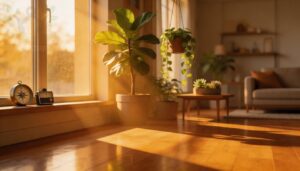
Light is the one thing no houseplant can fake its way through. Before you move a single pot, it helps to understand what your windows are actually offering.
Here’s what to look at when sizing up the light in your home.
Full Sun, Bright Indirect, Moderate, and Low Light
There are four light levels your plants live by: full sun, bright indirect, moderate light, and low light.
Full sun plants are the most demanding of the bunch — browse sun-loving plants that thrive in summer heat to see which ones actually pull it off.
Full sun exceeds 1,000 µmol — intense, direct rays all day. Bright indirect light sits between 200 and 800 µmol, with no harsh rays hitting leaves directly.
Moderate light drops to 50–200 µmol, often filtered through sheer curtains. Below 50 µmol? That’s low light — photoperiod management and window film impacts matter most here.
What South-, East-, West-, and North-facing Windows Provide
Each window direction tells a different story. South-facing windows deliver the strongest light intensity and peak UV exposure — ideal for sun-lovers. East and west-facing windows offer bright indirect light with notable heat gain differences by afternoon. North-facing windows stay cool with gentle, consistent light all day.
- South – Maximum directional color temperature and seasonal light variation
- East – Soft morning brightness, minimal heat gain
- West – Warm afternoon sun, higher heat gain
- North – Low, steady light; perfect for shade-tolerant plants
How Distance From Windows Changes Light Intensity
Direction only tells half the story — distance does the rest. Light intensity drops fast as you move away from the glass, following the Inverse Square Law: double your distance, and you get roughly one-quarter the light. This Light Decay Gradient hits hardest near south-facing windows.
Double your distance from the window, and you lose three-quarters of your light
Shelf Height Effects matter too — lower shelves lose out substantially.
Light-colored walls and reflective surfaces help bounce brightness deeper into the room.
Signs a Plant is Getting Too Much or Too Little Light
Your plant tells you when light intensity is off — you just have to read it.
Leaf scorch signs include brown, crispy tips, and bleached patches despite regular watering—classic light imbalance symptoms from too much direct sun.
Too little, and you’ll see etiolation growth: leggy stems, color chlorosis, and stunted new leaves reaching desperately toward any available light.
Match Plants to Each Window
Not every window gives plants the same thing, and that mismatch is often the reason a healthy plant starts to struggle. Once you know what each exposure offers, choosing the right spot becomes straightforward.
Here’s how to pair your plants with the window that actually suits them.
Best Plants for Bright South-facing Windows
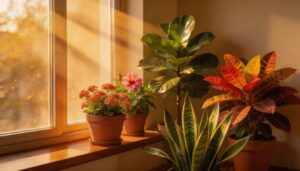
South-facing windows deliver the strongest light intensity in any home. Sun-loving succulents, like jade and cactus, thrive here naturally.
Here are five reliable picks for bright light:
- Fiddle leaf fig — rotate monthly to prevent leaning
- Croton — vivid colors deepen under direct sun
- Kalanchoe — blooms freely with minimal watering
- Hibiscus — a heat-tolerant foliage and flower powerhouse
- Snake plant — one of the few pet-safe sun plants around
Good Choices for East and West Exposure
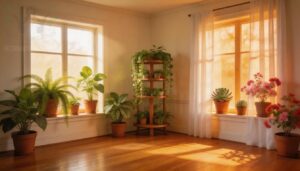
With east and west-facing windows, you can meet a wide range of light requirements. East-Facing Ferns and Calatheas East thrive in gentle morning light, while West-Facing Succulents and Bougainvillea West handle intense afternoon rays.
Place heat tolerant foliage closer to west windows, but use sheer curtains for sensitive leaves. Rotate plants weekly to balance light intensity and promote even growth.
Low-light Plants for North-facing Rooms
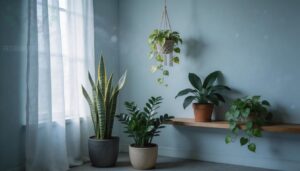
Even without direct sun, north-facing windows support a solid lineup of low‑light tolerant houseplants. Light diffusion accessories like sheer panels help spread indirect light more evenly. Wall reflectivity from pale walls quietly boosts what little reaches the room.
Place these 2–6 feet back and check soil moisture before each watering to avoid root rot:
- Snake plant – thrives at 100–200 lux, ideal for dimmer corners
- ZZ plant – maintains steady growth with minimal daily light
- Pothos – keeps leaf variegation care simple even in low-light intensity
- Cast iron plant – pet‑safe plant, a staple, tolerates cooler rooms
- Philodendron hederaceum – resumes growth after weeks of low indirect light
Safe Placement for Light-sensitive Foliage
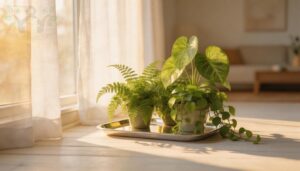
Light‑sensitive foliage burns fast — sometimes within two to three hours of midday sun. Sheer Curtain Effects cut intensity by 20–40%, while Diffusing Light Panels scatter rays evenly. Window Film Filters and a Reflective Surface Boost help balance indirect light year‑round. Seasonal Light Shifts matter too, so adjust placement each season.
| Tool | Light Reduction | Best Use |
|---|---|---|
| Sheer Curtains | 20–40% | East/west windows |
| Window Film Filters | 15–30% | South-facing windows |
| Diffusing Light Panels | 30–50% | High summer intensity |
| Reflective Surfaces | +10–20% boost | North-facing windows |
| Furniture Shadow Lines | Variable | Midday peak hours |
Water Indoor Plants Correctly
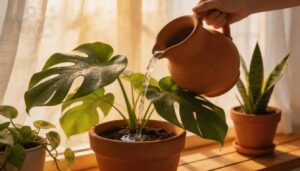
Watering sounds simple, but it’s where most houseplants quietly struggle. Too much, too little, or the wrong method can set a plant back faster than almost anything else.
Here’s what you actually need to know to get it right.
How to Check Soil Moisture Before Watering
Before you grab the watering can, check the soil first.
The simplest method is the finger test — push your finger about 2 inches deep. Still damp? Wait.
You can also lift the pot using the weight method, use a toothpick probe, or try a soil moisture sensor for consistent readings.
A moisture meter removes all guesswork from your watering schedule.
When to Water Small Versus Large Pots
Pot size changes everything about your watering schedule. Small pots — think 4 to 6 inches — dry out two to three times faster than larger ones.
Evaporation rate rises sharply, and root zone demand outpaces the soil volume effect quickly. Terracotta amplifies pot material impact even further.
Check a small pot every two days; probe deeper in large pots with a soil moisture sensor to avoid overwatering through drainage holes.
Top Watering Versus Bottom Watering
How you deliver water matters as much as how often. Top watering flushes salts from soil — preventing salt buildup — but can leave surface soil soggy while deeper roots stay dry.
Bottom watering, by contrast, promotes root zone uniformity, drawing moisture upward evenly. Give it 10–20 minutes in a tray.
Succulents and foliage-heavy plants like philodendrons generally do better with bottom watering.
How to Avoid Soggy Soil and Root Rot
Soggy soil is quieter than you’d think — root rot sets in before a single leaf turns yellow. Make sure your pot has drainage holes and that excess water escapes within 10–30 minutes.
moisture meter helps with calibration guesswork. soil mix porosity — around 40–60% air-filled space — keeps root zone aeration healthy and capillary action from waterlogging your plants.
Improve Humidity for Healthy Leaves
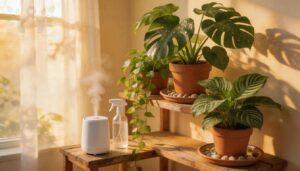
Most houseplants come from tropical environments where humidity rarely drops below 50%, so your average home’s dry air can quietly work against them. Crispy leaf edges and browning tips are often the first signs that moisture levels are too low.
Here’s what you can do to fix that.
Ideal Humidity Ranges for Common Houseplants
Not every plant wants the same air. Ferns and calatheas need ambient humidity around 60 to 80 percent, while pothos and philodendron do well at 50 percent. Desert plants tolerate 20 to 40 percent. Ignoring plant-specific RH targets causes real humidity stress symptoms — curled leaves, brown margins, dropped buds.
- Use humidity sensors with ±3% accuracy for reliable readings
- Watch for seasonal RH shifts, especially in winter when indoor air drops to 20–40%
- Identify microclimate zones — bathrooms and grouped plants hold higher humidity naturally
Best Ways to Raise Humidity Indoors
Once you know your plants need more moisture, the fix is simpler than you’d think. A cool-mist ultrasonic humidifier can push ambient humidity from 30 to 50 percent in about 20 minutes — faster than evaporative models, which work gradually over hours.
Mind your humidifier placement: keep it nearby but never spray directly onto leaves.
A digital hygrometer helps you track seasonal humidity adjustments accurately.
Pebble Trays, Grouping, and Humidifiers
Three simple tools can transform dry indoor air into a tropical microclimate that your plants will love.
Pebble Tray Setup and Grouping Microclimate Benefits:
- Fill a humidity tray with 2–3 cm of stones and water, keeping the pot above the waterline
- Clean pebble trays monthly to prevent algae
- Group plants together to boost collective transpiration
- Follow humidifier placement tips — never aim mist directly at foliage
- Use distilled water to reduce mineral buildup
When Misting Helps and When It Does Not
Misting works best when conditions align. Epiphytic plant preference plays a role here — Monstera and Philodendron respond well to a light misting schedule, especially in warm rooms where temperature synergy amplifies humidity gains.
But leaf texture impact matters: hairy or waxy leaves repel water, and water hardness concerns mean hard tap water leaves mineral spots. Skip evening misting — wet leaves overnight invite fungal trouble.
Keep Temperatures Stable Indoors
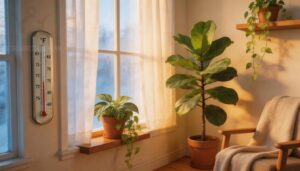
Most houseplants are more sensitive to temperature swings than people realize. A few degrees in the wrong direction — or a cold draft from a window — can slow growth, drop leaves, or stress a plant that was thriving just days before.
Here’s what to watch for and how to keep things stable.
Ideal Day and Night Temperature Ranges
Most houseplants are comfortable within a daytime range of 65–75°F, though tropical plants prefer staying closer to 78°F.
Your nighttime cool setpoint should land around 60–65°F — that day-night differential of 5–10 degrees actually promotes healthier growth cycles.
Succulents appreciate cooler nights near 50–60°F.
Managing temperature fluctuations matters too: swings beyond 15°F stress foliage fast, so seasonal temp adjustments keep your plants steady year‑round.
Why Drafts and Heater Vents Cause Stress
Think of drafts and heater vents as silent troublemakers. Airflow turbulence from HVAC vents creates temperature spikes of 5–8°C right at leaf level, triggering leaf curl and root desiccation as topsoil dries unevenly.
Cold drafts invite fungal spots on sensitive foliage. Managing indoor temperature and drafts means keeping calatheas and ficus well away from doors, vents, and anything that causes sudden temperature fluctuations.
Protecting Plants From Cold Windows in Winter
Cold glass in winter acts like a slow drain on your plant’s warmth. A few targeted fixes make a real difference:
- Apply Window Insulation Film to cut heat loss by up to 50%.
- Hang Thermal Curtains at night to trap warmth.
- Use a Radiator Shield nearby to reflect heat back.
- Place an Insulating Pot Mat under pots on cold sills.
- Try Microclimate Grouping to stabilize ambient temperature between 18–24°C.
Preventing Sudden Temperature Swings
Even a 5°F swing overnight can stress tropical plants into dropping leaves.
Here’s what protects them:
| Threat | Fix |
|---|---|
| Cold drafts | Draft-Free Shelf Placement away from doors |
| Radiator spikes | Heat-Resistant Plant Stands with insulating mats |
| Window chill | Insulated Curtain Use after sunset |
| Uneven room heat | Zoned Heating Controls with programmable thermostats |
Radiant Heat Mitigation and consistent temperature control for tropical plants keep your humidity management effective too.
Choose Soil and Pots Wisely
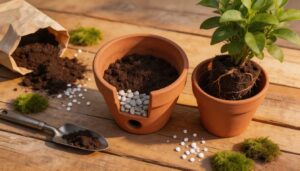
underneath your plant matters just as much as what you do for it above the soil. The wrong potting mix or a pot without drainage can quietly undo all your other efforts.
what to know before you plant or repot anything indoors.
Why Potting Mix Matters More Than Garden Soil
Garden soil compacts in a pot, cutting off the soil aeration and root health that your plants depend on.
A quality potting mix is engineered differently — built with perlite for drainage aeration, peat or coir for nutrient buffering and microbial activity, and lime for pH stability around 5.5 to 6.5. That balanced soil composition and potting media keep roots breathing, fed, and disease-free.
Soil Blends for Foliage Plants, Succulents, and Orchids
Not every plant wants the same potting mix. Your organic-inorganic ratio shapes everything from soil drainage to nutrient release timing.
- Foliage plants — 1 part coconut coir, 1 part perlite, 1 part vermiculite for balanced texture and aeration
- Succulents — gritty light-weight mix formulations: equal potting mix, coarse sand, perlite
- Phalaenopsis orchids — chunky bark for air pockets
- pH Adjustment Strategies — target 6.0–6.5 for most soil composition and potting media
Picking Containers With Proper Drainage Holes
Once your soil mix is dialed in, your container choice seals the deal. Pot drainage holes directly protect root health — aim for ¼ to ½‑inch holes on small pots and ¾‑inch holes on larger ones.
Grommets and mesh liners keep soil in while letting water escape cleanly.
| Feature | Recommendation |
|---|---|
| Hole Size | ¼–¾ inch depending on pot size |
| Hole Count | 1–3 holes for balanced drainage |
| Layer Materials | Gravel or pumice at base |
Terracotta, Plastic, and Ceramic Pot Differences
Your pot material shapes how fast soil dries.
Terracotta’s porosity, breathability pulls moisture through its walls, helping roots stay aerated — but it dries out fast, so water-loving plants may struggle.
Plastic retains moisture longer and offers better thermal insulation for roots.
Glazed ceramic balances both: durable, nonporous, and wins on aesthetic versatility.
Match your container selection and root health needs together.
Fertilize Without Overfeeding
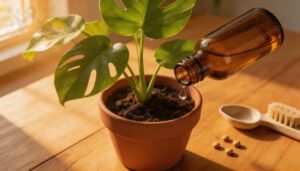
Plants need food, but not too much — and that balance matters more than most people realize.
Getting your fertilizing routine right comes down to a few simple decisions. Here’s what you need to know to feed your plants well without overdoing it.
Balanced Fertilizers for Everyday Houseplant Care
Think of fertilizer as a multivitamin for your plants. A balanced NPK ratio — like 10-10-10 — covers the basics without overcomplicating things.
Here’s what that label actually means for your houseplants:
- Nitrogen fuels leafy, green growth
- Phosphorus strengthens roots and promotes flowering
- Potassium boosts overall vigor and disease resistance
- Micronutrient Inclusion (iron, zinc, manganese) fills nutritional gaps your soil misses
Stick to a seasonal feeding schedule — every two to four weeks during active growth — and you’ll rarely go wrong.
Feeding Foliage Plants Versus Flowering Plants
Foliage plants and flowering plants don’t eat the same diet. For lush, green leaves, nitrogen balance is your priority — it drives chlorophyll and keeps growth steady.
Shift to a phosphorus boost when plants are budding; excess nitrogen actually delays blooms. Your fertilizer NPK ratio should reflect this: higher nitrogen for foliage, phosphorus-forward formulas for flowers.
Micronutrient priorities — iron, magnesium, calcium — matter for both.
Liquid Versus Slow-release Fertilizer Options
Both fertilizer types have real trade-offs. Water soluble fertilizer acts fast — nutrients reach roots within hours — making it ideal for correcting deficiencies quickly.
But nutrient release timing matters: liquid feeds require more frequent application and carry a Salt Accumulation Risk if overused. Slow-release fertilizer feeds steadily over three to nine months, reducing that risk and cutting application frequency substantially.
How Often to Fertilize During Active Growth
During active growth, most foliage plants follow a two-to-three-week fertilizer interval guideline. Flowering plants do well on a monthly schedule.
Your plant’s age matters too — young plants need half-strength NPK to protect tender roots.
Think of your seasonal feeding calendar as a rhythm: ramp up in spring, ease off by late summer.
That’s fertilizing houseplants’ best practices in a sentence.
Repot Plants at The Right Time
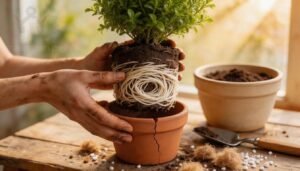
Plants are pretty good at telling you when they’ve run out of room — you just have to know what to look for. Repotting at the right time can mean the difference between a plant that thrives and one that quietly struggles.
Here’s what to watch for and how to handle it.
Signs a Plant Has Become Root Bound
Your plant is trying to tell you something.
Root circling at the soil surface, roots pushing through drainage holes, and stunted top growth are classic signs of a root-bound plant. You may also notice leaf yellowing on older growth, a pot weight shift as soil volume shrinks, and a water drainage slowdown as compacted roots leave little room for absorption.
How Much Bigger The Next Pot Should Be
Going one size too big can drown your roots in excess moisture. These repotting guidelines and timing rules keep things balanced:
- Move up 1–2 inches in diameter for small to medium plants.
- Use 2–4 inch diameter increment rules for large statement plants.
- Follow a 25–50% volume increase ratio for most foliage houseplants.
- Apply pot jump limits—never exceed 6 inches larger.
- Make sure your container size includes adequate pot drainage holes.
Fresh potting mix fills the extra space evenly.
Best Seasons for Repotting Indoor Plants
Timing matters just as much as pot size.
Spring repot timing is your best window—new growth signals the plant is ready to push into fresh soil. Summer heat management becomes key for fast-growing tropicals; avoid repotting during heat waves. Fall root renewal works for sturdy species, while winter dormant repot is a last resort. Watch seasonal growth indicators to guide every move.
Refreshing Old Soil to Restore Nutrients
Old soil loses its punch over time — nutrients deplete, structure compacts, and roots struggle.
When repotting, mix fresh potting media with compost at a 1:3 ratio for balanced organic matter incorporation. Add worm castings for gentle micronutrient amendments.
Check pH; most houseplants absorb nutrients best between 6.0 and 6.5.
Soil structure loosening during repotting restores drainage and keeps nutrient balance working in your favor.
Prevent Common Pests and Problems
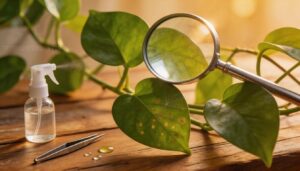
Even the healthiest plant can run into trouble if pests sneak in unnoticed. Catching problems early — before they spread — makes all the difference.
Here’s what to watch for and how to handle it.
How to Inspect and Quarantine New Plants
Every new plant you bring home deserves a two-week quarantine — full stop. Before placing it near your collection, run a visual vigor assessment within 24 hours of unboxing.
Check for:
- Uneven leaf discoloration signs like yellowing or speckling
- White powdery residue suggesting mildew
- Soft, discolored stems indicating plant stress indicators
- Root zone inspection for rot smells
- Brown spotting from transit stress
Set up an isolation container setup in a separate room until you’re confident it’s clean.
Identifying Spider Mites, Gnats, Aphids, and Mealybugs
Once you’ve finished quarantine checks, it’s time to know exactly what you’re looking for.
Spider mites leave leaf stippling — tiny pale dots — plus fine webbing; detection is your cue they’ve settled in. Aphids cluster on new growth, leaving honeydew buildup that turns sticky and dark. Mealybugs show as cottony masses at stem joints.
Use sticky traps near soil to identify common houseplant pests like fungus gnats early.
Safe Treatments With Soap, Neem, and Alcohol Solutions
Once you’ve spotted the culprit, three organic pest treatments get the job done.
For soap, mix 1 teaspoon of mild dish soap per liter of water. Neem oil works at 1–2 teaspoons per liter with a soap drop. Alcohol solutions run 1 part isopropyl to 3 parts water.
Always do a leaf patch test first, apply during cooler hours, and rotate between pest control methods for houseplants to avoid resistance.
Cleaning Leaves and Improving Airflow to Prevent Disease
Dust removal is one of the most overlooked disease prevention steps. Wipe both sides of each leaf with a damp microfiber cloth using room-temperature water — it takes about 60 seconds per plant.
Do it in the morning so leaf drying timing works in your favor before night humidity rises.
For air circulation, fan placement matters: an oscillating fan on low, 6–12 inches away, keeps air moving without stressing foliage.
Adjust Care Through The Seasons
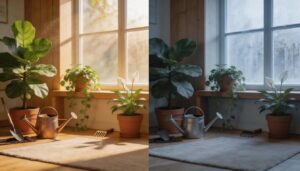
Your plants don’t need the same care in January as they do in July — and adjusting with the seasons makes a real difference. As light shifts and growth slows, small changes to your routine keep plants healthy instead of stressed.
Here’s how to tune your care through each part of the year.
Watering Less During Winter Dormancy
Winter changes everything. Your plant’s metabolism slows, and shorter days trigger stomatal closure — meaning it simply doesn’t drink the way it did in July. Seasonal dormancy water reduction isn’t optional; it’s biology.
Cut your seasonal adjustments to watering schedules by 30–60% and watch for these signs before reaching for the watering can:
- Leaves losing slight firmness (leaf turgor monitoring catches this early)
- Top 2–3 inches of soil still feel damp
- Moisture meter calibration reads mid-range at root depth
- Root zone drying hasn’t fully occurred between sessions
- Saucers holding standing water — a root rot warning
Preventing overwatering and root rot starts with patience.
When to Reduce or Pause Fertilizing
Your fertilization schedule isn’t one-size-fits-all — it shifts with your plant’s life stage. During winter dormancy, low light stress slows growth, so nutrients pile up as unused salts. Pause or reduce feeding until spring. The same applies after repotting, post-pruning recovery, or pest disease stress — push fertilizer then, and you risk burn, not growth.
| Situation | Action |
|---|---|
| Winter dormancy | Stop feeding entirely |
| Low light stress | Reduce by half |
| After repotting | Wait 4–6 weeks |
| Post-pruning recovery | Resume only after new leaves appear |
| Pest disease stress | Pause until plant recovers |
Fertilizing Houseplants Best Practices means reading your plant first. Pale tips and leaf burn are classic plant stress symptoms — signs you’re overfeeding, not underfeeding. Match fertilizer types and application methods to the moment, not the calendar.
Using Grow Lights During Short Days
short days rob your plants of the light they need to thrive. Using LED grow lights indoors bridges that gap without overheating your space.
Dial in Spectrum Tuning — blue-dominant light around 4,000–4,500K keeps foliage compact. Set Timer Scheduling to 12–14 hours daily, keeping the photoperiod consistent.
Calibrate light intensity and distance carefully:
- Place lights 6–12 inches above low growers
- Keep light duration uninterrupted at night
- Use Heat Dissipation fans to manage canopy temperature
Seasonal Care Changes for Tropical and Flowering Plants
Tropical and flowering plants follow the sun’s rhythm — and so should your care routine. As photoperiod shifts shorten days, growth cycle slowing means less water, less food, and more patience.
Cut fertilizer to half strength from October through February. Watch for root zone cooling near cold windows.
Bloom timing adjustments depend on steady warmth, ideal humidity levels, and consistent light — small seasonal care adjustments make all the difference.
Frequently Asked Questions (FAQs)
How often should I water indoor plants?
There’s no single answer. Watering frequency depends on light, pot size, humidity, and growth phase. Check soil moisture first—stick your finger 1–2 inches deep. If it’s still damp, wait.
Can I bring an outdoor geranium inside for the winter?
Yes, absolutely — geraniums are practically begging to come indoors before frost hits.
Place them in a south-facing window for 6–8 hours of light daily, water when the top inch of soil dries out, and keep temperatures above 50°F.
How do to know my plants have enough sunlight?
Your plants tell you everything. Watch for pale leaves, leggy stems, or a lux reading below 1, Those are your clearest signals that light levels aren’t meeting their needs.
How to take good care of indoor plants?
Good plant care comes down to a few basics: meeting light requirements for indoor plants, smart watering, humidity control, fertilizing, and soil drainage and pot selection.
Get those right, and your plants will thrive.
What are the biggest mistakes when repotting?
Repotting mistakes often start before the plant leaves its old pot.
Root hair damage, oversized pot selection, inadequate soil mix, and skipping the acclimation period are the four most common errors.
What plants are safe for dementia patients?
Spider plant, parlour palm, and coleus are non-toxic foliage picks that offer sensory calming color without thornless leaf risks. These low maintenance, low-light tolerant houseplants suit safe placement near dementia patients beautifully.
Consider using self-watering plant containers(https://www.alzheimers.org.uk/get-support/publications-and-factsheets/dementia-together/ideas-help-dementia-keeping-houseplants) to simplify care.
How to care for indoor plants for beginners?
Start simple.
beginner-friendly houseplant species like pothos or snake plants, set a care schedule, and focus on watering houseplants properly.
Choosing the right light for houseplants makes all the difference.
How do I keep my indoor plants healthy?
Healthy indoor plants come down to six basics: right light, consistent watering, proper humidity, stable temperatures, good soil, and timely feeding. Nail those, and your plants will genuinely thrive.
How do you care for indoor plants?
Caring for indoor plants comes down to matching watering, light and sunlight requirements for indoor plants, humidity and air moisture control in houseplants, fertilizing houseplants best practices, and pest control methods for houseplants to each plant’s needs — consistently.
What are the best indoor plant care tips?
Green thumbs aren’t born — they’re built.
Match light spectrum to each plant’s needs, keep watering consistent, control humidity, fertilize wisely, and stay ahead of pests through regular leaf cleaning and air circulation.
Conclusion
As you master these 10 indoor plant care tips, you’ll notice a shift in your relationship with your plants—from anxious caretaker to confident nurturer. plants will thrive, and you’ll wonder how you ever managed without this knowledge.
With the right balance of light, water, and nutrients, your indoor jungle will flourish. By applying these expert indoor plant care tips, you’ll create a haven that brings joy and serenity to your daily life, every day.