
This site is supported by our readers. We may earn a commission, at no cost to you, if you purchase through links.

Somewhere between folk wisdom and garden folklore, marigolds earned a reputation as the paramount pest deterrent—plant a few around your tomatoes and watch the bugs flee. It’s a satisfying idea. It’s also only partly true.
Research from Rutgers University found marigolds don’t reliably reduce cabbage, carrot, or onion pest populations the way gardeners expect.
But here’s what the science does confirm: under the right conditions, marigolds’ repelling vegetable garden pests is a real phenomenon—rooted in chemistry, not charm.
French marigolds (Tagetes patula) exude a compound called alpha-terthienyl from their roots, which disrupts soil nematodes and confuses whiteflies near tomatoes. Knowing when and how to deploy them turns a garden myth into a legitimate strategy.
Table Of Contents
Key Takeaways
- French marigolds (Tagetes patula) release a root compound called alpha-terthienyl that genuinely suppresses soil nematodes — but only when planted densely and at least two months before your main crops go in.
- The whitefly-repelling effect near tomatoes is real, but distance matters: marigolds need to sit within 6–12 inches of your vegetables to have any chemical influence.
- Marigolds earn their biggest wins by attracting beneficial insects — hoverflies, lacewings, and parasitic wasps — that do the actual pest-control heavy lifting across your whole garden.
- Tilling spent marigold plants into the soil as green manure extends their nematicidal benefits into the next growing season and boosts soil organic matter by up to 40%.
Do Marigolds Really Repel Pests?

Marigolds have earned a near-legendary reputation in the vegetable garden, but the real story is a little more complicated than the rumors suggest. Some of what you’ve heard is genuinely backed by research — and some of it just isn’t. Here’s what the science actually says, and where marigolds are worth your time.
The same goes for other classic pairings — common companion planting myths around vegetables can quietly steer well-meaning gardeners in the wrong direction for years.
What Gardeners Often Expect
Marigolds have long held a near-mythical reputation in the vegetable garden. Most gardeners plant them expecting natural pest protection alongside cheerful Summer Color Display — practically a two-for-one deal. That’s a reasonable hope, honestly.
Here’s what most gardeners commonly expect:
- Marigold pest repellent effects against beetles, whiteflies, and soil nematodes
- Easy Low Maintenance Care with basic watering and deadheading
- Flexible Border Plant Placement for Quick Seasonal Fill between crops
- Uniform Bed Coverage that doubles as companion planting in the vegetable garden
This gardening myth — that any marigold variety repels all pests equally — shapes how millions of gardeners plan their beds every spring. Adding a fresh compost layer each season can boost soil health and improve plant vigor.
What Research Actually Shows
The science here is more nuanced than the reputation suggests. Rutgers University laboratory studies found marigolds didn’t reliably reduce cabbage, carrot, or onion pest infestations — a humbling finding for companion planting believers.
Where research consistently holds up, though, is underground. Marigold roots release alpha-terthienyl, a compound proven to disrupt root-knot nematode egg hatching and suppress soil nematode populations substantially.
Repellent Myths to Avoid
Knowing where marigolds fall short matters just as much as knowing where they shine. A few stubborn myths tend to lead gardeners astray.
The "natural only" myth is a big one. Marigolds don’t provide reliable protection in all soil conditions — especially against root-knot nematodes without dense planting, proper timing, and soil incorporation.
Distance matters more than most realize. Border plantings look tidy, but marigolds need to grow within 6–12 inches of your vegetables to have any real chemical influence. A pretty perimeter won’t stop nematodes from finding roots deeper in your beds.
Not all marigolds work the same way, either. French marigolds (T. patula) produce different root exudates than African types — species selection genuinely affects results.
Timing is everything. Planting after your vegetables are established offers no meaningful relief. And perhaps most importantly, marigolds can’t replace crop rotation, resistant varieties, or soil sanitation. They work best as one piece of a larger plan — not the whole strategy.
Where Marigolds Help Most
So where do marigolds genuinely earn their place? Nematicidal soil benefits are their strongest suit.
Planted densely as a cover crop before tomatoes or peppers, they release alpha-terthienyl from their roots — suppressing root-knot nematodes before your main crops ever go in.
That early-season shield is real, measurable, and backed by field trials.
Best Use in Pest Plans
Think of marigolds as one tool in a larger Integrated Management Strategy — not a silver bullet. Your best results come from combining nematode suppression through soil-incorporated roots, attracting beneficial insects like hoverflies and lacewings, and following a smart Rotation Schedule Planning approach each season.
- Sow marigold seeds 2–3 weeks before main crops
- Pair them as a companion plant with tomatoes or squash
- Rotate beds yearly to refresh soil bioactive compounds
How Marigolds Fight Root-Knot Nematodes

Root-knot nematodes are one of the toughest soil problems a vegetable gardener can face — and this is actually where marigolds earn their reputation. Unlike their mixed results with flying insects, marigolds have real, research-backed power underground. Here’s exactly how that works, and how to put it to use in your garden.
If you’re just getting started, beginner-friendly summer flowers like French marigolds are an easy entry point for building this kind of natural pest defense in your garden.
Alpha-terthienyl Root Compounds
The real magic happens underground. Tagetes spp. roots release alpha-terthienyl — a phototoxic compound with the formula C₁₂H₈S₃ — directly into the surrounding soil through plant root exudates. Once UV light activates it, it generates reactive oxygen species that effectively overwhelm root-knot nematodes at the cellular level, disrupting their ability to reproduce.
Marigold roots silently poison nematodes underground, releasing a UV-activated compound that destroys their ability to reproduce
| Property | Detail | Garden Impact |
|---|---|---|
| Activation | UV/sunlight required | Works best in open, sunny beds |
| Target | Meloidogyne nematodes | Protects tomatoes, carrots, peppers |
| Mechanism | Reactive oxygen species | Disrupts nematode egg hatching |
That phototoxic mechanism sounds complicated, but think of it like a slow-release trap your soil sets for itself. Nematicidal efficacy depends on soil bioavailability — how well the compound moves through soil moisture into nematode territory. Since alpha-terthienyl is water-insoluble, it stays concentrated near the rhizosphere, exactly where nematode suppression matters most.
Why Dense Planting Matters
Density is the difference between a marigold that dabbles and one that delivers. A sparse row of plants simply can’t release enough alpha-terthienyl into the soil to matter. Pack in Tagetes patula properly, though, and you get a compounding effect — allelopathic chemicals build up right where nematodes live.
Dense planting does more than nematode work:
- Soil moisture retention improves as canopy shading cuts evaporation
- Weed suppression kicks in naturally, leaving fewer gaps for soil disturbance
- A canopy microclimate forms that stabilizes soil temperature and nourishes microbial activity
That healthier soil environment accelerates biological control, boosts beneficial insects, and — over successive seasons — drives a measurable yield increase in following vegetable crops.
Two-month Cover Crop Timing
Timing is everything with marigolds as a cover crop. Plant two full months before your cash crop goes in — that’s the minimum window for Tagetes patula roots to release enough alpha-terthienyl to meaningfully suppress soil nematode populations.
| Growth Stage | Timeframe | Soil Benefit |
|---|---|---|
| Seedling establishment | Weeks 1–2 | Minimal root exudate release |
| Active root growth | Weeks 3–5 | Alpha-terthienyl builds in soil |
| Full canopy coverage | Weeks 6–7 | Peak nematode suppression begins |
| Pre-termination biomass | Week 8 | Maximum beneficial insect activity |
| Termination window | Weeks 8–10 | Soil incorporation ready |
In cooler temperate climates, early spring or late-summer planting hits that 8-week active growth window reliably. Warmer regions have more flexibility, but drought shortens your window fast — choose accordingly.
Tilling Plants as Green Manure
Once your marigolds hit that 8-week mark, don’t yank them out — till them in. Incorporating the full biomass as green manure is where the real soil magic happens. You’re not just ending a cover crop; you’re making a deposit into your soil’s long-term health account.
Here’s what that one act of tilling actually does:
- Boosts soil organic matter by 20–40% within a single season, improving moisture retention and structure
- Accelerates microbial activity, which mineralizes nitrogen and phosphorus into forms your next crop can actually use
- Suppresses weeds by burying seeds below germination depth and creating a temporary mulch layer
- Improves root system access by breaking compaction and increasing soil porosity
- Sustains alpha-terthienyl concentration, extending nematicidal biocontrol into the following growing season
The carbon-to-nitrogen ratio of marigold biomass is low enough that nutrient release rate stays relatively fast — meaning your next transplants won’t wait long for that fertility boost. Cut plants at about 12 inches, then till immediately while tissue is still fresh. That’s integrated pest management meeting practical soil health in one shovelful.
Best Marigold Types for Soil
Not all marigolds pull equal weight in the soil. For soil nematode suppression, Tagetes patula — the French marigold — is your frontline fighter, especially in lighter, well-drained beds. African marigold manages richer, heavier soils better. Both prefer pH 6.0 to 7.0 and reward a compost amendment at planting with stronger roots and longer bloom.
| Marigold Type | Best Soil Condition |
|---|---|
| French marigold | Light, well-drained soil |
| African marigold | Moderately fertile, heavier soil |
| Both types | pH 6.0–7.0 |
| Sandy soils | Add compost for moisture retention |
| Clay soils | Amend for drainage and aeration |
Insect Pests Marigolds May Influence
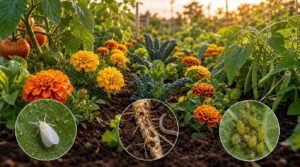
Marigolds aren’t a silver bullet for every pest, but they do influence a handful of insects that regularly cause headaches in vegetable gardens. The key is knowing which pests respond and under what conditions — because context matters more than most gardeners realize. Here’s a closer look at the insects where marigolds can actually make a difference.
Whiteflies Near Tomatoes
Whiteflies are sneaky — they hide on the undersides of tomato leaves, siphon sap, and trigger yellowing and stunted growth before you even notice them.
Planting French marigolds beside tomatoes helps by releasing limonene, a volatile compound that confuses whiteflies and disrupts their ability to locate host plants.
Aim for one marigold per two tomato plants.
Squash Bugs on Cucurbits
Squash bugs hit cucurbits hard — and if you’ve ever watched a healthy zucchini vine collapse seemingly overnight, you know the frustration. These oval, brownish insects (6–10 mm, shield-shaped) overwinter in garden debris and move in fast once new growth appears. Interplanting with marigolds has shown real promise for reducing pressure, especially in enclosed growing spaces.
Here’s what actually helps:
- Scout for bronze egg clusters on leaf undersides — catching them early, before the 7–9 day hatch window, is your best leverage.
- Interplant French marigolds between cucurbit rows to attract beneficial insects that prey on nymphs.
- Use row covers over young transplants to block adult squash bugs during vulnerable early growth.
- Remove crop debris after harvest to eliminate overwintering sites near next season’s beds.
- Rotate cucurbits annually away from previous planting areas — marigolds used as cover crops in rotation add soil benefits too.
Marigolds won’t eliminate squash bugs alone, but as part of a layered approach, companion planting benefits are real and worth stacking.
Cucumber Beetle Pressure
Cucumber beetles are a different kind of threat. Unlike squash bugs, they don’t just damage plants — they transmit bacterial wilt, which can collapse entire vines within days. Even one beetle per plant on cucumbers or melons can cross the economic threshold.
Iowa State trials showed interplanting marigolds with cucurbits reduced cucumber-beetle damage meaningfully, making companion planting a smart first layer of defense.
Aphids and Soft-bodied Pests
Soft-bodied pests like aphids are a sneakier problem. Their rapid asexual reproduction means a small colony becomes a full infestation fast.
Marigolds help indirectly here — not by repelling aphids directly, but by attracting hoverflies and lady beetles that hunt them. Think of marigolds as a recruitment poster for your garden’s own biocontrol team.
Limits in Open Gardens
Open gardens, unfortunately, work against marigolds’ best efforts.
Volatile compounds like limonene disperse quickly once there’s no enclosure to hold them, so the whitefly-masking effect fades fast outdoors.
Fence height regulations and sight triangle requirements further limit how densely you can screen borders — meaning your marigolds work harder as beneficial insect recruiters than as direct natural repellents in truly open beds.
Beneficial Insects Marigolds Attract

Marigolds don’t just keep unwanted insects guessing — they also roll out a welcome mat for the ones you actually want. The right beneficial insects can do more pest control work than any spray bottle you’ll ever own. Here’s who shows up when marigolds are in bloom.
Hoverflies for Aphid Control
Hoverflies are one of the garden’s best‑kept secrets. These nectar‑feeding adults look like small bees, but their larvae are voracious aphid predators.
Marigolds attract them reliably because they offer accessible pollen and nectar. One blooming patch can draw enough adults to establish meaningful aphid suppression across nearby vegetable beds within weeks.
Lady Beetles and Lacewings
While hoverflies get the glory, lady beetles and lacewings are quietly doing just as much heavy lifting in your marigold-filled beds.
Lady beetles — yes, ladybugs — are drawn to marigold flowers for nectar and pollen. Once they arrive, aphid predation efficiency skyrockets. A single adult can devour hundreds of aphids daily, and their alligator-like larvae are equally relentless.
| Beneficial Insect | Key Behavior | Garden Benefit |
|---|---|---|
| Lady Beetle Adult | Forages on marigold blooms | Draws them into vegetable beds |
| Lady Beetle Larva | Lady Beetle Predation of aphids | Rapid colony knockdown |
| Lacewing Adult | Feeds on nectar and honeydew | Sustained presence near crops |
| Lacewing Larva | Lacewing Egg Laying near prey | Targeted soft-pest elimination |
| Both Species | Overwintering Adults in debris | Spring population head start |
Lacewings follow a similar pattern. Lacewing egg laying happens on slender stalks near aphid hotspots, and their larvae — called aphid lions — chew through mites and soft-bodied pests with impressive efficiency.
One caveat worth knowing: under high pest pressure, intraguild predation can occur, meaning these two beneficial insects may compete. Diverse plantings around your marigolds help reduce that tension, keeping both working for you as part of a reliable organic pest control strategy.
Parasitic Wasps for Caterpillars
Parasitic wasps are the garden’s silent assassins — tiny, often just 1–6 millimeters long, and completely invisible until caterpillar damage mysteriously stops. Marigold flowers draw them in with nectar provisioning, fueling egg production.
Once present, they target cabbage worms and tomato hornworms, injecting eggs directly into the host. The developing larvae consume the caterpillar from within, killing it before adulthood.
Bees and Pollination Support
Bees don’t just visit your garden — they quietly determine whether your tomatoes set fruit or your cucumbers stall. Marigolds as bee-friendly flowers pull in both honey bees and bumble bees with their bright blooms and accessible nectar, boosting pollination support right where fruiting crops need it most.
Here’s what that looks like in practice:
- Honey bees visit hundreds of flowers daily, dramatically increasing fruit set on tomatoes and strawberries nearby
- Bumble bees perform buzz pollination, shaking loose pollen that other insects can’t reach
- Nectar-rich plantings like marigolds reduce nutritional stress, keeping bee colonies stronger throughout the season
- Pesticide-free practices around marigold beds protect foraging bees and sustain their pollination efficiency
Plant marigolds alongside fruiting vegetables, and you’re fundamentally setting out a welcome sign for the pollinators your garden genuinely depends on.
Habitat Corridors in Beds
Think of marigolds as the connective tissue of your garden’s ecosystem. Distributed corridor plantings — ideally 3–5 meters wide along bed edges — link vegetable zones, giving hoverflies, lacewings, and parasitic wasps continuous movement paths between crops. Narrower strips under 2 meters still work for smaller spaces.nn| Corridor Feature | Recommended Practice | Benefit |n|—|—|—|n| Width | 3–5 meters along bed edges | Reduces edge effects |n| Plant Layers | Ground herbs, mid shrubs, tall perennials | Nourishes diverse arthropods |n| Seasonal Cover | Semi-evergreen species mix | Year-round insect habitat |n| Soil Maintenance | 2–3 inch mulch layer | Feeds beneficial soil microbes |nnLayered plant diversity — low herbs, mid-height shrubs, taller perennials alongside your marigolds — creates microhabitat niches that shelter beneficial arthropods through heat spikes. Root turnover from these mixed companions also feeds soil microbial networks, quietly cycling nutrients toward your vegetables. Deadhead blooms twice per season and leave overwintering structure intact come autumn.
Planting Marigolds With Vegetables
Knowing marigolds work is one thing — knowing where to put them is what actually makes the difference. Placement, spacing, and timing all affect how much benefit you get. Here’s how to pair marigolds with your vegetables the right way.
Tomatoes and Marigold Spacing

When pairing marigolds with tomatoes, spacing makes or breaks the partnership. Plant one marigold per two tomato plants, keeping marigolds 12 to 18 inches from each tomato stem.
French marigolds (Tagetes patula) work best here — their compact size fits neatly without crowding roots or blocking airflow around your tomato foliage.
Squash, Zucchini, and Cucumbers

Cucurbits — squash, zucchini, and cucumbers — respond well to marigold companion plants tucked between hills or along row edges. Iowa State trials showed interplanting reduced squash-bug and cucumber-beetle pressure noticeably. Here’s what works best for this group:
- Place marigolds every 2–3 feet between zucchini hills
- Use French marigolds as a natural insect deterrent near cucumber vines
- Rotate beds annually — crop rotation strategies plus marigolds slow pest cycles
- Support cucumbers on a vine trellis system so marigolds stay visible and accessible to beneficials
Border Planting for Protection

Moving marigolds to the border of your garden takes companion planting to a whole new level. A layered border — tall hedge at the back, marigolds and companion plants in front — creates a living barrier that pulls double duty.
It blocks pest movement while drawing in beneficial bugs right where you need them most.
Seasonal Planting Schedule

A solid border sets the stage, but timing is what holds everything together.
Start seeds indoors in March or April, once the soil outdoors approaches 50°F. Transplant after your last spring frost date — usually May in temperate zones.
Marigolds bloom through summer well into fall, overlapping neatly with your vegetable season for steady, nonchemical pest management all season long.
Deadheading and Fall Cleanup

Deadheading marigolds — removing faded blooms — is the simplest way to extend flowering into fall. Use clean, sharp scissors and cut just above the first healthy leaf. A quick weekly walk-through keeps new buds coming.
After the first frost, don’t yank plants out. Till the spent stems into the soil; their allelopathic root compounds keep working as green manure through winter.
Frequently Asked Questions (FAQs)
Can marigolds grow well in containers or pots?
Yes, marigolds thrive in containers. Use 6–12 inch pots with a well-draining container soil mix, place them in full sun, and water moderately. Even African marigold does well with the right pot size guidelines.
Do marigolds affect soil pH over time?
Marigolds don’t dramatically shift soil pH on their own, but over time their organic matter decomposition gently buffers pH toward neutrality, supporting soil health improvement and steadier microbial activity season after season.
Which marigold varieties work best in shade?
Not all marigolds love shade equally. Compact French marigolds like Bonanza and Hero and Signet marigolds (Tagetes tenuifolia) handle partial shade best. African types struggle most in low light.
How do marigolds interact with herb garden companions?
Think of it like a kitchen spice rack—everything works better together. French marigold aromatic compounds can mask herb scents, confusing aphids. Their allelopathic properties mildly suppress weed competition, giving herbs room to thrive.
Are marigold blooms safe for vegetable consumption?
Some Tagetes blooms are edible — particularly signet marigolds. Stick to pesticide-free, organically grown petals. Start small to check for allergies. Avoid African marigold varieties, which can irritate.
Conclusion
Marigolds mastered strategically make all the difference. Marigolds repelling vegetable garden pests isn’t folklore—it’s chemistry you can actually use.
French marigolds planted densely suppress soil nematodes, confuse whiteflies near tomatoes, and pull beneficial insects into your beds. That’s not magic; it’s a well-timed biological tool working quietly beneath the surface.
Give them the right conditions—dense planting, proper timing, smart placement—and they’ll earn their spot in your garden every single season.
- https://blog.mountain-plover.com/2016/07/07/garden-advice-marigold-myths
- https://nicksgardencenter.com/gardening-blog/marigold_natural_pest_control
- https://www.piedmontmastergardeners.org/article/magical-repelling-powers-of-marigolds-myth-or-fact
- https://bellgardentn.org/benefits-of-french-marigolds-in-the-garden
- https://www.growveg.com/guides/how-to-make-all-natural-pest-repellent-using-marigolds