This site is supported by our readers. We may earn a commission, at no cost to you, if you purchase through links.

Most fruit trees won’t tell you they’re hungry until the damage is already done—poor fruit set, stunted shoots, or leaves turning the wrong shade of yellow mid-summer. Feeding at the wrong time, or skipping it altogether, costs you a whole growing season.
The good news is that once you understand how a tree’s nutritional needs shift with its age, the soil it grows in, and the time of year, the guesswork disappears. Knowing how often fruit trees should be fertilized changes how you read your trees—and how well they produce.
Table Of Contents
Key Takeaways
- Young trees need feeding every 4 to 6 weeks during the growing season, but once a tree matures, one well-timed spring application each year is usually all it takes.
- Your soil type quietly controls how often you fertilize — sandy soil drains nutrients fast and needs more frequent feeding, while clay holds them longer but benefits from compost to stay workable.
- Stop applying nitrogen after July, because late-season feeding pushes soft new growth that can’t survive the first frost and pulls energy away from ripening fruit.
- Yellowing leaves, weak shoot growth under 8 to 18 inches, and small misshapen fruit are your tree’s clearest signals that nutrients are running low and it’s time to act.
How Often to Fertilize Fruit Trees
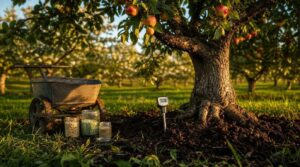
How often you fertilize depends mostly on how old your tree is and what your soil is like. Get the timing wrong, and you’ll either starve the tree or push it into growth at the worst possible moment. Here’s what that looks like across five key situations.
For a deeper look at each stage, fertilizing fruit trees by age and soil type breaks down exactly what to apply and when.
Newly Planted Trees
Newly planted trees are in survival mode — their main job is putting down roots, not pushing out new leaves. That’s why root-focused, low-nitrogen blends work best at this stage.
Use shallow, frequent irrigation to keep the root ball evenly moist for the first two to four weeks, and always do a soil moisture check four to six inches deep before watering again. You can also consider adding mycorrhizae fungi to help improve water and phosphorus absorption.
Young Trees Every 4–6 Weeks
Once your tree has settled in and roots start reaching outward, it’s time to shift gears. Young trees need feeding every 4 to 6 weeks throughout the growing season.
A balanced fertilizer with equal parts nitrogen, phosphorus, and potassium promotes steady growth without pushing the tree too hard. Always water thoroughly after feeding to move nutrients down to the roots.
Mature Trees Once Yearly
Once a fruit tree hits maturity, it doesn’t need constant feeding anymore. One annual fertilization is usually all it takes to support healthy canopy growth and a strong fruit set.
Apply a balanced NPK fertilizer at the drip line each early spring, run a quick soil test first, and avoid nitrogen late in the season to protect new growth from frost.
Heavy Feeders Twice Yearly
Some trees are just hungrier than others. Heavy feeders — like citrus and certain stone fruits — burn through macronutrients fast and need twice-yearly fertilization to stay productive.
A spring heavy feeding two weeks before bud break gets growth started right, and a second round six to eight weeks after fruit set keeps energy steady. Split application benefits include less leaching and better uptake overall.
Soil Type Adjustments
Your soil type quietly controls how often you need to fertilize. Sandy Soil Management means fertilizing more frequently — nutrients drain fast and don’t stick around long. Clay is the opposite, holding nutrients well but needing Clay Soil Amendments like compost to let roots breathe. Loam sits in the sweet spot.
Three adjustments make a real difference:
- Test soil pH every one to two years and correct it gradually with lime or sulfur.
- Integrate Organic Matter like compost to boost nutrient retention across any soil type.
- Apply soil amendments during dormancy to avoid stressing active roots.
Loam Soil Benefits are real — stable fertility, balanced drainage. If you’re not there yet, consistent soil testing and smart soil quality improvements will get you close.
Fertilizing Schedule by Season
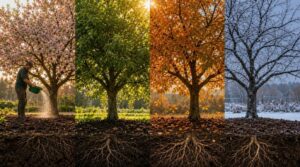
Timing matters just as much as what you feed your trees. Fertilize at the wrong time, and even the best product can do more harm than good. Here’s how to break your feeding schedule down by season so your trees get the right nutrients at exactly the right moment.
Early Spring Feeding
Early spring is your tree’s first real hunger signal of the year. As trees exit dormancy, nutrient timing matters most — apply a balanced nitrogen-forward fertilizer just before bud swell to fuel new shoot growth. Below is a quick guide to spring fertilization by tree type:
| Tree Type | Fertilizer Focus | Application Timing |
|---|---|---|
| Apple/Pear | Nitrogen + trace minerals | Just before bud break |
| Citrus | Balanced energy, potassium | Early spring, small doses |
| Cherry | Slow release nitrogen | Pre-bloom, soil warming |
Soil microbial activity naturally increases as temperatures rise, helping roots absorb nutrients more efficiently. That’s why watering in after application matters — it moves nutrients straight to the root zone. Avoid overdoing nitrogen early, since excess can delay fruit set. A quick soil testing check before you apply keeps things balanced and prevents waste.
After Fruit Set
Once fruit set is confirmed, your fertilization schedule shifts to promote rapid fruitlet development. Potassium and calcium become your priorities now — potassium drives sugar transport, while calcium strengthens cell walls and reduces fruit drop. Keep nitrogen moderate; too much delays color development timing.
Water stress at this stage triggers abscission, so consistent soil moisture promotes healthy nutrient allocation and protects your crop.
Summer Slow-release Feeding
Summer heat puts your feeding routine to the test. Slow-release fertilizer is your best ally here, delivering nutrients steadily over 8 to 12 weeks without overwhelming roots.
Apply it evenly across the root zone near the drip line, rake it lightly into the topsoil, and water in right away. Rotate applications every 6 to 8 weeks to keep your fertilization schedule consistent all season.
Avoid Late Nitrogen
Once July arrives, stop applying nitrogen. Late nitrogen applications push trees into new vegetative growth right when they should be slowing down and focusing energy on ripening fruit. That fresh growth is soft and frost-sensitive, leaving your tree vulnerable heading into fall.
Beyond that, nitrogen leaching prevention matters — unused nitrogen washes away in late summer rains, helping no one.
Low-nitrogen Fall Feeding
Fall feeding isn’t about pushing growth — it’s about building strength. A low-nitrogen fall application in September through November gives your fruit trees exactly what they need before dormancy: stronger roots, better cold tolerance, and a head start on spring. Keep nitrogen between 0 and 0.5 pounds per 1,000 square feet, and lean on potassium and phosphorus instead.
Choose slow-release formulations like polymer-coated blends, bone meal, or compost topdressing. These feed gradually through cooler soil, supporting microbial activity without triggering soft new growth. Run a quick soil test first — if nitrogen levels are already adequate, skip it entirely and focus on pH management. Water thoroughly after applying, and consider mulching to lock in moisture and keep nutrients cycling through fall.
Signs Trees Need Fertilizer
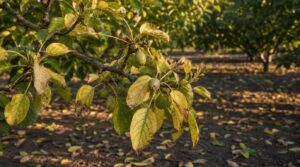
Your fruit trees can’t tell you when they’re hungry, but they do leave clues. Learning to read those signs is one of the most useful skills you can develop as a grower. Here are the key symptoms to watch for.
Fruit trees can’t voice their hunger, but they always leave clues for those paying attention
Weak Annual Shoot Growth
When your fruit tree’s new shoots fall short — think less than 8 inches for mature cherries or under 18 inches for young apple trees — that’s a clear signal something is off.
Weak annual shoot growth often traces back to a nitrogen imbalance, heavy crop load stealing carbon away from new growth, poor light reaching inner branches, water stress, or compacted roots blocking nutrient uptake.
Yellowing Leaves
Yellowing leaves are your tree’s way of asking for help. Nutrient deficiency diagnosis starts by noticing where the yellowing appears. Here’s what to watch for:
- Uniform yellowing across older leaves often signals nitrogen deficiency.
- Interveinal yellowing on new growth points to iron chlorosis, usually caused by high soil pH.
- Yellowing with scorched edges suggests potassium deficiency or drought stress.
Purplish Foliage
Purple leaves can stop you in your tracks, but don’t assume the worst right away. Phosphorus deficiency is one common cause, pulling sugars toward pigment production under stress. However, cool night temperatures trigger anthocyanin production naturally, deepening leaf color without any nutrient problem at all.
Check your soil pH and recent nighttime temps before reaching for fertilizer.
Scorched Leaf Edges
Scorched leaf edges are a red flag worth reading carefully. Potassium deficiency is one culprit, but drought impact, salt buildup from over-fertilization, sunburn damage, root damage, or chemical injury can all cause the same browning.
Before adjusting your NPK or fertilizer plan, run a soil test — misreading the cause leads to the wrong fix.
Small Misshapen Fruit
Small, misshapen fruit is your tree telling you something went wrong early. Incomplete pollination, cold night temperatures below 60°F during fruit set, and boron or potassium deficiency are the most common triggers. Sunscald damage and pest feeding at blossom time can also warp developing fruit.
Soil testing and consistent seasonal application help you catch these gaps before fruit set.
Best Fertilizer Application Tips
Knowing when to fertilize is only half the battle — how you apply it matters just as much. A few simple habits can mean the difference between nutrients that actually reach the roots and fertilizer that just washes away. Here’s what to keep in mind before you open that bag.
Test Soil First
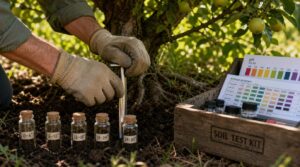
Before you pour a single granule into the soil, test your soil first. A simple soil test measures your soil pH and nutrient levels — nitrogen, phosphorus, and potassium — so you’re not guessing.
Collect samples from four to six spots across the root zone, about six to eight inches deep. Then interpret the results to identify any nutrient deficiency and adjust your amendments accordingly.
Apply Near Drip Line
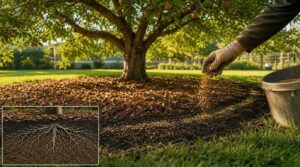
Once you know what your soil needs, placement is everything.
Always spread fertilizer near the drip line — the outer edge of the canopy — rather than against the trunk. That’s where the active feeder roots actually live.
Apply granules evenly across that zone, and top it with mulch to help lock moisture in and move nutrients down toward the roots.
Calculate Nitrogen Carefully
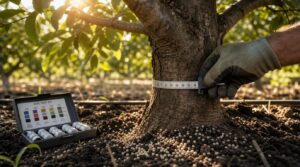
Getting nitrogen wrong is one of the most common mistakes with fruit trees — too much, and you push leafy growth instead of fruit.
Start with a soil nitrogen test before adding anything. Then use the 0.10 lb N per inch of trunk diameter rule. Split those doses across active growth periods, and choose a slow-release nitrogen formula to keep feeding steady without flooding the roots.
Water Fertilizer Deeply
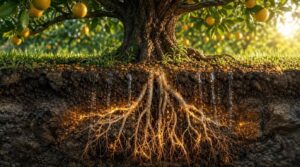
After applying fertilizer, water is what carries nutrients down to the root zone. Without a good soaking, granules just sit at the surface and never reach the roots.
Aim to wet the soil 12 to 18 inches deep, which moves both water and dissolved nutrients where roots actively feed and prevents nutrient leaching past the absorption zone.
Add Compost Topdressing
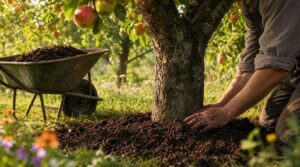
Compost topdressing is one of the simplest ways to feed your fruit trees while quietly rebuilding the soil beneath them.
Spread a quarter to three-eighths inch of finished compost from the trunk outward to the drip line. That thin layer introduces beneficial microbes that cycle nutrients naturally, improve water retention, and reduce your dependence on synthetic fertilizers over time. Water it in well afterward.
Top 6 Fruit Tree Products
Picking the right fertilizer doesn’t have to be overwhelming. There are a few solid products that consistently deliver results for home growers and orchardists alike. Here are six worth knowing about.
1. Ruffles Potato Chips Variety Pack
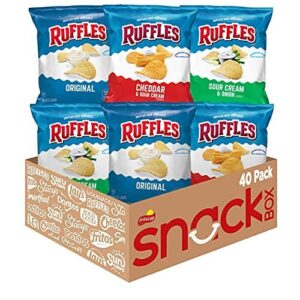
Ruffles Potato Chips Variety Pack isn’t a fruit tree fertilizer — and it shouldn’t be on this list.
It’s a 40-bag snack assortment featuring Original, Sour Cream & Onion, and Cheddar Sour Cream flavors, each bag weighing one ounce. Great for office breaks or on-the-go munching, but it won’t feed your apple tree.
If it appeared here, that’s an error worth flagging before you head into the genuinely useful products coming up next.
| Best For | Anyone who needs easy grab-and-go snacks for the office, school, or group settings where portion control actually matters. |
|---|---|
| Product Form | Multi-pack bags |
| Product Weight | 2.5 lbs |
| Indoor Use | Yes |
| Outdoor Use | Yes |
| Certifications | None listed |
| Serving Size | 1 oz per bag |
| Additional Features |
|
- Three solid flavors in one pack — Original, Sour Cream & Onion, and Cheddar Sour Cream — so there’s something for most people
- Single-serve bags make portion control effortless and keep things mess-free
- 40 bags total means you’re stocked for a while without constant restocking
- Not everyone will love all three flavors, so some bags might get left behind
- At one ounce per bag, it’s a light snack — might not cut it if you’re actually hungry
- You’d need to check the nutrition panel yourself if ingredients or allergens matter to you
2. Nutricost Micronized Creatine Monohydrate Powder

Like the potato chips before it, Nutricost Micronized Creatine Monohydrate Powder belongs nowhere near your fruit trees. This is a sports supplement, designed to support muscle recovery and cognitive function in people — not plants.
It comes as a tasteless, fine powder in a 1 kg container with 200 servings at 5 grams each. Pure, non-GMO, and GMP-compliant, it’s a solid product for gym bags, not garden beds.
| Best For | Athletes and gym-goers looking for a clean, no-frills creatine supplement to support muscle performance and recovery. |
|---|---|
| Product Form | Micronized powder |
| Product Weight | 2.2 lbs |
| Indoor Use | Yes |
| Outdoor Use | Yes |
| Certifications | GMP, FDA-registered |
| Serving Size | 5 grams |
| Additional Features |
|
- Pure micronized formula with zero additives, fillers, or artificial ingredients
- 200 servings per kilogram makes it a solid value for daily use
- Mixes easily into water, shakes, or electrolyte drinks with no taste
- Fine powder consistency makes it easy to spill and messy to handle
- May leave a slightly gritty texture if it doesn’t fully dissolve
- Some containers arrive without a measuring scoop, which is frustrating
3. Anker Prime Thunderbolt 5 Docking Station
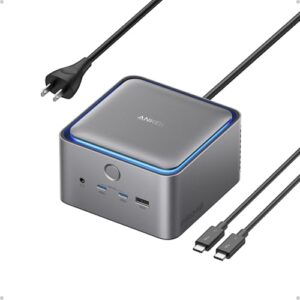
The Anker Prime Thunderbolt 5 Docking Station is another product that simply doesn’t belong in a fruit tree guide. It’s a high-performance tech hub, offering 120Gbps data transfer, up to 140W power delivery, and a 14-in-1 port setup that works with Windows 10/11 and macOS 15 or later.
Great for your home office setup — not your orchard. Your trees can’t plug into it, and honestly, neither need would ever overlap.
| Best For | Power users, content creators, and remote workers who need a single hub to run multiple high-end displays and peripherals from one cable. |
|---|---|
| Product Form | Desktop hub unit |
| Product Weight | 2.37 lbs |
| Indoor Use | Yes |
| Outdoor Use | No |
| Certifications | None listed |
| Serving Size | Single unit |
| Additional Features |
|
- Blazing 120Gbps transfer speeds — move a 150GB file in about 25 seconds flat
- 140W power delivery keeps even demanding laptops charged during heavy workloads
- Versatile 14-in-1 port setup covers just about everything: USB-C, USB-A, SD card, Ethernet, HDMI, and more
- MacBooks on standard M1, M2, or M3 chips are stuck at one external display, no matter what
- A few users ran into connection hiccups that needed a full device restart to fix
- USB-A hubs don’t play nice with it, which could be a real headache if you rely on one
4. Miracle Gro Water Soluble Plant Food
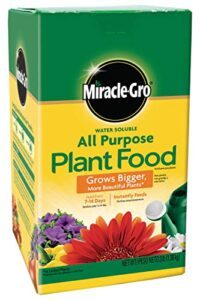
Now for something that actually belongs here. Miracle-Gro Water Soluble Plant Food comes in a 24-8-16 NPK ratio, meaning it leans heavily on nitrogen to push leafy, vigorous growth.
Mix it with water, apply every 7 to 14 days during the growing season, and your trees get a quick nutritional boost right at the roots. Just don’t apply it after July — late nitrogen pushes soft new growth that frost can damage fast.
| Best For | Gardeners who want fast, reliable results across a wide range of plants — from roses and vegetables to trees and shrubs, both indoors and out. |
|---|---|
| Product Form | Water-soluble powder |
| Product Weight | 3 lbs |
| Indoor Use | Yes |
| Outdoor Use | Yes |
| Certifications | None listed |
| Serving Size | Per label ratio |
| Additional Features |
|
- Absorbs quickly thanks to the water-soluble powder formula, so plants get fed right away
- The 24-8-16 NPK ratio drives strong, leafy growth, and chelated iron plus five trace elements keep plants looking vibrant
- Works in containers and in-ground gardens, making it flexible for almost any setup
- Needs reapplication every 7 to 14 days, which can feel like a lot to keep up with
- Not safe for orchids or Venus fly traps, so specialty plant owners will need something else
- You have to be careful not to wet the leaves in direct sunlight — it can burn them
5. Fox Farm Big Bloom Organic Fertilizer
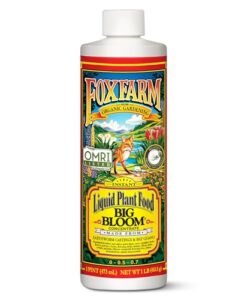
Fox Farm Big Bloom takes a gentler approach than most fertilizers, built around bat guano and earthworm castings instead of synthetic salts. Its NPK ratio is 0-0.5-0.7, so it won’t push excessive leaf growth — it focuses on flowering, fruit set, and root strength.
Mix about 4 tablespoons per gallon of water and apply through a watering can or drip system. It’s OMRI certified organic, works across all growth stages, and won’t burn roots when diluted correctly.
| Best For | Gardeners who want a certified organic boost for flowering plants, fruits, and veggies without the risk of chemical burn. |
|---|---|
| Product Form | Liquid concentrate |
| Product Weight | 1 pint |
| Indoor Use | Yes |
| Outdoor Use | Yes |
| Certifications | OMRI, CDFA Organic |
| Serving Size | Per label ratio |
| Additional Features |
|
- Made with natural bat guano and earthworm castings — no synthetic salts
- OMRI certified and safe for all growth stages, from seedlings to bloom
- Works with basically any watering setup — cans, drip systems, hose sprayers
- Settles fast, so you have to shake it every single time before use
- Can build up salts in the soil over time, which means occasional flushing is a must
- A pint goes quick if you’re feeding a large garden regularly
6. Alaska Organic Liquid Fish Fertilizer
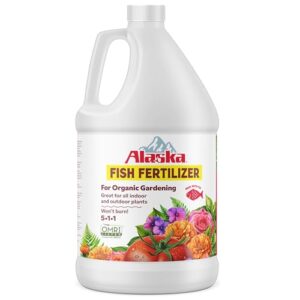
Alaska Organic Liquid Fish Fertilizer brings a 5-1-1 NPK ratio to the table, making it a strong choice when your trees need a vegetative push in spring. Dilute the concentrate and apply near the drip line every 2–3 weeks during the growing season. It’s OMRI certified organic, so it fits right into chemical-free orchards.
One heads-up: the low phosphorus and potassium means you’ll want a separate bloom or fruit fertilizer once your trees start flowering.
| Best For | Organic gardeners and orchardists who want to fuel leafy, vigorous growth in spring without synthetic chemicals. |
|---|---|
| Product Form | Liquid concentrate |
| Product Weight | 8.8 lbs |
| Indoor Use | Yes |
| Outdoor Use | Yes |
| Certifications | OMRI Listed |
| Serving Size | Per label ratio |
| Additional Features |
|
- OMRI certified, so it’s a clean fit for organic gardens and certified crop production
- Cold-processed formula keeps natural proteins and micronutrients intact, feeding your soil biology too
- Easy to apply—just dilute and use with a watering can or hose-end sprayer
- The fish smell is strong and can draw flies or curious pets during application
- Low phosphorus and potassium means you’ll need a separate fertilizer once flowering or fruiting kicks in
- Can drop soil pH over time, so it’s worth keeping an eye on your soil levels
Frequently Asked Questions (FAQs)
Can you fertilize fruit trees too much?
Yes, you absolutely can. Too much fertilizer burns roots, triggers lush leafy growth with little fruit, and invites pests. More isn’t better — it’s often the fastest way to hurt a healthy tree.
Can fruit trees be fertilized during a drought?
Fertilizing during a drought is possible, but water first. Dry soil blocks nutrient absorption, so irrigate before and after applying any fertilizer, and stick to slow-release formulas only.
Does mulching reduce how often trees need fertilizer?
Mulching reduces fertilizer needs by releasing nutrients as it breaks down and keeping moisture steady. A 2–4 inch layer of wood chips or leaf litter can meaningfully cut how often you need to feed.
How does rainfall affect fruit tree fertilization frequency?
Rainfall directly shapes your fertilization timing. Light rain boosts nutrient uptake, but heavy downpours leach nitrogen fast. In sandy soils especially, split your applications after moderate rain events.
Should container-grown fruit trees be fertilized differently?
Container-grown fruit trees need more frequent feeding than those planted in the ground. Nutrients leach out faster in pots, so small, steady applications every few weeks keep your tree healthy and productive.
Conclusion
What separates a productive orchard from one that just barely gets by? The answer almost always comes back to feeding.
How often should fruit trees be fertilized depends on their age, your soil, and the season—but now you know how to read all three signals. You’re no longer waiting for yellowed leaves to tell you something went wrong. Feed with intention, and your trees will respond with exactly the harvest you’ve been working toward.