
This site is supported by our readers. We may earn a commission, at no cost to you, if you purchase through links.

Most gardeners feed their soil from a bag. A handful of fertilizer here, a sprinkle of amendments there—and repeat every season. It works, but it keeps you dependent on inputs your garden could be producing on its own.
The soil beneath a healthy garden is a living system. Roots trade minerals, bacteria fix nitrogen from the air, and fungi shuttle nutrients between plants. When you plant the right companions, you tap into that system instead of fighting it.
Improving garden soil with companions isn’t a shortcut—it’s a smarter long game. These steps show you exactly how to start.
Table Of Contents
- Key Takeaways
- Test Soil Before Choosing Companions
- Plant Nitrogen-Fixing Soil Builders
- Add Deep-Rooted Mineral Miners
- Protect Soil With Living Mulches
- Boost Microbes and Pest Balance
- Follow a Seasonal Companion Plan
- Frequently Asked Questions (FAQs)
- What companion plants improve soil?
- What is the 70 30 rule in gardening?
- What can I add to my garden soil to improve it?
- How long before companions visibly improve soil health?
- Do companion plants work in raised beds or containers?
- Which companions grow well in shaded garden areas?
- Can companion planting reduce the need for compost applications?
- Conclusion
Key Takeaways
- Testing your soil for texture, pH, and nutrient gaps before choosing companions prevents guesswork and lets you target exactly what garden is missing.
- Nitrogen-fixing plants like beans, clover, and alfalfa quietly rebuild soil fertility season after season, reducing your dependence on store-bought fertilizers.
- Deep-rooted plants like comfrey, daikon radish, and dandelion act as natural mineral pumps, pulling nutrients up from layers your crops can’t reach on their own.
- Following a seasonal companion rotation — peas and clover in spring, basil and marigolds in summer, cover crops in fall — keeps soil fed, protected, and balanced year-round.
Test Soil Before Choosing Companions
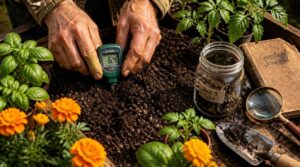
Before you pair any plants together, it helps to know what you’re actually working with. Your soil has a story — and a quick assessment tells you what it needs. Start with these five checks before you pick a single companion.
Pairing sun, water, and soil needs thoughtfully sets you up for success — and this companion planting guide for herbs walks you through exactly how those factors play out in practice.
Check Texture and Drainage
Grab a handful of soil and squeeze it. If it crumbles apart, you likely have loam or sandy texture — good news for drainage. If it holds a sticky clump, clay dominates.
Dig a hole, fill it with water, and time it. Well‑drained soil clears in under an hour. Slow drainage signals:
- High clay content
- Compaction below the surface
- Poor pore spacing
Fix compaction before planting companions.
The USDA Soil Textural Triangle defines the relative proportions of sand, silt, and clay that determine soil texture.
Measure Soil PH
Once you know how your soil drains, pH is the next puzzle piece.
A simple slurry test — soil mixed with deionized water in a 1:1 ratio — gives a reliable reading. Digital meters are faster, but calibrate them first.
Most vegetables thrive between pH 6.0 and 7.0. Outside that window, nutrients lock up, no matter how rich your soil looks.
Identify Nutrient Gaps
pH tells you what’s available. A soil test report shows what’s actually there.
Look for these four gaps first:
- Phosphorus below 20 ppm near pepper beds
- Magnesium under 0.25 meq/100 g in clay soils
- Iron deficiency when pH climbs past 6.5
- Sulfur dipping below 10 ppm in rain-heavy beds
Tissue testing recently expanded leaves confirms what’s missing right now.
Map Sunny Growing Zones
Once you know your nutrient gaps, light exposure becomes the next puzzle piece.
Your USDA hardiness zone tells you winter lows, but sun hours shape what actually thrives. Track which beds get six-plus hours daily — that’s true full sun. South-facing spots can run a zone warmer. Even small shade patterns shift which companions belong where.
Note Compacted Problem Areas
Before you plant a single companion, walk your beds after rain. If water pools for hours, soil compaction is likely slowing infiltration below the surface.
Push a pencil into the soil — resistance at 4–6 inches signals a restrictive layer blocking roots. Stunted, shallow growth confirms it.
These spots need deep-rooted plants like daikon radish before anything else.
Plant Nitrogen-Fixing Soil Builders
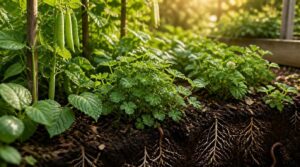
Some plants do more than just grow — they quietly rebuild your soil from the inside out. Nitrogen-fixing companions are your best starting point for creating soil that feeds itself season after season. Here are five ways to put these natural soil builders to work in your garden.
Beans Beside Heavy Feeders
Beans are quiet workers. As they grow, their roots form nodules that pull nitrogen from the air and lock it into the soil — right where hungry crops like tomatoes and corn need it most.
Plant beans alongside heavy feeders early in the season. Their roots also loosen compacted soil, opening channels that improve aeration and help neighbors feed more efficiently.
Peas Before Leafy Crops
Leafy crops like spinach and kale are hungry for nitrogen — but peas do the prep work first. Their roots develop rhizobia nodules that fix atmospheric nitrogen directly into the soil.
- Boosts nitrogen-enriched soil before planting
- Enhances microbial diversity naturally
- Mobilizes subsoil nutrients for shallow roots
- Works as green manure when chopped
Timing matters. Turn pea biomass in early.
Clover as Living Mulch
Clover pulls double duty in your garden. It spreads low across the soil, shading out weeds while fixing atmospheric nitrogen through root nodules — no synthetic input needed.
That ground-hugging mat also cuts evaporation and buffers soil temperature on hot days. When clover flowers, beneficial insects move in, turning your garden floor into a quiet, working community beneath your main crops.
Alfalfa for Green Manure
Alfalfa works deep. Its deep taproot breaks through compacted layers and draws minerals upward from several feet down.
When incorporated, it supplies up to 200 kg of nitrogen per hectare and boosts phosphorus availability for the next crop.
Three things it builds beneath your beds:
- Nitrogen reserves via symbiotic root bacteria
- Porous soil structure through deep root channels
- Microbial activity that unlocks bound phosphorus
Chop-and-drop Timing
Timing your chop-and-drop right makes all the difference. Cut legumes and mulch plants at post-bloom, before seeds set, to avoid volunteer seedlings next season.
In temperate gardens, late summer to early fall is your window. Soil is still warm, microbial activity peaks, and incoming rain drives breakdown fast — turning green manures into rich organic matter without wasting a single leaf.
Add Deep-Rooted Mineral Miners

Some plants do more than feed the soil — they reach deep into it and pull up what your garden is missing. Roots from comfrey, daikon, dandelion, and lavender can tap minerals several feet down that shallower plants simply can’t reach. Here’s how to put each one to work in your beds.
Comfrey for Potassium Mulch
Comfrey is one of the best effective accumulators you can grow. Its roots mine deep soil layers, pulling up potassium, calcium, and magnesium for crops.
Cut leaves and lay them around fruiting plants:
- Spread 2–3 inches thick as potassium-rich mulch
- Dilute comfrey tea 10:1 for root drenching
- Layer into compost to boost soil organic matter
- Repeat monthly during peak fruiting
Daikon Radish Loosens Soil
While comfrey feeds plants from above, daikon works quietly below. Its taproot drills 1–2 feet deep, breaking through compacted layers like a natural broadfork.
Those channels become organic aeration tunnels — improving drainage and reducing surface crusting. As roots decompose, they release subsoil nutrients upward and form crumb-like aggregates.
Sow daikon in late summer. Let winter do the rest.
Dandelion Pulls Calcium Upward
Daikon opens the soil. Dandelion pulls calcium upward — further than your crops can reach alone.
Its taproot taps subsoil reserves, acting as a natural nutrient pump. As leaves shed and decompose, calcium-rich litter returns to the surface, improving soil aggregation around neighboring crops.
- Grow at bed edges
- Chop before flowering
- Mulch around tomatoes
- Pair with comfrey
- Brew as foliar tea
Lavender Supports Dry Beds
Calcium rises with dandelion — but dry beds need a different kind of ally.
Lavender’s deep taproot channels subsoil moisture upward while improving drainage in sandy soils. Its scent deters slugs and beetles. Plant it as a drought-resilient border, and it pulls in pollinators for neighboring crops too — all with minimal watering once established.
Cut Leaves Before Flowering
Before deep-rooted plants flower, cut shading leaves to let light reach developing buds. Light interception drops fast in dense canopies.
- Target leaves that directly shade bud sites
- Improve airflow around flower clusters
- Cut during the first 2–4 weeks of bloom
- Keep 50–70% of leaf area intact
- Sterilize shears between cuts
Defoliation timing matters. Done right, it helps bud development without stressing the plant.
Protect Soil With Living Mulches

Bare soil doesn’t stay healthy for long — something always needs to cover it. Living mulches do that job while quietly feeding and protecting what’s underneath. Here are a few that work well between your rows and along garden edges.
Clover Between Vegetable Rows
White clover works like a living carpet between your vegetable rows. It fixes nitrogen through Rhizobium colonization, feeding nearby crops as it grows.
The dense mat cuts soil evaporation noticeably and keeps interrow moisture where roots need it.
It also draws in lady beetles and pollinators, creating beneficial insect habitats that quietly manage pest pressure across your whole bed.
Creeping Thyme Near Paths
Along garden paths, creeping thyme earns its place as more than decoration. This perennial ground cover tolerates light foot traffic without complaint and releases a clean herbal scent when brushed.
It’s a quiet defender too — its dense, low-growing mat locks surface moisture in and slows path-edge erosion. When it blooms, pollinators arrive.
Plant it in well-drained, sunny spots only.
Oats for Seasonal Cover
Oats are a workhorse cover crop — sow them in fall and they get to work fast. Germination hits within 7–10 days, and a dense mat forms before weeds get a foothold.
Their fibrous roots grip the soil through heavy rain, cutting erosion on slopes.
- Reach 2–4 feet tall before winter
- Provide 60–80% soil cover by early winter
- Scavenge excess nitrogen and phosphorus
- Winter-kill naturally, leaving ready mulch
- Support legume establishment as a nurse crop
Rye Before Spring Planting
Rye earns its spot as a spring soil shield. Sow it at 80–120 kg per hectare for dense, even coverage. Growth kicks in above 5°C, and biomass builds surprisingly fast.
| Variety | Sowing Time | Key Benefit |
|---|---|---|
| Winter Rye | Late fall | Deep roots, erosion control |
| Spring Rye | Early spring | Fast spring biomass |
| Cereal Rye | Fall or spring | Strong weed suppression |
Time termination before seed heads form — that single step prevents nitrogen tie-up. Roll, mow, or chop it down early, then incorporate the residue to lift your overall soil organic matter.
Keep Mulch Below Stems
Pulled-back mulch is everything here. Keep it 2–4 inches from stems to prevent rot pathogens from taking hold.
- Leave a clear stem ring for airflow
- Avoid mulch volcanoes against trunks or crowns
- Use a donut-shaped zone around each plant
- Recheck after rain and adjust if shifted
- Keep depth shallow near root crowns
Boost Microbes and Pest Balance

The plants you choose don’t just feed your soil — they shape the whole living community around it. Certain companions actively push back against pests while quietly feeding the microbes that keep your garden healthy. Here’s how to put that to work, one plant at a time.
Basil Near Tomatoes
Basil and tomatoes belong together — in the kitchen, yes, but first in the garden bed. Basil’s volatile oils deter aphids and whiteflies by masking tomato scent, disrupting pest host-finding cues before damage starts. Flowering basil draws pollinators that improve tomato fruit set and ripening. Shallow basil roots also cover the soil surface, retaining moisture and keeping tomato roots cooler on hot days. Harvest both at once — caprese-ready gardening at its simplest.
| Benefit | How It Works | Practical Outcome |
|---|---|---|
| Pest deterrence | Basil oils mask tomato host cues | Fewer aphids and whiteflies on leaves |
| Pollinator support | Basil flowers attract bees | Better fruit set and uniform ripening |
| Moisture retention | Shallow roots shade soil surface | Cooler tomato root zone in summer |
Marigolds for Nematodes
Basil controls what flies above. Marigolds work below.
French marigolds release nematicidal root exudates that suppress root-knot nematodes directly in your soil. Plant them as solanaceous crop borders around tomatoes and peppers, spaced 12–18 inches apart.
- French types outperform African marigolds for nematode suppression
- Root exudates disrupt nematode mobility underground
- Root turnover adds organic matter between seasons
- Dense borders create a reliable nematode sink
Nasturtiums as Aphid Traps
Marigolds guard the roots. Nasturtiums handle what’s above the soil line.
Plant them 3–5 feet from main crops as a dedicated trap zone. Aphids flock to nasturtium’s soft, peppery foliage first, concentrating pests where you can see and remove them easily.
Check trap plants weekly. Pull heavily infested stems before aphid populations spill over onto your vegetables.
Diverse Roots Feed Microbes
Trap crops draw pests away. Meanwhile, underground, something quieter is happening.
Every root type releases a different mix of sugars and organic acids. This variety feeds different microbes, building a richer soil microbiome. Mycorrhizal networks then extend outward, pulling phosphorus toward your crops. Glomalin, a microbial byproduct, binds soil particles together. More root diversity means more microbial partners — and a stronger, self-sustaining system beneath your feet.
Diverse roots feed diverse microbes, and diverse microbes build the self-sustaining soil your garden depends on
Flowers Attract Beneficial Insects
Flowers do more than look good — they pull beneficial insects straight to your beds.
Open blooms like yarrow and dill give hoverflies and bees easy nectar accessibility. Scent-driven plants like lavender guide parasitoid wasps from nearby areas. Dense groundcovers offer predator habitat between feeds.
- Dill and fennel for hoverfly nectar access
- Yarrow attracts diverse pollinator food sources
- Lavender draws in parasitoid wasps
- Alyssum helps bees and butterflies
- Low groundcovers shelter ground-dwelling predators
Follow a Seasonal Companion Plan
Companion planting works best when it follows the rhythm of the seasons. Each time of year calls for a different set of plants doing different jobs in your soil. Here’s how to build that plan from spring through winter and keep it running strong year after year.
Spring Pea and Clover Starts
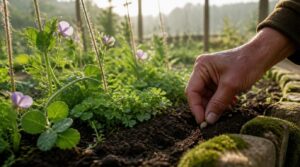
Early spring is prime time to get peas and clover in the ground.
Peas germinate at soil temperatures as low as 40°F, while clover kicks off between 50–65°F. Together, they smother weeds within 3–6 weeks.
Inoculate seeds before planting to boost nitrogen‑fixing nodule formation.
Their roots loosen compacted soil, and once chopped down, they hand off usable nitrogen to your next crop.
Summer Basil and Marigolds
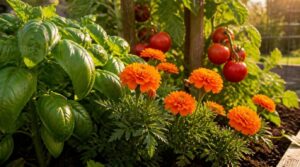
Once summer heat arrives, basil and marigolds become your bed’s power duo.
Plant them near tomatoes. Basil’s aroma masks pest scent cues, while shared foliage shades the soil, cutting moisture loss and supporting essential oil production.
- Marigolds supply pollinator nectar early in the season
- Basil deters hornworms and softens aphid pressure
- Their canopy reduces soil moisture evaporation
- Together, they sharpen pest deterrence around vegetables
Fall Cover Crop Sowing

As summer crops wind down, don’t leave soil bare — that’s an open invitation for erosion and nutrient loss.
Sow rye, oats, or field peas between late August and mid-September. Soil temperatures should stay above 5°C for good germination. A firm, raked seedbed helps seeds settle without crusting. Legume-grass mixes balance nitrogen fixation with rapid canopy cover, protecting your soil all winter long.
Winter Residue Protection

Once frost arrives, let your garden keep its coat on. Leaving stalks and leaf litter in place creates a natural insulating blanket that slows temperature swings and shields soil from erosion.
A 5–10 cm mulch layer goes further — it buffers moisture, prevents compaction, and gradually releases nutrients as it breaks down, setting up richer soil by spring.
Rotate Companions Each Season

Think of your garden as a living schedule. Shifting plant pairings each season prevents nutrient depletion and breaks pest cycles before they settle in.
- Rotate nitrogen fixers to beds that fed heavy feeders
- Vary canopy heights to limit opportunistic weeds
- Sequence flowering companions for pollinator succession
Different roots aerate different layers at the right time, keeping soil open and balanced year-round.
Frequently Asked Questions (FAQs)
What companion plants improve soil?
Legumes, deep-rooted miners, and living mulches are your best options. Beans, clover, and alfalfa fix nitrogen. Comfrey and daikon pull up minerals. Marigolds and basil balance pests and feed soil microbes.
What is the 70 30 rule in gardening?
The 70/30 rule splits your garden into 70% perennial structural plants and 30% seasonal accents. Reliable backbone plants do the heavy lifting. Annuals and bulbs fill the rest with color and variety.
What can I add to my garden soil to improve it?
Compost, aged manure, and nitrogen-fixing plants like beans and clover are your best starting points. They rebuild organic matter, feed soil microbes, and cycle nutrients back where roots can reach them.
How long before companions visibly improve soil health?
Within 4 to 12 weeks, you’ll notice real shifts. Groundcover cuts evaporation fast. Nitrogen fixers green up neighbors in 3–6 weeks. Deep roots open compacted layers by week
Do companion plants work in raised beds or containers?
Yes, companion plants work well in both. Raised bed drainage and loose soil help roots intermingle easily. In containers, choose small habit fixers like dwarf beans to avoid crowding limited root space.
Which companions grow well in shaded garden areas?
Shade doesn’t mean empty. Hostas, ferns, and ajuga thrive with minimal light. Lettuce and spinach extend harvests in partial shade. Sweet woodruff and epimedium cover bare ground beautifully beneath trees.
Can companion planting reduce the need for compost applications?
Yes — companion planting can meaningfully cut your compost needs. Nitrogen-fixing plants like beans and clover feed the soil naturally. Chop-and-drop organic matter keeps nutrients cycling without hauling in bags.
Conclusion
The less you interfere, the more your garden produces.
That’s not laziness—it’s the logic behind every step to improve garden soil with companions.
Each root, leaf, and bloom you plant becomes part of a system that feeds itself.
Nitrogen fixes. Minerals rise. Microbes multiply. You stop buying what the soil can already make.
Start with one companion. Watch what shifts. The garden doesn’t need managing—it needs a little trust.
- https://www.milorganite.com/blog/garden-landscape/what-is-companion-planting
- https://www.thrivelot.com/resources/how-to-use-dynamic-accumulators-in-your-garden
- https://pmc.ncbi.nlm.nih.gov/articles/PMC10184335
- https://www.canr.msu.edu/news/understanding-companion-trap-and-cover-crops-a-guide-for-home-gardeners
- https://dug.org/gardening-resources/companion-planting