
This site is supported by our readers. We may earn a commission, at no cost to you, if you purchase through links.

Most gardeners think about what they’re adding to their soil — compost, fertilizer, amendments. Fewer think about what their plants are doing to it.
Underground, roots are breaking compacted layers, fungal networks are routing minerals across species, and legumes are pulling nitrogen straight from the air. Some pairings can double nutrient uptake in low-fertility soil without a single bag of granules.
Choosing the right vegetable companions for healthy soil isn’t just about avoiding bad neighbors. It’s about building a living system where each plant actively improves conditions for the next. These combinations do exactly that.
Table Of Contents
- Key Takeaways
- Best Companions for Healthy Soil
- Legumes That Feed Neighboring Vegetables
- Deep-Rooted Vegetables That Loosen Soil
- Living Mulches That Protect Garden Beds
- Cover Crops for Vegetable Companions
- Aromatic Herbs That Support Soil Health
- Flowers That Protect Vegetable Roots
- Three Sisters Soil-Building Method
- Root-Depth Pairings for Better Beds
- Seasonal Soil Companion Planting Plan
- Frequently Asked Questions (FAQs)
- What is the 70 30 rule in gardening?
- What veggies like poor soil?
- What are good companion planting pairs for a vegetable garden?
- What is the best soil combination for vegetables?
- Can companion planting replace synthetic fertilizers entirely?
- How do soil microbes interact with companion plant roots?
- Which companions work best in raised bed gardens?
- Does companion planting help with waterlogged or clay soils?
- How soon do soil benefits appear after companion planting?
- Conclusion
Key Takeaways
- Legumes, like beans, peas, and clover pull nitrogen straight from the air and deposit it into your soil, replacing what synthetic fertilizers would otherwise need to provide.
- Deep‑rooted vegetables, like daikon radish and parsnips physically break up compacted soil layers, leaving behind channels that improve drainage and give future roots an easier path down.
- Underground fungal networks connect neighboring plants, routing water and minerals between roots so a young seedling can tap into an established plant’s resources almost immediately.
- Living mulches like squash and clover do triple duty — blocking weeds, cutting moisture loss, and anchoring soil against erosion without any extra effort on your part.
Best Companions for Healthy Soil

Some plant pairings do more for your soil than any bag of fertilizer ever could. The right companions work underground — fixing nitrogen, breaking up compaction, and cycling nutrients back where your vegetables need them. Here are the best combinations to start with.
If you want a full season’s worth of these soil-building duos, this summer garden companion planting guide lays out which crops thrive side by side.
Soil-building Pairings
Some of the most productive gardens don’t rely on synthetic inputs — they rely on the right plant partnerships.
- Legumes fix atmospheric nitrogen, feeding neighbors through root nodules
- Deep-rooted species break compacted layers and create biopores
- Active accumulators mine trace minerals and return them as mulch
Research shows that mixed species rhizosphere benefits can double nutrient uptake in low‑fertility soils.
These pairings drive microbial cooperation, strengthen soil aggregate formation, and improve overall soil fertility naturally.
Root-sharing Benefits
Below the surface, plants don’t just coexist — they cooperate. Mycorrhizal fungal networks thread through the soil, connecting roots across species, trading carbon for minerals and routing water where it’s needed most.
Underground, mycorrhizal networks connect roots across species, trading carbon for minerals and water
A young seedling planted near an established plant can tap into that network immediately, which dramatically speeds establishment. During dry spells, drought tolerance sharing through these connections helps buffer the whole bed against stress.
Nutrient Cycling Basics
What those fungal networks are really doing is keeping nutrients moving. Microbial mineralization breaks down dead organic matter into forms roots can actually absorb — nitrate, ammonium, phosphate. Without this constant microbial activity, nutrients lock up in the soil and plants go hungry regardless of what you’ve added.
Organic matter turnover drives the whole process.
Beginner-friendly Combinations
Start simple. Two or three plants sharing a bed can do more for your soil than a full fertilizer program. Try fast greens with root crops — lettuce and radishes, for example — to cover bare soil quickly while building texture below.
- Pair peas with leafy greens for steady nitrogen
- Tuck clover between rows as a living nitrogen source
- Plant basil near tomatoes to attract beneficial insects
- Add radishes between slow growers to open compacted soil
- Use squash as ground-level moisture cover
Legumes That Feed Neighboring Vegetables

Legumes are quiet workhorses in the garden — they pull nitrogen from the air and leave it in the soil for whatever’s growing nearby. The right pairing can genuinely change how well your other vegetables perform without a bag of fertilizer in sight. Here are the legume companions worth knowing.
Bush Beans Near Corn
Bush beans quietly do something impressive: they pull nitrogen from the air and deposit it into the soil around your corn, contributing 20 to 40 pounds of nitrogen per acre. That’s free fertilizer, built right into your planting plan.
Beans also shade the ground between corn rows, cutting moisture loss and keeping roots cooler on hot days.
Peas With Leafy Greens
Peas and leafy greens are one of those combinations that just work. Peas fix nitrogen in the soil as they grow, quietly improving fertility for spinach and lettuce planted nearby. Both crops thrive in cool seasons, and their shared canopy helps retain soil moisture.
Harvest greens early so pea vines get the sun they need.
Clover Between Rows
Between rows of vegetables, clover earns its place on three fronts:
- It fixes atmospheric nitrogen through root nodules, steadily feeding neighboring crops
- Its dense mat suppresses weeds by blocking light to bare soil
- It builds beneficial microbe networks that improve soil porosity and nutrient flow
Ladino or white clover spreads quickly via stolons. Mow it to 2–4 inches to keep it productive without shading your crops.
Vetch Before Heavy Feeders
Hairy vetch is one of the best investments you can make before planting corn, squash, or tomatoes. It fixes up to 60 pounds of nitrogen per acre when properly inoculated, then hands that fertility straight to your heavy feeders.
Inoculate your seed before sowing. Without compatible rhizobia, nodules won’t form efficiently and fixation drops considerably.
| Growth Stage | Key Benefit | Management Action |
|---|---|---|
| Fall seeding | Establishes deep roots | Sow 4–6 weeks ahead |
| Overwintering | Protects soil from erosion | Leave undisturbed |
| Early spring | Warms soil, aids germination | Monitor regrowth |
| Pre-flowering | Peak nitrogen fixation | Terminate here |
| Post-termination | Mulch retains 20% more moisture | Roll or crimp residue |
Terminate at pre-flowering to capture peak nitrogen before it locks into seed production. The leftover mulch then reduces soil evaporation and keeps the seedbed ready for whatever heavy feeder comes next.
Planting Distance Tips
Getting legume spacing right makes the difference between a soil-building partnership and root competition.
- Bush beans: 2–4 inches apart, rows 36–48 inches
- Peas: 2–4 inches apart, rows 18–24 inches
- Clover: broadcast or 6–12 inch spacing between rows
- Vetch: sow densely, then terminate before neighboring crops emerge
- Carrots beside beans: stagger rows 12–18 inches apart
Deep-Rooted Vegetables That Loosen Soil
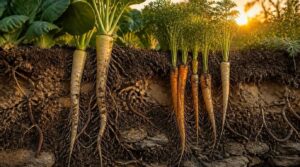
Some vegetables do more than feed you — they work underground to fix problems you can’t see. Deep-rooted crops are nature’s own tillage, breaking up compacted layers and leaving behind channels that improve drainage for everything growing nearby. Here are the best ones to add to your beds.
Timing your plantings right makes all the difference — this guide to winter garden cover crop options walks you through when to sow and terminate for the best results.
Daikon Radishes for Compaction
Think of daikon radish as a natural subsoiler. Its taproot drives several feet down, mechanically breaking through hardpan that hand tools can’t easily reach.
When frost kills the plant, those channels remain — open conduits that improve vertical water infiltration and give spring roots a ready-made path through soil that was once locked tight.
Carrots Beside Shallow Roots
Carrots extend down past six inches in loose soil — and that makes them natural partners for shallow-rooted onions, which stay in the top few inches. The two occupy different soil layers without competing.
Keep carrot rows 12–18 inches apart, thin seedlings to two or three inches, and avoid excess nitrogen, which drives leafy tops at the expense of root depth.
Parsnips Opening Dense Beds
Parsnips need 12–18 inches of loose soil to grow straight. In dense beds, roots fork and twist rather than push down cleanly.
Before sowing, remove rocks and break up any hardpan. Target a soil pH of 6.0–7.5 with organic matter above 3%.
Three steps for straighter roots:
- Sow shallow — 0.6–2.0 cm deep
- Thin to 6–8 inches apart
- Water evenly to prevent forking
Potatoes Improving Soil Texture
Potatoes do more than fill your pantry. Each season, their vines and roots leave behind substantial organic residue that breaks down into stable humus — quietly improving your soil’s crumb structure.
Potato residue decomposition feeds soil microbes, which in turn build the aggregates that give good garden soil its loose, workable feel. Tuber harvest also physically aerates compacted layers, creating lasting pore spaces for drainage and future roots.
Biopores for Future Roots
When deep-rooted vegetables die back, their decayed root channels leave behind biopore networks — vertical tunnels that your next crop’s roots can follow straight into the subsoil. These pores aren’t empty.
Their walls accumulate beneficial microbes and nutrients, giving incoming roots a ready-made, enriched pathway.
Minimize tillage to keep those channels intact.
Living Mulches That Protect Garden Beds
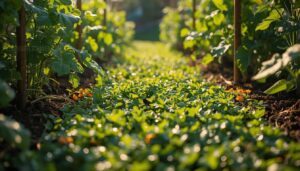
Some plants do double duty by covering bare soil the way mulch does — only they’re alive and growing.
Instead of straw or wood chips, you use low-spreading plants that block weeds, hold moisture, and protect roots all season long.
Here are the best living mulches to pair with your vegetable beds.
Squash Shading Bare Soil
Squash doesn’t just produce food — its broad leaves act as a living mulch, blanketing bare soil with dense shade that slows weed emergence and cuts evaporation by up to 20 percent.
- Soil temperature stays more stable under that canopy
- Microbial activity in the top layer benefits from reduced fluctuation
- Moisture retention improves noticeably, even in hot climates
Pumpkins Suppressing Weeds
Pumpkin vines don’t just sprawl — they work. Within 3 to 5 weeks after transplanting, the canopy closes enough to cut weed emergence by up to 60 percent.
| Factor | Effect | Timing |
|---|---|---|
| Canopy closure | Blocks light to weed seedlings | 3–5 weeks post-transplant |
| Dense vine cover | Reduces weed establishment | Mid to late summer |
| Post-harvest residue | Suppresses germination | Into following season |
That living mulch also locks in soil moisture, giving your vegetables a steadier growing environment all season.
Clover as Groundcover
Clover might be the hardest-working groundcover crop you’re not using. Tucked between rows, white or crimson clover forms a dense mat that crowds out weeds without chemicals:
- Releases roughly 8 mg nitrogen per square meter daily
- Draws pollinators to nearby flowering vegetables
- Reduces soil moisture evaporation through consistent canopy shading
- Fibrous roots improve drainage and prevent surface crusting
Moisture-saving Plant Layers
Think of plant layers as nature’s own irrigation strategy. When you stack squash foliage over clover groundcover, you create a two-tier moisture shield that keeps soil shaded and cool from above while the living mat below slows evaporation at ground level.
A 2–4 inch organic mulch beneath both layers locks that moisture in further.
Erosion Control Benefits
Every garden bed on a slope is one heavy downpour away from losing its best topsoil. That’s where living mulches earn their keep. Dense squash and clover foliage acts as a ground-level buffer, catching rainfall before it can dislodge soil particles and carry them downhill.
Five ways living mulches control erosion:
- Root networks anchor soil, preventing displacement during heavy rain
- Biopores speed up infiltration, reducing surface runoff on sloped beds
- Leaf canopy slows rainfall impact, cutting splash erosion
- Groundcover crops shield soil from wind year-round
- Organic matter from decomposing foliage improves soil structure and porosity
Cover Crops for Vegetable Companions

Cover crops do more than fill empty beds between seasons — they actively build the soil your vegetables grow in. The right ones can fix nitrogen, pull up phosphorus, and add bulk organic matter before you ever put a seedling in the ground. Here are five worth planting alongside or before your vegetables.
Crimson Clover for Nitrogen
Few cover crops earn their place the way crimson clover does. Planted in fall, it fixes 70 to 150 pounds of nitrogen per acre through root nodules, building a genuine nitrogen credit for spring vegetables.
As residues decompose, nutrients are released gradually — feeding lettuce, radishes, or greens without the leaching losses that bare soil invites.
Buckwheat for Phosphorus
Nitrogen sets the table — but phosphorus builds the bones. Buckwheat earns its place by mobilizing bound phosphorus through rhizosphere organic acids that dissolve minerals most roots can’t reach. Planted in summer, it drives soil P cycling in weeks, not seasons.
- Exudes acids that release fixed phosphorus
- Forms mycorrhizal associations that extend root foraging
- Pulls phosphorus into biomass before releasing it through decomposition
- Improves soil fertility after incorporation
- Works best where soil P is moderate to high
Winter Rye for Biomass
Where buckwheat hands off phosphorus, winter rye takes over as a serious biomass machine. Under temperate conditions, it produces 6–12 tons of dry matter per hectare — enough bulk to transform your soil structure and suppress weeds through sheer ground coverage.
Seed it at 90–120 kg per hectare in autumn and let it work.
Austrian Winter Peas
Austrian winter peas do something winter rye can’t — they fix nitrogen as they grow. These vining legumes work with Rhizobium bacteria in their root nodules to pull nitrogen from the air and deposit it where your next crop can use it.
Pair them with small grains to keep the vines upright and simplify incorporation.
Here’s what makes them worth planting:
- They fix nitrogen comparable to commercial fertilizer rates
- Dense vines reduce soil erosion through cold months
- Decomposing biomass improves soil tilth and moisture retention
- Flowers attract wildlife and support early pollinators
- Break pest cycles when rotated before heavy feeders
Sow in early fall. They’ll overwinter, resume growth in spring, and leave your beds richer than they found them.
When to Cut Covers
Once Austrian winter peas finish flowering, the clock starts. That’s your signal.
Cut covers at 6–8 inches before they shade nearby crops, or right after flowering peaks to lock in maximum biomass without letting seeds set.
Wait 1–2 weeks before planting into the residue — decomposing matter needs time to release nitrogen without creating allelopathic effects that slow seedlings.
Aromatic Herbs That Support Soil Health

Aromatic herbs do more than season your food — they actively work to protect and support the plants growing beside them. A handful of well‑chosen herbs can reduce pest pressure, draw in beneficial insects, and keep your vegetable beds healthier with almost no extra effort.
Here are the best ones to plant alongside your vegetables.
Basil Near Tomatoes
Few plant partnerships are as practical as basil near tomatoes. Basil’s strong aroma actively deters aphids, whiteflies, and tomato hornworms — pests that target tomato foliage and fruit.
Space plants 12 to 18 inches apart for good airflow.
Basil also shades the soil, slowing moisture evaporation and suppressing weeds — quiet benefits that add up fast.
Dill Attracting Beneficial Insects
Dill earns its place by pulling in the insects that do your pest control for you. Its umbrella-shaped flower heads are nectar-rich landing pads for hoverflies, lacewings, and parasitic wasps — all of which prey on or lay eggs inside common garden pests.
Sow a fresh patch every few weeks to keep blooms going all season.
Rosemary Deterring Pests
Rosemary works like a scented fence around your beds. The oils it releases — camphor and 1,8-cineole — disrupt pest sensory cues, making it harder for cabbage moths, whiteflies, and carrot flies to locate host plants.
- Plant rosemary as a border hedge around brassica beds
- Trim leaves regularly to keep essential oil levels fresh
- Pair with other aromatics for layered protection
- Use potted rosemary for mobile, flexible placement
- Expect reduced egg-laying, not complete elimination
Garlic Beside Brassicas
Garlic brings more than flavor to the garden. Its sulfur-based compounds and allicin confuse cabbage moths and aphids, making it harder for them to locate brassicas.
Plant it snugly beside cabbage, broccoli, or kale — the root zones coexist well, so you won’t sacrifice soil space. The result is cleaner head development with less chemical intervention.
Pest Pressure Reduction
Aromatic herbs don’t just flavor your cooking — they quietly run pest suppression duty across the whole bed. Basil, rosemary, dill, and garlic together create overlapping scent profiles that confuse and repel a surprising range of insects. That kind of layered pest control is harder for pests to adapt around than any single-species approach.
Dill pulls in lacewings and ladybugs, giving you natural predator support without lifting a finger.
Flowers That Protect Vegetable Roots

Flowers do more than brighten up your garden — the right ones actively defend your vegetable roots from pests, attract the insects you want, and keep soil life thriving.
Choosing them strategically makes a real difference in how healthy your beds stay season after season.
Here’s a look at the best flowering companions and exactly how to use them.
Marigolds Against Nematodes
Few flowers earn their place in a vegetable bed the way marigolds do. Their roots release alpha terthienyl, a compound that penetrates nematode tissue and triggers oxidative stress — in effect poisoning root-knot and lesion nematodes from the inside out.
Plant them as border rows before susceptible crops, and that suppressive effect lingers in the soil even after the plants decompose.
Nasturtiums as Trap Crops
Nasturtiums work differently from marigolds — instead of killing pests in the soil, they pull them away from your crops entirely. Their scent and sap act as a sacrificial zone strategy, drawing aphids, cabbage whites, and beetles toward the nasturtiums first.
Plant them along perimeter borders, upwind when possible; pests intercept the trap before reaching your tomatoes or brassicas.
Borage for Pollinators
Borage pulls pollinators in fast. Its bright blue star-shaped blooms and high nectar concentration keep honey bees, bumblebees, and solitary bees working in your garden longer each day.
That increased activity means better fruit set on nearby tomatoes and squash. Plant it in full sun near heavy-fruiting crops — the bloom timing runs late spring through midsummer, right when your garden needs it most.
Calendula Supporting Soil Life
While borage works above ground, calendula earns its keep below it. Its branching root network creates microchannels that improve aeration and break up light compaction — giving neighboring vegetable roots an easier path through the soil.
Here’s what calendula contributes to your soil life:
- Rhizosphere bacteria: Root exudates feed beneficial microbes that suppress soil pests.
- Organic matter: Shed leaves and stems decompose quickly, boosting microbial activity.
- Moisture retention: Dense foliage shades the soil surface, slowing evaporation.
That active soil microbiome underneath calendula keeps nutrient cycling moving between crops.
Flower Placement Tips
Where you place companion flowers shapes everything from pest pressure to pollinator access.
Tuck trap crops like nasturtiums at bed edges, and cluster nectar-rich insectary plants near vegetable rows. Stagger bloom heights so shorter flowers don’t vanish behind foliage.
Group moisture-loving varieties near irrigation, drought-tolerant ones further out.
That spatial logic turns a pretty border into a working pollinator habitat.
Three Sisters Soil-Building Method
The Three Sisters — corn, beans, and squash — are one of the oldest and most effective soil-building combinations in North American gardening history. Each plant plays a specific role, and together they create a self-supporting system that feeds the soil while it feeds you. Here’s how each piece of the trio works.
Corn as Living Trellis

Corn is one of the oldest living trellises in agriculture. Reaching 6 to 8 feet tall, each stalk gives climbing beans a single, sturdy vertical anchor — no hardware required.
Here’s why it works so well:
- Vertical growth efficiency keeps vines off the ground, improving airflow
- Tall stalks create microclimate shade at the base, holding soil moisture
- Planting timing matters — sow corn a few weeks early so stalks are strong before beans climb
- The layered canopy maximizes space, letting you grow more per square meter
That staggered start is key. Beans planted too soon compete with young corn for light, which slows both crops down.
Beans Fixing Nitrogen

While corn earns its place as the scaffold, beans are doing quiet chemistry below ground. Their roots host Rhizobium bacteria in small nodules that pull nitrogen straight from the air and convert it into a form plants can use.
Low soil nitrogen actually triggers more fixation. That’s the cycle working in your favor.
Squash Conserving Moisture

Squash earns its place in the Three Sisters not by climbing or fixing nitrogen, but by shading bare soil. Those broad leaves act like a living mulch, cutting soil evaporation by up to 50 percent. That moisture stays in the root zone where corn and beans need it most — no sprinkler required.
Balanced Canopy Layers

The Three Sisters stack the garden vertically on purpose. Corn rises above everything, intercepting rain and diffusing light downward. Beans fill the middle tier. Squash spreads low and wide.
- Microhabitat diversity increases as each layer hosts different insects and soil organisms
- Canopy spread softens raindrop impact, reducing soil crusting
- Lower layers stay cooler and more humid, aiding germination
- Continuous ground cover limits weed pressure and locks in moisture
Traditional Planting Layout

The simplest layout runs north-to-south rows, placing corn at the back so it doesn’t shadow shorter plants. Beans go beside it, squash spreads forward.
Keep central pathways clear — at least 18 inches — so you can reach every plant without compacting the soil.
Stagger your planting dates slightly to avoid everything competing for light at once.
Root-Depth Pairings for Better Beds

Not every root grows the same way, and that difference is actually one of your best tools for building healthier beds. Pairing plants by root depth lets them share space underground without fighting over the same nutrients and water. Here’s how a few smart combinations can do exactly that.
Onions With Carrots
Onions and carrots are one of those pairings that quietly do a lot beneath the surface. Onion sulfur compounds disrupt soil pests while stimulating microbial activity around carrot roots.
Their contrasting root depths — shallow onions, deep carrots — reduce competition and support balanced nutrient uptake.
Together, their foliage retains moisture and suppresses weeds between harvests.
Lettuce Under Tall Crops
Lettuce thrives in the dappled shade created by corn or sunflowers. That partial cover drops soil temperatures by up to 10°F at peak sun, slowing moisture loss by as much as 40 percent.
Plant lettuce 12 to 18 inches away from tall companions — close enough to benefit from the microclimate, but with room for roots to access moisture freely.
Radishes Between Slow Growers
Shade-loving lettuce gets its shelter from tall neighbors, but radishes work differently — they earn their place by moving fast.
Maturing in 25 to 40 days, they slip in and out before slow growers like parsnips or lettuce claim the space.
That speed means no nutrient competition, just quick ground cover that suppresses weeds and locks in moisture.
Tomatoes With Shallow Herbs
Tomatoes are deep feeders, but their shallow roots still fill the upper soil layer. That’s where herbs like basil, chives, and thyme earn their place.
Planted close, they create a herb microclimate that conserves moisture, softens surface crusting, and attracts beneficial insects — all without competing for the nutrients tomatoes actually need.
Reducing Nutrient Competition
Think of root depth as resource partitioning in action. When deep feeders like carrots and tomatoes grow beside shallow‑rooted onions or herbs, they’re drawing from different soil layers — so real competition rarely develops.
Stagger harvest timing, run a quick soil test and apply fertilizer where each crop actually roots. That simple approach prevents nutrient uptake spikes and keeps the whole bed cycling steadily.
Seasonal Soil Companion Planting Plan

Good soil doesn’t happen in one season — it builds across the whole year. Each season brings a different set of companion plants that keep your beds working even when you’re not. Here’s how to plan it out, season by season.
Spring Peas and Greens
Spring is pea season. Once soil temperatures sit between 40 and 75°F, sow directly and don’t wait. Pair peas with these shade-tolerant greens that thrive in the same cool window:
- Spinach
- Arugula
- Lettuce
- Swiss chard
- Kale
Peas fix nitrogen as they grow, quietly enriching soil for the greens right beside them.
Summer Beans and Corn
When soil hits 60°F, it’s time to plant corn first. Sow beans once stalks reach 6–12 inches tall. Beans fix 20–40 lbs of nitrogen per acre, feeding the corn naturally. Their dense foliage shades soil, retains moisture, and creates a physical pest barrier against beetles and moths.
| Crop | Key Benefit |
|---|---|
| Corn | Living trellis support |
| Beans | Nitrogen fixation |
| Together | Weed-suppressing canopy |
Harvest both within the same seasonal window.
Fall Radish Cover Crops
After beans and corn wrap up summer, fall radish cover crops step in to keep your soil working. Forage radishes drill taproots 12–24 inches deep, cracking compacted layers and forming biodrill channels that future roots will follow.
They establish fast — a dense canopy in 3–4 weeks — suppressing early fall weeds naturally. Come spring, decomposing residue releases nitrogen and sulfur into the bed.
Winter Rye Protection
When the garden goes quiet, winter rye gets to work. Sow it after your fall radishes, and it establishes fast, forming a dense protective mat that shields bare soil from wind and rain erosion through freeze-thaw cycles.
It also scavenges residual nitrogen, locking it into plant tissue before winter leaching can strip it away. Come spring, terminate it and let that biomass feed your next crop.
Year-round Soil Renewal
Healthy soil isn’t a destination — it’s a continuous cycle you manage all year long.
- Spring: Plant nitrogen-fixing peas and clovers to recharge beds.
- Summer: Use squash and beans for living mulch and nitrogen input.
- Fall: Sow daikon radishes to break compaction.
- Winter: Let rye lock nutrients and prevent erosion.
Keep soil covered. Keep it fed.
Frequently Asked Questions (FAQs)
What is the 70 30 rule in gardening?
The 70/30 rule seems to promise more by asking you to plant less. Seventy percent backbone plants hold year-round structure; 30 percent seasonal fillers add color — balancing garden form with variety while reducing maintenance work.
What veggies like poor soil?
Green beans, beets, kale, radishes, and potatoes all handle poor or compacted soil well. Most fix or need little nitrogen, making them reliable choices when soil fertility is low.
What are good companion planting pairs for a vegetable garden?
Some of the best pairings include beans with corn, peas with leafy greens, and daikon radishes beside shallow-rooted crops. Each pair improves soil structure, cycles nutrients, or reduces competition between roots.
What is the best soil combination for vegetables?
Loam with balanced sand and clay works best. Aim for a pH of 0 to 0 and roughly 40 percent organic matter. Good drainage and regular compost keep nutrients available and roots healthy.
Can companion planting replace synthetic fertilizers entirely?
Not entirely — but closer than you’d think. Legumes and cover crops can dramatically cut your fertilizer needs. Heavy feeders may still need a boost, especially in drought or compacted soil.
How do soil microbes interact with companion plant roots?
Soil microbes work like a hidden service network beneath your feet. Mycorrhizal fungi extend hyphae outward from roots, pulling in phosphorus. Rhizosphere bacteria fix nitrogen and suppress pathogens before they establish.
Which companions work best in raised bed gardens?
Raised beds drain fast but can starve.
Legumes like bush beans and peas fix nitrogen while sharing small spaces efficiently. Clover groundcover conserves moisture and feeds neighboring roots year-round.
Daikon radishes loosen compacted soil beneath.
Does companion planting help with waterlogged or clay soils?
Yes, companion planting genuinely helps with clay drainage solutions.
Deep-rooted plants like daikon radish create root-driven biopores, improving water infiltration and relieving compaction.
Legumes enrich the soil while their roots open dense, waterlogged beds.
How soon do soil benefits appear after companion planting?
You’d think soil takes years to respond. It doesn’t. Microbial activity shifts within 2–4 weeks, nitrogen becomes available within a month, and moisture retention improves noticeably in that same first growing season.
Conclusion
Soil doesn’t forget what you plant in it. Every root channel, every nitrogen deposit, every fungal thread left behind becomes an inheritance for the next crop.
The right vegetable companions for healthy soil aren’t just growing together — they’re quietly rebuilding what was there before you arrived.
Start with one pairing. Watch what changes.
A garden that feeds itself is less about adding more and more about choosing better. That choice starts beneath the surface.
- https://hgic.clemson.edu/plant-partners-5-benefits-of-companion-planting
- https://www.groworganic.com/blogs/articles/nitrogen-fixing-cover-crops
- https://gardening.stackexchange.com/questions/1356/do-legumes-provide-nitrogen-to-their-companions
- https://www.gardenia.net/guide/nitrogen-fixing-plants-to-enrich-soil
- https://reencle.co/blogs/news/companion-planting-vegetables