
This site is supported by our readers. We may earn a commission, at no cost to you, if you purchase through links.

I once watched a bed of corn, beans, and squash outperform its monocropped neighbor by every measure that counts—moisture retention, weed pressure, harvest weight. The beans were feeding the corn nitrogen through Rhizobium bacteria while the squash leaves shaded the soil cool enough to stop evaporation in its tracks. Nobody planted a fertilizer bag. Nobody sprayed for weeds.
That’s the quiet power behind soil-building companion plant combinations: plants doing each other’s jobs so you don’t have to.
Some pairings fix nitrogen, others mine calcium and potassium from deep subsoil, and a few simply confuse the pests hunting your tomatoes. Get the combinations right, and your garden starts building fertility on its own, season after season.
Table Of Contents
Key Takeaways
- Strategic plant pairings like the Three Sisters (corn, beans, squash) build soil fertility through nitrogen fixation, moisture retention, and root stratification—eliminating the need for synthetic fertilizers.
- Dynamic accumulators like comfrey, dandelions, and nettles mine deep subsoil minerals and return them to the topsoil through chop-and-drop, running a free nutrient cycle season after season.
- Pest suppression works best through scent masking and trap cropping—marigolds cut nematode pressure by up to 90%, while basil and nasturtiums confuse insects before they ever reach your crops.
- Some combinations actively damage soil health—fennel releases allelopathic compounds that stunt neighbors, and pairing nightshades like tomatoes and potatoes accelerates shared disease spread through the soil.
Best Soil-Building Companion Plant Combinations

Some plant combinations do more than just coexist — they actively build the soil around them. The pairings below are rooted in real biological mechanisms, not garden folklore. Here are five combinations worth putting to work in your beds.
For a deeper look at how nitrogen-fixers, deep-rooted dynamos, and ground-cover allies team up underground, check out this guide to companion plants that improve soil health.
Corn, Beans, and Squash
The Three Sisters aren’t just folklore — they’re a masterclass in symbiotic soil-building. Corn stalks give beans something to climb. Beans fix atmospheric nitrogen directly into the soil. Squash sprawls low, shading out weeds and locking in moisture.
This intercropping method results in higher yields than monocrop systems.
Root depth stratification across all three reduces competition and erosion. Together, they support microbial diversity and deliver a nutritionally complete harvest — complementary amino acids included.
Tomatoes, Basil, and Clover
Basil earns its spot beside tomatoes through volatile aroma masking — its essential oils confuse pest insects searching for that distinctive tomato scent. Plant it 12 inches from the stem.
White clover fills the gaps below, retaining soil moisture and pulling in predatory insects. When basil flowers, pollinators move straight to your tomatoes. Harvest both crops together — they’re already paired in the kitchen.
Cucumbers, Nasturtiums, and Borage
Cucumbers thrive with the right crew. Nasturtium scent masks cucumber odors, confusing beetle pests before they locate your vines. Plant 2–3 per row. Borage anchors each bed corner, drawing bees that improve fruit set without crowding the vines.
- Nasturtiums deter cucumber beetles through scent masking
- Borage returns trace minerals via chop-and-drop
- Nasturtium foliage suppresses weeds and retains soil moisture
- Borage blooms extend pollinator activity all season
- Both flowers make edible garnish with fresh cucumbers
Brassicas, Dill, and Chamomile
Brassicas attract pest pressure fast. Dill’s sharp aroma confuses cabbage moths, reducing egg-laying on broccoli and kale. Chamomile pulls in parasitoid wasps that hunt aphids and caterpillars directly.
| Companion | Key Benefit |
|---|---|
| Dill | Repels cabbage moths |
| Chamomile | Attracts parasitoid wasps |
| Both | Support beneficial insects |
| Chamomile | Conserves soil moisture |
| Dill | Tolerates same soil pH |
Fruit Trees and Comfrey
Plant comfrey within 1–2 meters of your drip line and let it work quietly beneath your trees.
Its deep roots practice subsoil mineral mining, pulling potassium and phosphorus upward. Then you chop the leaves down, and decomposition does the rest.
Four reasons this guild earns its space:
- Chop-and-drop feeds the root zone with repeating nutrient pulses
- Leaf mulch improves soil porosity and reduces surface crusting
- Flowers draw pollinators, boosting fruit set naturally
- Dense ground cover stabilizes orchard microclimate through drought
Nitrogen-Fixing Pairings for Heavy Feeders
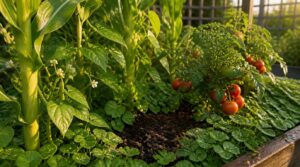
Heavy feeders like corn, tomatoes, and leafy greens pull nitrogen from the soil fast — sometimes faster than you can replenish it. That’s where nitrogen-fixing companions earn their place in your garden. Here are the pairings that actually move the needle.
Beans Beside Corn
Corn is a heavy feeder — it pulls nitrogen from the soil fast. Beans solve that problem without a bag of fertilizer in sight.
Timing bean rotations alongside corn fits well with a seasonal herb gardening calendar, helping gardeners coordinate nitrogen-friendly crop schedules throughout the year.
Through symbiotic nitrogen fixation, Rhizobium bacteria in bean root nodules convert atmospheric N₂ into plant-available ammonium, feeding corn steadily through the season. Their canopy diversity also reduces soil erosion and locks in moisture where bare ground otherwise wouldn’t.
Peas Near Leafy Greens
Peas punch above their weight in a cool-season bed. Their root nodules fix atmospheric nitrogen, and nitrogen transfer efficiency here is real — leafy greens like spinach and lettuce green up faster with less synthetic fertilizer.
Three things to manage well:
- Trellis peas vertically to free ground space
- Place greens on the north side to minimize shading
- Time succession so greens establish as peas peak
Clover Under Tomatoes
Clover is fundamentally a free fertilizer system tucked right beneath your tomato canopy. Subterranean and white clover varieties stay low, fix atmospheric nitrogen through rhizobia root nodules, and release some of that nitrogen directly into the surrounding soil.
The dense mat suppresses weeds, retains moisture, and shifts microbial activity in ways that support tomato root health — quietly doing several jobs at once.
Vetch Before Summer Crops
Hairy vetch is basically a nitrogen bank you open in spring. Terminated at flowering, it contributes 60–120 kg N per hectare through gradual mineralization — enough to meaningfully reduce synthetic fertilizer inputs for corn or tomatoes.
Rolling or mowing preserves topsoil moisture and leaves residue that suppresses weeds. Aim for 2–3 tons dry matter before termination to hit that sweet spot.
Alfalfa Around Perennials
Alfalfa is the quiet workhorse of perennial beds. Its deep root porosity loosens compacted soil while nitrogen fixation steadily enriches the root zone of neighboring plants over multiple seasons.
Use it as chop-and-drop mulch to lock in moisture and cycle nutrients back to the surface. Here’s what that delivers:
- Improved perennial nutrient stability season after season
- Reduced soil crusting through organic matter buildup
- Natural soil pH modulation via decomposing residues
- Consistent moisture retention during summer heat
Dynamic Accumulators That Feed Soil

Some plants don’t just grow — they work the soil while they’re at it, pulling minerals up from deep below and cycling them back to the surface where your crops can actually use them. These are your adaptable accumulators, and a handful of them belong in almost every serious garden bed. Here’s how each one earns its keep.
Comfrey Chop-and-Drop Mulch
Chopping comfrey and leaving it where it falls is low effort with outsized returns. Fresh leaves break down within weeks, releasing potassium steadily to fruiting crops. That decomposition fuels microbial activity and pulls earthworms into the topsoil — signs of your soil gaining vitality. Aim for 2–4 cm living mulch depth and reapply every few weeks to keep nutrient cycling running.
| Comfrey Benefit | Soil Impact |
|---|---|
| Potassium release | Helps fruiting crops and stress tolerance |
| Earthworm habitat | Drives microbial activity and humus formation |
Yarrow for Nutrient Cycling
Yarrow works differently than comfrey — quieter, but just as methodical. Its deep taproots reach below the plow line, pulling calcium, potassium, and magnesium up from subsoil layers your other crops can’t touch.
Chop it down, leave it in place, and those minerals transfer directly into the topsoil as the foliage breaks down. That’s mineral mobilization doing exactly what you need it to.
Dandelions as Soil Miners
Most gardeners yank dandelions out on sight. That’s a mistake.
Their deep taproots drill through compacted layers, pulling calcium, potassium, and phosphorus up from subsoil horizons your vegetables can’t reach. When leaves die back and roots decay, those mined minerals release directly into the topsoil. The plant effectively runs a free nutrient elevator — season after season, no amendments required.
Deep taproots mine calcium, potassium, and phosphorus from the subsoil, releasing them into topsoil as roots decay each season
Nettles for Potassium Boosts
Dandelions mine deep. Nettles work the topsoil layer, quietly stacking potassium in their leaves all season long. Chop them before flowering — that’s when mineral density peaks — and drop them as mulch.
As they break down, potassium helps plant osmoregulation, helping your crops regulate water uptake during dry spells. Six months of decomposing nettle mulch can raise soil potassium by around 22%.
Borage for Trace Minerals
Borage pulls up trace minerals — potassium, iron, magnesium, zinc — concentrating them most densely in its leaves rather than stems.
Chop and drop those leaves as mulch to cycle minerals back into the root zone. Raw leaves offer:
- Potassium-rich tissue, outpacing many common greens
- Iron comparable to standard salad crops
- Magnesium supporting enzymatic soil processes
- Zinc for microbial protein synthesis
Borage seed oil adds gamma-linolenic acid through dietary variety.
Living Mulch Companion Combinations
Living mulch takes the guesswork out of ground-level soil management — it works while you sleep. Instead of bare soil between your companion plantings, low-growing plants hold moisture, crowd out weeds, and keep biological activity humming. Here are the combinations worth trying.
White Clover Under Vegetables
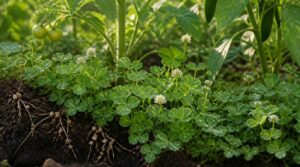
White clover is a quiet workhorse beneath your vegetables. It fixes 50–150 kg of nitrogen per hectare each season through Rhizobium partnership, cutting your fertilizer needs by up to 40%. That dense mat also reduces surface evaporation by 30% and smothers weeds by competing for light.
| Benefit | Mechanism | Impact |
|---|---|---|
| Nitrogen fixation | Rhizobium bacteria | 20–40% less fertilizer |
| Moisture retention | Ground cover shading | 30% less evaporation |
| Weed suppression | Light competition | Significant reduction |
Mow it to 2–6 inches. Keep it low, keep it working.
Creeping Thyme Around Herbs

Walk your fingers across creeping thyme and you’ll release a fragrance that doubles as pest control. This living mulch stays under 3 inches, smothering weeds while its aromatic oils repel aphids and cabbage worms drifting toward basil, oregano, and rosemary.
Mid-summer blooms pull in bees, boosting pollination for nearby herbs. Trim after flowering, plant in fast-draining soil — your soil health improves while erosion drops near the bed’s edges.
Squash Beneath Corn Stalks

Squash sprawling beneath corn stalks is living mulch at its finest — sometimes the oldest tricks in companion planting still outperform anything new. Broad leaves drop soil temperature swings by 5–10°F, cutting weed emergence up to 70%.
That same canopy slows rain splash, keeping soil-borne pathogens off leaves while locking in moisture. It’s the Three Sisters principle: structure above, shade below, soil health throughout.
Lettuce Below Taller Crops
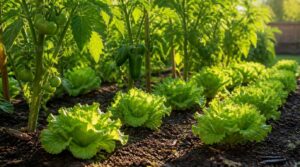
Ever notice how lettuce sulks and bolts the moment summer heat hits? Tucking it beneath taller crops fixes that through real thermal stress mitigation and microclimate temperature control.
- Cooler leaves, slower bolting
- Moister root zone moisture
- Sturdier, less bitter heads
This intercropping trick boosts nutrient uptake efficiency too — proof that smart companion planting keeps soil health and sustainable gardening working hand in hand.
Straw Between Companion Rows

Straw is the unsung workhorse of any companion bed. A 5–10 cm layer between rows cuts weed germination pressure by around 40%, reduces evaporation by up to 40%, and stabilizes soil temperature by 2–4°C on hot days.
As it breaks down, it slowly lifts soil organic carbon and shields roots from soil-borne pathogens splashing up after rain.
Pest-Reducing Soil Companion Pairings

Healthy soil doesn’t just feed your plants — it’s your first line of defense against pests. The right companions work quietly underground and above it, disrupting pest cycles without a drop of synthetic spray. Here are the pairings that actually pull their weight.
Marigolds Near Root Crops
Plant marigolds around your root crops — they release thiophenes into the soil, slashing root-knot nematode pressure by up to 90%.
Five reasons this pairing works:
- Thiophene release disrupts nematode life cycles underground
- Dense litter boosts root zone microbial biomass
- Marigold canopy retains soil moisture near roots
- Blooms attract beneficial insects that control root pests
- Decomposing residues slowly add phosphorus and potassium
Onions Beside Carrots
Where marigolds work underground, onions work through the air. Their sulfur compounds act as scent masking, confusing carrot flies before they ever locate roots.
Space them 6–8 inches apart in alternating rows.
| Benefit | Mechanism |
|---|---|
| Pest deterrence | Sulfur scent disrupts fly navigation |
| Soil health | Shallow roots improve surface structure |
Onions also harvest weeks earlier, giving you staggered harvest timing without replanting.
Basil Around Tomatoes
Scent is basil’s first weapon. Its pest repellent oils confuse aphids, whiteflies, and thrips — disrupting their ability to feed and reproduce on nearby tomatoes. Keep basil 12–18 inches from tomato stems for maximum volatile diffusion without crowding roots.
That proximity also delivers flavor enhancement cooperation, encouraging richer aromatic compounds in ripe fruit. Basil’s low canopy promotes soil moisture retention underneath, acting as living mulch.
Nasturtiums Near Cucumbers
Nasturtiums work as a trap crop — luring aphids and cucumber beetles away from your vines. Lady beetles and hoverflies follow, disrupting pest life cycles before damage spreads.
Their trailing stems do more than distract pests:
- Retain soil moisture beneath shallow cucumber roots during heat spells
- Attract pollinators during peak cucumber fruit set
- Offer edible flowers as a secondary harvest alongside your cucumbers
Space them 12–18 inches from vines for airflow.
Herbs Among Brassicas
Tuck aromatic herbs into your brassica beds and you’re running a full pest-management system in plain sight.
| Herb | Primary Benefit | Mechanism |
|---|---|---|
| Dill | Aphid repulsion | Confusing volatile scent |
| Sage | Moth suppression | Deters cabbage larvae |
| Chamomile | Soil microbial diversity | Root-zone enrichment |
Oregano quietly builds beneficial nematode populations underneath. Parsley adds microclimate shading, keeping moisture where heavy-feeding brassicas need it most.
Combinations to Avoid for Soil Health
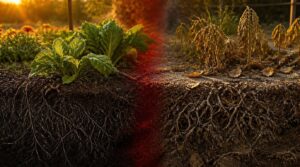
Not every plant makes a good neighbor, and some combinations will actively work against the soil health you’ve spent all season building.
A few specific pairings trigger chemical conflicts, competitive root wars, or shared disease vulnerabilities that can quietly undo your progress. Here are the combinations worth keeping off your planting map.
Fennel With Most Crops
Fennel earns its loner reputation honestly. Its roots release allelopathic compounds that stunt most neighbors, undermining companion planting and soil health alike. Even with strong nutrient exudation and real root aeration benefits, that nitrogen balancing rarely offsets the damage.
Aromatic compatibility with dill is the rare exception—plant fennel solo, far from your main plant combinations, and let it do its own thing.
Garlic Near Beans
Mix garlic into a bean bed and you’re trading one benefit for another headache. Garlic’s sulfur compounds offer real pest deterrence, but beans are nitrogen fixers, not allium partners—garlic doesn’t fix nitrogen and competes for root space.
Three fixes:
- Stagger planting by weeks
- Space rows 12+ inches apart
- Harvest garlic before bean canopy fills in
Manage root competition this way, and microbial cooperation still works in your favor.
Onions Near Peas
Onions and peas make poor roommates—garlic’s cousin causes the same trouble. Onions release sulfur compounds that trigger allelopathic growth inhibition and disrupt nitrogen nodulation, the process peas need to fix nitrogen.
| Problem | Fix |
|---|---|
| Sulfur compounds | Separate beds |
| Nutrient competition | Alternate seasons |
| Shading | Periphery placement |
Strategic bed separation preserves both crops’ symbiotic relationships and overall soil health.
Potatoes Beside Tomatoes
Potatoes and tomatoes are nightshade cousins, which sounds harmless until you realize they share the same blight and Fusarium wilt pathogens. Planting them together spreads disease through shared soil inoculums fast.
Keep 3–4 feet clear spacing, mulch both, and rotate beds yearly. Tomatoes hog nitrogen tomato fruiting needs; potatoes want potassium early. Harvest logistics get messy too—tuber digging disturbs tomato roots nearby.
Brassicas Near Strawberries
Strawberries crave acidic soil around pH 5.5–6.5, while brassicas lean alkaline—an instant soil pH conflict. Add nutrient competition risks from brassicas’ heavy feeding, plus shading impact that blocks photosynthesis for fruiting, and you’ve got a losing pairing.
Decomposing brassica residue also shifts microbial activity and raises pH temporarily, while both crops compete hard for water in summer heat. Keep them in separate beds.
Frequently Asked Questions (FAQs)
What companion plants improve soil?
Legumes drive nitrogen fixation through Rhizobium partnership, while comfrey and dandelion handle nutrient mining with deep taproots. Diverse root architecture boosts soil porosity and microbial diversity, feeding fertility through smart companion planting and steady nutrient cycling.
How long until companion planting improves soil quality?
Think of soil as a slow-simmering pot, not a microwave meal. Nitrogen jumps 20-50% near legumes within one season, while active accumulators cycle minerals in 1-2 seasons. Real fertility, with microbial richness, builds over 3-5 years.
Can companion planting replace synthetic fertilizers entirely?
Not entirely. A nitrogen fixer covers part of the load, but high feeders still outpace what companions supply. Run soil tests to catch deficits, combine organic methods with targeted inputs, and lean on companions for long-term durability, not full replacement.
How does crop rotation interact with companion planting?
Rotation moves crops yearly for temporal pest disruption; companion planting adds spatial diversity the same season.
Together they create microhabitat pest suppression, boost soil microbial strength, and improve nutrient cycling, giving you integrated yield stability instead of relying on one fragile layout.
What spacing works best in small raised beds?
Picture a chessboard where every square still needs room to breathe — that’s your raised bed layout. Keep 18–24 inch aisles for tool access, leafy greens at 6–8 inches, and trellised crops vertical to boost square foot density.
Conclusion
Picture that corn bed again: beans threading nitrogen through dark soil, squash leaves cupping shade like green hands holding moisture in place. That’s what soil building companion plant combinations deliver, season after season—a garden that feeds itself while you sleep.
Skip the synthetic bag. Trust the partnerships instead: nitrogen fixers, effective accumulators, living mulches, all working underground in quiet cooperation. Plant smart once, and your soil keeps paying you back, harvest after harvest.
- https://permacultureeducation.org/in-harmony-with-nature-companion-planting
- https://buildingafoodforestscotland.com/2025/10/18/permaculture-and-dynamic-accumulators-natures-secret-to-thriving-gardens
- https://permacultureapprentice.com/building-soil
- https://coastofmaine.com/blogs/growing-guide/companion-planting-a-natural-way-to-grow-a-healthier-garden-from-the-soil-up
- https://fruitfulfoodforestry.com?p=6028