This site is supported by our readers. We may earn a commission, at no cost to you, if you purchase through links.
A single bee can visit up to 5,000 flowers in one day. That’s not a typo—it’s a small, fuzzy miracle that keeps roughly one-third of everything you eat in existence. Yet most gardens quietly work against bees without meaning to, packed with showy hybrids that look beautiful and deliver almost nothing worth foraging.
The good news: plants that bring bees naturally aren’t exotic or hard to find. Many are the same herbs sitting on your kitchen windowsill, the wildflowers you’ve been pulling out as weeds, or the native shrubs nurseries have quietly stocked for years.
What follows is a season-by-season guide to the plants bees genuinely use—from the first crocus pushing through frozen soil in early spring to the goldenrod still humming with activity in October.
Table Of Contents
Key Takeaways
- Planting a seasonal succession of natives—from early crocuses and serviceberry through summer bee balm and coneflower to fall goldenrod and asters—keeps nectar flowing continuously and prevents the colony-stressing gaps that single-season gardens create.
- Flower shape and color matter as much as plant species: bees are wired to seek out purple, blue, and yellow blooms, flat landing-pad flowers like coneflower and yarrow for easy access, and tubular blooms like salvia and penstemon for long-tongued specialists.
- Many culinary herbs—lavender, thyme, oregano, borage, and salvia—quietly double as high-value pollinator plants, making a kitchen garden one of the most efficient ways to support local bees without dedicating extra space.
- Avoiding pollen-free hybrid cultivars and systemic insecticides like neonicotinoids is just as important as what you plant, since both can silently undermine your garden’s value as a food source and safe haven for bees.
Best Plants That Bring Bees Naturally
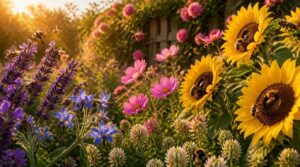
Spring doesn’t wait around, and neither do bees — they’re out searching for food the moment temperatures nudge above freezing. The plants you choose for early in the season can make or break your garden’s value as a pollinator haven. Here are the best spring bloomers to get things started on the right foot.
Timing matters as much as plant choice, so mapping out spring perennial bloom sequences for pollinators can help you fill every gap from the first thaw through late May.
Crocus and Serviceberry
Two plants anchor early spring forage before summer: crocus and serviceberry. Plant crocus bulbs 2–3 inches deep in fall. Serviceberry flowers early, then offers edible berries — giving your pollinator garden genuine multi-season interest. These plants provide nectar for bees during the early growing season.
- Crocus blooms February to March
- Feeds emerging queen bumblebees early
- Serviceberry white blossoms attract native bees
- Edible berries attract birds in summer
- Both bridge staggered bloom calendars
California Poppy Blooms
Where crocus fades, the California poppy (Eschscholzia californica) takes over. This drought-tolerant wildflower opens its satiny orange-to-yellow petals in bright sun and closes them at night — a diurnal cycle worth watching.
Its open cup shape lets short-tongued bees land and feed effortlessly, making it a reliable spring anchor for any pollinator garden.
| Feature | Detail |
|---|---|
| Petal colors | Orange, yellow, cream |
| Blooming habit | Opens in sun, closes at night |
| Soil preference | Poor, well-drained |
| Bee attraction | Open cup, accessible nectar |
| Seed capsules | Self-sow after blooms drop |
Spiderwort for Spring Nectar
After the California poppy hands off, Spiderwort (Tradescantia virginiana) fills early spring nectar gaps reliably. Each bloom lasts one day, but new flowers open daily for weeks — a steady bridge for pollinators.
Native bees visit for good reason:
- Blue-violet petals signal nectar-rich resources
- Open blooms suit short-tongued bees
- Mason bees and bumblebees forage here
- Plants tolerate sand to loam soils
Early Bulbs for Hibernators
Spiderwort keeps things moving, but before it even wakes up, early bulbs are already doing the heavy lifting. Snowdrops (Galanthus) and crocuses push through late-winter soil when hibernating bees catch their first warm day.
Plant them 2–3 inches deep in well-drained sandy loam, in fall, so cold triggers proper dormancy. Dense clusters give foragers an unmissable target right when colonies need it most.
Native Spring Bloom Timing
Timing matters more than you’d think. Soil temperatures hitting 40–50°F trigger growth, but blooms follow emergence by days to weeks — and warming springs are pushing that window earlier by up to a month.
Watch for:
- Pollinator mismatch if bees emerge later
- Ephemeral windows lasting only 2–6 weeks
- Containers warming faster than open ground
Photoperiod and temperature together fine-tune when native perennials finally open.
Summer Flowers Bees Visit Most
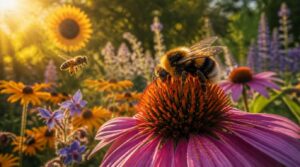
Summer is when your garden really starts pulling its weight for local bee populations. A handful of plants bloom at just the right time and with just the right flower structure to keep bees fed through the warmest months. Here are the summer standouts worth making room for.
Bee Balm in Full Sun
Few plants earn their place in a bee garden as decisively as Bee Balm (Monarda didyma). Give it full sun — at least six hours daily — and it responds with vivid tubular blooms that peak with nectar mid-summer, drawing bees, butterflies, and hummingbirds in waves.
| Factor | Requirement | Benefit |
|---|---|---|
| Sunlight | 6+ hours daily | Intense bloom color, strong fragrance |
| Soil moisture | Evenly moist, well-drained | Steady nectar output |
| Plant spacing | 18–24 inches apart | Reduces mildew, improves airflow |
Its rhizome growth habit means one plant quietly becomes a clump. Divide every two to three years to keep vigor high.
When you do divide, replanting those offshoots alongside bee balm and anise hyssop creates a thriving patch — here’s a closer look at fall garden plants that keep pollinators fed through the season.
Purple Coneflower Pollen Cones
Purple Coneflower (Echinacea purpurea) earns its reputation among native plants through its central pollen cone — a dense cluster of florets packed with protein-rich pollen bees can’t resist.
Three reasons pollinators keep returning:
- Pollen protein fuels larval growth in native bee colonies
- Cone florets peak mid-to-late summer, aligning with peak foraging
- Drought-tolerant perennials reliably sustain pollen production when nectar sources fade
Black-eyed Susan Long Blooms
Black-eyed Susan (Rudbeckia hirta) keeps your garden buzzing longer than almost any other wildflower. Its golden yellow rays circling a dark central cone create that classic daisy silhouette bees navigate toward instinctively.
Spreading through rhizomes into dense clumps, these perennials deliver nectar and pollen from early summer well into fall — sturdy, low-maintenance, and reliably generous.
Milkweed for Pollinator Gardens
Milkweed isn’t just another summer bloomer — it’s every monarch butterfly‘s lifeline and a cornerstone of pollinator gardens.
- Choose Asclepias syriaca, a reliable native nectar source
- Swamp milkweed extends blooms into late summer
- Plant in full sun, well-drained soil
- Water through the first two seasons
- Monitor pests; treat only when needed
Grouped plantings build a nectar corridor bees reliably return to.
Coreopsis for Poor Soils
If your soil is more gravel than garden, Coreopsis is your answer. This drought-tolerant perennial thrives in sandy, nutrient-poor ground — pH 6.0 to 7.0 — where most plants sulk.
Compact clumps push out long-blooming yellow heads all summer, drawing bees back reliably. Skip the fertilizer; rich soil causes leggy growth. Poor conditions actually sharpen its flowering.
Late-Season Nectar Plants for Bees
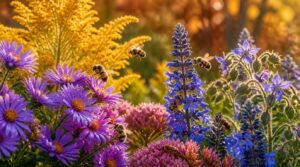
Once summer starts winding down, your garden doesn’t have to go quiet — bees are still out there working hard and need reliable food sources well into fall. The right plants can carry your garden through those critical late-season weeks when other blooms have faded. Here are five that do the job beautifully.
Goldenrod for Fall Forage
When most gardens go quiet, goldenrod (Solidago spp.) steps up. Its dense yellow plumes bloom from August through October, delivering high nectar volumes that sustain bumble bees, honey bees, and native solitary bees through the lean fall stretch.
Once established, it’s drought tolerant, spreads via rhizomes, and leaves behind seed heads that support wildlife well into winter.
Asters With Sugary Nectar
Asters (Symphyotrichum spp.) pick up right where goldenrod leaves off. Their high-sugar nectar is exactly what migrating butterflies and late-foraging bees need heading into autumn. The composite flower heads — rings of ray flowers surrounding dense disk centers — give short- and long-tongued pollinators alike somewhere to feed.
As a hardy perennial, asters tolerate partial shade and average soils without complaint.
Joe-Pye Weed Flower Clusters
Joe-Pye weed (Eutrochium purpureum) towers at 5 to 7 feet, lifting its pink inflorescence clusters well above surrounding plants so pollinators spot them easily. Those dome-shaped heads — sometimes 12 inches across — pack in dense disk florets that reward visiting bees with abundant nectar.
The whorled leaf arrangement along sturdy stems makes it instantly recognizable, and its late-season bloom timing fills a real gap for foraging bees.
Blazing Star Bloom Spikes
Blazing star (Liatris spicata) brings something Joe-Pye weed can’t — vertical spike drama that cuts straight up through mid-border plantings. Those purple bottlebrush spikes, reaching up to 40 inches, open floret by floret from tip downward across several weeks.
Bees work them steadily through late summer, drawn by consistent tubular nectar production. Once established, it shrugs off drought without complaint.
Autumn Sedum for Bees
When other late-season blooms start winding down, autumn sedum (Hylotelephium ‘Autumn Joy’) quietly takes over. Its flat-topped flower clusters act as natural landing pads, letting honey bees and solitary species rest while feeding.
Drought stress actually concentrates nectar, drawing heavier bee traffic through September and October — exactly when colonies need fuel most before winter sets in.
Bee-Friendly Herbs for Kitchen Gardens
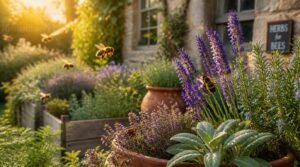
Your kitchen garden can pull double duty — feeding your family and fueling local bees at the same time. Many culinary herbs are quietly some of the best pollinator plants you can grow, partly because they bloom freely and partly because bees genuinely can’t resist them. Here are a few worth making room for.
Lavender With Well-drained Soil
Lavender is one of those rare perennials that rewards neglect over attention. Bees flock to its purple spikes precisely because it thrives in well-drained, low-fertility soil — pH 6.5 to 7.5 works best.
Poor drainage causes root rot fast. Plant it on a slope or raised bed in full sun, and it’ll pump out fragrant essential oils all season.
Salvia for Summer Nectar
Salvia pulls bees in from the moment its dense flower spires open. Bees follow UV nectar guides invisible to the human eye, landing directly on the blooms to access nectar rich in fructose and glucose.
Prune spent stalks after the first flush and you’ll get a second wave of blooms well into late summer — doubling your garden’s nectar corridor without planting a single extra thing.
Thyme Between Garden Beds
Thyme does double duty between beds — it’s a drought-tolerant ground cover that stays under 6 inches tall while producing nectar-rich tubular flowers bees actively seek out in summer.
Its creeping habit suppresses weeds, stabilizes soil edges, and holds up surprisingly well underfoot. That makes it a natural fit for Mediterranean garden design, where low-maintenance borders do the heavy lifting.
Oregano Flowers for Bees
Oregano earns its place in any pollinator-friendly herb garden. Its clustered white-to-pink blooms offer accessible nectar to short-tongued bee species that struggle with deeper flowers, and the nectar concentration is reliable enough to keep foragers coming back.
Pair it with thyme and sage to build a continuous nectar supply that bridges seasonal gaps and keeps your garden buzzing well into summer.
Borage for Edible Blooms
Few herbs pull double duty quite like borage. Its star-shaped blue blooms are edible, offering a fresh cucumber flavor with faint honey notes — lovely scattered over salads or frozen into ice cubes for summer drinks.
Bees adore it too. Abundant nectar production keeps pollinators returning all season, making borage a quiet powerhouse in any kitchen garden.
Native Shrubs and Trees Bees Love
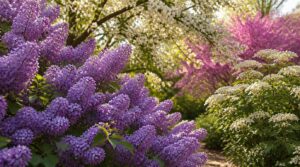
Flowers get most of the attention, but shrubs and trees are quietly doing some of the heaviest lifting for bees — especially early in the season when not much else is blooming.
Adding even one or two woody plants to your yard can dramatically extend your garden’s value as a pollinator habitat. Here are the native shrubs and trees worth making room for.
Serviceberry for Early Nectar
Serviceberry (Amelanchier) blooms 2–4 weeks before most spring plants, offering bees one of the earliest nectar sources of the season. Its white clustered flowers suit short- and medium-tongued pollinators.
- Nectar peaks over several days at full bloom
- Compact size suits small yards and urban gardens
- Thrives in moist, well-drained soil with full sun
- Native varieties actively support local bee populations
Willow Catkins in Spring
While serviceberry takes care of the nectar shift, willows cover the pollen gap. Male catkins open first, releasing protein-rich pollen before leaves even appear — exactly what nurse bees need for brood development in early spring.
Wind carries pollen far, but bees visit directly. A single willow stand can noticeably lift local pollinator activity, making it a quiet powerhouse for biodiversity in any yard.
Redbud Blooms for Bees
Redbud (Cercis canadensis) picks up right where willow leaves off. Its pink blossoms open in March through April, covering bare twigs before a single leaf appears — delivering both nectar and protein-rich pollen to honey bees, bumble bees, and mason bees simultaneously.
Three reasons redbud earns its place in pollinator gardens:
- It bridges the early nectar gap before spring wildflowers peak.
- Its flowers sit directly on stems, making nectar accessible to short-tongued bee species.
- Pollen contributes essential fatty acids that support brood development colony-wide.
In urban yards, even one redbud meaningfully extends your spring foraging window.
Native Fruiting Shrubs
Beyond trees, native fruiting shrubs pull double duty — feeding bees during bloom and supporting wildlife food webs through edible berries that persist into winter. Hawthorn, serviceberry, and viburnum offer staggered seasonal bloom, so something’s always flowering. They’re also surprisingly drought-tolerant once established, quietly anchoring native biodiversity with minimal fuss.
| Shrub | Bloom Season | Bee Benefit |
|---|---|---|
| Serviceberry | Early spring | Nectar and pollen |
| Hawthorn | Late spring | Clustered flowers |
| Viburnum | Spring–summer | Pollinator forage |
Berries double as edible preserves or winter wildlife food.
Small-yard Tree Choices
Even three compact tree cultivars can turn a small lot into a real pollinator habitat. Aim for small canopy spreads of 10 to 20 feet to avoid crowding structures.
Top picks for tight yards:
- Native serviceberry for early spring nectar
- Eastern redbud for dense pollinator blooms
- Drought-tolerant dogwood for low-maintenance garden biodiversity
Pruning for shape after flowering keeps them tidy year-round.
Flower Shapes and Colors Bees Prefer
Bees don’t just wander into your garden by luck — they’re guided by very specific visual and structural cues that evolution has fine-tuned over millions of years.
The shape of a bloom and the color of its petals can make the difference between a flower bees flock to and one they walk right past. Here’s what to look for when choosing plants that genuinely speak their language.
Purple, Blue, Yellow Flowers
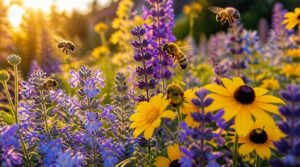
Bees don’t see color the way you do — they’re tuned to violet, purple, blue, and yellow wavelengths, which means a garden built around these hues is basically a neon sign for pollinators.
That’s why pairing purple salvia with yellow coreopsis works so well. UV nectar guides on these blooms direct bees straight to the reward, no guesswork needed.
White Blooms for Visibility
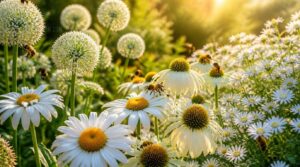
White might not top your list, but it punches above its weight as a pollinator attractor. Against green foliage, white blooms create sharp daytime visibility contrast that bees spot from a distance — and at dusk, those petals reflect available light, giving low-light foraging cues that colored flowers simply can’t match.
Four reliable white options worth planting:
- Shasta Daisy — flat, open blooms with strong nectar and pollen
- White Allium — globe clusters bees return to repeatedly
- White Aster — late-season nectar source when most color has faded
- White Coneflower — pollinator-friendly and heat-tolerant
At night, moonlight reflection benefits nocturnal visitors like moths, extending your garden’s working hours effortlessly.
Flat Landing-pad Flowers
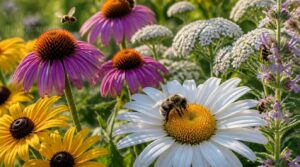
Think of flat landing-pad flowers as nature’s helipad — a stable surface bees drop onto without acrobatics. Disk-shaped blooms like Shasta Daisies span 5–15 cm wide, packed with florets that keep nectar fully exposed. Slightly rough, conical petal cells give bees solid grip on landing.
| Flat Landing-pad Plant | Key Benefit |
|---|---|
| Shasta Daisy | Wide disk, accessible nectar |
| Purple Coneflower | Pollen-rich central cone |
| Black-Eyed Susan | Long bloom, high bee traffic |
| Yarrow | Dense florets, multiple landings |
| Mountain Mint | Energy-efficient multi-bloom foraging |
These pollinator-friendly blooms let small and medium species feed simultaneously — efficient, accessible, endlessly visited.
Tubular Flowers for Long-tongued Bees
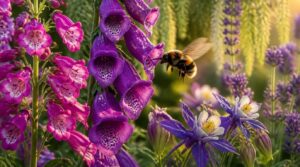
Not every bee can reach every flower. Tubular blooms like foxglove, penstemon, and columbine position nectar deep in their corollas — perfectly matched to long-tongued species like Bombus and Osmia. That tongue-to-corolla fit isn’t accidental; it maximizes nectar access efficiency while filtering out short-tongued visitors.
Plant a succession from spring penstemon through summer lavender, and you’ll sustain these specialized foragers continuously.
Clustered Blooms Save Energy
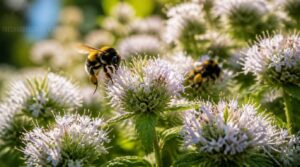
Clustered plants like mountain mint let bees work smarter, not harder. A forager harvests multiple nectar-rich flowers in one landing spot, cutting flight time a lot.
Bloom clustering benefits:
- Shorter flight paths between blooms
- Higher nectar density per patch
- Faster spatial memory learning
- Steadier colony energy intake
- Longer foraging windows
That efficiency translates directly into stronger colonies.
Grow a Natural Bee Habitat
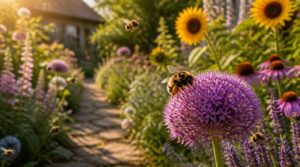
Creating a bee-friendly garden isn’t just about planting the right flowers — it’s about building a space that looks after bees through every season. A few smart, consistent choices can turn even a modest plot into a reliable habitat. Here’s what actually makes the difference.
Plant Continuous Seasonal Blooms
Bees don’t take breaks between seasons — and your garden shouldn’t either. Closing seasonal foraging windows even briefly can stress local colonies.
Start with crocus and serviceberry in early spring, layer in bee balm and coneflower through summer, then let goldenrod and asters carry the forage into fall. That kind of seasonal succession keeps nectar flowing continuously.
Choose Native, Heirloom Varieties
Seasonal succession sets the stage — but what you plant matters as much as when you plant it. Native and heirloom varieties adapt to local soils and climate over generations, meaning less fussing and stronger blooms.
They also support seed saving year to year, preserving genetic diversity that hybrids simply can’t match. That toughness is exactly what pollinators need from your garden.
Avoid Pollen-free Hybrids
Choosing native varieties also means avoiding pollen-free hybrids, which sound appealing but quietly undermine your garden’s value as a pollinator food source. Bees need pollen to feed their young — no pollen means no reward, and fewer return visits.
Labels can mislead too; many "pollen-free" cultivars are simply pollen-reduced, not pollen-absent, offering little nutritional payoff for foraging bees.
Skip Systemic Insecticides
Pollen-free hybrids aren’t the only quiet threat to your pollinator garden. Systemic insecticides like neonicotinoids get absorbed into plant tissues — nectar and pollen included — so bees carry the contamination home. Sublethal doses impair navigation and foraging efficiency without killing outright.
Systemic insecticides absorbed into nectar and pollen turn bees into unwitting carriers of their own decline
If pest pressure is real, lean on integrated pest management: rotate controls, time applications carefully, and keep flowering plants off the treatment list entirely.
Add Containers for Small Spaces
Even a tiny balcony can become a pollinator attractor. Lightweight resin pots paired with vertical planter systems let you multiply nectar-rich flowers without losing floor space. Try:
- Lavender in 6-inch pots along railings
- Oregano for compact herb gardening
- Self-watering containers for steady moisture
- Tiered shelves for layered blooms
- Narrow planters under 8 inches wide
Urban gardening thrives on smart choices.
Frequently Asked Questions (FAQs)
What plant attracts bees the most?
Lavender (Lavandula spp.) tops most lists — its high nectar volume and essential oils draw bees from surprising distances. Purple and blue hues land squarely in their preferred color spectrum, making it nearly irresistible.
What is the 3 3 3 rule for bees?
The 3-3-3 rule guides hive relocation: move a hive under 3 feet or over 3 miles. Anything between disorients bees, disrupting their navigation mental maps and causing foragers to lose the hive entirely.
How to attract bees quickly?
Plant native, nectar-rich flowers in clusters, add a shallow water feature, and skip pesticides. Bees find food fast when blooms are grouped and the garden feels safe.
What can I put in my bee trap to attract bees?
A few drops of lemongrass oil on a cotton pad mimics orientation pheromones effectively. Add old brood comb and a beeswax-coated interior, and scout bees find it irresistible. A shallow dish of sugar water seals the deal.
How do bees find water near garden spaces?
Bees detect water through odor cue detection, homing in on mineral traces and organic scents carried on the breeze. Once a forager finds a reliable source, she communicates its location back to the hive via the waggle dance.
Can bee-friendly plants grow in shady areas?
Yes — many shade-tolerant bee plants thrive beautifully. Virginia bluebells, wood anemone, and bleeding heart all bloom in partial shade, offering early nectar when bees need it most.
How can I attract solitary bees specifically?
The quieter your garden, the louder it speaks to solitary bees. Leave bare sunlit soil for ground nesters, install a bee hotel with 3–10 mm holes, and keep all nesting sites strictly pesticide-free each season.
Conclusion
Somewhere right now, a bee is landing on a flower you haven’t planted yet. That’s the quiet coincidence of timing—your garden and her survival operating on the same seasonal clock, whether you’ve noticed or not.
Plants that bring bees naturally don’t demand expertise or a large plot, just deliberate choices: a native shrub here, a patch of goldenrod there. Start with one plant. Watch what finds it. That’s how a habitat begins.
- https://www.gardenary.com/blog/easy-plants-that-attract-bees-and-butterflies-to-the-garden
- https://gardeningsolutions.ifas.ufl.edu/plants/edibles/vegetables/herbs-for-pollinator-gardens
- https://shiftingroots.com/flowers-and-herbs-for-bees
- https://www.wishgardenherbs.com/blogs/wishgarden/5-botanical-herbs-that-attract-pollinators-to-your-garden
- https://gardenforwildlife.com/blogs/learning-center/boost-your-gardens-buzz-attracting-wild-bees-with-native-plants