This site is supported by our readers. We may earn a commission, at no cost to you, if you purchase through links.
Your tomato plants are finally loaded with fruit, and then you spot the problem: aphids, spider mites, or worse. The instinct to reach for a spray bottle is understandable, but the wrong product can silence every bee visiting your garden within hours.
Bees drive 10–30% of your harvest through pollination alone, so losing them costs you far more than a pest infestation ever would. Pest control safe for bees isn’t a compromise—it’s a smarter strategy that targets the real threats while keeping your garden’s most valuable workers on the job.
Table Of Contents
- Key Takeaways
- Why Bee-Safe Pest Control Matters
- Avoid Bee-Toxic Pest Products
- Choose Low-Risk Garden Treatments
- Use Non-Chemical Pest Controls
- Apply Treatments Without Harming Bees
- Frequently Asked Questions (FAQs)
- What pest control is safe for bees?
- What weedkiller is safe for bees?
- Does pest control work with bees?
- Is there a pesticide that doesn’t kill bees?
- How do you protect bees from pesticides?
- Are pesticides safe for bees?
- How can people manage pests to reduce harm to bees?
- Can you use a pesticide around a bee hive?
- Can pesticide spray kill bees?
- Why do bees need pesticides?
- Conclusion
Key Takeaways
- Bees drive up to 30% of your harvest through pollination, so losing them to a careless pesticide spray costs far more than the pest problem you were trying to fix.
- Neonicotinoids, pyrethroids, and broad-spectrum insecticides don’t just kill pests on contact—they quietly impair bee navigation, memory, and colony health even at low doses.
- Safer alternatives like insecticidal soap, neem oil, Bt, and beneficial predatory insects can handle most common garden pests without putting your pollinators at risk.
- Timing and precision matter as much as product choice—spraying after sunset, targeting leaf undersides, and staying away from open blooms keep treatments effective while protecting the bees working your garden.
Why Bee-Safe Pest Control Matters
Your garden’s success depends more on bees than most people realize, and the way you handle pests can either protect or quietly undermine that relationship. Common pesticides carry real risks for pollinators, but so does ignoring the balance of beneficial insects that keep your garden healthy.
Switching to eco-friendly garden pest control methods helps you manage problems without sacrificing the bees your garden depends on.
Here’s what you need to know about why bee-safe pest control isn’t just a nice idea — it’s a practical necessity.
Bees and Garden Harvests
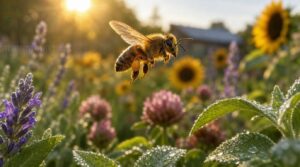
Every tomato you harvest, every apple you bite into — a bee made that possible. Pollination yield boost is real: bee activity can increase garden harvests by 10 to 30 percent. Bumblebees even perform buzz pollination, shaking loose pollen that tomatoes and blueberries need.
Without consistent bee visits, your garden simply won’t reach its full potential. Protecting these insects is essential to maintain global food security for everyone.
Pesticide Risks to Pollinators
Those bees doing the heavy lifting in your garden face a quiet, persistent threat. Pesticide exposure reaches them through direct contact, contaminated pollen, and even soil.
Sublethal effects are especially sneaky — bees survive the initial dose but lose their ability to navigate home. Neonicotinoids act as systemic endocrine disruptors, contaminating nectar and putting roughly 50% of wild bee species at risk.
Neonicotinoids don’t just kill bees — they leave survivors too lost to find their way home
Beneficial Insects in Balance
Pesticides don’t just harm bees — they quietly dismantle the natural predator-prey balance your garden depends on. Lady beetles, lacewings, and parasitic wasps work daily to keep aphids, whiteflies, and caterpillars in check through biological control, no chemicals needed.
Habitat diversity keeps these allies around. When you support them, pest pressure drops naturally.
Protecting Garden Biodiversity
Protecting your garden’s biodiversity means thinking beyond bees alone. Native plant diversity — lavender, coneflowers, wildflowers — creates layered habitats that shelter beetles, butterflies, and soil microbes together. Habitat layering benefits every level, from canopy to bare soil patches.
A healthy soil microbiome sustains the whole food web, making your garden naturally more resilient to pests over time.
Avoid Bee-Toxic Pest Products
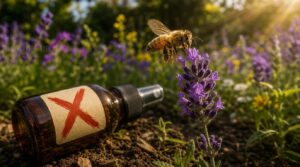
Not all pest control products are created equal, and some can do serious damage to the very insects your garden depends on. Before you reach for anything on the shelf, it’s worth knowing which chemicals pose the biggest threat to bees. Here are the main offenders to watch out for.
Neonicotinoids
Think of neonicotinoids as a slow poison hidden inside the very flowers you’re trying to protect. These systemic insecticides absorb into roots and seeds, traveling into nectar and pollen — places bees feed daily. Sublethal effects include impaired navigation, memory loss, and reduced colony health, even at low doses.
| Exposure Level | Bee Effect | Garden Risk |
|---|---|---|
| Single contact | Disorientation | Reduced pollination |
| Repeated low-dose | Memory impairment | Colony decline |
| Chronic exposure | Overwintering loss | Harvest failure |
Water leaching carries residues into soil and groundwater long after application. The EU’s regulatory bans on outdoor neonicotinoid use reflect the weight of this evidence. For safe pesticides for bees, integrated pest management and nontoxic pest control options offer smarter, gentler alternatives.
For hands-on guidance, this fruit tree pest control guide walks through bee-safe IPM strategies you can actually apply in your own orchard.
Pyrethroids
Pyrethroids might seem like a safer swap after avoiding neonicotinoids, but they carry their own serious risks to pollinators. Synthetic versions of natural pyrethrins, these insecticides target voltage-gated sodium channels, keeping insect nerves in a state of constant firing — causing rapid paralysis and death in bees and butterflies on contact.
Organophosphates and Carbamates
Two more chemical families worth knowing are organophosphates and carbamates — and both work by disrupting nerve signaling in ways that spell trouble for bees. They block acetylcholinesterase (AChE), the enzyme that clears nerve signals, causing a dangerous cholinergic crisis: tremors, paralysis, and death.
Even carbamates, which break down faster, still harm non-target organisms during that critical exposure window.
Broad-spectrum Insecticides
Broad-spectrum insecticides are fundamentally a blunt instrument — they don’t discriminate between pests and the beneficial insects you’re counting on. Ingredient combinations often mix pyrethroids, organophosphates, and carbamates into one product, targeting multiple insect groups at once.
| Risk Factor | Why It Matters |
|---|---|
| Ingredient combinations | Attack bees and pests alike |
| Environmental persistence | Some compounds linger for weeks |
| Resistance management | Repeated use accelerates pest resistance |
| Regulatory labeling | Labels specify buffer zones and timing |
| Application timing | Wrong timing increases pollinator exposure |
Integrated pest management favors targeted solutions over broad-spectrum approaches for good reason.
Flowering Plant Contamination
Even when you’re careful with application, flowering plants absorb and transfer residues in ways that aren’t always visible. Systemic insecticides accumulate directly in nectar and pollen, while spray drift and waterborne residue from irrigation quietly reach open blooms.
Treating plants mid-flower is fundamentally setting a contaminated table for bees — integrated pest management starts with keeping chemicals away from blossoms entirely.
Choose Low-Risk Garden Treatments

Switching to safer treatments doesn’t mean accepting a buggy garden. Several low-toxicity options can handle common pests without putting your pollinators at risk. Here’s what’s worth keeping in your toolkit.
Insecticidal Soap
Insecticidal soap is one of the gentlest tools in your pest-control kit. It works on contact, disrupting the cell membranes of soft-bodied pests like aphids, whiteflies, and spider mites — then becomes harmless once dry.
Mix it at 1–2% concentration in soft water, spray leaf undersides thoroughly, and avoid open blooms where bees are foraging.
Neem Oil
Neem oil takes a different approach to pest control. Extracted from the seeds of Azadirachta indica, it contains azadirachtin, a compound that disrupts insect hormones, preventing pests like aphids and spider mites from molting or reproducing. It doesn’t kill on contact — it quietly dismantles their life cycle.
Apply it diluted with water and a mild soap during cooler morning or evening hours, and keep it off open blooms to protect foraging bees.
Bacillus Thuringiensis
While neem oil disrupts pest hormones, Bacillus thuringiensis (Bt) goes straight for the gut — literally. This naturally occurring soil bacterium produces Cry toxin crystals that target specific larvae like caterpillars and beetles, leaving bees completely unharmed.
Here’s why Bt earns its place in integrated pest management:
- Its Cry proteins bind only to receptors found in certain insect orders, so beneficial insects are safe.
- Bt kurstaki works against caterpillars, while Bt israelensis targets mosquito larvae.
- Crystals break down quickly outdoors, minimizing residual environmental impact.
- It’s approved for organic and pollinator-safe farming systems worldwide.
Apply Bt during early morning or evening, targeting actively feeding larvae for best results.
Spinosad After Drying
Once Bt has done its work, you might reach for spinosad, a bee-safe insecticide that becomes low-risk once dry.
Thanks to UV degradation, spinosad’s toxicity fades fast—especially on sunny leaf surfaces. In shaded spots, drying efficacy and surface binding help residues linger, but rain can wash off active particles. Microbial breakdown also limits residual toxicity, further protecting pollinators.
Targeted Pest Control
Spinosad controls flying pests well, but targeted pest control goes further by focusing only where problems actually exist.
Using targeted bait systems and localized treatment zones means you’re not broadcasting chemicals across healthy garden areas. Think of it like spot treatment—precise, low-risk, and far kinder to beneficial insects exploring your blooms.
Use Non-Chemical Pest Controls

Sometimes the best pest control doesn’t come in a bottle at all. Physical and biological methods can handle a surprising range of garden problems without putting your pollinators at risk. Here are five non-chemical approaches worth adding to your toolkit.
Floating Row Covers
Think of a floating row cover as a soft shield that sits directly over your plants, blocking pests without any chemicals at all. Made from lightweight nonwoven fabric, it transmits 85–95% of sunlight, so photosynthesis continues normally. It also traps just enough warmth — about 2–6°F — to extend your growing season safely.
Remember to lift covers during flowering so pollinators can still reach blooms.
Beneficial Predatory Insects
Some of nature’s most effective pest fighters are already looking for a job in your garden. Beneficial predatory insects — ladybugs, lacewings, and ground beetles — quietly patrol your plants, targeting aphids, whiteflies, and caterpillars around the clock.
- Lacewing release programs deploy larvae that consume over 200 aphids weekly
- Lady beetle attraction works best with nearby nectar-rich flowering plants
- Predatory mite deployment controls spider mites in warm, dry conditions
Hand-picking Garden Pests
Walking your garden rows each morning is one of the simplest, most satisfying forms of natural pest suppression. A daily inspection routine lets you catch newly hatched hornworms, aphids, and beetle larvae before they spread. Check the underside of leaves first — that’s where pests hide and eggs get laid. Gloves keep your skin safe during removal.
Drop collected pests into a soap water disposal solution to kill them instantly. Repeat this every one to three days during peak activity for effective, frequent hand removal — no chemicals, no risk to bees.
Yellow Sticky Traps
Yellow sticky traps are one of the quietest tools in your bee-safe toolkit. Their bright yellow color naturally lures flying pests like whiteflies, aphids, and thrips, while leaving bees largely unbothered.
Hang them at canopy level, spaced every two to five meters, and keep them away from open blooms to protect foraging pollinators.
Diatomaceous Earth Barriers
Diatomaceous earth — DE for short — works like a microscopic minefield for crawling pests. The fossilized shell powder abrades insect cuticles, causing them to dry out and die without any chemical toxicity. For DE barrier placement, dust a narrow band around plant stems and entry points, reapplying after rain since moisture clumps the particles and kills its effectiveness.
Keep DE off open blooms entirely.
Apply Treatments Without Harming Bees
Even the safest pesticide can harm bees if you apply it the wrong way or at the wrong time. How you spray matters just as much as what you spray. These simple application strategies help you get rid of pests without putting your pollinators at risk.
Spray Outside Foraging Hours
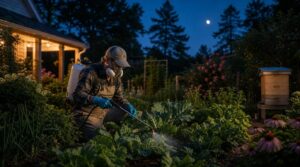
Timing your spray like a shift worker makes all the difference. Honey bees forage most heavily between 9 am and 5 pm, so spray after sunset to sidestep peak activity entirely.
Here’s what good evening timing looks like:
- Start 1 hour after sunset
- Finish 2 hours before sunrise
- Check winds stay below 3–5 mph
- Avoid temperature inversions trapping aerosols near ground
- Let residues dry overnight undisturbed
Avoid Open Blooms
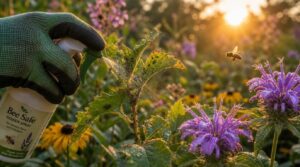
Open blooms are basically a welcome mat for bees, so treating flowering plants mid-day is asking for trouble. Pesticide residues on petals and nectar can transfer directly to foraging bees and back to the colony.
Instead, target non-flowering stems and leaves where pests hide, and use physical barriers like row covers to shield bloom zones during any nearby treatment.
Treat Leaf Undersides
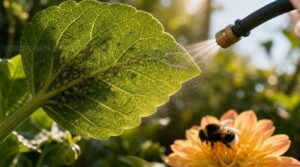
Once you’ve steered clear of open blooms, the next smart move is turning your attention to leaf undersides. That’s where most pests — aphids, spider mites, whiteflies — quietly set up camp.
- Underside spot sprays with insecticidal soaps or horticultural oils target pests directly
- Leaf underside monitoring weekly helps catch infestations early
- Biocontrol on undersides using predatory mites works without risking pollinators
Precision leaf treatments and safe underside application are core to integrated pest management.
Prevent Spray Drift

Even the most careful leaf treatment can backfire if your spray drifts onto nearby blooms or bee habitats.
Lowering boom height places droplets closer to the target and sharply cuts drift potential. Coarse droplet settings resist wind carry far better than fine mists. Pair those with drift-reducing nozzles or shielded boom designs, and you’ve built a reliable buffer between your treatment and nontarget species.
Keep Bee Habitats Safe
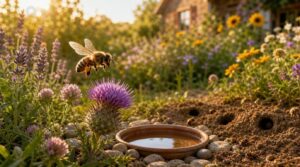
Drift control keeps your spray where it belongs, but protecting bee habitats means going a step further. Establish no-spray buffer zones around flowering plants and nesting areas.
Support ground nesting sites with bare soil patches, offer shallow water sources, and plant native forage diversity year-round. Together, these habits form a living safety net for every pollinator in your garden.
Frequently Asked Questions (FAQs)
What pest control is safe for bees?
Funny enough, the safest choices have been under your nose all along. OMRI-listed soaps and oils, Bt, and spinosad all break down quickly, sparing bees while targeting the pests that matter.
What weedkiller is safe for bees?
Glyphosate-based herbicides are among the safest weedkiller options for bees when applied away from blooming plants. Timing matters — spray before flowers open to keep residue off nectar sources and foraging bees safe.
Does pest control work with bees?
Yes — and more effectively than most people think. Integrated pest management lets you target the bad guys while keeping pollinators safe, using bee-safe application timing, nontoxic solutions, and habitat-friendly practices that protect your garden’s balance.
Is there a pesticide that doesn’t kill bees?
A few pesticides won’t harm bees when used correctly. Bacillus thuringiensis targets caterpillars specifically, and neem oil repels soft-bodied pests without affecting pollinators. Both are low-toxicity, bee-safe options backed by integrated pest management research.
How do you protect bees from pesticides?
Protecting bees starts with smart pesticide choices and timing. Apply treatments outside peak foraging hours, avoid blooms, and swap harsh chemicals for neem oil or beneficial insects whenever possible.
Are pesticides safe for bees?
Most pesticides aren’t safe for bees. Neonicotinoids disrupt navigation; pyrethroids cause paralysis. Even sublethal doses impair learning and brood production, quietly threatening colony health over time.
How can people manage pests to reduce harm to bees?
Managing pests without harming bees comes down to smart timing, targeted tools, and working with nature. Choose bee-safe options, welcome beneficial insects, and apply treatments with precision to keep your garden balanced and pollinators safe.
Can you use a pesticide around a bee hive?
Think of your hive as a neighbor’s house — you wouldn’t spray chemicals next door without a plan. Yes, you can, but only with strict timing, drift control, and buffer distances.
Can pesticide spray kill bees?
Yes, pesticide spray can kill bees. Direct contact with certain insecticides causes immediate paralysis or death, while pollen contamination can harm entire colonies long after the spray has dried.
Why do bees need pesticides?
Bees don’t need pesticides — they need protection from them. Colony collapse disorder and insecticide toxicity threaten their survival, making pollinator conservation and integrated pest management essential for sustaining healthy hives and reliable pollination services.
Conclusion
Once upon a harvest, gardens thrived without synthetic chemical interference—and yours absolutely can too. Pest control safe for bees isn’t about doing less; it’s about choosing smarter. Timing your treatments, selecting low-risk products, and welcoming predatory insects all work strongly in your favor.
The bees visiting your tomatoes aren’t just passing through—they’re essential partners behind every fruit you pick. Protect them well, and they’ll keep rewarding your garden for many seasons to come.