This site is supported by our readers. We may earn a commission, at no cost to you, if you purchase through links.
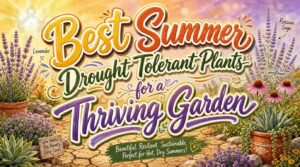
Most gardeners water on faith—hoping the forecast delivers, watching leaves droop through July, and wondering why their borders look exhausted by August.
The problem isn’t their dedication.
It’s the plants.
Pair the wrong species with a dry summer, and you’re fighting biology every single week.
Summer drought tolerant plants flip that equation entirely.
Lavender, coneflower, Russian sage—these aren’t compromise choices for neglected corners.
They’re engineered by nature to thrive when rainfall disappears and temperatures climb.
Your garden doesn’t need more water.
It needs smarter plants.
Table Of Contents
- Key Takeaways
- Best Summer Drought Tolerant Flowers
- Low-Water Perennials for Summer Gardens
- Drought Tolerant Shrubs and Grasses
- Succulents for Dry Summer Beds
- Summer Care for Water-Wise Plants
- Frequently Asked Questions (FAQs)
- What grows best in a hot, dry climate?
- What plant can survive the longest without water?
- What plants are most heat and drought tolerant?
- What plants are full sun heat tolerant for pots?
- What to plant in a hot dry area?
- What plants do well in drought conditions?
- What plants are heat and drought-tolerant?
- What plants can survive in extreme heat?
- What plants don’t require a lot of water?
- What is the hardiest summer flower?
- Conclusion
Key Takeaways
- Picking drought-tolerant plants like lavender, coneflower, and Russian sage means you work with nature instead of fighting it all summer long.
- Good soil drainage, deep infrequent watering, and a 2–3‑inch layer of mulch are the three habits that keep water‑wise plants thriving when rain disappears.
- Grouping plants by water needs—called hydrozoning—stops you from overwatering tough plants while keeping thirstier ones happy.
- Native species are your strongest long‑term bet because they’re already adapted to your local soil, climate, and rainfall without needing extra help from you.
Best Summer Drought Tolerant Flowers
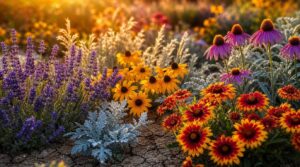
The right flowers can turn a dry summer garden into something worth stopping to look at. You don’t need to water constantly to get real color and life out of your yard. Here are five drought-tolerant flowers that hold their own all season long.
These easy-to-grow summer flowers that thrive in the heat prove you don’t have to sacrifice beauty just because the rain stopped showing up.
Lavender for Fragrant Blooms
If you want a plant that pulls double duty — gorgeous blooms and a scent that stops people in their tracks — lavender is your answer. Lavandula angustifolia ‘Munstead’ is a top pick for waterwise gardens, thriving in full sun with minimal watering once established.
Plant it in soil with a pH of 6.5–7.5, and it’ll reward you with rich, aromatic foliage all summer long.
It also attracts pollinators such as bees, enhancing garden biodiversity.
Yarrow for Hot Borders
Lavender sets a high bar, but yarrow matches it step for step — and thrives where conditions get truly tough. Achillea millefolium brings flat-topped flower clusters in white, pink, yellow, and coral to full sun areas from May through October.
- Grows 12–36 inches tall with feathery, silvery-green foliage
- Blooms reliably in dryish rocky soils with little fertilizer
- Yarrow pest resistance makes maintenance nearly simple
- Deep, infrequent watering every 2–3 weeks keeps it strong
- Deadheading extends flowering well into late summer
Achillea ‘Moonshine’ is especially reliable for hot border edges, staying compact and colorful all season long.
Coneflower for Pollinators
Yarrow earns its place, but coneflower brings something extra — it turns your garden into a pollinator hub. Echinacea purpurea, the purple coneflower, is a native prairie species that bees and butterflies genuinely can’t resist.
Its raised central cone delivers nectar and pollen all season, making it a cornerstone of any pollinator-friendly garden.
Blanket Flower for Color
If coneflower is your pollinator hub, blanket flower is your garden’s summer color engine. Gaillardia pulchella blazes with red, yellow, and orange blooms from late spring straight into fall — no fuss required.
It’s a true heat-resistant, low-maintenance performer that thrives in full sun and dry soils, making it perfect for compact borders and vibrant rock gardens.
Top 5 reasons to grow blanket flower:
- Blooms for up to 12 weeks per season
- Attracts butterflies as a natural pollinator magnet
- Stays colorful even in drought conditions
- Fits neatly into compact border plantings
- Requires only deadheading for a summer color boost
Russian Sage for Dry Sun
When the summer sun beats down hard, Russian sage doesn’t flinch — it thrives. Its silver foliage reflects heat beautifully, and its deep root system pulls moisture from well below the surface.
Hardy across hardiness zones 4–9, this full-sun ornamental perennial blooms lavender‑blue spikes from midsummer into fall.
It’s a top pick for xeriscaping and heat‑tolerant perennial borders.
If you’re building a low-water garden around it, summer flower ideas for heat-tolerant borders can help you find great companion plants that thrive with minimal irrigation.
Low-Water Perennials for Summer Gardens
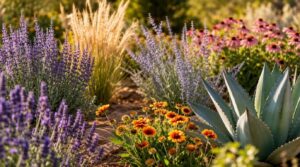
Low-water perennials are some of the hardest workers in a summer garden — they come back year after year without asking much from you. Once established, they handle heat and dry spells better than most plants you’ll find at a nursery. Here are five standout options worth adding to your lineup.
Butterfly Weed for Monarchs
If you want to bring monarchs into your garden, Asclepias tuberosa butterfly weed is your go-to plant. It’s a native drought-tolerant species that doubles as a monarch host plant — females lay eggs directly on new growth, and caterpillars feed on the leaves.
Bright orange blooms provide butterfly weed nectar all summer, making it a standout xeriscaping plant and butterfly attractor for dry, sunny beds.
Red Hot Poker Spikes
Few drought tolerant plants command attention like Kniphofia uvaria, the Red Hot Poker.
Its torch spikes rise 3–4 feet tall, blazing red‑orange to yellow — a living flame in your border.
Plant it in full sun with fast‑draining soil, water deeply at the root zone, and it thrives all summer with minimal fuss.
Salvia for Repeat Blooms
Salvia keeps the color coming all season long. Salvia × sylvestris ‘Mainacht’ blooms hard in May and June, then rebounds with fresh spikes when you deadhead spent flowers promptly.
That simple habit redirects energy away from seed production and back into new blooms. Give it full sun, well-drained soil, and steady moisture during dry spells, and it won’t quit on you.
Sedum for Late Color
When summer fades, sedum steps up. Sedum Autumn Joy opens with soft pink clusters in late summer, deepening to rosy tones as autumn arrives.
Here’s why it earns a spot in your garden:
- Late-season color stretches from August through frost
- Drought-tolerant once established — no fussing required
- Pairs beautifully with ornamental grasses for texture contrast
- Sedum kamtschaticum var. ellacombeanum adds orange tones to mixed borders
- Low-maintenance seed heads stay ornamental all winter
Place it at the border’s edge where those warm tones really shine.
Ice Plant Groundcover
Ice plant is the kind of ground cover for dry soil that works hard without asking much back. Delosperma cooperi spreads into a dense, weed‑suppressing mat and blooms from late spring through autumn.
It accommodates salt spray tolerance beautifully, making it perfect for coastal spots.
Plant it on slopes for erosion control benefits and water deeply every few weeks once it’s settled in.
Drought Tolerant Shrubs and Grasses
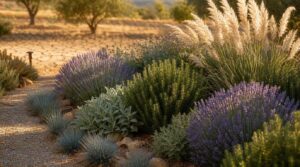
Shrubs and grasses are some of the hardest workers in a drought-tolerant garden. They hold structure through summer’s hottest stretch without asking for much in return. Here are five standout picks worth growing.
Rosemary for Edible Landscaping
Rosemary pulls double duty in any edible landscape design. It grows 2–4 feet tall, so you can shape it into a tidy border around vegetable beds while still clipping stems for the kitchen.
It’s highly drought tolerant once established, needing only deep, infrequent watering.
Pair it near tomatoes for natural companion planting benefits, and harvest morning stems for peak flavor.
Sage for Aromatic Foliage
Sage picks up right where rosemary leaves off. It’s another aromatic, edible shrub that earns its place in any water-wise garden. Growing 18–30 inches tall, sage forms woody, evergreen clumps that look great all season and need very little from you once established.
Here’s why sage deserves a spot in your landscape:
- Drought tolerant and heat hardy — sage thrives in sandy or rocky soil with minimal watering, making it a reliable choice among heat tolerant perennials.
- Sage soil requirements are simple: aim for a pH of 6.0–7.0 with excellent drainage and low to moderate fertility.
- Sage pruning techniques keep plants compact — trim regularly to encourage fresh, fragrant foliage and prevent woody sprawl.
- Sage pollinator benefits are real; bees and butterflies visit the blooms, quietly supporting your garden’s biodiversity.
- Sage oil extraction happens naturally when you crush a leaf — those camphor and pine-like notes come from compounds like cineol and alpha-pinene.
For culinary sage pairings, try it with butter, garlic, or roasted poultry. Harvest stems in late morning for peak flavor.
Want variety? Blue sage and Salvia sylvestris ‘Mainacht’ offer rich violet blooms, while Perovskia atriplicifolia ‘Little Spire’ — Russian sage — adds soft, silvery texture to dry sun borders.
Blue Fescue for Texture
If sage brings fragrance, blue fescue brings texture. This compact, clumping grass grows just 6–12 inches tall, forming neat silvery‑blue mounds that look sharp in borders, rock gardens, and containers.
Its fine needle‑like blades create a cool, almost frosty effect year‑round — a perfect foil for brighter flowering perennials. Plant it in full sun, water deeply but infrequently, and it practically takes care of itself.
Feather Reed Grass Structure
Where blue fescue stays low and compact, feather reed grass goes tall.
Culm architecture gives it a strong vertical backbone — rigid, hollow stems that won’t flop even in the wind. Plume height reaches up to 2.5 meters, making it a natural focal point.
Its narrow leaf form and deep root system make it a reliable choice for full-sun, water-wise gardens.
Yucca for Bold Form
If you’re after a bold form design that stops people in their tracks, yucca delivers every time. Its architectural leaves rise in sharp, sword-like rosettes — striking, structural, unforgettable.
- Vertical structure that anchors dry borders
- Thrives in dry climate landscaping with minimal water
- Works beautifully as container yucca on sunny patios
Among top drought-tolerant plant varieties, yucca is a standout choice.
Succulents for Dry Summer Beds
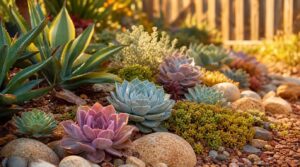
Succulents are the workhorses of a dry summer bed — built tough, looking great, and asking for almost nothing in return.
Their fleshy leaves and deep roots let them shrug off heat that would flatten most plants.
Here are the best ones to grow, plus a smart mulching trick to tie it all together.
Agave for Full Sun
Agave is one of the best full-sun succulents you can plant for easy summer drama. It needs at least six hours of direct sun daily to keep its rosette tight and vigorous. In hotter spots, morning sun with afternoon shade protects sensitive varieties from leaf scorch.
Well-drained soil is non-negotiable. Mix in coarse sand or grit to prevent root rot before it starts.
Prickly Pear for Heat
Prickly pear is built for summer heat. Its waxy cuticle locks in moisture while CAM photosynthesis keeps it thriving when other plants wilt. This makes it one of the most reliable xeriscaping plants you can choose.
Try pad propagation for quick results — just let a cut pad dry overnight, then plant it in well-drained soil.
Stonecrop for Rock Gardens
Stonecrop is the perfect plant for filling gaps between rocks.
Sedum spurium forms low, creeping mats just 4 inches tall, spreading easily across crevices with almost no effort.
It thrives in full sun and dry soil, asking for water only every 2–3 weeks once established.
Propagate it simply by tucking stem cuttings into gritty, well-drained soil.
Hens-and-Chicks for Containers
Few container plants are as effortlessly charming as hens-and-chicks. These succulents form tight rosettes that spill over pot edges in a beautiful cascade.
Use a container soil mix of cactus blend plus perlite for sharp drainage.
They’re built for bright sun exposure and handle temperatures from 5°F to 95°F.
Propagation by offsets happens naturally — new chicks appear each season without any effort from you.
Gravel Mulch Pairings
Gravel mulch is the quiet secret behind a stunning succulent bed. A 2 to 3 inch layer suppresses weeds, reflects heat, and keeps roots from sitting in moisture.
Pair dark gravel with light‑flowering sedums for bold color contrast, or use round river stones beside blue fescue for softer texture.
It’s low‑maintenance, long‑lasting, and built for water‑wise gardens.
Summer Care for Water-Wise Plants
Picking the right plants is only half the battle—how you care for them through summer makes all the difference. A few smart habits will keep your water-wise garden looking great even when the heat is relentless. Here’s what actually works.
Improve Soil Drainage
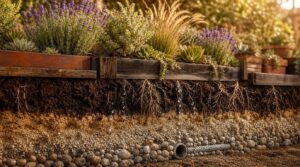
Good drainage is the foundation of any successful xeriscape gardening plan. Without it, even the toughest drought tolerant plants can drown in waterlogged soil.
- Amend soil texture by mixing in coarse sand or grit (up to 25% by volume).
- Organic matter integration — work 2–4 inches of compost into the top 6–12 inches.
- Use raised beds elevated 6–12 inches to improve aeration and water movement.
- Add gravel layer (2–4 inches) at the bed base for faster percolation.
- Install French drain — a perforated pipe in gravel, 18–24 inches deep, diverts excess water fast.
Start with well-drained soil preparation and your plants will thank you.
Water Deeply, Less Often
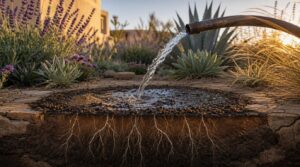
Once your soil drains well, the next step is learning to water smarter.
Water deeply, less often — it sounds simple, but it changes everything.
Deep watering pushes moisture 6 to 12 inches into the root zone, encouraging roots to follow it down.
That means stronger, more drought-resistant plants that don’t need your attention every other day.
Mulch to Reduce Evaporation
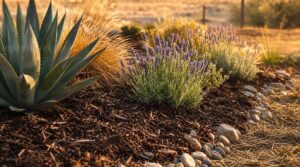
Deep watering sets roots up for success — and mulch keeps that hard-won moisture from slipping away.
A 2 to 3 inch layer of mulch cuts soil evaporation by around 30 percent in hot, sunny conditions. That’s water staying exactly where your drought-tolerant plants need it.
Pick what works for your beds:
- Bark mulch blocks sunlight and holds moisture for a full growing season
- Wood chips break down slowly, feeding soil biology while improving water retention
- Straw mulch covers large areas fast and reduces evaporation quickly
- Gravel or decorative stone shields the soil, lowers evaporation, and cuts weed growth
- Landscape fabric lets water through while slowing surface moisture loss
Keep mulch a few inches away from plant stems to prevent rot. Replenish it each growing season as it breaks down — a small habit that pays off big in a low-maintenance, water-wise garden.
Group Plants by Water Needs
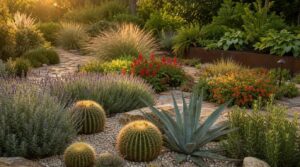
Mulch does its best work when your plants are already in the right neighborhood. Hydrozone planning — grouping plants by water needs — is one of the smartest moves you can make. Low-water plants together, thirsty ones together. This prevents overwatering your drought-tolerant plants while keeping water-hungry ones happy.
Seasonal reassessment keeps your zones working as plants mature and conditions shift.
Choose Native Varieties
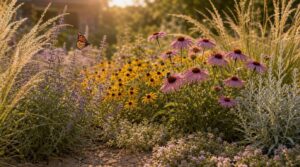
Every plant you’ve chosen tells a story — and native varieties write the best ones. When you practice thoughtful native plant sourcing, you’re picking plants already fluent in your local soil, rainfall, and seasons.
Native plants are already fluent in your local soil, rainfall, and seasons
- Native species tolerate regional soil conditions without amendments
- They need less water once established
- They offer pollinator compatibility with local bees and butterflies
- Local genotypes strengthen ecosystem resilience
- Sourcing by region protects genetic integrity
Choose native drought-tolerant species and let your garden practically care for itself.
Frequently Asked Questions (FAQs)
What grows best in a hot, dry climate?
Like a camel built for the desert, drought-tolerant plants thrive where others wilt. Lavender, rosemary, and native perennials handle heat and low water usage with ease — perfect for arid climate gardening.
What plant can survive the longest without water?
Cacti win hands down. Some species survive over six months without a single drop of water. Their water storage tissues and xerophyte adaptations make them the undisputed champions of extreme drought survival.
What plants are most heat and drought tolerant?
Plants like lavender, sage, and yucca are built to handle the heat. They use deep root systems and low-water ornamental traits to stay strong through the hottest, driest days.
What plants are full sun heat tolerant for pots?
Full sun, heat tolerant picks for pots include lavender, rosemary, yarrow, and sedums. These drought resistant containers favorites handle intense heat with minimal water, making them smart summer container selections for any sunny spot.
What to plant in a hot dry area?
Hot, dry spots don’t have to stay bare. Try drought-tolerant plants like lavender, sage, or yucca. They thrive with little water, need minimal care, and keep your garden looking great all season.
What plants do well in drought conditions?
Drought-tolerant plants thrive by using deep root systems, storing water, and needing very little care. Hardy perennials, native species, and succulents are your best picks for dry conditions.
What plants are heat and drought-tolerant?
Some plants are built tough. Heat-tolerant perennials like lavender, yarrow, and coneflower thrive with little water, making them ideal low-maintenance landscaping choices that support pollinators and adapt beautifully to dry, sunny conditions.
What plants can survive in extreme heat?
Some plants are practically built for the heat. Lavender, yarrow, and coneflower handle intense sun with ease, while blanket flower and Russian sage keep blooming through the hottest, driest days of summer.
What plants don’t require a lot of water?
Like the ancient Romans who built aqueducts to outlast dry seasons, water-wise plants solve the same problem today. Lavender, sedum, and sage thrive with minimal irrigation once established.
What is the hardiest summer flower?
If you’re after the hardiest summer flower, coneflower wins easily. It shrugs off heat, survives dry spells, and keeps blooming all season — no fussing needed.
Conclusion
The proof is in the pudding—summer drought tolerant plants don’t just survive a dry season, they own it. Lavender, agave, coneflower, Russian sage: each one is a quiet promise that your garden won’t tap out when July turns relentless.
Fix your soil, mulch well, and group plants by their needs. Do that, and you’re not just gardening smarter—you’re building something that holds its color, its shape, and its life, year after year.
- https://theplantnative.com/guides/best-native-plants-for-dry-areas
- https://www.gardenia.net/guide/florida-native-plants-that-are-drought-tolerant
- https://gbdmagazine.com/drought-tolerant-landscaping
- https://livetoplant.com/drought-tolerant-landscaping-must-have-california-native-species
- https://www.desertmuseum.org/programs/succulents_adaptation.php