
This site is supported by our readers. We may earn a commission, at no cost to you, if you purchase through links.

A garden that survives on rainfall alone sounds like wishful thinking—until you realize some of the most beautiful landscapes in the world grow in near-desert conditions. Mediterranean hillsides covered in lavender, Southwestern courtyards blooming with agave and sage, and German cottage gardens holding color through summer droughts without a sprinkler in sight.
The secret isn’t luck or special soil. It’s choosing the right plants and giving them a strong start. This planting guide for drought-tolerant plants walks you through exactly that—matching species to your conditions, preparing the ground properly, and building the kind of roots that thrive when the rain stops coming.
Table Of Contents
- Key Takeaways
- Choose Suitable Drought-Tolerant Plants
- Select Plants for Your Climate Zone
- Match Species to Soil Type
- Check Full Sun or Partial Sun Needs
- Look for Drought-tolerance Traits
- Choose Native and Mediterranean Plants
- Include Perennials, Shrubs, Grasses, and Succulents
- Add Edible Drought-tolerant Options Like Fig and Prickly Pear
- Pick Pollinator-friendly Choices Such as Lavender and Sage
- Prepare Well-Draining Soil
- Plant for Quick Establishment
- Water Deeply, Then Reduce
- Mulch and Maintain for Success
- Apply 2–3 Inches of Mulch
- Choose Organic or Gravel Mulch by Plant Type
- Keep Mulch Away From Stems and Crowns
- Use Groundcovers to Reduce Evaporation
- Remove Weeds That Compete for Moisture
- Watch for Overwatering and Root Rot
- Prune Lightly to Maintain Shape and Airflow
- Refresh Mulch and Check Soil Moisture Seasonally
- Frequently Asked Questions (FAQs)
- What plants are safe for dementia patients?
- How do you plant drought-tolerant plants?
- How to prepare soil for drought-tolerant plants?
- How often should I water drought-tolerant plants after planting?
- How do I choose a drought tolerant plant?
- How do I Make my Garden drought tolerant?
- Which plants are drought tolerant?
- How to create a drought tolerant landscape?
- Are drought tolerant plants low-maintenance?
- What is drought tolerant landscaping?
- Conclusion
Key Takeaways
- Matching plants to your specific climate zone, soil type, and sun exposure before you buy is the single most important step toward a drought-tolerant garden that actually thrives.
- Deep, infrequent watering right after planting trains roots to dig deeper to reach lasting moisture, so your plants can handle dry spells on their own over time.
- A 2–3 inch layer of the right mulch — organic for woodland plants, gravel for Mediterranean herbs — reduces evaporation, blocks weeds, and keeps soil temperatures stable all season.
- Once established, drought-tolerant plants truly look after themselves, rewarding smart upfront choices with a low-maintenance garden that works with your climate instead of against it.
Choose Suitable Drought-Tolerant Plants
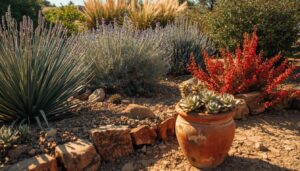
Not every plant belongs in every garden, and that mismatch is usually why dry-summer gardens struggle.
Choosing the right varieties from the start makes all the difference, and these long-lasting summer flowers for dry, sunny gardens prove that the right plant in the right place thrives with minimal fuss.
The good news is that plenty of beautiful, useful plants are built for exactly these conditions. Here’s what to look for when making your picks.
Select Plants for Your Climate Zone
Before you fall in love with a plant at the nursery, check whether it can actually survive your winters. USDA zone mapping places most of Germany in zones 6b–8a, meaning winter minimum temperatures can drop to around -20°C in colder spots. Understanding garden hardiness zones helps you avoid costly losses.
Look for:
- Zone-specific perennials suited to your cold hardiness range
- Native plant selection for drought resistance and local adaptation
- Plants with deep or fibrous root systems for moisture access
- Species matching your planting zones and sun exposure requirements
Don’t forget microclimate pockets — a sheltered south-facing wall can bump you up a full zone. Also, account for urban heat island effects that can raise local winter temperatures.
Match Species to Soil Type
Once you know your zone, think about what’s under your feet. Soil type shapes everything.
Sandy soil picks like rosemary and butterfly weed thrive where drainage is fast.
Clay soil matches — ninebark and purple coneflower — handle tight, moisture-heavy ground.
Loam soil options support the widest range.
Chalky soil selections favor lavender and yarrow.
Silt soil choices like black-eyed Susan prefer that fertile middle ground.
Check Full Sun or Partial Sun Needs
Soil type sorted — now look up. Sun exposure mapping is your next move before buying a single plant.
Full sun means 6+ hours of direct light daily, while partial shade sits around 3–6 hours. Morning vs. afternoon light matters significantly — afternoon sun hits harder. Check your garden using light measurement tools or through simple hourly observation:
- Full sun zones suit sun-loving plants like lavender and Russian sage.
- West-facing beds deliver intense afternoon heat for sun-loving plants.
- East-facing spots offer soft morning light for partial-shade-tolerant plants.
- Seasonal sun shifts mean summer shade trees can block winter light differently.
- Sun angle considerations change exposure as the year progresses.
Prioritize seasonal and angular light changes to ensure year-round plant health.
Look for Drought-tolerance Traits
Once you’ve mapped your sun zones, look at the plants themselves. The best drought-tolerant picks wear their toughness visibly. Waxy, silvery, or fleshy leaves signal low water needs after establishment. Deep root systems pull moisture from far below dry topsoil. Succulent tissue stores reserves between rains. Thick or leathery leaves rarely disappoint.
Plants with strong stomatal control and osmolyte accumulation bounce back fast.
Choose Native and Mediterranean Plants
Native and Mediterranean plants are your safest bet for true drought resistance. Consider lavender (Lavandula spp.), rosemary (Salvia rosmarinus), and fig (Ficus carica) — all fire-adapted species shaped by hot, dry summers.
Climate analogues are advantageous here: plants from similar regions adapt quickly.
Native legumes improve soil naturally, while aromatic hedges add seasonal color and structure without requiring extra water.
Include Perennials, Shrubs, Grasses, and Succulents
Building a layered height strategy — perennials at the front, drought-tolerant shrubs and native grasses mid-border, taller specimens behind — creates year-round structure. Perennials like lavender deliver a seasonal bloom sequence, while blue fescue and contrasting leaf textures add movement.
Weave in succulent groundcover to seal bare soil and support wildlife habitat benefits. This approach combines aesthetic appeal with functional advantages, ensuring both visual interest and ecological support.
Choosing drought-tolerant plants for water conservation has never looked this good.
Add Edible Drought-tolerant Options Like Fig and Prickly Pear
Weaving edible plants into your waterwise garden means your harvest timing lines up with the hottest, driest months — no extra irrigation required. Fig Tree (Ficus carica) and Prickly Pear Cactus (Opuntia spp.) thrive on minimal water once established.
Their culinary uses range wide: fresh figs, dried preserves, and nopales, stir-fried like vegetables. They also offer significant nutrient benefits — fiber, vitamin C, and antioxidants. Incorporating edible drought-tolerant plants makes your edible landscape pull double duty.
Pick Pollinator-friendly Choices Such as Lavender and Sage
Pollinators need steady food from spring through fall — that’s where lavender (Lavandula spp.) and sage (Salvia spp.) earn their places. Their nectar timing overlaps beautifully, giving bees and butterflies support across the season.
Scent attraction draws visitors fast, while color cues guide them straight to the blooms.
Incorporating pollinator-friendly, drought-resistant flowers creates genuine pollinator habitat in your waterwise landscape.
Prepare Well-Draining Soil
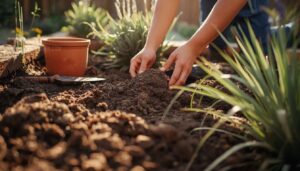
Good soil prep is the foundation of a drought-tolerant garden — get it right, and your plants will need far less help from you down the road.
Before planting, it’s worth checking what you’re working with. This step ensures your soil is set up for success, allowing you to address any issues early and create an environment where plants can thrive with minimal intervention.
Test Drainage Before Planting
Before you dig a single planting hole, check how your soil actually drains — it’s the kind of detail that separates a thriving xeriscape from a waterlogged disappointment.
- Hole Dimensions: Dig 12 inches deep and wide with straight sides.
- Saturation Step: Fill it once, let it drain completely, then refill.
- Drain Rate: Ideal soil loses 1–3 inches per hour.
- Site Clues & Test Timing: Surface puddles and soggy patches after rain signal trouble — test those spots first.
Improve Clay Soil With Compost and Grit
Clay soil is stubbornly slow to drain — but genuinely transforms it. Work organic compost into the top 12 inches to open up pore spaces and improve soil structure enhancement over time.
For raised bed mix situations, combine compost with horticultural grit. Grit application rates matter, however: small amounts barely help.
Autumn is the ideal time for amendments, allowing winter frost to carry improvements deeper.
Add Organic Matter to Sandy Soil
Sandy soil drains fast — sometimes too fast. Unlike clay, the challenge here isn’t compaction; it’s moisture slipping away before roots can use it. Compost integration solves this by filling gaps between sand particles.
- Apply 2–4 inches of organic compost and mix to an amendment depth of 6–8 inches.
- Try biochar amendment to boost soil moisture retention dramatically.
- Follow seasonal incorporation each fall, maintaining nutrient balance annually.
Adjust Soil PH for Plant Preferences
After addressing moisture retention, soil pH is the next piece worth checking. Most drought-tolerant and Mediterranean plants thrive in a neutral to slightly alkaline range—ideally pH 6.5–7.5. Conducting a soil pH test before planting indicates your starting point, ensuring optimal conditions for root development and nutrient uptake.
If adjustments are needed, amendments vary based on soil condition:
| Soil Condition | Amendment | Timing |
|---|---|---|
| Too acidic | Lime (application rates vary by soil type) | Before planting |
| Too alkaline | Sulfur | Early fall (apply weeks ahead) |
| Balanced | Compost (improves water retention) | Anytime |
Wrong pH locks out nutrients even when fertilizer is present—this is pH Impact on Nutrients in action. An imbalance prevents plants from absorbing essential elements, stunting growth and weakening resilience. Regular testing and targeted amendments ensure a fertile foundation for healthy plant development.
Use Raised Beds in Poorly Drained Areas
Once soil pH is balanced, poor drainage is the next obstacle — and raised beds solve it beautifully.
Build your bed frame using recycled plastic lumber or treated wood, aiming for 12–24 inches in height.
Start with a drainage base of gravel or broken stones, then fill with a rich soil amendment blend of compost and perlite.
Proper bed orientation on a gentle slope helps excess water drain naturally away from roots.
Clear Weeds Before Planting
With your raised bed ready, don’t skip this step — weeds steal moisture that your new plants desperately need. Competition reduction starts before the first plant goes in.
- Manual Digging – Pull deep-rooted weeds by hand after watering the soil.
- Hoeing Weeds – Sever shallow seedlings on dry days so roots wither fast.
- Sheet Mulching – Layer cardboard over cleared areas, then top with organic mulch.
- Soil Solarization – Cover bare ground with clear plastic for 8 weeks to cook remaining seeds.
Clean soil preparation and amendment for xeriscaping begins weed-free.
Plan Permeable Paths and Dry Garden Zones
Once your soil is weed-free, focus on how water moves across your entire yard—not just through it. This foundational step ensures efficient drainage and absorption.
Smart path and zone planning forms the backbone of xeriscaping. Strategic design directs water flow while minimizing waste. Key elements include:
| Permeable Pathway Materials | Dry Zone Design Features |
|---|---|
| Gravel Path Design | Swale Integration |
| Open-Grid Pavers | Dry Zone Mulch Layers |
Gentle Slope Management keeps runoff slow, allowing rainwater to infiltrate naturally. Pairing permeable hardscaping with drought-tolerant borders transforms dry climate gardening into an effortless, waterwise system.
Plant for Quick Establishment
How you plant matters just as much as what you plant. A few simple steps during planting day can mean the difference between a struggling seedling and a thriving, drought-ready plant.
Here’s what to do to give your plants the best possible start.
Plant in Cooler Seasons When Possible

Timing is everything when giving drought-tolerant plants a strong start. Fall planting and early-spring planting dramatically reduce heat stress, allowing roots to settle into warm soil without battling summer’s intensity.
Seasonal root development occurs naturally during cooler months, with up to 80% of perennial root growth happening in fall. This timing ensures roots establish efficiently before warmer weather returns.
Lower irrigation needs follow automatically, making the plant establishment period far more forgiving. By aligning planting schedules with these natural cycles, gardeners conserve water while fostering resilient, deep-rooted growth.
Space Plants by Mature Size

Crowding plants together might seem efficient, but it actually works against you. Mature width spacing matters more than most people realize — it’s the difference between a thriving garden and a tangled, disease-prone mess. Lavender Hidcote needs 18–24 inches center-to-center distance; large agaves want 8 feet.
Proper spacing ensures proper airflow corridors keep foliage dry and roots competition-free, following the simple principle of right plant, right place.
Dig Holes as Deep as Root Balls

Root ball measurement is your starting point — match the hole depth exactly to the root ball height, no deeper. Setting plants on an undisturbed soil base prevents settling and keeps crowns exposed.
Avoid excess depth: even two extra inches invites rot.
Soil compaction at the base gives deep roots a firm foundation to spread outward.
Loosen Roots Before Setting Plants

Before you set a plant in its hole, take a moment to free those roots. Pre-soaking roots in a bucket softens compacted soil and makes loosening easier.
Try gentle root massaging to open up packed sides, then bottom root teasing to expose inner roots.
For tightly bound plants, use root ball slicing.
Plant at The Correct Crown Depth

Crown leveling might be the most overlooked step in planting. Find where the stem meets the roots — that’s your root crown placement. Match the soil surface mark from the nursery container, keep the trunk flare alignment just above grade, and do a quick crown visibility check before backfilling.
Most perennials sit at or just one inch below the surface. Nail this during the plant establishment period and you’ll sidestep crown rot for good.
Group Plants With Similar Water Needs
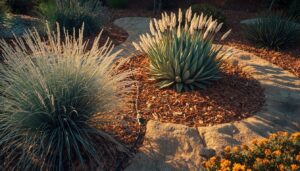
Once your crown depth is set, consider your plant’s neighbors. Hydrozone mapping simplifies this by grouping plants according to their water needs, ensuring each irrigation zone functions cohesively. This approach minimizes inefficiency and supports seasonal water scheduling.
Root depth matching is equally vital—pair shallow-rooted plants like lavender with blue fescue, avoiding water-hungry companions such as fruit trees. Such deliberate pairings prevent overwatering and resource waste.
By implementing intentional plant water grouping, you streamline irrigation practices, reduce excess usage, and maintain consistent hydration schedules throughout the growing season.
Cluster Plants to Create Shade at Soil Level
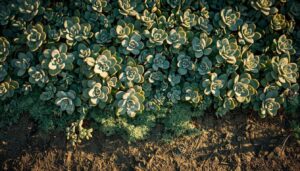
Grouping plants close together does more than look tidy — it builds a living canopy that keeps soil cool and moist. Canopy layering with shade-generating species like sedum or creeping thyme blocks sun before it hits bare ground. Microclimate benefits kick in fast with drift planting.
- Groundcover density drops soil temps by up to 10°C
- Interlocking leaves trap moisture through natural mulching
- Succulent and stonecrop uses in xeriscape designs add structure while shading roots
Water Immediately After Planting
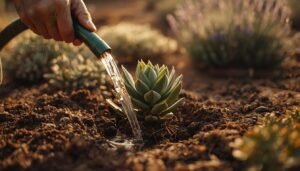
Once your plants are settled in, water right away. That first-day soak is your foundation. Immediate root hydration closes air gaps and pulls the roots into contact with surrounding soil.
Apply settling water at the soil line using controlled infiltration: slow and steady, with no splashing. This method ensures even moisture distribution without disturbing the soil or damaging delicate roots.
A hose without a nozzle provides the ideal watering pressure management needed for this process. Avoid forceful streams, as gentle flow encourages deep, healthy root establishment from the start.
Water Deeply, Then Reduce
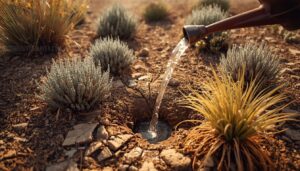
Getting water right in that first year makes all the difference for drought-tolerant plants. The goal isn’t to water often — it’s to water smart, then gradually step back as your plants find their footing.
Water smart in year one, then step back and let drought-tolerant plants find their strength
Here’s how to build that habit from day one.
Follow a First-year Watering Schedule
Think of the first year as your plant’s boot camp — it needs structure to build strength. Begin with Daily Initial Watering for week one, then transition to an Alternate Day Schedule through week two. By midsummer, adopt a Weekly Deep Soak routine.
To optimize care, follow these practices:
- Skip watering on Rainfall Pause Days
- Practice Soil Moisture Monitoring by checking 2–3 inches down
- Water early in the morning, at the soil line
Soak The Root Zone 12–18 Inches Deep
Deep watering means getting moisture all the way down 12–18 inches—which is where feeder roots actually drink. Use a Gradual Soak Rate with drip lines or soaker hoses, letting water move slowly through the root zone spread.
After watering, a Moisture Probe Check confirms you’ve hit the mark.
A simple basin water retention ring around young plants keeps water right where roots need it.
Water Once or Twice Weekly, Not Daily
Once or twice a week is all your drought-tolerant plants really need.
Daily watering waterlogs roots, cuts oxygen, and triggers fungal disease — the opposite of what you want.
Deep watering sessions spaced out boost root depth benefits, improve nutrient retention, and support real water use efficiency. Stick to this rhythm, and your plants build strength instead of dependence.
Irrigate in Early Morning or Evening
Timing is everything for water conservation. Watering early in the morning — ideally before 6 a.m. — reduces evaporation losses by 15–20% compared to midday. Evening works too, but water at the soil line, not on foliage, to prevent foliar disease.
Smart irrigation scheduling also involves staying ahead of municipal water timing peaks. This approach ensures roots stay cool and hydrated through extreme heat, maximizing efficiency while minimizing waste.
Use Drip Irrigation or Soaker Hoses
Drip irrigation is one of the smartest moves for water-wise gardening. A basic system layout includes a filter, a pressure regulator set to 15–30 psi, and emitters delivering 1–2 gallons per hour directly to roots — cutting water use by up to 70%.
Soaker hoses work great for smaller beds. Either way, water savings add up fast, and seasonal shutdown takes just minutes.
Avoid Shallow, Frequent Watering
Frequent, shallow watering is a trap — it trains roots to stay near the surface, where heat and wind dry them out fast. This approach undermines Water Use Efficiency and creates Surface Crust Management problems, causing water to run off instead of soaking in.
Instead, adopt deeper, less frequent watering to encourage stronger root growth. Try these practices:
- Water at the soil line, not overhead
- Space out sessions for smarter Irrigation Frequency Planning
- Check moisture below the surface with Moisture Sensor Placement
Reduce Irrigation After Establishment
Once your plants are settled in, pull back on watering gradually. Soil moisture sensors take the guesswork out — they tell you when the root zone actually needs a drink.
Pair that with ET scheduling and zone grouping, and you’re watering smarter, not more.
Cycle soak watering, pressure regulation, and mulch to lock in moisture all support reducing reliance on sprinkler systems over time.
Extend Deep Watering for Young Trees
Young trees need more patience than most plants. Even drought-tolerant species take two to three growing seasons before their roots venture beyond the original planting hole. Track root depth as the canopy grows, and adjust your irrigation timing and water volume calculation accordingly.
Deep, slow soaks every one to two weeks beat frequent shallow sprinkles every time.
- Use soil moisture sensors to know exactly when to water
- Mulch to lock in moisture and moderate soil temperature
- Make seasonal watering adjustments during extreme heat spells
- Target the drip line, not just the base, for irrigation efficiency
Mulch and Maintain for Success

Once your plants are in the ground and watered in, the real work shifts to keeping them thriving with minimal fuss.
A few simple maintenance habits make a big difference — especially when dry spells hit.
Here’s what to focus on to protect your plants and stretch every drop of water further.
Apply 2–3 Inches of Mulch
Mulch is your best friend when summer heat sets in. Applying it with a 2–3 inch layer is key for reducing evaporation. This thickness stabilizes soil temperature, slows the decomposition rate of organic matter underneath, and blocks weeds competing for moisture.
Mind layer uniformity—thin patches lose their effect fast.
Keep it even, and you’ll lock in moisture all season long.
Choose Organic or Gravel Mulch by Plant Type
Not every plant wants the same thing under its feet. Woodland organic mulch — bark, leaf mold, compost — suit hostas, ferns, and astilbe perfectly, supporting the moist living soil they love. Flip that around for Mediterranean gravel mulch: lavender, rosemary, and thyme need sharp drainage and dry crowns, especially during wet winters.
Match your mulch to your plants:
- Woodland beds — bark or leaf mold for steady moisture retention
- Mediterranean herbs — crushed granite or pea gravel for fast drainage
- Succulent grit cover — fine gravel under half an inch keeps roots dry
- Vegetable straw mulch — straw or compost feeds soil between replanting
- Tree wood-chip mulch — arborist chips build fungal networks around roots
Keep Mulch Away From Stems and Crowns
Once you’ve matched your mulch type to your plants, placement matters just as much. Think of it like a donut, not a volcano — keep a clear gap around every stem and crown. Piling organic mulch against the base traps moisture against living tissue, creating the perfect conditions for rot, fungal disease, and hidden pest damage.
| What Goes Wrong | Why It Happens |
|---|---|
| Crown rot | Wet mulch holds moisture against soft tissue |
| Fungal infection | Poor air circulation breeds disease |
| Pest hiding spots | Packed mulch shelters insects and rodents |
| Girdling roots | Deep mounds encourage roots to wrap stems |
| Missed pest damage | No crown exposure means problems go unnoticed |
Pull mulch back a few inches from the base. A flat, even ring beats a cone every time, preventing moisture buildup and ensuring healthy air circulation around your plants.
Use Groundcovers to Reduce Evaporation
Low-growing ground cover plants pull double duty in a dry garden. Their dense canopy delivers a living cover advantage — shading soil, buffering temperature swings, and sheltering the root zone from punishing sun.
Coverage density impact is real: tighter plantings keep moisture in longer.
Creeping thyme and sedum are smart, water-wise design picks that outperform bare soil every time.
Remove Weeds That Compete for Moisture
Weeds are silent thieves — and they work fast. A single patch of crabgrass can drain over 80 gallons of water per pound of growth. Early season weeding stops that loss before it starts.
- Hand pulling after rain removes entire root systems cleanly
- Shallow hoeing kills small annuals without disturbing nearby roots
- Flame weeding scorches seedlings while preserving soil structure
- Weed barrier fabric cuts weed growth by up to 90%
- Low-maintenance groundcovers fill gaps so weeds can’t take hold
Watch for Overwatering and Root Rot
Even drought-tolerant plants can drown. When soil oxygen disappears from waterlogged roots, trouble follows fast.
Watch for yellow, limp leaves — those are your leaf wetness signs. Fungus gnat warning: Tiny flies hovering near soil indicate excessive moisture. Root inspection often reveals mushy, dark roots, a clear sign of rot.
For post-rot recovery, trim damaged roots, repot in fresh mix, and resume watering at the soil line only.
Prune Lightly to Maintain Shape and Airflow
Think of pruning as editing — remove just enough to let your plants breathe. Late winter is ideal: use sharp tools for crown thinning on dense shrubs, clearing up to a quarter of the live branches to improve airflow. Heading back stems by one-third of their length encourages bushier regrowth.
For shaping herbs, trim lavender and sage lightly after their flowering to maintain compactness and productivity.
Refresh Mulch and Check Soil Moisture Seasonally
Mulch timing makes or breaks a drought-tolerant garden. Refresh mulch in late spring before summer heat peaks, then top off thin spots mid-summer to lock in moisture. In fall, nudge that layer up to three inches for root protection.
To maintain moisture effectively, implement these monitoring strategies:
- Check soil moisture every 7–10 days using moisture probe techniques
- Probe 4–6 inches deep — surface dryness misleads you
- In heat above 85°F, switch to every 2–3 days for seasonal watering strategies during extreme heat
- Build a seasonal moisture map by probing the same spots consistently
- Apply mulch for evaporation reduction after every heavy rain or storm
Frequently Asked Questions (FAQs)
What plants are safe for dementia patients?
When in doubt, go green and gentle. For dementia patients, Non‑Toxic Herbs like Lavender Lavandula spp, Rosemary Salvia rosmarinus, Sage Salvia spp, and Thyme Thymus spp offer safe therapeutic options.
These plants provide Aromatic Therapy, Sensory Stimulation, and Edible Safe Choices through their Soft‑Texture Plants, supporting well-being without risks.
How do you plant drought-tolerant plants?
Start with well-draining soil, plant at the right depth, and water deeply after planting.
Smart companion plant pairing and microclimate creation help roots settle in fast with less water from day one.
How to prepare soil for drought-tolerant plants?
Good soil works on three levels: texture, drainage, and life. Nail those, and your plants practically care for themselves.
How often should I water drought-tolerant plants after planting?
Water deeply once or twice a week right after planting. Soak the root zone fully, then let the soil dry slightly before watering again. Less often as roots settle in.
How do I choose a drought tolerant plant?
Look for a few key traits: deep root systems, waxy or hairy leaf texture, and water storage in stems. Seasonal dormancy is a bonus.
Native plants often check every box naturally.
How do I Make my Garden drought tolerant?
Making your garden drought tolerant comes down to smart choices: selecting the right plants, improving your soil, mulching well, and watering deeply but less often. Small changes add up fast.
Which plants are drought tolerant?
Drought-tolerant plants encompass a diverse range, from native xerophytes and Mediterranean perennials—such as Lavender (Lavandula spp.) and Russian Sage (Perovskia atriplicifolia)—to resilient species adapted to arid conditions.
Additional categories include drought-tolerant grasses, succulent groundcovers like Stonecrop (Sedum spp.), and flowering perennials such as Coneflower (Echinacea spp.).
How to create a drought tolerant landscape?
Creating a drought-tolerant landscape starts with smart planning—hydrozone planning, rainwater capture, and reflective hardscape work together so your garden thrives on less water year-round.
Are drought tolerant plants low-maintenance?
Once established, drought-tolerant plants are genuinely low-maintenance.
They require little water, minimal fertilizer, and light pruning.
This translates to labor savings, cost efficiency, and a garden that largely takes care of itself.
What is drought tolerant landscaping?
It’s a water-wise approach to gardening that relies on low maintenance plants, smart design principles, and water harvesting strategies to sustain your landscape.
This method ensures your garden thrives even when rain doesn’t show up on schedule.
Conclusion
Most gardeners spend years fighting their climate—watering daily, watching plants wilt anyway, and wondering what they’re doing wrong.
This planting guide for drought-tolerant plants flips that entirely. Once your plants are matched to the right soil, planted in the right season, and mulched properly, they practically take care of themselves.
The roots go deep, the water goes further, and your garden stops depending on you quite so much.
That’s not a small win—that’s a completely different way to garden.
- https://www.rhs.org.uk/plants/for-places/drought-resistant
- https://hambrooks.co.uk/how-to-plan-a-drought-tolerant-garden/
- https://newsroom.ucla.edu/releases/duration-of-heat-waves-accelerating-faster-than-global-warming
- https://ed.primo.exlibrisgroup.com/discovery/fulldisplay?context=PC&vid=44UOE_INST:44UOE_VU2&search_scope=UoE&tab=Everything&docid=cdi_proquest_journals_3265307747
- https://www.biodiversitylibrary.org/part/250731