This site is supported by our readers. We may earn a commission, at no cost to you, if you purchase through links.
Farmers in the U.S. spend over $10 billion on pesticides every year—yet pest pressure keeps climbing, resistance keeps spreading, and the environmental bill keeps growing.
Something isn’t adding up.
The problem isn’t that growers aren’t trying hard enough; it’s that spraying on a schedule, regardless of what’s actually happening in the field, is a losing strategy.
The benefits of integrated pest management cut through that cycle by replacing reactive chemical use with monitoring, thresholds, and targeted interventions that work with natural systems instead of against them.
What that shift means for your operation, your community, and the land you steward is worth understanding in full.
Table Of Contents
- Key Takeaways
- Reduced Reliance on Chemical Pesticides
- Enhanced Environmental Protection
- Economic Benefits for Growers
- Improved Human and Community Health
- Sustainable and Long-Term Pest Control
- Frequently Asked Questions (FAQs)
- What are the benefits of integrated pest management?
- What are the benefits and drawbacks of IPM?
- What are the four goals of integrated pest management?
- What is a good reason to implement integrated pest management?
- What are the benefits of integrated disease management?
- What are the three goals of IPM?
- What does integrated pest management help with?
- What training is needed to implement IPM programs?
- How do you set pest action thresholds?
- What tools help monitor pest populations effectively?
- Conclusion
Key Takeaways
- Integrated pest management replaces routine spraying with monitoring, thresholds, and targeted actions so you use fewer pesticides while still keeping pests under control.
- By cutting spray volumes and rotating control methods, IPM slows pest resistance and helps keep both chemical and biological tools effective for the long term.
- IPM protects the environment by safeguarding pollinators, improving soil and water quality, and supporting biodiversity so natural systems work for your farm instead of against it.
- A well-run IPM program lowers pest control costs, stabilizes yields, improves market access, and reduces health risks for workers, families, and nearby communities.
Reduced Reliance on Chemical Pesticides
One of the biggest advantages of IPM is that you don’t have to lean on chemical sprays every time a pest shows up. By focusing on prevention, targeted action, and smarter long term planning, you cut both use and exposure.
For a deeper look at building resilient, low-spray programs, check out this guide to long-term integrated pest management solutions.
Here are some practical ways IPM helps you reduce your dependence on chemical pesticides while still keeping pests under control.
Minimizing Pesticide Use and Exposure
When you lean on Integrated Pest Management, you start cutting spray volumes without sacrificing Pesticide Use and Safety.
- Threshold Monitoring plus Biological Controls and other Nonchemical controls replace routine calendar spraying.
- Precision Spraying with proper Protective Equipment strengthens Environmental Protection on and beyond your fields.
- Sustainable Pest Control Practices and Community Education keep families informed and reinforce everyday practical care.
Adopting IPM helps reduce pesticide risk and helps biodiversity.
Lower Risk of Chemical Resistance
Cutting spray volumes also protects something less visible: the effectiveness of the chemicals you still use.
When pests face the same active ingredient repeatedly, they adapt — that’s resistance in action.
Mode rotation, resistance monitoring, and biocontrol integration work together to slow that process.
Threshold decision-making and nonchemical controls reduce selection pressure, preserving biological pest control and sustainable pest control practices long-term.
Safer Alternatives for Sensitive Environments
Some environments simply can’t afford chemical shortcuts — greenhouses, schools, pollinator habitats, organic farms. That’s where Integrated Pest Management really earns its place.
- Biological Controls deploy beneficial insects that hunt pests naturally
- Pheromone Traps disrupt mating cycles without a single spray
- Mechanical Barriers physically block pest entry before problems start
- Botanical Pesticides break down quickly, leaving minimal residue
- Microbial Biopesticides target specific pests while sparing everything else
Eco‑friendly pest management isn’t a compromise — it’s precision.
If you’re rethinking your whole approach, this guide to sustainable, low-toxicity pest control strategies walks through practical, real-world examples.
Enhanced Environmental Protection
When you use IPM, you’re not just managing pests, you’re also protecting the land that sustains your farm and community.
This approach helps keep natural systems working for you instead of against you.
Let’s look at a few key ways IPM strengthens environmental protection on and around your fields.
Safeguarding Beneficial Insects and Pollinators

Protecting pollinators isn’t a luxury; it’s the backbone of your farm’s ecological balance. You do that by designing habitat gardens, timing sprays carefully, and using Integrated Pest Management Benefits that keep control targeted while letting beneficial insects work hard.
native plants provide nectar(https://livetoplant.com/best-practices-for-protecting-beneficial-insects-in-garden-ecosystems/) for local pollinators and support a thriving garden ecosystem.
| Habitat Corridors | Nesting Sites | Floral Diversity |
|---|---|---|
| Pesticide Buffer Zones | Community Monitoring | Biodiversity Conservation |
| Ecological Balance | Sustainable Pest Management | Ecofriendly Pest Management |
Improving Soil and Water Quality

Healthy soil starts with fewer chemicals in it. Integrated Pest Management promotes environmental sustainability by reducing runoff that degrades water quality and strips nutrients from your fields.
Buffer strips along field edges cut phosphorus and nitrogen losses by up to 50 percent. Combine that with cover crops for soil organic matter, improved water infiltration, erosion control, and nutrient management — and sustainable pest control actively rebuilds the land beneath your feet.
Supporting Biodiversity and Ecosystem Services
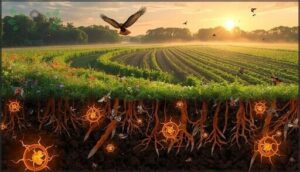
When you manage pests ecologically, you’re protecting far more than this season’s crop. Integrated Pest Management provides the living infrastructure your farm depends on:
- Habitat Connectivity through hedgerows and buffer strips facilitates native predator conservation and pollinator habitat across your landscape.
- Soil microbial diversity drives nutrient cycling and disease suppression naturally.
- Landscape heterogeneity strengthens ecosystem conservation and environmental sustainability long‑term.
Sustainable pest control builds resilience from the ground up.
Economic Benefits for Growers

When you look at IPM from a grower’s perspective, the numbers matter just as much as the insects.
A well-designed IPM program can reduce what you spend on control while protecting the value of every acre you plant.
Here’s how IPM helps your bottom line through lower costs, stronger yields, and better access to key markets.
Lower Pest Management Costs
With Integrated Pest Management, you cut costs by improving Scouting Efficiency, using Action thresholds so you only pay for Targeted treatments when pest pressure justifies them.
Data‑Driven Alerts and Targeted Spraying focus labor and materials on hot spots, not fields.
Seasonal Budgeting, Cooperative Purchasing, and Preventive Pest Control wrap those choices into a clear plan, turning Sustainable Practices into savings.
Stable and Increased Crop Yields
Stable yields don’t happen by accident. When you combine Forecast-Driven Scouting with Resistant Varieties and Soil Nutrient Balance, you’re building a system that buffers crops against unpredictable pressure.
Yield Monitoring shows you where losses occur, while Precision Irrigation keeps plants productive during critical growth stages. Integrated Pest Management ties these Pest Management Techniques and Sustainable Practices together, so Environmental Protection and Pest Prevention work in your favor every season.
Market Access and Certification Advantages
Think of certification as a second harvest: when your Integrated Pest Management program already meets strict Regulatory Standards, Pest Control Regulations and Compliance become easier.
Regulatory Streamlining reduces paperwork, and Pest Control Training and Certification enable Procurement Eligibility, Export Market Entry, Certification Premium Pricing, stronger Consumer Trust Signals, and recognition for Environmental Sustainability in Pest Control across high-value premium markets.
Improved Human and Community Health

IPM doesn’t just protect crops; it also protects the people who grow, handle, and live around them.
IPM protects not just crops, but also the people who grow, handle, and live near them
When you reduce unnecessary chemicals and focus on prevention, you lower everyday health risks for workers, families, and nearby communities. In the next points, you’ll see how IPM enhances safer working conditions, cleaner food, and healthier air where you live and farm.
Reduced Health Risks for Farmworkers
Farmworkers face real risks every season — skin irritation, respiratory exposure, and pesticide drift are daily hazards in conventional systems.
Integrated Pest Management changes that equation. By limiting unnecessary pesticide applications and scheduling treatments around worker schedules, IPM cuts exposure at the source. Combined with safety training and proper protective equipment, it is one of the strongest environmental health practices you can adopt to protect farmworker health risks and public health and safety.
Safer Food and Living Environments
Protecting workers is half the story; you also want safer kitchens and homes.
With Sanitation Protocols, Water Quality Management, and sealed storage, Integrated Pest Management Strategies keep pests away from food surfaces.
Air Filtration Systems, Pest‑Resistant Design, and Sustainable Practices support Pest Prevention, Environmental Protection, and Public Health and Safety, strengthened by Community Education Programs that align habits with IPM.
Lower Exposure to Allergens and Asthma Triggers
Beyond safer food spaces, you also want the air you breathe to work in your favor.
Integrated Pest Management Strategies use Dust Mite Control, Pollen Filtration, and Mold Moisture Management together with Pet Dander Reduction and Cockroach Allergen Mitigation.
Pest Prevention and Exclusion Methods lower Public Health Risks and strengthen Environmental Health for sensitive workers and families everywhere today.
Sustainable and Long-Term Pest Control

Sustainable pest control isn’t just about stopping today’s infestation; it’s about keeping problems from coming back year after year.
With IPM, you build systems and habits that make your fields and community less inviting to pests, even as conditions change. In the next section, you’ll see key strategies that help you prevent outbreaks, stay flexible, and involve others in long‑term pest management.
Preventing Pest Outbreaks and Recurrence
When you catch a pest problem early, you stop it before it snowballs. IPM builds that early detection into your routine — weekly scouting, monitoring thresholds, and action thresholds that tell you exactly when to move.
These sustainable practices keep pressure low year-round:
- Crop rotation disrupts pest life cycles each season
- Habitat modification removes shelter and breeding sites
- Biological controls reduce reliance on reactive spraying
- Targeted treatments intervene only when thresholds are crossed
- Consistent pest prevention and control logs guide smarter future decisions
Adaptive Strategies for Changing Conditions
Early detection sets the foundation, but the real staying power of IPM comes from staying flexible. Conditions shift — climate patterns, pest pressure, market demands — and your strategies need to shift with them.
| Factor | Adaptive Response | Outcome |
|---|---|---|
| Climate variability | Scenario planning for drought or wet seasons | Fewer unexpected outbreaks |
| Pest resistance trends | Rotating targeted treatments and chemistries | Longer-lasting control |
| Real-time scouting data | Flexible thresholds recalibrated within 24 hours | Smarter, timely decisions |
Stakeholder collaboration and data-driven decisions keep your adaptive pest management aligned with what’s actually happening in the field — not just what worked last season.
Promoting Education and Community Engagement
Building knowledge around pests turns your community into part of the management team.
Through School Workshops, Youth Programs, Resident Education, and Environmental Education, you turn abstract ideas into hands-on skills.
Community Outreach, Farmer Mentorship, Citizen Science, and Community Involvement in IPM anchor Sustainable Practices in Education, and support Public Health Pest Management on every field and block across your region.
Frequently Asked Questions (FAQs)
What are the benefits of integrated pest management?
In IPM programs, pesticide sprays drop while yields stay steady, linking Soil microbial health, Worker safety training, Crop quality premium, Community education, Climate resilience, Sustainable Practices, Pest Prevention Methods, Environmental Health, Public Health, and outcomes.
What are the benefits and drawbacks of IPM?
Balanced pest management strategies like IPM boost farmer income and community safety while supporting soil health and climate adaptability — though upfront training costs and scouting demands can challenge early adoption.
What are the four goals of integrated pest management?
Four priorities drive Integrated Pest Management: Damage Prevention through sanitation and exclusion, Risk Minimization via action thresholds, Strategic Integration of Sustainable Practices, and Pest Resistance Management — together building lasting Community Resilience across every farm and field.
What is a good reason to implement integrated pest management?
One compelling reason to implement IPM is sustainable, long-term prevention.
By combining biodiversity preservation, pest resistance management, and climate resilience strategies, you reduce costs, meet consumer demand, support environmental health, and stay ahead on regulatory compliance.
What are the benefits of integrated disease management?
Integrated disease management cuts costs, protects ecosystems, safeguards farmworker health, and builds yield resilience — all while reducing chemical dependency through sustainable pest prevention strategies rooted in community involvement and climate adaptation.
What are the three goals of IPM?
IPM’s three goals are Pesticide Minimization, Ecosystem Preservation, and Grower Profitability.
Through Safety Prioritization and Adaptive Management, this Sustainable Pest Management approach protects Environmental Health while using Action thresholds to guide smarter, science‑based decisions.
What does integrated pest management help with?
Apparently, the magic spray-and-pray era is over;
IPM helps you focus on Pest Prevention through Monitoring Thresholds, Habitat Modification, Biological Controls, smarter Pest Management, Sustainable Pest Control Methods, Community Education, and protecting Environmental Health for everyone.
What training is needed to implement IPM programs?
Effective IPM program implementation starts with solid pest control training covering pest identification, monitoring techniques, threshold setting, regulatory compliance, and community outreach — giving your team the skills to apply professional IPM strategies confidently in the field.
How do you set pest action thresholds?
You set Action thresholds with Data-driven scouting and Monitoring Practices, tying Crop value analysis, Pest biology metrics, Seasonal growth stages, and Economic loss modeling.
Then choose Threshold levels to direct Integrated Pest Management and Pest Management.
What tools help monitor pest populations effectively?
On your fields, sensor traps, Drone imaging, Acoustic sensors, and IoT networks feed dashboards that optimize inspection monitoring, identification, threshold levels, measurement and evaluation, helping you adjust Action thresholds and target interventions where pressure is rising.
Conclusion
Pest pressure, profitability, and people’s health are all connected—and the benefits of integrated pest management pull every thread in the right direction. When you monitor before you spray, set thresholds before you act, and work with natural systems instead of overpowering them, you’re not just managing insects. You’re managing risk, cost, and legacy.
The growers who understand that connection don’t just grow better crops. They build something that lasts.