This site is supported by our readers. We may earn a commission, at no cost to you, if you purchase through links.
Most gardeners pack up their beds in October and wait.
A cold frame changes that entirely—kale, spinach, and arugula keep producing well into December with nothing more than a glazed lid and smart positioning.
The physics behind it is straightforward: trap solar heat during the day, hold it through the night, and your soil stays 2°C to 6°C warmer than exposed ground during the very frosts that end everyone else’s season.
Pair that with staggered sowings every two to three weeks, and cold frame gardening vegetables become less of a seasonal hobby and more of a year-round food system.
What follows covers exactly how to build, plant, and manage that system from the ground up.
Table Of Contents
- Key Takeaways
- Why Grow Vegetables in a Cold Frame
- Best Cold-Hardy Vegetables to Grow
- Build a Sunny Cold Frame
- Manage Heat, Water, and Frost
- Top 9 Cold Frame Gardening Guides
- 1. New Organic Grower Manual
- 2. VNIMTI Round Garden Shovel with Wooden Handle
- 3. Growing Under Cover Vegetable Garden Guide
- 4. Year Round Vegetable Gardener Guide
- 5. Container Gardening Complete Guide
- 6. Beneficial Bugs Garden Guide
- 7. Good Bug Bad Bug Garden Insect Guide
- 8. Raised Bed Revolution Gardening Guide
- 9. Food Garden Design Ideas Book
- Frequently Asked Questions (FAQs)
- What vegetables grow best in a cold frame?
- What vegetables do I plant in October?
- How to grow vegetables in a cold frame?
- Can you grow vegetables in a cold frame?
- What are the disadvantages of cold frames?
- Are there any vegetables that can be planted in October?
- When should you start using a cold frame?
- How to use a cold frame for vegetables?
- What is the most cold tolerant vegetable?
- What are the disadvantages of a cold frame?
- Conclusion
Key Takeaways
- A cold frame traps solar heat to keep soil 2°C–6°C warmer than open ground, letting you harvest kale, spinach, and arugula well into December when everyone else has quit.
- Sow every two to three weeks, match crop height to your lid clearance, and space plants 12–18 inches apart so air moves freely and disease pressure stays low.
- Vent by mid-morning on sunny days to prevent temperatures from spiking past 100°F inside, then close the lid two hours before sunset to lock in the day’s warmth.
- Spinach is your most cold-tolerant crop, surviving down to 20°F–25°F, while roots like carrots and radishes thrive when soil stays between 5°C and 15°C with consistent moisture.
Why Grow Vegetables in a Cold Frame
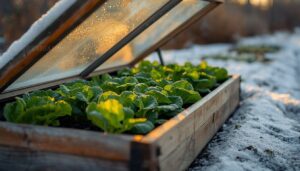
cold frame does more than protect your plants — it quietly extends what’s possible in your garden. Whether you’re in zone 6 or zone 3, the right setup can shift your growing season weeks in either direction.
With the right placement and setup, you can extend your cold frame growing season by weeks — pulling in harvests long after your neighbors have called it a year.
Here’s why so many gardeners consider it the best investment they never expected to make.
Extend The Harvest Into Late Fall and Winter
A cold frame can stretch your harvest by four to eight weeks in most temperate zones — sometimes more. Through staggered planting and seasonal succession, you’ll have kale, spinach, and arugula ready every two to three weeks well into December.
Mulch insulation around the base holds soil warmth, while microclimate monitoring inside the frame helps you fine-tune heat retention before the next frost arrives.
Before planting, consult the USDA Hardiness Zone to match crops to your climate.
Protect Crops From Frost, Wind, and Snow
Your cold frame acts as a first line of defense against frost, wind, and snow. Frost blanket layers raise bed temperatures by 2 to 6 degrees Celsius on bitter nights.
A windbreak fence design cuts damaging gusts by up to 40 percent. Add mulch insulation around the base, manage snow load management promptly, and use thermal mass placement — water bottles work — for reliable frost protection.
Create a Warmer Microclimate for Cooler Nights
Beyond blocking frost and wind, your frame can hold warmth through the night by stacking a few passive strategies together. Dark water barrels absorb heat all day and release it steadily after sunset — thermal mass at its simplest.
Pair that with a double-glazed lid, a low hedge on the windward side, and a reflective wall coating nearby, and you’ve built a genuine microclimate creation that stays 2 to 4°C warmer than open beds.
Start Spring Crops Earlier Than Outdoor Beds
That warmer microclimate pays off again when spring arrives. By preheating soil and tracking temperature thresholds inside your frame through microclimate monitoring, you can start spring transplants two to four weeks ahead of open beds.
Transplant scheduling becomes straightforward once you know your overnight lows.
Hardening off happens gradually using smart ventilation strategies, and early soil heating gives seedlings a strong, confident head start.
Grow More Food in a Small Space
Maximizing a cold frame’s footprint is easier than you’d think. Vertical stacking with a compact trellis lets peas or cucumbers climb without widening your raised bed cold frames.
Intercropping methods pair quick radishes between slower spinach rows, while succession planting keeps harvests rolling every few weeks.
Even portable cold frames open up small garden spaces you’d otherwise ignore — vertical cold frame gardening genuinely squeezes more from every square foot.
Best Cold-Hardy Vegetables to Grow
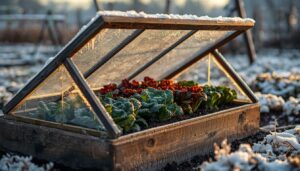
Not every vegetable can handle the cold, but the right ones will genuinely surprise you.
Your cold frame works best when you fill it with crops that stay compact, tolerate short days, and keep producing even as temperatures drop.
Here’s what to grow.
Choose Leafy Greens That Stay Compact Under The Lid
Not every green earns its place under a lid — size matters here.
In compact garden spaces, cold-hardy vegetables must stay well within your Cold Frame’s clearance. Prioritize these for year‑round vegetable production:
- Low-height spinach — stays 6–8 inches tall
- Compact lettuce cultivars — 4–6 inches, slow‑bolt greens that resist leggy stretch
- Tight rosette crops like tatsoi — under 8 inches
- Dwarf kale varieties — tops out around 12 inches with proper plant spacing
Grow Roots That Tolerate Cool Soil and Short Days
When days drop below 12 hours, roots like carrots, radishes, and turnips shift energy underground — that’s short day root growth working in your favor.
Keep soil temperature between 5–15°C using mulch temperature stabilization and root zone insulation beneath the frame.
Deep-rooted varieties need evenly moist, well-drained soil; use a moisture sensor to stay within 60–70% field capacity.
These cold-hardy crops resist temperature fluctuations inside your microclimate beautifully, but watch soil moisture — root rot strikes fast in waterlogged beds.
Plant Crops That Fit The Frame’s Height Limits
Your cold frame lid sets the rules — every plant inside must respect that ceiling.
- Low Height Peas (24 inches max) train neatly on a short trellis.
- Miniature Kale Selections and broccoli rabe stay under 18 inches.
- Compact Root Crops like radishes and turnips keep foliage under 12 inches.
- Dwarf Tomato Varieties stay below 24 inches with regular sucker pruning.
- Herb Height Control keeps basil and chives under 18 inches with frequent harvesting.
Use Spacing That Supports Airflow and Healthy Growth
Think of your cold frame as a living room — cramped furniture blocks the breeze.
Space leafy greens 12 to 18 inches apart and maintain 18 to 24 inches of aisle width between rows. Staggered planting breaks airflow barriers better than straight columns.
Keep canopy height balance consistent so air moves smoothly above leaves. Apply mulch edge buffer 1 to 2 inches from stems and vent for airflow daily to regulate humidity.
Match Sowing Dates to Winter Harvest Timing
Timing is everything in a cold frame. Back-calculate your seed sowing schedule from frost dates — most greens need 40 to 60 days from germination to harvest.
Staggered sowing every two to three weeks keeps your winter harvest continuous.
Watch germination temperature: soil below 10°C slows emergence.
Daylength planning and transplant hardening sharpen harvest forecasting, giving you a reliable seasonal planting schedule for year-round harvest.
Build a Sunny Cold Frame
Where you put your cold frame matters more than most people think. The right spot — with the right lid and the right build — can mean the difference between thriving greens in January and a box full of frost‑killed disappointment.
Here’s what to get right before you plant a single seed.
Set The Frame in a South-facing Location
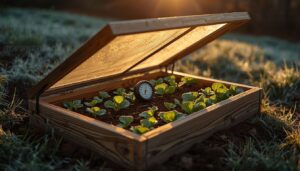
For maximum heat retention, orient your cold frame on a south-facing slope — a South Slope Tilt that captures Morning Light Capture from sunrise to midday. Selecting a sunny south-facing location for cold frames means your microclimate stays warmer with no extra effort.
Full sun exposure through a clear lid with Lid Glare Reduction lets plants photosynthesize efficiently. Position your Temperature Sensor Placement centrally to monitor real daily highs.
Place It Near a Wall or Wind-break for Shelter
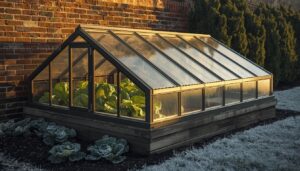
A sunny location does half the work — your placement does the rest.
Set your frame against a south-facing brick or stone wall to benefit from Wall Heat Transfer: the wall absorbs daytime warmth and releases it after sunset.
A dense evergreen windbreak nearby manages Wind Break Orientation, cutting gusts by up to 60%.
That Microclimate Buffer stabilizes night temperatures noticeably.
Leave an Insulation Gap of 6–12 inches, and mount Vent Placement on the side away from the wall.
Choose Glass, Polycarbonate, or Reclaimed Window Lids
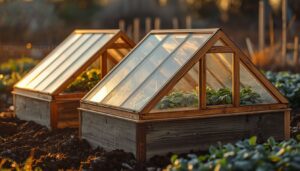
Your lid choice shapes everything — light transmission, warmth retention, and long-term cost.
Glass delivers 80–90% clarity and lasts decades, but it’s heavy and breakable.
Polycarbonate panel cold frames are lighter, offer solid impact resistance, and multiwall versions add real thermal insulation.
Reclaimed window lids and old windows cost almost nothing and have genuine recycling potential — just inspect for cracks before repurposing.
Size The Frame for Crop Height and Easy Access
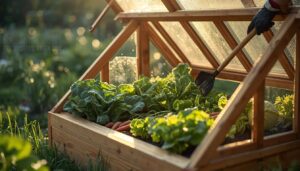
Once your lid material is sorted, frame dimensions become the next decision. Ideal Frame Height sits between 28 and 36 inches — a 30‑inch build suits most gardeners without kneeling.
Pair that with an Adjustable Lid Mechanism and Side Access Panels on two sides, so tools reach every row.
Match Crop Height Clearance to your plant height: leafy greens need 8–12 inches; root crops, less.
Add Thermal Mass or Insulation for Extra Warmth
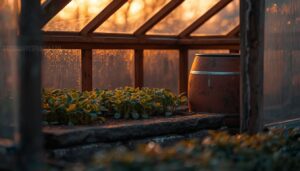
Think of your cold frame as a heat bank — what you store during the day pays dividends at night.
A cold frame is a heat bank — the warmth you store by day pays dividends all night long
A dark stone slab or brick wall mass beneath your beds absorbs solar energy and releases it slowly after dark. Water barrel storage works the same way; a sealed 100-liter container holds surprising warmth.
Foam board insulation and a reflective radiative barrier on exterior walls lock that heat in.
Manage Heat, Water, and Frost
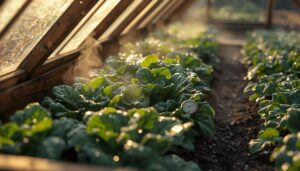
A cold frame is surprisingly good at trapping heat — sometimes too good.
Knowing when to vent, when to close up, and how much water your crops actually need makes the difference between thriving plants and a frustrating mess. Here’s stay on top of all three.
Vent The Frame on Sunny Days Before Overheating Starts
Heat is your cold frame’s silent enemy on clear days. Once temperatures push past 100°F inside, crops wilt fast. Daily venting starting mid-morning gives plants the airflow path they need. Place temperature sensors near center-height for accurate readings, not just guesswork.
- Open vents 1–2 inches by 9–10 a.m. in a sunny south-facing location for cold frames
- Use adjustable louvers or hinged lids to fine-tune airflow without tools
- Pair ventilation strategies to regulate temperature and humidity with shade screens on peak-sun days
- Vent timing matters — close gradually as afternoon cools, not all at once
Close The Lid Before Sunset to Hold in Warmth
Closing the lid two hours before sunset locks in the day’s warmth before convection carries it away. Consistent Heat Retention Timing is simple: watch the sky, not just the clock.
Lid Sealing Techniques — tight hinges, weatherstripped edges — cut cold drafts substantially.
Thermal Mass Integration from brick walls releases stored heat overnight, stabilizing your microclimate naturally.
| Condition | Close Lid At | Expected Overnight Low Inside |
|---|---|---|
| Clear, calm evening | 2 hrs before sunset | 10°F above outdoor temp |
| Overcast, mild wind | 1 hr before sunset | 6°F above outdoor temp |
| Heavy cloud, gusty | At sunset | 3°F above outdoor temp |
| Hard frost forecast | 3 hrs before sunset | 8°F above outdoor temp |
| Mild winter evening | 90 min before sunset | 9°F above outdoor temp |
Water Sparingly and Keep Foliage as Dry as Possible
Inside a cold frame, wet foliage is an open invitation for fungal foliar diseases. Stick to a morning watering schedule and base irrigation only — never overhead spray.
A mulch moisture barrier slows evapotranspiration without dampening leaves.
Winter watering schedules are minimal; once or twice weekly is plenty when days shorten below 10 hours.
Use a hygrometer for humidity monitoring and improve soil drainage enhancement with raised beds.
Use Drip Irrigation to Reduce Disease Pressure
Drip irrigation is your best defense against fungal foliar diseases in a cold frame. It delivers root zone moisture precisely where plants need it, keeping canopy dryness intact.
- Position emitters with proper emitter spacing to avoid surface pooling
- Use timing controls to irrigate during cooler morning hours
- Monitor soil moisture to prevent anaerobic pockets near roots
- Prioritize filter maintenance to stop pathogen buildup in lines
Add Row Covers or Extra Insulation During Cold Snaps
A sudden cold snap can undo weeks of careful cultivation overnight.
Layer a floating row cover directly over your crops, then add frost cloth or bubble wrap on top — a double layer can boost protection by up to 6°F.
Use breathable materials to maintain moisture exchange, and secure edges with soil or landscape staples.
Install protective coverings before nightfall to trap daytime heat effectively.
Top 9 Cold Frame Gardening Guides
The right resources can make a real difference once your cold frame is up and running. Whether you’re troubleshooting pests, planning your layout, or just looking to sharpen your technique, a good gardening guide earns its shelf space fast.
Here are nine worth having in your collection.
1. New Organic Grower Manual
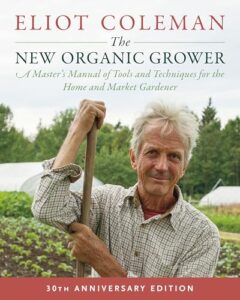
Eliot Coleman’s The New Organic Grower is one of those books you’ll keep reaching for season after season.
The updated 30th anniversary edition covers soil health, crop rotation, and green manure strategies in real depth — exactly what you need when managing a cold frame system long-term.
At 304 pages and $16.99, it punches well above its price.
If you’re farming under 2.5 acres or running an intensive home garden, this is a practical, no-nonsense foundation worth owning.
| Best For | Small-scale farmers and serious home gardeners working with 2.5 acres or less who want a proven, practical guide to organic growing. |
|---|---|
| Format | Paperback Book |
| Price (USD) | $16.99 |
| Language | English |
| Skill Level | Intermediate |
| Primary Use | Organic farming |
| Garden Scale | Small farm / large garden |
| Additional Features |
|
- Covers soil health, crop rotation, and green manure in real depth — a genuine long-term reference, not a one-read wonder.
- The 30th anniversary edition adds new photos and updated techniques, so it reflects 35 years of real-world experimentation.
- At $16.99 for 304 pages, the value is hard to beat.
- The sheer volume of techniques can feel like a lot if you’re just dabbling with a backyard plot.
- It’s rooted in New England and European growing conditions, so some advice may need tweaking for different climates or soil types.
- Putting the methods into practice takes real commitment — expect labor, planning, and some upfront equipment investment.
2. VNIMTI Round Garden Shovel with Wooden Handle
Good books get you thinking — but the right tool gets you digging.
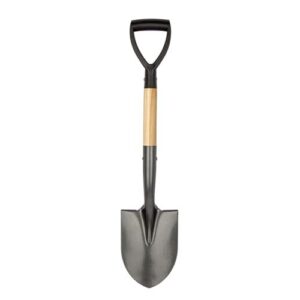
The VNIMTI Round Garden Shovel is a compact, 28-inch workhorse weighing just 1.55 lb, so transplanting cold frame crops won’t wear you out. Its heat-treated carbon-steel blade cuts cleanly into prepared beds, and the D-grip handle gives you control in tight spaces.
It won’t replace a full spade for heavy work, but for transplanting, compost turning, and seasonal bed prep, it earns its spot.
| Best For | Gardeners, beginners, and anyone who needs a lightweight, compact shovel for transplanting, compost turning, or small-space digging. |
|---|---|
| Format | Hand Tool |
| Price (USD) | $N/A |
| Language | N/A |
| Skill Level | All Levels |
| Primary Use | Digging & transplanting |
| Garden Scale | Any scale |
| Additional Features |
|
- Heat-treated carbon-steel blade with anti-rust coating means it holds up through seasons of regular garden use.
- At just 1.55 lb and 28 inches long, it’s easy to maneuver in tight beds and simple to stash in a trunk or toolbox.
- The D-grip handle gives you solid control for detail work like transplanting seedlings or turning compost.
- The small blade isn’t built for heavy digging or large landscaping jobs — it’ll slow you down fast.
- Some users have found the blade flexes under hard or rocky soil, which can be frustrating.
- No protective sheath included, and the wooden handle can degrade if left exposed to moisture over time.
3. Growing Under Cover Vegetable Garden Guide
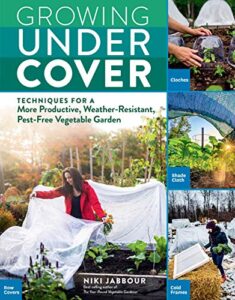
Once you’ve got the right tool in hand, the next step is knowing exactly what to plant and when. The Growing Under Cover Vegetable Garden Guide fills that gap well.
Published by Storey Publishing and running 216 pages, it walks you through protective structures — from basic row covers to cold frames — with a monthly planner and crop-specific timing advice.
At $13.84, it’s a practical reference you’ll actually reach for, not just read once and shelve.
| Best For | Home gardeners — from beginners to seasoned growers — who want to stretch their growing season without spending a lot or going the commercial route. |
|---|---|
| Format | Paperback Book |
| Price (USD) | $13.84 |
| Language | English |
| Skill Level | Beginner–Intermediate |
| Primary Use | Season extension |
| Garden Scale | Small to medium |
| Additional Features |
|
- Covers everything from simple row covers to cold frames, so you can start small and scale up as you get comfortable.
- The monthly planner and crop-specific timing tips make it genuinely useful year-round, not just a one-read wonder.
- At $13.84 for 216 pages, it’s one of the better deals you’ll find for practical, hands-on garden advice.
- Assumes you have some basic building skills — if you’ve never picked up a hammer, a few projects might feel a bit intimidating.
- It’s built around small-scale setups like raised beds, so it won’t be much help if you’re running a larger operation.
- No deep engineering specs, so if you’re dealing with heavy snow loads or extreme weather, you’ll need to look elsewhere for structural guidance.
4. Year Round Vegetable Gardener Guide
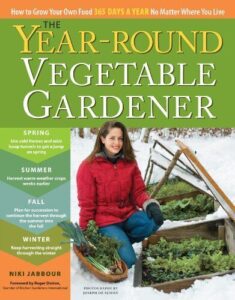
If you want to keep harvesting all year, not just stretching into late fall, the Year Round Vegetable Gardener Guide by Niki Jabbour is worth keeping close.
At $13.17 for 256 pages, it covers cold frames, hoop tunnels, and low-cost protective structures with a vegetable-by-vegetable breakdown — sowing dates, variety picks, and harvest windows included.
The climate focus leans toward Atlantic Canada, so you’ll adjust timing for your zone, but the succession planting charts alone make it a reliable seasonal planning tool.
| Best For | Home gardeners — beginner to intermediate — who want to grow and harvest vegetables through every season, including winter. |
|---|---|
| Format | Paperback Book |
| Price (USD) | $13.17 |
| Language | English |
| Skill Level | Beginner–Intermediate |
| Primary Use | Year-round harvest |
| Garden Scale | Small to medium |
| Additional Features |
|
- Practical and affordable at $13.17, with low-cost cold frame and hoop tunnel plans anyone can build.
- Vegetable-by-vegetable breakdowns make variety selection and planting schedules easy to follow.
- Succession and inter-planting charts are genuinely useful for squeezing more out of limited garden space.
- Climate examples lean heavily on Atlantic Canada, so gardeners in different zones will need to do some timing adjustments.
- Advanced gardeners looking for deep horticultural theory may find the content a bit surface-level.
- Paperback only — no digital version, companion app, or online resources included.
5. Container Gardening Complete Guide
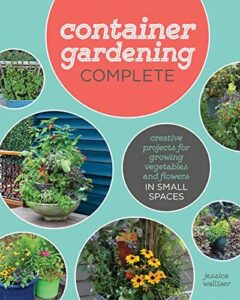
Container Gardening Complete by Luke Miller takes a different angle — and that’s exactly why it earns a spot here.
Cold frames and containers often work together: you’re already thinking small-space, compact varieties and controlled conditions.
At $27.92 for 272 pages, it covers drainage, soil-mix recipes, pest management, and over 125 plant species with full-color photographs.
If you’re pairing container-grown greens with frame protection, the spacing guidance and DIY project ideas help you make every square inch count.
| Best For | Urban dwellers, apartment renters, and small-space gardeners who want to grow food and flowers without a traditional yard. |
|---|---|
| Format | Paperback Book |
| Price (USD) | $27.92 |
| Language | English |
| Skill Level | Beginner |
| Primary Use | Container gardening |
| Garden Scale | Urban / container |
| Additional Features |
|
- Covers 125 plant species with full-color photos that make it easy to follow along, even as a total beginner.
- Includes DIY container ideas and soil recipes that save money and let you get creative with everyday materials.
- Tackles the practical stuff — drainage, pest management, irrigation — so you’re not left guessing when things go sideways.
- Vegetable content is solid but not deep; serious food growers will probably want a more dedicated resource alongside it.
- Print-only format makes it harder to search quickly when you’re elbow-deep in soil and need a fast answer.
- Plant advice leans toward temperate climates, so gardeners in tropical or extreme regions may need to adapt some recommendations.
6. Beneficial Bugs Garden Guide
Here is the written section:
Beneficial Bugs Garden Guide by Jessica Walliser confronts a problem every cold frame gardener eventually faces — pests that sneak in and quietly wreck your greens.
Published in 2013 by Timber Press, this 240-page guide ($36.75) profiles predators like lacewings, lady beetles, and hoverflies — all insects that prey on aphids, scale, and mites. It also explains how nectar plants like dill, fennel, and yarrow attract these allies close to your frame.
If you’re tired of reaching for the spray bottle, this is your smarter alternative.
| Best For | Gardeners and small-scale organic growers who want to ditch the spray bottle and build a natural, bug-friendly ecosystem that keeps pests in check year-round. |
|---|---|
| Format | Paperback Book |
| Price (USD) | $36.75 |
| Language | English |
| Skill Level | Intermediate |
| Primary Use | Pest management |
| Garden Scale | Backyard to farm |
| Additional Features |
|
- Covers a wide range of beneficial insects with clear ID help, so you actually know who’s doing the work in your garden
- Gives you practical, hands-on planting strategies — insectary borders, interplanting, beetle bumps — not just theory
- Works for all garden sizes, from a small backyard plot to a community garden or emerging farm
- Plant recommendations skew temperate, so tropical or arid-climate gardeners may need to adapt the advice
- Takes time to establish — don’t expect overnight results if you’re dealing with a serious infestation right now
- Published in 2013, so a handful of the science and plant-pest research may be a bit dated by now
7. Good Bug Bad Bug Garden Insect Guide

Good Bug Bad Bug by Sheila Daar is the quick-reference guide your cold frame sessions have been missing. At just 104 laminated, wire-bound pages, it’s built to survive a muddy workbench.
It identifies 41 insects — split clearly into beneficial and harmful — so you can spot aphids clustering on your kale or recognize a ground beetle doing useful work in your soil.
The organic control advice is practical and chemical-free, and the updated 2nd edition covers newer invasive pests like the Brown Marmorated Stink Bug.
| Best For | Home gardeners, Master Gardener volunteers, and hobbyists who want a fast, field-friendly way to identify insects and manage them without reaching for chemicals. |
|---|---|
| Format | Wire-Bound Cards |
| Price (USD) | $17.06 |
| Language | English |
| Skill Level | All Levels |
| Primary Use | Insect identification |
| Garden Scale | Any scale |
| Additional Features |
|
- Laminated, wire-bound cardstock holds up in real garden conditions — mud, water, and all
- Clear "good bug vs. bad bug" layout makes identification quick and straightforward
- Organic control tips are practical and don’t require any chemistry knowledge
- Only covers 41 species, so region-specific or less common pests may leave you guessing
- Photos show adult insects only — no eggs, nymphs, or size scale to help with younger life stages
- Published in 2011, meaning some newer invasive species might not be in here yet
8. Raised Bed Revolution Gardening Guide
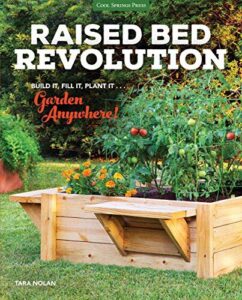
Raised Bed Revolution by Tara Nolan pairs naturally with cold frame gardening — because better beds mean better harvests. At 272 pages, it covers frame heights, materials, and soil mixes in practical detail, with high-quality photographs and step-by-step construction projects.
drip irrigation guidance, hugelkultur techniques, and pest-reduction strategies that translate directly to your cold frame setup.
accessible, countertop-height beds that reduce kneeling.
Available for $27.90, it’s a solid investment for year-round food production.
| Best For | Home gardeners — especially seniors or those with mobility issues — who want to build their own raised beds from scratch and get more out of a small or urban growing space. |
|---|---|
| Format | Paperback Book |
| Price (USD) | $27.90 |
| Language | English |
| Skill Level | Beginner–Intermediate |
| Primary Use | Raised bed building |
| Garden Scale | Urban to suburban |
| Additional Features |
|
- Covers everything from bed height and materials to soil mixes and watering systems, so you’re not left guessing
- Loaded with photos, diagrams, and step-by-step build plans that make construction approachable
- Includes practical extras like hugelkultur, pest control, and planting calendars for real seasonal planning
- Leans heavily on visuals, so if you want deep written guidance on planting techniques, you may need to look elsewhere
- Assumes you already have some basic DIY or carpentry skills to follow the build plans
- Niche topics like close-spacing different plant species get only a quick mention, not a full treatment
9. Food Garden Design Ideas Book
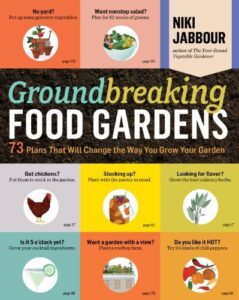
If you’ve ever stared at a blank garden bed and thought, "where do I even start?" — this book answers that question 73 times over.
Food Garden Design Ideas Book from Storey Publishing packs 73 distinct edible garden layouts into 272 pages, each with a plant list, illustration, and real gardener insights.
At $11.99, it’s an affordable way to plan cold-frame-compatible beds, especially designs featuring compact greens, layered spacing, and year-round salad plots suited to small or urban spaces.
| Best For | Home gardeners — beginner to experienced — who want quick visual inspiration and fresh ideas for edible garden layouts without getting buried in technical detail. |
|---|---|
| Format | Paperback Book |
| Price (USD) | $11.99 |
| Language | English |
| Skill Level | All Levels |
| Primary Use | Garden design |
| Garden Scale | Any scale |
| Additional Features |
|
- 73 ready-to-use garden designs means you’re never starting from scratch — just flip to something that fits your space and vibe.
- At $11.99 for 272 pages, it’s genuinely good value, especially as a gift or a "rainy day planning" book.
- Covers a wide range of themes (cocktail gardens, chili retreats, year-round salad beds) so there’s something useful no matter your taste or growing goals.
- It’s more of an idea book than a how-to guide — you’ll need other resources to actually dig in and build what you see.
- Sketch-style illustrations work fine for layout planning, but if you’re a visual person who needs photos to picture the finished look, these may fall short.
- Some designs don’t account for climate zones, so gardeners in trickier regions may need to swap out plants before the layout makes practical sense.
Frequently Asked Questions (FAQs)
What vegetables grow best in a cold frame?
Cold-tolerant leafy greens thrive best—such as spinach, arugula, kale, and lettuce.
Root crops like carrots, beets, and radishes also perform well.
These low-growing plants stay compact enough to fit comfortably beneath the lid.
What vegetables do I plant in October?
In October, focus on spinach, lettuce, kale, arugula, mâche, carrots, beets, turnips, and radishes. Garlic sets go in now too, establishing roots before the ground freezes hard.
How to grow vegetables in a cold frame?
Growing vegetables in a cold frame means choosing cold-hardy crops, placing your frame in full sun, managing heat through venting, and watering sparingly to keep foliage dry and disease-free all winter.
Can you grow vegetables in a cold frame?
Yes, and it works better than most gardeners expect. A cold frame keeps temperatures 5–15°F warmer than outside, letting you grow spinach, kale, lettuce, and carrots well into winter.
What are the disadvantages of cold frames?
They’re not perfect. Limited space, tricky ventilation, and temperature swings that demand daily attention are the main drawbacks — plus hard freezes can still threaten crops without added insulation.
Are there any vegetables that can be planted in October?
Absolutely. Spinach, kale, arugula, radishes, and garlic all go in during October. Radishes can be ready in as little as 25 days, making them one of fall’s most rewarding quick wins.
When should you start using a cold frame?
Start using your cold frame two to three weeks before your first planned sowing.
That head start pre-warms the soil to around 45°F — the minimum most cool-season crops need to germinate reliably.
How to use a cold frame for vegetables?
Place your cold frame in a south-facing spot, sow cold-hardy greens like spinach or arugula, vent on warm days, and close the lid before sunset to lock in heat.
What is the most cold tolerant vegetable?
Spinach takes the crown here. It tolerates temperatures down to 20°F–25°F and keeps producing after repeated frosty nights.
Kale runs a close second, staying productive around 25°F–28°F and actually sweetening after a hard frost.
What are the disadvantages of a cold frame?
Cold frames work well, but they come with real trade-offs.
Limited interior space restricts crop variety, temperature swings demand constant monitoring, and high humidity encourages fungal disease — so they reward attentive gardeners, not hands-off ones.
Conclusion
A farmer who stops working when the first frost arrives has always left half the harvest on the table. Cold frame gardening vegetables work the same way—it rewards those who refuse to accept October as a full stop.
You’ve now got the build, the crops, and the management rhythm to keep production moving through the coldest months. The frame doesn’t change winter. It just means winter no longer changes your plans.
- https://www.vegetables.cornell.edu/pest-management/disease-factsheets/diseases-occurring-in-winter-greens-and-their-management/organic-disease-control-in-winter-tunnels/
- https://www.chelseagreen.com/2023/gardening-tips-from-eliot-coleman-how-to-start-seedlings-in-a-cold-frame/?srsltid=AfmBOoqC9DYUiOMrKCFrG_yqP_xfYx3flQTLClgrqLiqkmrPnwfEcjd-
- https://joegardener.com/podcast/mastering-succession-planting-meg-cowden/
- https://sunshinerenewable.com/what-is-solar-ventilation/
- http://charleysgh.com/