This site is supported by our readers. We may earn a commission, at no cost to you, if you purchase through links.

Snap a six-inch branch off your neighbor’s stubborn old fig tree, stick it in damp perlite, and in three weeks you’ll have roots. Try that with an avocado and you’ll get mush—the wood’s loaded with latex that blocks hormone uptake before rooting ever starts.
That gap between "easy" and "nearly impossible" trips up most beginners before they cut a single stem. Growing fruit trees from cuttings rewards precision: the right wood, the right week, the right balance of moisture and warmth.
Get those variables locked in, and you’ll clone your favorite varieties for free, season after season.
Table Of Contents
- Key Takeaways
- Best Fruit Trees to Grow From Cuttings
- When to Take Fruit Tree Cuttings
- How to Prepare Fruit Tree Cuttings
- How to Root Fruit Tree Cuttings
- Caring for and Transplanting Rooted Cuttings
- Frequently Asked Questions (FAQs)
- What is the best fruit tree to grow from cuttings?
- Can you cut a branch off a fruit tree and plant it?
- What are common mistakes to avoid when propagating by cuttings?
- Is October too late to plant fruit trees?
- What fruits can be propagated from cuttings?
- How long does it take for fruit tree cuttings to root?
- What is the easiest tree to grow from cuttings?
- How to grow fruit trees from cuttings?
- Can apple trees grow from cuttings?
- How can I propagate a fruit tree?
- Conclusion
Key Takeaways
- Easy root like figs, grapes, and berries strike root in 2-4 weeks, while latex-heavy or inhibitor-laden wood like avocado, mango, and apricot fight you the whole way.
- Match your cutting type to the season: hardwood in winter dormancy, softwood in late spring to early summer, and semi-hardwood from late July to early September.
- Nail preparation with sterilized tools, correct cut lengths, stripped leaves, and immediate rooting hormone application to give your cutting its best shot.
- Once roots hit 1-2 inches and turn white or cream, harden off your cutting over about ten days before transplanting it into open ground.
Best Fruit Trees to Grow From Cuttings

Not every fruit tree cooperates when you cut it off from its roots. Some varieties strike root in weeks, practically begging to be cloned, while others test your patience and technique. Here’s what you need to know before you make the first cut.
Before you even reach for pruning shears, timing matters just as much as technique, so it’s worth reviewing tips for harvesting fruit at peak ripeness to set your cuttings up for success.
Easiest Fruits to Root
Grapes, figs, and berries root fastest, often in 2 to 4 weeks. Take hardwood grape cuttings in late winter; berry canes root with minimal fuss. Fig dormancy gives cuttings a head start before spring growth. Strawberries skip cutting entirely—just root runners.
These forgiving fruits build propagation confidence before you tackle stubborn cultivars. Using different types of cuttings can help you match the right method to your specific plant.
Hard-to-Root Fruit Trees
Avocado, mango, and apricot fight you the whole way. Avocado wood oozes latex that blocks hormone uptake. Mango’s cambial alignment needs are brutally specific. Apricot wood carries natural rooting inhibitors.
- Avocado – needs bottom heat, high humidity
- Mango – narrow rooting windows
- Apricot – hormone-dependent, low success
- Pear – drought-stressed wood roots poorly
- Wild plum – suckers instead of rooting cleanly
Cloning Favorite Varieties
Cloning a favorite tree means vegetative propagation, not gambling on seeds. Fruit cuttings grow into genetically identical plants, preserving flavor, size, and texture exactly.
That’s genetic trait preservation in action—consistent cultivar performance harvest after harvest. Track provenance for every cutting: variety name, parent tree, date taken. Selecting vigorous parents with uniform fruit quality gives your clones the best shot at matching the original.
Choosing Healthy Parent Plants
Pick your mother plants carefully—clones only inherit what’s already there, good or bad. Look for uniform vigorous growth, bright green leaves, and normal fruiting.
Choose mother plants with care—clones inherit every strength and flaw already present in the original
- Vigorous branching, no dieback
- Clean leaves, no spots
- Healthy roots, not rootbound
- No pests or webbing
- Consistent genetic traits, season after season
Skip stressed plants. Seasonal readiness matters too—spring growth roots best.
Avoiding Diseased Wood
Bad wood ruins good genetics. Before cutting anything, walk your mother plants and start identifying cankers, oozing sap, or wart-like growths—these signal active plant pathogens.
Tapping the trunk for hollow spots is another quick check worth adding to your routine, and this guide on timing your cuts around apple tree pruning explains why catching these signs early makes healthier cuts possible.
Inspecting bark for uniform color matters too; darkened or resin-soaked patches mean hidden decay. Selecting healthy limbs with strong bud viability, not brittle or discolored wood, keeps disease resistance high. Sterile tools and clean gloves finish the job, protecting overall plant health from cross-contamination.
When to Take Fruit Tree Cuttings
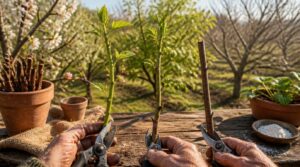
Timing makes or breaks your rooting success, and fruit trees don’t follow one single calendar. Softwood, semi-hardwood, and hardwood cuttings each demand their own window, tied to how the wood has matured that season. Here’s how to read your tree’s growth stage and know exactly when to make the cut.
Softwood Cutting Timing
Timing is everything with softwood cuttings. Grab shoots in late spring to early summer, when new growth bends without snapping—that’s your Peak Sap Period. Harvest during the Morning Harvest Advantage, before heat drops turgor.
Practice Flexible Shoot Selection from current-season growth, then follow Cut Length Guidelines: 4–6 inches. Apply Wound Protection Methods immediately, shielding cuts from sun for 24 hours.
Semi-Hardwood Cutting Timing
Somewhere between late July and early September, your softwood shoots stiffen into semi-hardwood—wood that resists bending but keeps a flexible tip. Higher latitudes push this window earlier.
Check maturity by snapping a stem gently—it should bend, not break clean. Harvest during cool morning hours to limit leaf drop. Skip heat waves entirely; wilted, stressed wood roots poorly.
Hardwood Cutting Timing
Full winter dormancy is prime time for hardwood cuttings—stems are sapless, disease risk drops, and buds are mature.
- Snap-test wood: firm, brown, no bend
- Cut early morning, dry conditions
- 3–5 hardened buds per stem
- Match timing to your climate zone
- Avoid hard frost days for callusing
Dormant stems root cleanest when sap flow’s minimized. Skip greenwood; it rots.
Seasonal Cutting Calendar
January and February belong to hardwood cuttings, taken dormant. March through April flips to softwood from spring flush. May and June favor semi-hardwood on stone fruits. July and August return to softwood.
September onward, shift to pruning and disease control—prepping wood for next year’s cuts.
Signs Wood is Ready
Grab a stem and check the end grain color—fresh pale green means wait, uniform brown means go. Snap it: hardwood cuttings should sound crisp, not mushy.
Compare weight against a same-size fresh stem segment; lighter wins. Run a moisture meter reading—20% or lower confirms readiness. Surface checks (fine cracks, not gouges) seal the deal for softwood or semihardwood cuttings alike.
How to Prepare Fruit Tree Cuttings

Preparation makes or breaks your rooting success, so don’t rush this stage. Every cut, every tool, every hormone dab matters more than you’d think. Here’s exactly what you need to nail before your cuttings hit the rooting medium.
Sterilizing Cutting Tools
Sterilize your pruning shears before every single cut—dip blades in 70% isopropyl alcohol for 5-10 minutes, or wipe down for quick jobs. Bleach solutions (5% sodium hypochlorite, 10-minute contact) work for grimy tools. Stainless steel models handle repeated cycles better than carbon steel.
Skipping this step invites pathogens straight into your rootstock, undoing weeks of careful propagation work before you’ve even started.
Correct Cutting Lengths
Length matters as much as sterilization. Softwood cuttings need 4–6 inches; hardwood, 4–8 for small trees, 10–15 for large ones. Cut at a 45-degree angle below a node, giving auxins a clear exit point.
Even a dull blade adds kerf loss, so measure generously and trim precise—your rootstock’s success depends on it, not guesswork.
Leaf and Fruit Removal
Once your cutting’s sized right, strip every leaf and any developing fruit before rooting. Energy redirection matters here—the stem can’t grow roots while feeding fruit or fanning out leaves.
This also curbs sunburn and humidity buildup around your propagation setup, echoing the airflow benefits growers chase in orchard canopies. Fewer leaves, fewer disease footholds. It’s the same logic vineyards use pre-harvest, just scaled to your workbench.
Rooting Hormone Application
Dip the cut end in hormone powder, gel, or liquid immediately after cutting—timing matters more than format. Powders (0.1–0.8% auxin) suit quick dips; gels cling longer for sandy media; liquids brush on evenly. Don’t re-dip.
Higher concentrations aren’t better—they risk phytotoxicity in sensitive species. Store hormones cool and dark; degraded auxins mean wasted effort and poor rooting success.
Stone Fruit Girdling
Peaches and nectarines respond best to girdling—stripping a narrow bark ring weeks before cutting concentrates auxins and redirects carbohydrates upward. Time it before rapid fruit growth, never repeat it, and leave a small uncut strip so the tree survives.
Wounds heal in 6–8 weeks with some gum flow. Skip this on stressed trees; it invites canker.
How to Root Fruit Tree Cuttings
Your cutting’s prepped and ready, but the real work happens now. Rooting success comes down to getting five variables right at the same time, not just one. Here’s exactly what your setup needs to cover.
Step-by-Step Rooting Method
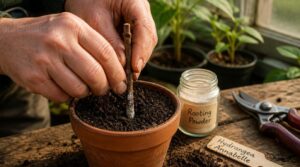
Ready to turn a single stem into a whole new tree? Select a semi-hardwood cutting with two nodes, strip blossoms and fruit to redirect energy, then dip the base in rooting hormone, tapping off excess.
Insert it node-down, one to two inches deep, into moist (not soggy) medium. Label with cultivar and date—future you will thank you. Place somewhere warm and bright, out of direct sun.
Best Rooting Mediums

Medium matters as much as the cutting itself. Skip generic potting soil—it stays too wet and invites rot.
- Perlite-vermiculite blends (1:1) balance drainage and moisture
- Coconut coir offers pH-neutral, sustainable structure
- Peat and perlite (2:1) suits slow-rooters
- Rockwool cubes deliver uniform humidity
Whatever you choose, demand a well-draining medium—soggy roots simply won’t survive.
Temperature and Bottom Heat
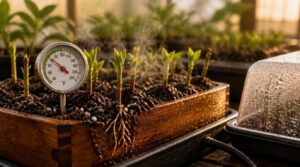
Warmth drives roots, not just air temperature. Keep the medium at 65–70°F using bottom heat—electric mats or heating cables work great. Push past 86°F and you risk damping off, so monitor root zone temps with a probe, not guesswork.
Citrus prefers cooler zones (68–75°F), while tropicals tolerate higher heat. Match your species, and rooting success follows.
Humidity and Mist Control
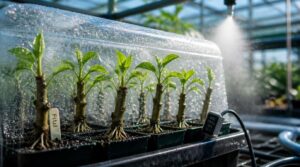
Humidity dome or plastic tent, keep it at 70–80% to stop desiccation cold.
- Mist system design: fine 20–100 micron droplets
- Sensor placement: canopy level and media surface
- Automated cycles: short bursts, not long soaks
- Filtered water: prevents clogged emitters
Avoid prolonged leaf wetness—it invites fungus. Short cycles, good airflow, and clean components keep your microclimate balanced and rooting success climbing.
Indirect Light Requirements

Bright, filtered light—not a sunbath—is what your cuttings crave. Aim for 500–2000 foot candles, cast a soft shadow, not a sharp one.
| Distance from Window | Light Quality | Result |
|---|---|---|
| 2–3 ft, sheer curtain | Balanced spectrum | Steady rooting |
| 5+ ft | Too dim | Etiolation |
| Direct beam | Scorching risk | Leaf burn |
Run 12–14 hours daily, monitor pale stems, and adjust placement accordingly.
Caring for and Transplanting Rooted Cuttings

Roots are only half the battle, so don’t get complacent now. Your cuttings still need the right water, nutrients, and timing to become strong, transplant-ready trees. Here’s exactly what to watch for at every stage.
Watering Without Root Rot
Drowning your cuttings kills more roots than drought ever will. Keep potting mix in the 40 to 60 percent moisture range using a moisture meter for accuracy.
- Bottom-water to hydrate evenly without perched water
- Let the top 1–2 inches dry before rewatering
- Skip saucer water sitting past 15 minutes
Good soil drainage and airflow humidity balance prevent overwatering—and root rot—before it starts.
Disease and Fungus Prevention
Sanitation practices stop fungal problems before they start. Sterilize pruning tools between every cut, keep airflow open around leaves, and remove debris fast.
Choose disease-resistant cultivars when possible, and rotate fungicides to prevent resistance. Watch soil moisture closely—overwatering invites root rot in even the healthiest well-draining medium. Consistent plant health maintenance beats treatment every time.
Early Fertilizing Tips
Hold off on fertilizer until roots form and new leaves appear—usually 2 to 4 weeks post-potting. Use balanced 10-10-10 at quarter strength, favoring phosphorus for root development over nitrogen. Try fish emulsion or compost tea for gentle organic feeding.
Water thoroughly after application to prevent nutrient burn, and keep soil pH between 6.0 and 6.5 for best absorption.
When Roots Are Ready
White, cream-colored roots at least 1–2 inches long, plus two mature leaves, signal true rooting success.
- Root Color Indicators: white or pale, never dark and mushy
- Root System Distribution: fibrous growth spreading evenly, not circling
- Shoot Growth Balance: vigorous leaves matching root development
Gently check root ball integrity—it should hold together. Species-specific timelines vary; hardwood cuttings simply need more patience than softwood.
Hardening Off Young Trees
Toughening up your new tree doesn’t happen overnight—hardening off takes about ten days of deliberate stress.
| Day Range | Action |
|---|---|
| 1–3 | Shade, 1 hr outdoors |
| 4–6 | Morning sun, wind exposure |
| 7–10 | Full light, 4 hrs |
Watch leaf turgor daily. Scale back watering, skip fertilizer, and let roots adapt before transplanting into open ground.
Frequently Asked Questions (FAQs)
What is the best fruit tree to grow from cuttings?
Figs and grapes top the list among easiest rooting species—no rooting hormone needed. Currants, gooseberries, and pomegranates follow close behind.
For reliable genetic cloning benefits and disease-free source plants, choose vigorous parent stock and skip stressed or diseased wood entirely.
Can you cut a branch off a fruit tree and plant it?
Snip a branch and stick it in dirt? Nature isn’t that generous. Wood maturity and node presence determine success—softwood stem cuttings from spring growth root fastest with rooting hormone, while species success rates vary wildly between fruit types.
What are common mistakes to avoid when propagating by cuttings?
Improper tool sterilization, wrong hormone concentrations, and poor medium drainage tank rooting success fast. Watch substrate pathogen buildup, sloppy humidity control, and rushed acclimation processes too—each mistake compounds the last, turning promising cuttings into compost.
Is October too late to plant fruit trees?
Late? October’s practically prime time — while everyone else waits for spring, you’re giving roots a head start. Keep soil temperature above 40°F, choose frost-tolerant rootstocks, skip bare root in favor of container stock, and mulch heavily.
What fruits can be propagated from cuttings?
Grapes, figs, strawberries, and raspberries root fastest and easiest, often within 2 to 6 weeks. Pomegranates, peaches, and olives prove trickier, needing hormone treatments and 6 to 12 weeks patience. Choose disease-free mother plants for reliable propagation success.
How long does it take for fruit tree cuttings to root?
Timeframes vary widely: softwood roots in 3-6 weeks, semi-hardwood takes 6-12 weeks, hardwood needs 12-16 weeks. Species matter too—figs and pomegranates root fast, while apples and pears test your patience for months.
What is the easiest tree to grow from cuttings?
Willow tops the list, rooting in just 1 to 2 weeks with minimal hormone help. Elderberry, mulberry, crabapple, and fig follow close behind—all beginner-friendly, fast-rooting species with strong success rates from simple stem cuttings.
How to grow fruit trees from cuttings?
Cut, dip, plant, wait: take a healthy softwood cutting, apply rooting hormone to the base, set it in well-draining perlite mix, cover with a humidity dome, and keep warm until roots form.
Can apple trees grow from cuttings?
Yes, but expect stubborn results. Apple rooting success hinges on vigorous softwood, taken in spring, dipped in rooting hormone, and planted in a well-draining medium—preserving clonal variety traits, though cultivar stability varies with stock environment and care.
How can I propagate a fruit tree?
Giving new life to a favorite tree starts with softwood cuttings: snip flexible spring growth, dip in rooting hormone, plant in perlite, then hold at 60-65°F under indirect light and 70-80% humidity until roots emerge.
Conclusion
Roots don’t lie—they show you exactly who mastered the craft and who rushed it. Growing fruit trees from cuttings isn’t luck; it’s timing, clean cuts, and patience measured in weeks, not days.
Nail the right wood, the hormone, the humidity, and you’ll watch calloused stems push out pale new roots like clockwork. That fig branch you started with? It’s now a genetic twin, free of charge, ready to fruit for decades. Cut once, grow forever.
- https://www.phillyorchards.org/2016/04/18/edible-perennial-propagation-cuttings-and-layering
- https://permies.com/t/197532/Propagating-fruit-trees-hardwood-cuttings
- https://mikesbackyardnursery.com/2015/03/grow-cuttings
- https://www.rhs.org.uk/propagation/softwood-cuttings
- https://yardandgarden.extension.iastate.edu/how-to/propagation-trees-shrubs-and-vines-hardwood-cuttings