This site is supported by our readers. We may earn a commission, at no cost to you, if you purchase through links.
The wrong basket doesn’t just slow you down—it bruises your tomatoes, crushes your herbs, and turns a satisfying harvest into a sorting mess. Most gardeners learn this after one muddy morning of watching strawberries roll through gaps meant for potatoes.
Basket choice is actually a crop decision, not a gear decision. Mesh size, material, and volume all interact with how your produce manages moisture, weight, and movement during transport. Get those three variables right, and everything from a handful of thyme to a 15-pound squash arrives at the kitchen intact.
Table Of Contents
Key Takeaways
- Basket choice is a crop decision: mesh size, material, and volume must match what you’re harvesting, or you’ll bruise, crush, or lose produce before it hits the kitchen.
- Delicate crops like herbs and berries need small wicker baskets under 5 liters with 1/4-inch mesh, while root crops and squash demand rigid metal mesh baskets over 20 liters to handle weight and shed mud.
- Material durability comes down to use conditions — powder-coated steel and UV-stabilized polymers outlast bare wire and untreated wicker in wet, sunny, or coastal gardens.
- Handle design and ergonomics aren’t extras — neoprene padding, centered load placement, and adjustable shoulder straps are what keep you comfortable across long harvesting sessions with heavy loads.
Match Basket to Harvest Type
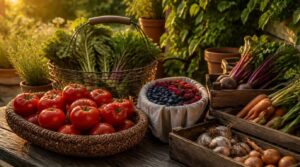
The wrong basket can bruise a berry or bury a tomato under its own weight. What you’re harvesting should drive what you carry it in — full stop. Here’s how different crops match up with the right basket type.
Pairing the right container with each crop is just one piece of the puzzle — fruit picking tips for home gardeners cover the timing and handling side just as well.
Your harvest type should dictate your basket — the wrong choice bruises berries and buries tomatoes
Herbs and Berries
Herbs and berries need a small basket under 5 liters — something light, gentle, and easy to carry with one hand. Wicker or rattan flex naturally, preventing bruising on strawberries or basil leaves. A tight 1/4-inch mesh keeps cherry-sized berries from falling through.
Rinse after each harvest; air dry fully to stop mildew before your next trip out.
Tomatoes and Tender Fruits
Tomatoes are a different problem. They’re climacteric fruits — they keep ripening after you pick them, driven by ethylene — so bruising accelerates that process.
A shallow basket with a wide 1/2-inch mesh lets air circulate and heat escape. Keep capacity modest; stacking tomatoes under heavy layers crushes the thin pericarp and tanks flavor fast.
Root Crops and Potatoes
Root crops and potatoes are a different kind of harvest. They come out muddy, dense, and heavy — and they don’t forgive rough handling. Tuber skin thickness matters here: freshly dug potatoes have thin, fragile skin that tears easily, accelerating moisture loss and rot before the potato curing process even begins.
Use a powder-coated metal mesh basket with wide 1/2-inch openings. Soil and debris sift through automatically, cutting cleanup time. The non-porous surface rinses clean fast — no grit trapped in wicker weaves.
Watch your weight distribution. Root crops are dense; a large basket over 20 liters loaded with carrots or potatoes gets heavy fast. Mid-size capacity keeps loads manageable without straining your wrist or bruising the harvest.
Squash and Bulky Vegetables
Squash is a different beast. A 15-pound hubbard squash or a dense butternut needs a large basket exceeding 20 liters with serious structural support — not something that flexes under load. Weight distribution matters: an overloaded basket with poor handle construction strains your wrist fast and risks bruising the rind.
Don’t wash squash before storage. Surface moisture accelerates mold.
Mixed Garden Harvests
When you’re pulling from several beds at once — herbs alongside tomatoes, greens next to carrots — a single-compartment basket creates sorting chaos later. Layered planting and harvest overlap mean you’re carrying delicate berries and firm roots in the same trip.
A divided, metal mesh basket with rust resistance carries both without bruising or moisture buildup.
Pair it with a contoured grip garden trowel to keep your palm comfortable during longer harvesting sessions.
Compare Materials and Durability
The material a harvest basket is made from decides how long it lasts and how well it does its job. Get this wrong and you’re replacing it every season, or worse, bruising half your crop. Here’s how the most common materials stack up.
Rust-resistant Metal Mesh
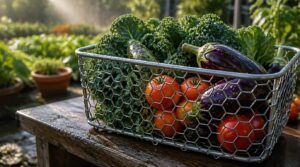
Metal mesh baskets earn their place in the garden through raw staying power. Powder-coated steel resists moisture far longer than bare wire, while 304 or 316 stainless steel withstands humid or coastal conditions where cheaper mesh fails fast. You may also benefit from aluminum mesh characteristics like high corrosion resistance and low density. Key factors to evaluate:
- Vinyl or polymer coatings seal fibers against moisture ingress
- 1/2-inch mesh openings shed soil and reduce rust hot spots
- Quarterly weld inspections catch corrosion before it spreads
Flexible Wicker and Rattan
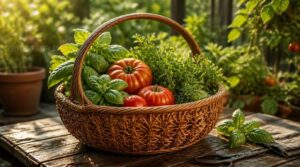
Wicker’s greatest strength is its natural give. Rattan vines bend without cracking when steamed, making rattan garden baskets ideal for cradling tomatoes or soft herbs without bruising. Breathable open weave dries fast after field washing. Synthetic wicker resists UV better outdoors.
Wipe woven vegetable gathering baskets with a damp cloth — don’t soak them, or fibers loosen and sag.
Strong Hardwood Frames
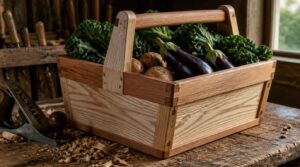
Hardwood frames are the backbone of a well-built harvest hod basket. Appalachian white ash, natural pine, and maple handle load stress without flexing under heavy crops. Kiln-dried wood resists warping when humidity swings between morning dew and afternoon heat.
Mortise-and-tenon joints and corner blocks keep the frame rigid season after season — no wobble, no split seams.
Easy-clean Plastic Surfaces
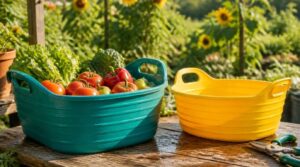
Plastic doesn’t get enough credit. A high-density polyethylene or polypropylene basket has a non-porous surface that won’t absorb soil, bacteria, or fruit juice — wipe it down, rinse it off, done. Antistatic properties reduce dust buildup between harvests. Food-safe coatings resist leaching, so contact with edible crops stays clean.
The SAMMART Collapsible Tub and Red Gorilla Tubtrug are solid examples of easy maintenance done right.
UV-resistant Outdoor Materials
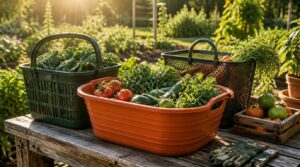
Sun breaks down materials faster than most gardeners expect.
UV-stabilized polymers resist cracking and chalking by absorbing radiation during formation — protection that’s uniform throughout, not just on the surface. Powder-coated steel pairs UV-inhibiting finishes with corrosion resistance, extending color life on metal mesh baskets. High-density polyethylene and UV-resistant coatings add another layer, blocking degradation on plastic tubs used season after season.
Choose Comfort and Capacity
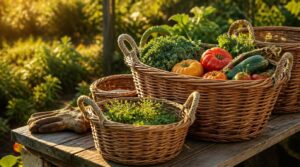
The right basket size and handle design matter more than most gardeners expect. Too small and you’re making three trips when one should do; too large and a full load strains your wrist by the second row. Here’s what to look for in comfort and capacity.
Small Under 5 Liters
A small harvest basket under 5 liters is the right tool for light, precision work. It holds 1 to 2 cups of herbs or a half pint of berries without crushing them. For a small-scale grower, that compact design means less fatigue when bending low.
Metal mesh baskets dry fast, resist soil buildup, and store flat when the season’s done.
Medium Everyday Harvest Baskets
When small baskets aren’t enough, a medium harvest basket closes the gap. Holding 8 to 12 liters, it supports a mixed load—herbs, tomatoes, small fruits—without compression bruising.
Padded, ergonomic supports distribute weight evenly across your palm. Food-grade materials clean up fast with mild soap. It’s the workhorse size most gardeners reach for first.
Large Over 20 Liters
Once your harvests outgrow medium containers, a large garden harvest basket — over 20 liters — becomes the right tool. These hold 21 to 40 liters and span 40 to 60 centimeters in length, fitting bulky squash, potatoes, and mixed loads.
Structural reinforcement via powder-coated metal mesh or high-density polyethylene resists sagging. Airflow perforations and raised bases keep produce breathable during transport.
Padded Handle Comfort
Size accommodates capacity, but padded handle comfort determines how long you can carry it. Padding thickness ranges from 6 to 12 millimeters depending on the model. Neoprene and closed-cell foam are the top choices — both resist compression and dry quickly.
Ergonomic design with contoured edges aligns with your palm, cutting pressure points during carries exceeding 5 kilograms.
Shoulder-friendly Carrying Designs
Fatigue is a slow saboteur — it creeps in before you notice.
Centered load placement keeps the basket against your torso, shortening the lever arm so you’re not fighting the weight. Two-point suspension with adjustable shoulder straps spreads the load evenly. Add chest strap integration and the whole system stays snug, reducing side-to-side sway across every row.
Top 3 Garden Harvest Baskets
You’ve covered the key factors — now it’s time to put that knowledge to work. These three baskets stand out for how well they match real harvesting conditions, from delicate herbs to bulky root crops. Here’s what each one brings to the garden.
1. Maine Garden Hod Vegetable Harvest Basket
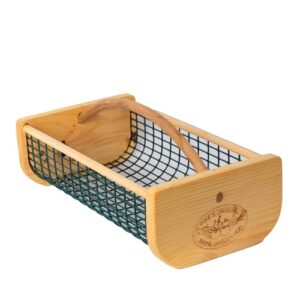
The Maine Garden Hod is one of those tools that earns its place in the garden fast. It measures 16 x 9 x 5.25 inches with an 8-quart capacity — enough for a solid mid-week harvest.
The food-grade PVC-coated wire mesh resists moisture and lets dirt fall through during rinsing. A steam-bent oak handle over pine end panels keeps it sturdy without adding bulk.
One caveat: small items like peas slip through the mesh spacing.
| Best For | Home gardeners who want a durable, good-looking basket for harvesting, rinsing, and hauling produce straight from the garden. |
|---|---|
| Body Material | PVC-coated wire mesh |
| Handle Material | Solid oak wood |
| Dimensions | 16 x 9 x 5.25 in |
| Drainage Design | Wire mesh gaps |
| Rust Resistance | PVC coating |
| Multi-Use Storage | Yes |
| Additional Features |
|
- Food-grade PVC-coated mesh holds up to moisture and makes rinsing produce a breeze
- Steam-bent oak handle and pine end panels feel solid and look great
- Versatile enough to use beyond the garden — magazines, toys, kindling, you name it
- Small items like peas will slip right through the mesh spacing
- The handle is only glued and brad-nailed, so it may not hold up to heavy daily use long-term
- Costs more than comparable baskets on the market
2. Metal Mesh Steel Harvest Basket
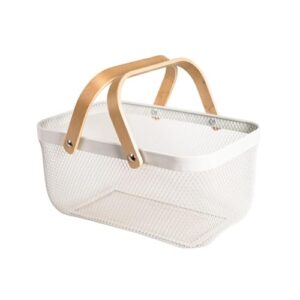
Metal Mesh Steel Harvest Basket measures 14.5 x 9.5 x 7 inches and weighs just 1.5 pounds — light enough to carry all morning without noticing it.
Its galvanized alloy steel mesh resists rust and lets water drain straight through, so you can rinse tomatoes or peppers right at the tap. Fixed wooden hand grips sit 4.92 inches above the rim, giving your hand real clearance.
One limitation: the wire spacing won’t hold small loose items like peas or cherry tomatoes.
| Best For | Home gardeners and kitchen enthusiasts who regularly harvest, rinse, and store fresh produce. |
|---|---|
| Body Material | Alloy steel mesh |
| Handle Material | Fixed wood |
| Dimensions | 14.5 x 9.5 x 7 in |
| Drainage Design | Open-wire ventilation |
| Rust Resistance | Silver-plated finish |
| Multi-Use Storage | Yes |
| Additional Features |
|
- Silver-plated alloy steel resists rust and lets water drain straight through — rinse fruits and vegetables right at the sink
- Lightweight at just 1.5 pounds with fixed wooden handles that make it comfortable to carry for extended periods
- Seamless one-piece design keeps cleaning quick and simple with no hard-to-reach crevices
- Wire spacing is too wide for small items like peas or cherry tomatoes
- Metal wires can feel rough against bare skin with repeated handling
- At 14.5 x 9.5 x 7 inches, it may not have enough capacity for large harvest loads
3. Portable Mesh Garden Harvest Basket
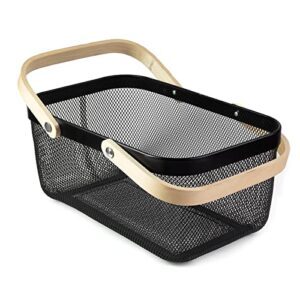
The Portable Mesh Garden Harvest Basket runs 9.8 inches deep, 15.7 inches wide, and 6.7 inches tall — roomy enough for a mixed morning pick without tipping. At 1.6 lbs, it won’t drag on your arm after an hour in the rows.
Bamboo grips fold flat for storage, and the anti-rust metal mesh drains water and soil on contact. One real caveat: color accuracy varies between batches, so what you order may not match exactly.
| Best For | Home gardeners and eco-conscious shoppers who want a durable, everyday basket for harvesting, rinsing, and hauling produce without the plastic waste. |
|---|---|
| Body Material | Metal mesh |
| Handle Material | Foldable bamboo |
| Dimensions | 15.7 x 9.8 x 6.7 in |
| Drainage Design | Breathable mesh openings |
| Rust Resistance | Anti-rust coating |
| Multi-Use Storage | Yes |
| Additional Features |
|
- Anti-rust metal mesh drains water and soil instantly — no extra steps after a rinse
- Bamboo handles fold flat, so it stows away without taking up shelf space
- Light enough at 1.6 lbs to carry around the garden or between rooms without fatigue
- Color accuracy isn’t guaranteed, so the shade you pick may not be what shows up
- Square base works best on flat surfaces, so uneven ground could be a problem
- Metal mesh may snag delicate produce like soft berries if you’re not careful
Frequently Asked Questions (FAQs)
How do I choose the right vegetable basket?
Start with what you’re harvesting. Match basket to crop — delicate herbs need wide mesh for airflow, while root crops need rigid, deep baskets. Get this wrong, and bruised produce follows.
Can harvest baskets double as market totes?
Yes, they can. Pick one with a flat bottom and sturdy rim to stabilize produce, reinforced grips for loads up to 15 kilograms, and a tight weave that allows airflow without snagging.
How do I clean a muddy harvest basket?
Tap off loose mud over a trash can first. Then use a damp cloth with mild soap — or diluted vinegar for wicker. Dry fully before storing to prevent mold.
Do collapsible baskets hold up over time?
Collapsible baskets consistently hold up — quality models survive 1,000 fold cycles with no frame deformation. Stick to UV-stabilized plastic or powder-coated metal, and they’ll last multiple growing seasons without cracking, rust, or hinge looseness.
What basket size works for container gardens?
For container gardens, 1 to 3 gallon baskets handle herbs and greens well. Tomatoes and peppers need 5 to 7 gallons. Match basket size to your container, not your ambition.
How should I store baskets during winter?
Clean and dry every basket before storing. Keep them in a space between 60–75°F with 40–60% humidity. Use breathable fabric bags, not plastic, and add a silica gel pack nearby.
Conclusion
Next season’s harvest will test every choice you make today—mesh size, material, handle comfort, and volume all compound quietly over dozens of trips to the garden. Knowing how to choose a garden harvest basket means matching those variables to your actual crops, not your wishlist.
A basket that truly fits your harvest protects produce, saves time, and reduces waste at the kitchen door. Get it right once, and you won’t think about it again.
- https://www.avantlink.com/click.php?tt=cl&merchant_id=737d05d7-ed69-4463-800c-c07e6f509eb5&website_id=1ca9733f-4327-4242-afaa-52aefeb33c55&url=https%3A%2F%2Feartheasy.com%2Fmaine-garden-hod%2F
- https://www.stonewallkitchen.com/nantucket-double-handle-basket-575875.html
- https://www.gardeners.com/buy/mod-hod-garden-basket/8595214.html