This site is supported by our readers. We may earn a commission, at no cost to you, if you purchase through links.
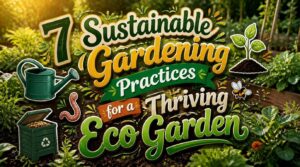
Most gardeners don’t realize that a single tablespoon of healthy soil contains more living organisms than there are people on Earth. That hidden ecosystem—fungi, bacteria, earthworms working in quiet cooperation—determines whether your garden thrives or just survives. When that balance breaks down, no amount of fertilizer or pest spray fully compensates.
Sustainable gardening practices work with that biology instead of against it. They cut water use, reduce chemical dependency, and build resilience into the soil itself. The seven practices ahead give you a clear, actionable path to a garden that nourishes both your harvests and the broader ecosystem around it.
Table Of Contents
- Key Takeaways
- Build Healthy Soil With Natural Methods
- Conserve Water With Smart Garden Strategies
- Choose Native and Climate-Resilient Plants
- Practice Organic Pest and Disease Control
- Create Wildlife-Friendly Habitats in Your Garden
- Reduce Waste Through Recycling and Reuse
- Design Your Garden for Long-Term Sustainability
- Frequently Asked Questions (FAQs)
- What sustainable practices do you use in your garden?
- What are sustainable gardening practices?
- How do I start composting in small spaces?
- What trees sequester the most urban carbon?
- Can sustainable gardens reduce my water bills significantly?
- How often should I apply organic fertilizers?
- What wildlife should I attract to my garden?
- How can I attract birds to my sustainable garden?
- What tools are most eco-friendly for garden maintenance?
- Can sustainable gardens thrive in small urban spaces?
- Conclusion
Key Takeaways
- Healthy soil is a living ecosystem—composting, no-till practices, and organic amendments protect the underground biology that actually drives plant growth.
- Smart water strategies like drip irrigation, rain barrels, and early-morning watering can cut outdoor water use by 40–60% without sacrificing plant health.
- Native and drought-tolerant plants reduce your maintenance load naturally, since they evolved for your climate and support local pollinators and soil health without extra intervention.
- Long-term garden resilience comes from diversity—mixing perennials, companion plants, and wildlife habitat features creates a self-regulating system that needs far less from you over time.
Build Healthy Soil With Natural Methods
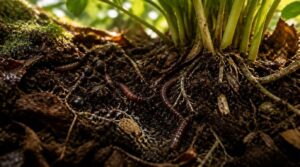
Healthy soil isn’t just dirt — it’s a living system that feeds everything growing above it. The good news is you don’t need synthetic chemicals or expensive products to build it up. Here are four natural methods that actually work.
Composting is one of the simplest starting points — and growing organic produce from healthy soil becomes a lot more rewarding once you understand what’s happening beneath the surface.
Composting Kitchen and Garden Waste
Turning kitchen scraps into garden gold is simpler than you think. Fruit peels, coffee grounds, and eggshells break down into rich compost within three to six months.
Aim for a 25:1 carbon-to-nitrogen ratio — roughly three parts shredded cardboard to one part fresh trimmings. That balance keeps your pile cooking at the right temperature. For faster results, you might consider using rotating compost tumblers.
Using Cover Crops and Crop Rotation
Once your compost is cooking, the next step is feeding the soil before you even plant.
Cover crops and crop rotation work like a long game for your soil. Legumes like clover and vetch fix atmospheric nitrogen naturally. Winter rye suppresses weeds through dense mulch. Together, they build organic matter and improve soil carbon sequestration — season after season.
Applying Organic Soil Amendments
Think of organic amendments as a buffet for your soil’s biology.
Compost tea delivers fast-acting microbial activity straight to the root zone. Biochar application improves porosity and locks nutrients in place. Aged manure and mineral amendments like rock phosphate release nutrition slowly, building lasting fertility.
Together, they create nutrient-rich soil without the crash that synthetic fertilizers bring.
Avoiding Unnecessary Soil Disturbance
Your soil is a living city beneath your feet — and every time you dig, you disrupt it. No-till gardening keeps that underground world intact, preserving beneficial microorganisms and the carbon they help trap.
No-till gardening preserves the living world beneath your feet, protecting the microorganisms and carbon that healthy soil depends on
Lay 3–4 inches of organic mulch on top, and you’ll prevent soil crusting while cutting watering needs greatly. Less digging. Healthier ground.
Conserve Water With Smart Garden Strategies
Water is one of your garden’s most precious resources — and it’s easier to waste than you’d think. The good news is that a few smart adjustments can cut your water use dramatically without sacrificing plant health. Here are five practical strategies to help you keep every drop working hard.
Installing Drip Irrigation and Soaker Hoses
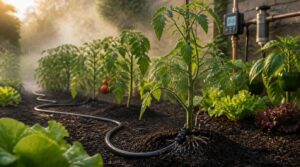
Water wasted is opportunity lost. Drip irrigation solves this by delivering water straight to the root zone through small emitters, cutting evaporation dramatically.
Soaker hose depth of 1–2 inches below the soil, combined with timer programming tips like early-morning scheduling, makes every drop count. Add a backflow preventer, filter, and pressure regulator, and your system runs clean and steady.
Harvesting Rainwater for Garden Use
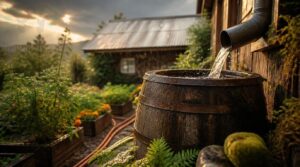
Catching rain off your roof is one of the simplest upgrades you can make. A first flush diverter clears the initial dirty runoff before water enters your rain barrel, keeping what’s stored clean and ready for your plants. Even a 100-square-foot roof yields around 62 gallons per inch of rainfall—that adds up fast.
| Setup Element | Key Detail |
|---|---|
| Rain Barrel Capacity | 50–100 gallons per barrel |
| Roof Material Selection | Metal roofs produce cleaner water |
| Gravity-Fed Delivery | Raise barrels for pressure-free flow |
Rainwater harvesting pairs naturally with drip lines. Connect your barrel to a soaker system, and you’ve got a gravity-fed delivery loop that needs almost no maintenance.
Mulching to Retain Soil Moisture
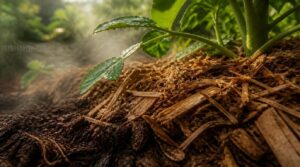
Layering your garden beds with organic mulch is one of the most reliable moves you can make for water conservation. Just 2 to 3 inches of wood chips, straw, or leaf mulch can cut evaporation by up to 50 percent.
Here’s what to keep in mind:
- Keep mulch away from plant stems to prevent rot
- Wood chips last 2 to 3 years before needing replacement
- Straw decomposes faster, enriching your soil more quickly
- Replenish mulch layers as they break down over time
Watering Early to Reduce Evaporation
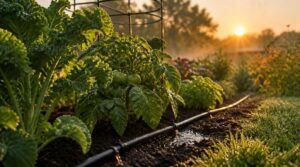
Timing your watering is a small shift that pays big dividends. When you water early in the morning, cooler air and calmer winds mean up to 30 percent less evaporation from the soil surface before plants even start their day.
| Watering Time | Evaporation Rate |
|---|---|
| Early morning | Up to 30% lower |
| Midday | Highest loss |
| Late afternoon | 20–40% higher than morning |
Pair that timing with drip irrigation or soaker hoses, and most of the water heads straight to the roots — not the air. Automating your schedule with a timer keeps things consistent without the guesswork.
Grouping Plants by Water Needs
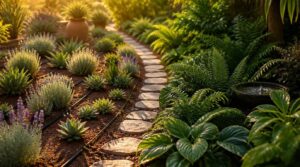
Think of your garden as a neighborhood where everyone has different needs.
Hydrozone planning groups plants by their water requirements — succulents and Mediterranean herbs in a low-water zone, thirsty ferns and tropicals together nearby. Pair each zone with dedicated drip irrigation lines, and you’re delivering exactly what each group needs, nothing more.
Choose Native and Climate-Resilient Plants
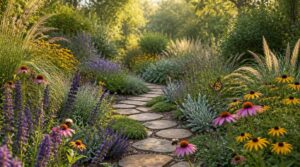
The plants you choose shape everything else in your garden. Native and climate-resilient varieties do the heavy lifting naturally—less watering, less fussing, better results. Here’s what to focus on when building a plant palette that actually works with your environment.
Benefits of Growing Native Plant Species
Want a garden that practically takes care of itself? Go native.
These plants evolved right here, so their deep roots boost soil health, prevent erosion, and lock away carbon. They need less water, resist local pests, and feed pollinators when they need it most.
You get biodiversity, low maintenance care, and a landscape that feels truly yours.
Selecting Drought-Tolerant Garden Varieties
Native plants are a great start, but pairing them with drought-tolerant varieties takes things further. Look for deep root systems, water storage leaves, and gray-green foliage that reflects heat.
Check soil drainage needs and sunlight exposure requirements before planting.
- Less watering, more weekend freedom
- Healthier soil, fewer worries
- A garden that thrives even when you don’t
Choose local provenance varieties, drought-tolerant grass, and perennials—true waterwise landscaping for lasting soil health.
Removing Invasive Plants for Ecosystem Health
A drought-tolerant garden won’t reach its full potential if invasive plant species are crowding out your natives. These aggressive growers steal water, light, and nutrients, hurting soil health and biodiversity.
Use mechanical removal methods like hand-pulling, plus organic control options when needed. Keep up invasive species monitoring for two seasons, then focus on native species replanting to restore balance.
Planting Perennials to Reduce Replanting
Once your beds are cleared of invaders, fill that space wisely. Perennials come back year after year, building deep root systems that improve soil health and water conservation. For longevity planning, choose disease-resistant native plants.
- Allow appropriate spacing for mature size
- Mulch early to suppress weeds
- Stagger bloom times for cover
- Pick clumping growth habits
Practice Organic Pest and Disease Control
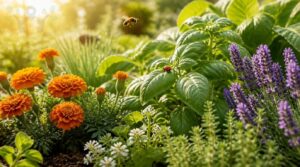
Pests and disease are part of gardening, but you don’t need harsh chemicals to handle them. A few smart, natural habits can keep your plants healthy and your garden balanced. Here’s where to start.
Using Companion Planting to Deter Pests
Some plants are natural bodyguards. Companion planting pairs crops so pests get confused or repelled. Try mint or thyme as aromatic barrier plants, basil with tomatoes, or marigolds with carrots. Nasturtiums work as trap crops, luring aphids away.
Rotate these companion pairings each season—root exudate disruption keeps pests guessing. It’s simple organic pest control that builds real integrated pest management habits.
Applying Neem Oil and Organic Remedies
Reaching for neem oil? It’s a solid backup when companion planting needs help.
Mix 0.5 to 2% with water, spray early morning or evening. Azadirachtin disrupts feeding and reproduction—works best on young aphids, whiteflies, mites. Soil drenches tackle root pests too.
Always test one leaf first: 1) dilute properly, 2) spray foliage, 3) check 24 hours, 4) avoid open flowers, 5) wear gloves.
Attracting Beneficial Insects Naturally
Inviting good bugs in is like hiring a tiny pest-control crew that works for free. Plant dill, fennel, and yarrow for layered habitat appeal, skip broad pesticides, and tuck in an insect hotel for shelter.
| Plant Type | Bloom Season |
|---|---|
| Crabapple | Spring |
| Yarrow | Summer |
| Aster | Fall |
Using Physical Barriers and Hand-Picking
Sometimes the best pest control is your own two hands. Exclusion netting keeps beetles off transplants, while hardware cloth around beds blocks gophers.
- Handpick pests in cool morning hours
- Remove egg masses under leaves
- Sanitize pruning shears between cuts
- Clear fallen debris for garden hygiene
These integrated pest management basics fit any sustainable gardening plan, no sprays needed.
Monitoring Gardens for Early Pest Detection
A little detective work goes a long way. Flip leaves weekly, checking for eggs or chew marks. Try Leaf Damage Imaging to spot trouble early, or set up a Sticky Trap Grid every two meters.
| Method | Frequency | Catches |
|---|---|---|
| Soil Pest Sampling | Monthly | Wireworms |
| Pheromone Trap Deployment | Weekly | Moths |
| Seasonal Pest Calendar | Yearly | Outbreaks |
This integrated pest management approach helps beneficial insects and natural pest control.
Create Wildlife-Friendly Habitats in Your Garden
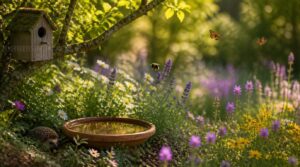
Your garden can be more than just plants—it can be a home. Every creature, from bees to birds, needs food, water, and shelter to stick around. Here are five simple ways to roll out the welcome mat.
Planting Nectar-Rich Flowers for Pollinators
Want a garden buzzing with life? Plant nectar-rich flowers like Idaho lupine, echinacea, and salvia. Choose native nectar plants suited to your climate.
Stagger bloom times for season-long pollinator support—early bulbs, mid-summer perennials, late asters. Group flowers in clusters for visibility.
This simple seasonal planting schedule turns any yard into a true pollinator paradise, boosting biodiversity naturally.
Installing Bee Houses and Butterfly Feeders
Give pollinators a place to crash, and they’ll stick around. Mount bee houses on a south-facing wall, 3-5 feet up, entrance tilted down so rain doesn’t pool inside.
For butterflies, use shallow dishes with 20% sugar water, refreshed every 2-3 days.
This combo creates real pollinator-friendly habitats:
- More bees pollinating your veggies
- Butterflies visiting daily
- A garden that feels alive
Providing Shelter and Nesting Sites
Bees and butterflies are just the start. Real wildlife habitats need shelter too.
Stack a rock pile in partial shade for reptiles and insects. Build a brush pile at least 3 feet high for ground-nesting birds. Mount tree cavities with predator guards and sloped roofs. Leave bare patches for ground nesting areas—your garden becomes a true sanctuary.
Adding Water Features for Amphibians and Birds
Shelter is great, but water seals the deal. A small pond with shallow shelf zones (5-15 cm) gives amphibians safe access. Clay liners keep water clear naturally.
Add submerged plants for oxygen and cover. A solar fountain keeps water moving, deterring mosquitos. Pair with rainwater harvesting or a rain garden for eco-friendly water conservation.
Maintaining Overwintering Habitat Features
Your pond keeps wildlife thriving in summer, but winter needs its own plan.
Build a brush pile shelter with branches and pine needles on the north side—it stays unfrozen for small mammals. Leave dead wood and snags for cavity-nesters. Stack a rock pile for thermal cover.
Keep your winter water source ice-free, and let leaf litter blanket beds for snow cover protection.
Reduce Waste Through Recycling and Reuse
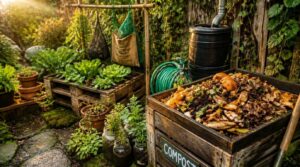
Your garden doesn’t have to send anything to the landfill. With a few smart habits, you can turn scraps and old materials into something useful again. Here’s where to start.
Composting Yard and Kitchen Scraps
Think of your compost pile as a living engine — it turns what most people throw away into nutrient-rich soil your garden will love. Toss in kitchen scraps alongside yard waste, keeping a rough brown-green ratio of 3:1.
If space is tight, vermicomposting lets red worms do the heavy lifting indoors. For food scraps, Bokashi fermentation pre-ages waste quickly in a sealed container before it joins the pile.
Upcycling Containers and Reclaimed Materials
Repurposing what you already have is one of the easiest wins in sustainable gardening. Shipping container greenhouses, pallet planters, and wooden crate planters can all replace store-bought options. Here are three quick starts:
- Drill drainage holes in old metal drums for metal drum planters
- Line glass jars for glass terrariums
- Refurbish pallets into vertical walls
Upcycled materials cut waste and cost simultaneously.
Grasscycling and Leaf Mulching Techniques
Grasscycling turns every mow into a free fertilizer application. Leave clippings on the lawn and they’ll return 50 to 75 percent of its nitrogen needs as they break down.
For leaves, run your mower over them to shred them fine — shredded leaf mulch decomposes faster, retains soil moisture, and suppresses weeds without smothering your grass.
Saving Seeds to Reduce Packaging Waste
Saving seeds is one of the most satisfying acts of environmental stewardship you can practice. When you collect from open pollinated seeds, you skip the store entirely — no plastic foil packets, no shipping emissions.
- Dry seeds to 8–12% moisture before storing
- Use glass jars or reusable containers as seed storage solutions
- Run a seed viability test before sowing
- Join community seed swaps to share locally adapted varieties
Design Your Garden for Long-Term Sustainability
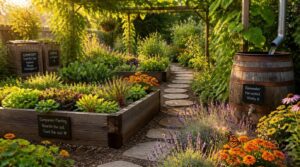
A well-designed garden doesn’t just look good — it works smarter over time. Small, intentional choices in layout, tools, and plant selection add up to real, lasting results. Here are four practical ways to build a garden that’s built to last.
Using Vertical Gardening and Raised Beds
Vertical gardening turns a small raised bed into a surprisingly productive space. By anchoring trellises or wire mesh panels securely to your bed frame before planting, you support heavy crops like cucumbers, climbing peas, and indeterminate tomatoes without disturbing established roots. Match plant height to your available vertical space, and you’ll avoid crowding while keeping airflow strong.
Pair that structure with drip irrigation lines running along the base, and water goes straight to the roots. Good drainage matters too — a loose, well-draining soil mix prevents waterlogging and keeps your plants breathing. Harvest becomes easier on your back, and every square foot works harder for you.
Choosing Electric or Manual Garden Tools
The tools you reach for matter more than you might think. Electric vs. manual isn’t just a preference — it’s a sustainability decision.
- Electric trimmers cut consistently through dense growth but need battery management
- Manual pruners offer precise control with zero emissions and lower costs
- Cordless models run 20–60 minutes, so plan tasks around battery life
For eco-friendly gardening, electric tools deliver zero tailpipe emissions and quieter operation, while manual tools keep your carbon footprint minimal with no charging required.
Positioning Trees for Shade and Energy Savings
A well-placed tree is one of the smartest investments your garden can make. Tree placement strategies matter enormously — positioning large deciduous trees 15 to 25 feet from your home’s west or south side can cut annual cooling costs by 20 to 40 percent. That kind of impact goes far beyond aesthetics.
| Placement Side | Key Benefit |
|---|---|
| West | Blocks hot afternoon sun |
| South | Reduces peak heat gain |
| East | Softens early morning warmth |
Aim for species reaching 50 to 70 feet at maturity, with a canopy width of 40 to 60 feet. This ensures shade spans your roofline and upper windows consistently. Deciduous varieties handle seasonal shade timing naturally — full leaf cover in summer, open canopy in winter for passive solar warmth.
Shaded walls run 9 to 36°F cooler, directly shrinking your fossil fuel energy use. Protect the root zone with mulch to support long-term canopy density and reduce your overall carbon footprint.
Diversifying Plantings to Support Biodiversity
Trees do a lot of heavy lifting, but plants at ground level carry just as much weight for long-term garden health. Diversifying your plantings — mixing a Native Plant Mix with Perennial Polyculture — builds a living system that sustains itself.
Try these five strategies for stronger biodiversity conservation:
- Plant a Bloom Succession of early, mid, and late-season natives to keep pollinator-friendly habitats active all year
- Layer heights using Habitat Layering — groundcovers, herbs, shrubs, and canopy trees — to create microhabitats for insects and birds
- Use companion planting to pair pest-deterring species like basil alongside food crops
- Establish perennial planting beds to reduce soil disruption and support deep-rooted carbon sequestration
- Practice Seed Saving from self-pollinating native plants to preserve genetic diversity without extra packaging waste
A diverse garden isn’t just prettier — it’s more resilient, productive, and alive.
Frequently Asked Questions (FAQs)
What sustainable practices do you use in your garden?
Roots before results — that’s the gardener’s mantra. I compost kitchen scraps, lean on native plants, and keep a rain barrel system humming. Organic mulch and companion planting do the rest.
What are sustainable gardening practices?
Sustainable gardening works with nature, not against it. It means building healthy, living soil, saving water, growing native plants, and skipping synthetic chemicals — creating a garden that gives back more than it takes.
How do I start composting in small spaces?
Even a small balcony gives you room to compost. A 5 to 10 gallon tumbler keeps things tidy, balances moisture, and with weekly mixing, turns kitchen scraps into nutrient-rich soil fast.
What trees sequester the most urban carbon?
If you want serious urban carbon storage, go big. Long-lived oaks like Quercus robur and high-biomass species like London Plane do the heavy lifting — their large canopy volume locks in carbon for decades.
Can sustainable gardens reduce my water bills significantly?
Yes — and often by more than you’d expect. Drip irrigation alone cuts outdoor water use by 40–60%. Add rainwater harvesting and moisture-retaining mulch, and your garden basically starts paying for itself.
How often should I apply organic fertilizers?
It depends on the fertilizer. Liquid organics need applying every 2–4 weeks during peak growth. Compost works 2–3 times yearly. Let soil tests guide you — they take the guesswork out completely.
What wildlife should I attract to my garden?
Focus on birds, pollinators, and amphibians. Each plays a role in natural pest control and plant health. Together, they create a self-regulating garden that needs far less intervention from you.
How can I attract birds to my sustainable garden?
Birds follow food, water, and shelter. Plant native berry shrubs like rowan and hawthorn, set up a bird feeder, and keep a clean, shallow bath nearby. That’s often enough to bring them in.
What tools are most eco-friendly for garden maintenance?
The best tools leave the lightest footprint. Reach for recycled steel hand tools, swap your lawn mower for a manual reel mower, and let solar garden lights handle the rest.
Can sustainable gardens thrive in small urban spaces?
Absolutely. A balcony or rooftop can punch well above its weight. With drip irrigation and smart microclimate management, even a few containers can grow food, support pollinators, and reduce your household footprint meaningfully.
Conclusion
Funny how gardening "experts" once swore by synthetic fertilizers and chemical sprays—convinced nature needed constant improving. Turns out, nature just needed room to breathe.
These sustainable gardening practices don’t ask you to reinvent your yard overnight. Start with one change: richer compost, a rain barrel, one native plant.
The soil beneath your feet is already working hard for you every day. Give it what it truly needs, and it’ll return the favor a hundredfold.
- https://www.turfnetsa.com/2026/02/03/how-sustainable-gardening-practices-protect-the-environment
- https://extension.umd.edu/resource/sustainable-gardening-solutions-climate-change
- https://www.jollylane.com/growing-tips/article/green-thumb-greener-planet-sustainable-gardening-tips
- https://indiananativeplants.org/2026/central-chapter-events-activities
- https://www.cdfa.ca.gov/healthysoilsweek