This site is supported by our readers. We may earn a commission, at no cost to you, if you purchase through links.

Something shifts in a garden the moment spring bulbs push through. Colors you forgot existed over winter suddenly compete for attention—tulip red against daffodil gold, hyacinth purple beside ranunculus blush. The abundance feels almost reckless.
Bringing those stems indoors and arranging them well transforms that energy into something lasting, something you can place on a table and live alongside for days.
A thoughtful spring garden flower arrangement isn’t complicated, but few key choices—which blooms to pair, how to prep your stems, where to position your focal flowers—make the difference between something beautiful and something that looks like you bought it from a designer.
Table Of Contents
- Key Takeaways
- Best Spring Flowers to Use
- Choose Colors and Style
- Prep Stems for Arranging
- Build a Balanced Bouquet
- Finish and Keep It Fresh
- Frequently Asked Questions (FAQs)
- What are the best flowers for a spring garden?
- What is the seasonal bouquet for spring?
- How do you prevent tulips from drooping over time?
- What flowers pair best with lavender or herbs?
- Can you reuse florist foam for multiple arrangements?
- How often should you change water in arrangements?
- What spring flowers are safe for pet-friendly homes?
- How do you preserve spring flowers for keepsakes?
- What mistakes should beginners avoid when arranging?
- Can you mix spring flowers with summer blooms?
- Conclusion
Key Takeaways
- Pairing focal blooms like tulips, ranunculus, or hyacinths with the right greenery and fillers is what takes your arrangement from a handful of stems to something that looks truly designed.
- A 45-degree stem cut, a two-to-four-hour conditioning soak, and clean lukewarm water are the three prep habits that make your flowers last days longer than they otherwise would.
- Your color direction — whether you go bold and contrasting, soft and pastel, or tonal and monochrome — sets the whole mood, so decide that before you pull a single stem.
- Keeping your arrangement out of direct heat and sunlight, recutting stems every two to three days, and swapping in fresh water regularly are what separate a week-long display from one that wilts overnight.
Best Spring Flowers to Use
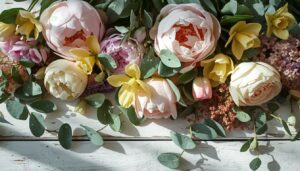
The flowers you pick set the whole mood of your arrangement, so it’s worth choosing ones that truly feel like spring. Some blooms bring soft color, others add texture or fragrance, and a few do all three at once.
For inspiration on what grows best this time of year, spring bulb planting guides can help you match the right varieties to your climate and vision.
Here are the best spring flowers to start with.
Tulips, Daffodils, and Hyacinths
These three blooms are the heart of any classic tulip bouquet or DIY spring flower arrangement. Get your bloom timing sync right, and they’ll peak together beautifully.
- Tulips bring bold color and clean stems
- Daffodils and narcissus mix add sunny structure
- Hyacinths offer intense fragrance layering
- Petal texture variation creates visual depth
- Seasonal longevity improves with good bulb planting tips
Consider that sparingly irrigated bulbs extend bloom.
Ranunculus, Poppies, and Delphinium
Beyond the classic trio, ranunculus, poppies, and delphinium open up a whole world of Spring flower arrangement ideas.
Ranunculus brings layered petal depth with its soft rosette shape, while poppies add an airy, papery texture — perfect for a Poppy and Peony Bouquet or a bold border mix.
Use delphinium as your vertical arrangement dynamics anchor, and don’t skip stalk support methods for taller stems.
Bluebells, Paperwhites, and Narcissus
Bluebells bring that dreamy Bluebell Carpet effect straight from a Woodland Habitat into your spring flower arrangement ideas.
They pair beautifully with Paperwhites, whose strong fragrance makes them stand out Fragrant Indoor Blooms. Try Paperwhite Forcing Techniques to time their blooms perfectly.
Good Narcissus Bulb Care keeps them lasting longer, adding soft Floral Centerpiece Inspiration and easy Seasonal Home Decoration to your DIY Spring Flower Arrangements.
Choosing Greenery and Filler Blooms
Once your focal blooms are chosen, greenery and fillers are what tie everything together.
Here are five go-to options for your DIY Spring Flower Arrangements:
- Leather leaf fern — adds Greenery Shape and a strong backdrop
- Eucalyptus — cool Leaf Color Harmony with a soft scent
- Baby’s breath — classic Filler Texture for airy Volume Balance
- Ruscus stems — sturdy support for wildflower inspired centerpiece styles
- Salal leaves — glossy fullness with excellent Stem Hydration and vase life
Weave them naturally through your spring flower arrangement ideas for floral centerpiece inspiration that feels effortlessly garden-fresh.
For stems that last, cut flowers at a 45-degree angle with sharp, clean tools so your spring centerpiece stays vibrant from garden to table.
Choose Colors and Style
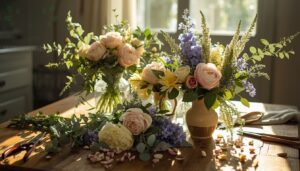
Color is where your arrangement really comes to life. Before you start pulling stems, it helps to have a direction in mind — a mood, a palette, a feeling you’re going for.
Here are a few ways to think about it.
Soft Pastels for a Spring Look
Pastel Pairing Rules are simple once you see them in action. Pick one dominant tone — blush pink or soft lavender — then layer in two supportive hues like pale yellow and mint.
Soft Green Accents from eucalyptus create Subtle Texture Layers that tie everything together. Follow a Gradient Color Flow, cool to warm, and your DIY flower arrangements will feel effortlessly complete.
Bright, Cheerful Color Combinations
When you want your spring flower arrangement ideas to pop, bold color pairings are your best tool. Think Lemon Yellow Lavender stems beside a Coral Turquoise Pairing, or a Bright Cobalt Sunflower bunch anchoring a Tulip Bouquet.
Try these vibrant color combinations:
- Mint Green Buttercup with hot pink tulips
- Sky Blue Apricot for a soft-bright balance
- Coral with turquoise for tropical freshness
- Yellow tulips beside deep purple hyacinths
- Vibrant Zinnia and Marigold Bouquet for a colorful spring palette, ideas centerpiece
Monochrome and Ombré Arrangements
Sometimes, less color is more beautiful. Monochrome arrangements use tonal depth — layering blooms from blush to deep rose — to create quiet drama. Ombré takes it further, shifting your color palette smoothly across gradient vases from light to dark.
Monochrome arrangements layer blooms from blush to deep rose, turning fewer colors into quiet, dramatic beauty
Try texture layering and focal rhythm to keep things interesting.
| Style | Spring Flower Arrangement Ideas |
|---|---|
| Monochrome | Soft lavender to deep violet tulips |
| Ombré | Pale peach fading into burnt coral ranunculus |
| Texture Layering | Round peonies with ruffled hyacinths |
| Leaf Tone Shift | Light eucalyptus beside deep ivy |
Rustic, Elegant, and Whimsical Styles
Your style sets the whole mood. Think of each approach as its own little world.
- Rustic Textures — tuck spring flowers into a rustic pitcher or wooden box lined with jute.
- Elegant Accents — try an Elegant Orchid Display in a marble-topped setting with brass details.
- Whimsical Props — use glass cloches and soft, Colorful Spring Palette Ideas with pastel ribbons.
- Lighting Mood — warm candlelight and Vessel Choices complete each look beautifully.
Prep Stems for Arranging
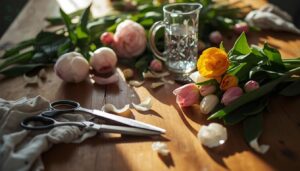
Before you place a single stem, a little prep work goes a long way. Flowers that are properly cut and conditioned drink water better and stay fresh much longer.
Here’s what to do before your arrangement even begins.
Cutting Stems at The Right Angle
A clean, angled cut is one of the best flower care tips you can follow. Slice each stem at 45 degrees — your Angle Measurement sweet spot — to boost Water Uptake and arrangement longevity.
Blade Sterilization keeps bacteria out, while Cut Timing and Stem Orientation matter too.
| Step | What to Do | Why It Helps |
|---|---|---|
| Angle the cut | Hold at 45° | More surface area drinks water |
| Sterilize blade | Wipe between cuts | Stops bacteria spreading |
| Recut every 2–3 days | Fresh angled slice | Restores cut flower freshness |
Removing Lower Leaves and Damaged Petals
Think of your stems like a clean kitchen counter — the tidier, the better. Leaf Hygiene Practices and Petal Trimming Techniques are quiet heroes of arrangement longevity.
- Strip leaves below the waterline using Tool Sterilization — wiped blades only
- Trim brown petal edges at their base for tips on extending flower freshness
- Follow Timing For Pruning: prune every 2–3 days on spring flowers
- Dispose of debris immediately for Water Clarity Management
- Avoid ripping — precise snips protect arrangement longevity
Conditioning Flowers Before Arranging
Once your stems are trimmed and tidy, conditioning is where spring flowers really wake up.
Fill a bucket with lukewarm water — around 100°F water temperature works best — then let stems soak for two to four hours. This soak duration restores hydration and firms up petals.
A simple preservative formula, like one teaspoon of sugar plus two drops of bleach per quart, keeps things fresh longer.
Filling Vases With Clean Water
Once your flowers are conditioned, the vase setup matters more than most people realize.
Use room temperature water — never cold — so your spring flowers don’t go into shock. Keep the water level high enough to cover stems by at least 3–4 centimeters, and swap it every 2–3 days.
simple routine that works:
- Add a pinch of sugar and one drop of bleach per liter for water additives that slow bacteria.
- Check your water level daily, especially in a mason jar or slim vessel where levels drop fast.
- Rinse the vase with mild vinegar every week or two for easy vase maintenance.
Fresh scents and firm petals tell you everything’s right.
Build a Balanced Bouquet
Now comes the part where your arrangement really starts to take shape. Building a balanced bouquet is less about excellence and more about knowing which steps to follow and in what order.
Here’s how to bring it all together.
Starting With Focal Flowers
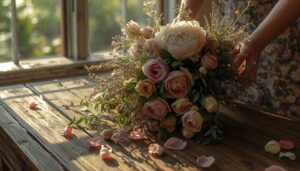
Every great bouquet starts with focal flower selection — your one to three showstopper blooms that anchor the whole design.
Think peonies and roses mix for soft romance, or bold color contrast like a sunflower and lavender bouquet for something livelier.
Place these spring flowers at eye-level placement, slightly off-center, so your centerpiece ideas feel natural, not stiff.
Adding Filler and Textural Blooms
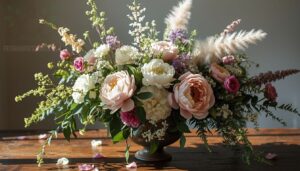
Once your focal blooms are set, it’s time to fill the space around them.
Wax Flower Accents and Limonium Airy Clusters tuck in beautifully between stems, adding lightness without crowding.
Baby’s Breath Clouds soften edges, while Astilbe Feathered Plumes bring gentle movement.
For a Cottage Garden Mix or Wildflower-Inspired Centerpiece feel, try weaving in Carnation Filler — it adds volume and lasts well.
Layering Stems for Height and Shape
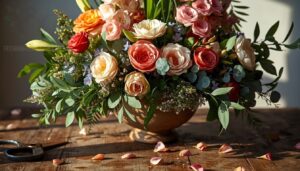
Now comes the part where your arrangement truly takes shape. Think of vertical tiering as building a little hillside — your tallest stems rise at the center or back, medium heights step forward, and shorter accents nestle at the front.
Stem strength matching matters here: thicker stems carry the height gradient, while delicate ones fill secondary layers. Textural layering and using greenery in bouquets add structural support and natural depth.
Balancing Symmetry and Movement
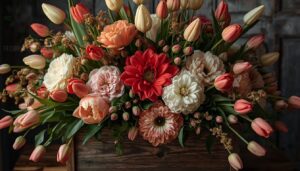
A great tulip bouquet feels alive — not stiff.
Start with axis alignment to anchor your blooms on a centered line, then add lively diagonals by angling stems outward.
Layered depth comes from placing taller blooms behind shorter ones.
A single bright color pulse off-center keeps things interesting.
Think proportional scale throughout, and your spring garden in a wooden box will look effortlessly natural.
Finish and Keep It Fresh
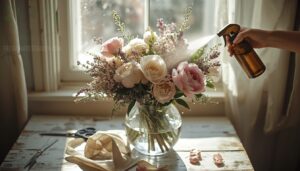
You’ve built your bouquet — now it’s time to make it last. A few small finishing touches can keep your blooms looking fresh for days longer than you’d expect.
what to focus on next.
Choosing The Right Vase or Vessel
Your vase does more work than you’d think. For tall stems, match your tall vase using a vase height ratio of roughly one and a half times the stem length.
A glass vase shows off water clarity and cleans easily.
For rustic and modern vase techniques, a wooden box with a liner works beautifully.
Watch your mouth size and base weight — both keep blooms steady.
Styling Centerpieces for Tables and Shelves
Where you place your arrangement matters just as much as how you build it. Keep these placement principles in mind:
- Use Vertical Accents like tulip stems to create Layered Levels, giving your centerpiece dimension from every angle.
- Practice Sightline Clearance — keep dining arrangements under 12 inches so guests can actually see each other.
- Try Material Pairings and Texture Contrast by combining ceramic vessels with woven baskets on shelves.
Using Greenery in Bouquets and Rustic and Modern Vase Techniques tie everything together beautifully.
Refreshing Water and Recutting Stems
Fresh water is your arrangement’s best friend. Every two to three days, swap in lukewarm water — it absorbs faster than cold.
Rinse the vase thoroughly as part of your vase sterilization process, then add a sugar bleach mix to slow bacteria.
Recut stems underwater to practice air bubble prevention and keep flower stem longevity strong.
| What to Watch | What to Do |
|---|---|
| Cloudy water indicators | Change water immediately |
| Limp or drooping stems | Recut and refresh |
Protecting Blooms From Heat and Sunlight
Think of your blooms as shade-lovers at heart. Direct sun and heat are the biggest threats to flower stem longevity, so position your indoor garden arrangement in bright, filtered light — sheer curtains or frosted glass work beautifully as light diffusing materials.
Keep temperatures around 65–72°F, practice cool water refresh every two days, and choose heat resistant varieties like peonies or ranunculus when sunlight is unavoidable.
Frequently Asked Questions (FAQs)
What are the best flowers for a spring garden?
Spring’s best garden flowers include tulips, daffodils, hyacinths, ranunculus, and poppies. Each brings color, fragrance, and life.
Choose a mix for variety, and your arrangements will feel full and naturally beautiful.
What is the seasonal bouquet for spring?
seasonal bouquet for spring pairs tulips, daffodils, and hyacinths — your classic spring blooms — for natural Color Harmony Tips and Signature Spring Scents that make any arrangement feel alive and genuinely of the season.
How do you prevent tulips from drooping over time?
Trim stems at an angle, add clean water daily, and avoid heat sources. Good soil moisture, fertilizer balance, and temperature control keep tulips upright and fresh longer.
What flowers pair best with lavender or herbs?
Lavender loves company. Pair it with rosemary, catmint, or salvia for a natural, herb-garden feel.
Add allium height, silver dollar eucalyptus greenery, and soft tulips for a wildflower-inspired, botanical arrangement full of texture.
Can you reuse florist foam for multiple arrangements?
Yes, you can reuse florist foam, but with care. Rinse and sterilize it between uses, trim edges to fit new containers, and skip reuse if it shows cracks.
How often should you change water in arrangements?
Change the water every one to two days. Fresh water, a clean vase, and a quick stem recut keep bacteria away and blooms looking their best.
What spring flowers are safe for pet-friendly homes?
Roses, orchids, gerbera daisies, snapdragons, and sunflowers are all pet-safe spring blooms. They bring seasonal color and beauty to your home without putting your curious cats or dogs at risk.
How do you preserve spring flowers for keepsakes?
Silica Gel Drying locks in color beautifully.
Air Dry Hanging works for bundles.
Try Pressing and Framing tulips, or Resin Casting Keepsakes for 3D blooms.
Freeze Dry Preservation keeps the structure best.
What mistakes should beginners avoid when arranging?
Overcrowding stems, cutting at the wrong stem angle, using improper water temperature, clashing textures, and neglecting daily recut are the most common beginner slips in floral design.
Can you mix spring flowers with summer blooms?
Yes, you absolutely can. Use Staggered Height Planning and Transitional Color Pairings to blend tulips with early zinnias. Bridge textures with greenery for Mixed Season Longevity during Seasonal Overlap Timing.
Conclusion
They say the best things grow slowly, and a spring garden flower arrangement is no different—it asks for a little patience and a lot of attention. You’ve learned how to choose stems that sing together, prepare them properly, and build something balanced and alive.
Now the real part begins: trusting your eye, your instincts, and your own sense of beauty.
Put flowers in your home often. You’ll get better every single time.
- https://www.instagram.com/tinekegeerlings/
- https://www.dutchgrown.com/blogs/the-dutchgrown-blog/when-is-the-tulip-season
- https://www.gardendesign.com/bulbs/spring.html
- https://piedmontmastergardeners.org/article/spring-flowering-bulbs/
- https://bloomeffects.com/blogs/bloomeffects/tulip-season-explained-by-bloomeffects