This site is supported by our readers. We may earn a commission, at no cost to you, if you purchase through links.

Every harvest extracts more than crops from the ground—it withdraws nutrients, disturbs soil structure, and can degrade the very foundation of future productivity. Yet farmers practicing sustainable harvesting for soil health have documented 15-40% reductions in degradation indicators while simultaneously improving yields. The difference lies not in harvesting less, but in harvesting smarter.
Conservation tillage protects soil architecture, residue retention feeds microbial communities, and strategic timing preserves organic carbon reserves that would otherwise oxidize into the atmosphere. These aren’t experimental techniques requiring specialized equipment or prohibitive investment—they’re evidence-based practices grounded in soil science that transform extraction into regeneration, ensuring your land remains productive for decades rather than depleting after a few intensive seasons.
Table Of Contents
Key Takeaways
- Sustainable harvesting practices reduce soil degradation by 15-40% while improving yields through conservation tillage, residue retention, and strategic timing that preserves soil structure and organic carbon reserves.
- Post-harvest soil fertility rebuilds most effectively when you retain 30-50% crop residue coverage, apply compost at 50 Mg/ha to boost organic carbon by 25%, and manage microbial activity through moisture control and diverse residue incorporation.
- Assessment tools including soil sensors, GPS-guided penetrometers, and moisture monitoring enable you to time harvests when soil water potential sits between -0.3 and -0.6 MPa, minimizing compaction while protecting organic carbon stocks.
- Long-term soil health maintenance requires integrating 3-6 year crop rotations, establishing cover crops within two weeks post-harvest to retain 10-26% more nitrogen, and leveraging precision farming technology for variable-rate applications across field zones.
Principles of Sustainable Harvesting for Soil Health
Sustainable harvesting isn’t just about what you take from the ground—it’s about what you leave behind for the soil to thrive. Your approach to harvesting directly shapes the physical, chemical, and biological health of your land, influencing everything from nutrient cycling to erosion control.
Sustainable harvesting protects soil health by focusing not on what you extract, but on what you preserve for the land’s future vitality
Let’s break down the core principles that’ll help you harvest in ways that protect and regenerate your soil’s long-term vitality.
Definition and Importance of Sustainable Harvesting
Sustainable harvesting means extracting your crops at a rate that preserves soil organic matter and microbial diversity—your foundation for thriving land. When you adopt conservation harvesting and sustainable practices, you’re not just protecting soil health; you’re investing in harvest optimization and ecosystem balance for years to come. By incorporating AP Biology concepts into your farming strategy, you can make more informed decisions about crop rotation and soil management.
- Reduced degradation: You’ll see 15–40% fewer long-term degradation indicators
- Enhanced stability: Conservation tillage improves soil structure by 10–25%
- Lower environmental impact: Sustainable agriculture cuts yield variance by 20–35%
How Harvesting Practices Impact Soil Health
Your harvest choices ripple through the soil long after you leave the field. Conservation tillage cuts soil compaction by 10–25%, protecting structure and reducing soil erosion. Proper harvest timing preserves soil organic carbon, which climbs 0.2–0.9 g/kg over 4–6 years with residue retention.
Meanwhile, smart fertilizer use and diversified rotations stabilize crop yields while building sustainable agriculture from the ground up.
Effective communication about theme development strategies is vital for implementing these sustainable practices.
Key Principles Guiding Sustainable Harvesting
Five core principles anchor your approach to sustainable agriculture. Minimal disturbance through conservation tillage cuts disruption by 20–50%, while continuous ground cover slashes erosion by 30–70%.
Residue management stabilizes soil moisture and reduces runoff by 15–40%. Nutrient cycling via crop residues satisfies 60–90% of demand in rotations.
Adaptive harvesting—paired with long-term monitoring—delivers 8–12% annual gains in soil health indicators, building soil organic carbon and supporting regenerative agriculture.
Assessing Soil Health Before Harvest

Before you harvest, you need to know what’s happening beneath the surface. Evaluating soil health isn’t guesswork—it’s a systematic evaluation of physical, chemical, and biological indicators that tell you whether your soil can handle the stress of harvest and recovery.
Let’s walk through the essential indicators and practical assessment tools, and how soil condition should guide your harvest timing.
Physical, Chemical, and Biological Soil Indicators
You’ll want to monitor three interconnected dimensions when gauging soil health.
Physical metrics—bulk density, water infiltration, and soil structure—reveal compaction and erosion risks.
Chemical indicators track soil organic carbon, nutrient cycling capacity, pH, and soil fertility through cation exchange.
Biological markers measure microbial activity, soil biodiversity, and nitrogen mineralization, reflecting the living ecosystem that sustains productive land and prevents soil erosion through enhanced resilience.
Tools and Methods for Soil Health Assessment
You’ll deploy soil testing kits to measure pH, nutrient availability, and soil organic carbon levels alongside microbial analysis that quantifies biological activity and soil biodiversity. Erosion monitoring tools track surface loss, while soil mapping with GPS-guided penetrometers reveals compaction patterns.
These integrated methods inform soil conservation and management decisions, supporting both soil health and fertility while enabling carbon sequestration tracking—essential for maintaining productive, resilient land.
Timing Harvest Based on Soil Condition
As soil moisture sensors reveal ideal conditions, you can achieve yield gains by aligning harvest scheduling with favorable soil health metrics. Consider these principles:
- Monitor soil water potential between -0.3 and -0.6 MPa to minimize soil compaction and protect soil organic carbon.
- Reduce field traffic during wet periods, cutting rut depth markedly.
- Preserve soil condition through conservation tillage-compatible timing.
- Leverage precision farming tools to prevent soil erosion and fine-tune crop yield management.
Sustainable Harvesting Techniques
Sustainable harvesting techniques form the backbone of soil conservation, balancing productivity with long-term land stewardship. The methods you choose during harvest season directly influence soil structure, nutrient retention, and microbial health for seasons to come.
Let’s explore four proven techniques that protect your soil while maintaining the yields you need.
Reduced Tillage and Conservation Harvesting
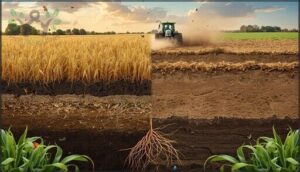
You can think of reduced tillage as conservation agriculture’s first line of defense against soil erosion. No-till farming and conservation tillage systems cut erosion by 30–90% while building organic carbon at rates of 0.2–0.5 Mg per hectare annually.
These conservation methods slash machinery energy use by 10–25%, letting you fine-tune harvest while implementing regenerative practices that safeguard your soil’s future.
Residue Management for Soil Protection
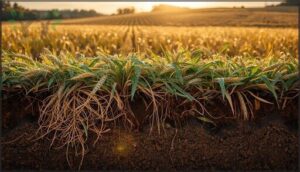
Leaving crop residues on your soil surface acts like nature’s protective blanket—one you can’t afford to ignore. This practice delivers outstanding benefits when you retain 30–50% coverage:
- Soil Erosion Control: You’ll reduce runoff by 20–60% and soil loss by 30–70% under moderate rainfall.
- Residue Retention: Maintaining 40–70% coverage boosts Soil Organic Matter from 0.8% to 2.5% within five years.
- Microbial Habitat Enhancement: Surface residues increase beneficial fungal-to-bacterial ratios by 12–28%.
- Soil Organic Carbon: You’ll gain 0.5–1.2 g C per kilogram of soil through consistent Crop Residue Management.
Crop Rotation and Diversification Strategies

Rotating your crops isn’t just good practice—it’s the backbone of Soil Resilience and Agricultural Productivity. When you integrate a 3–6 year cycle mixing cereals, legumes, and deep-rooted species, you’ll boost Soil Organic Carbon by 0.2–0.5% per decade while cutting erosion by 20–50%.
This Crop Diversity strengthens Farm Ecosystems and enhances Ecosystem Services, proving that smart Rotation Planning within Agroecology Systems delivers lasting Soil Health through proven Sustainable Agricultural Practices.
Integrating Cover Crops During and After Harvest
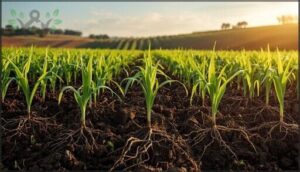
When you establish Cover Crops within two weeks post-harvest, you retain 10–26% more nitrogen while enhancing Soil Erosion Control and supporting Regenerative Farming principles. Integrating Cover Cropping with Conservation Tillage and Crop Rotation Strategies amplifies Soil Health benefits:
- Mixed-species covers boost root density at 15–25 cm, improving structure
- Intercropping reduces compaction risk by 16–22%
- Post-harvest biomass feeds nutrient cycling and respiration
This approach aligns with NoTill Farming for lasting Cover Crop Benefits.
Enhancing Soil Fertility Post-Harvest

Once the harvest is complete, your soil needs more than just rest—it needs intentional replenishment to stay productive season after season. The strategies you choose during this critical window will determine whether your land bounces back stronger or slowly loses its capacity to nourish future crops.
Let’s explore three practical approaches that rebuild fertility naturally and set the stage for long-term success.
Organic Amendments and Compost Application
Compost benefits extend well beyond short-term fertility gains—you’re actively rebuilding soil carbon reserves that support microbial activity for decades. A single application of 50 megagrams per hectare can boost soil organic carbon by 25% and sustain elevated yields nearly 30 years later.
Organic fertilizers paired with compost deliver 340% more plant-available phosphorus while enriching soil health through regenerative farming principles that safeguard nutrient cycling.
Nutrient Cycling With Crop Residues
Incorporating crop residues boosts soil organic carbon by 0.2–0.8 megagrams per hectare annually, strengthening nutrient cycling and microbial activity through conservation tillage.
You’ll see soil carbon sequestration improve nutrient uptake when diverse residues—legume and non-legume mixes—raise mineralizable nitrogen by 10–30% over two to three years.
High-carbon materials (C:N > 50:1) temporarily immobilize nitrogen, so supplement them for ideal ecosystem balance.
Managing Soil Microbial Activity After Harvest
After harvest, you need active microbe management to sustain nutrient cycling and soil respiration. Here’s how:
- Retain crop residues to stabilize microbial biomass—bacterial populations can drop 15–40% in two weeks without them
- Use conservation tillage to maintain fungal networks
- Keep moisture at 60–80% water-filled pore space
- Incorporate diverse residues for 20–35% functional diversity gains
- Adjust soil temperature between 15–25°C for peak microbial activity
Long-Term Strategies for Soil Health Maintenance
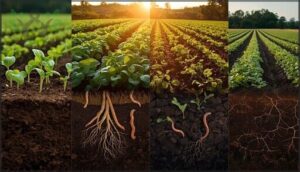
Sustaining soil health beyond a single growing season requires you to think strategically about how your practices evolve over time. You’ll need to monitor outcomes, embrace regenerative principles, and tap into both technology and community resources.
These four approaches will help you build a long-term framework that keeps your soil thriving year after year.
Monitoring and Adapting Harvest Practices
You can’t manage what you don’t measure—adaptive management hinges on continuous monitoring. Soil sensors paired with precision farming tools deliver real-time data on moisture, compaction, and organic carbon, guiding harvest timing to minimize erosion and nutrient loss.
These sustainable farming practices, aligned with conservation tillage principles, improve agricultural sustainability by preserving soil health through informed, responsive decision-making and proactive soil conservation.
Regenerative Approaches and Ecosystem Services
Regenerative farming builds resilience by enriching soil carbon stocks at 0.3–0.8 Mg C ha⁻¹ yr⁻¹, supporting ecosystem restoration and biodiversity conservation. These practices go beyond harvesting—they embody stewarding ecological balance through agroecology principles that deliver measurable ecosystem services.
You’re not just harvesting—you’re contributing to enhanced water quality, pollination gains of 5–15%, and carbon sequestration reaching 0.8 Mg CO₂e ha⁻¹ yr⁻¹. These ecological farming strategies replenish your soil’s vitality for generations.
Leveraging Technology for Sustainable Outcomes
Through real-time Soil Sensors and Drone Monitoring, you’ll gain precision insights that AI Optimization transforms into actionable decisions. Digital Mapping techniques through GIS systems enable variable-rate applications—optimizing water, nutrients, and Conservation Tillage interventions across heterogeneous field zones.
These Sustainable Agriculture Practices embed Agroecology principles into Ecological Farming systems, enhancing Soil Health through data-driven Precision Farming at spatial resolutions reaching 50 × 50 m².
Participating in Soil Health Initiatives and Programs
Collaboration unlocks resources you need to advance your conservation goals. National Soil Health Day celebrations and program enrollment opportunities connect you to soil incentives that offset practice adoption costs—68% of participating farms implement cover crops or reduced tillage within year one. Initiative funding through Policy Support mechanisms and Farmers for Soil Health networks provides technical assistance, cost-share dollars, and long-term monitoring frameworks that strengthen sustainable soils across diversified operations.
- Farm Participation in established soil health initiatives delivers proven support for conservation practice implementation
- Soil Incentives reduce financial barriers while you build organic matter and improve water-holding capacity
- Initiative Funding sustains momentum through multi-year commitments that align with your regenerative agriculture timeline
Frequently Asked Questions (FAQs)
How does climate change affect sustainable harvesting decisions?
Temperature shifts and unpredictable rainfall alter your harvest windows, increasing compaction risks when soil moisture climbs. You’ll face nutrient availability changes and biological activity fluctuations, requiring adaptive timing strategies that protect soil structure and long-term resilience under evolving weather patterns.
What are the economic costs of transitioning practices?
Shifting to conservation practices involves conversion costs averaging $50–$150 per acre, offset by financial incentives covering 15–40%.
You’ll see input savings of 10–20% annually as regenerative farming techniques boost agricultural productivity and efficiency through sustainable soils management.
Can sustainable harvesting work on small-scale farms?
You might think farm size limits your options, but smallholder support systems prove otherwise.
Reduced-tillage practices and crop yield management deliver sustainable soils—boosting agricultural productivity through harvest timing and soil erosion control on compact acreage.
How do different soil types respond to harvesting?
Your soil type dictates harvest impact on soil structure, soil fertility, and the soil microbiome.
Clay soils crust and compact more, while sandy soils face increased soil erosion without crop residues protecting them.
What role do earthworms play in harvest recovery?
You’ll find that earthworm benefits extend beyond simple soil mixing—their casting enriches microbial activity and enhances soil structure, boosting aggregate stability up to 50% while accelerating nutrient cycling essential for vigorous harvest recovery and sustained soil fertility.
Conclusion
Soils managed with sustainable harvesting for soil health can sequester up to 0.4 tons of carbon per hectare annually—turning your fields into climate assets rather than carbon sources.
Each practice you implement compounds over seasons, building resilience that withstands drought, erosion, and nutrient depletion. The question isn’t whether your soil can sustain another harvest, but whether your harvest practices sustain the soil.
Your next decision at the field edge determines productivity for future generations.
- https://myperfectwords.com/blog/research-paper-guide/research-paper-topics
- https://www.sjsu.edu/writingcenter/docs/handouts/Methodology.pdf
- https://scholar.google.com/scholar_lookup?title=Solutions+for+a+Cultivated+Planet&author=Foley,+J.A.&author=Ramankutty,+N.&author=Brauman,+K.A.&author=Cassidy,+E.S.&author=Gerber,+J.S.&author=Johnston,+M.&author=Mueller,+N.D.&author=O%E2%80%99Connell,+C.&author=Ray,+D.K.&author=West,+P.C.&author=et+al.&publication_year=2011&journal=Nature&volume=478&pages=337%E2%80%93342&doi=10.1038/nature10452&pmid=21993620
- https://doi.org/10.1038/nature10452
- https://www.ncbi.nlm.nih.gov/pubmed/21993620