This site is supported by our readers. We may earn a commission, at no cost to you, if you purchase through links.
Summer flowers are thirsty, but they’re also surprisingly easy to kill with too much kindness. Overwatering is one of the leading causes of bloom failure, yet most gardeners assume more water means more flowers.
The reality is that timing and technique matter far more than volume. Rose drenched at noon on a 95°F day absorbs almost nothing—most of it evaporates before reaching the roots.
Getting your watering routine right means understanding how soil holds moisture, how heat accelerates stress, and what your flowers actually signal when they’re struggling. Watering tips for summer flowers will help you work smarter, not harder, all season long.
Table Of Contents
- Key Takeaways
- Best Times to Water Summer Flowers
- How Much Water Do Summer Flowers Need?
- Soil Moisture Management for Summer Blooms
- Deep Watering Vs. Shallow Watering
- Efficient Watering Techniques for Flowers
- Using Mulch to Retain Soil Moisture
- Water Conservation Strategies in Hot Weather
- Caring for Potted and Container Flowers
- Common Watering Mistakes to Avoid
- Top 5 Tools for Summer Flower Watering
- Frequently Asked Questions (FAQs)
- Do you need to water flowers every day in the summer?
- How much water do container flowers need daily?
- Can I use tap water for summer blooms?
- Should I fertilize while watering in summer heat?
- Do mulched flowers need less frequent watering?
- Whats the best water temperature for summer flowers?
- Should you water newly planted flowers differently?
- How do wind and sun exposure increase water needs?
- Do companion plants help reduce watering frequency?
- How does fertilizing affect a flowers water requirements?
- Conclusion
Key Takeaways
- early in the morning your your flowers so the soil stays cool, evaporation stays low, and roots actually absorb what you give them before the heat kicks in.
- Deep, infrequent watering builds stronger roots than daily shallow sprinkles, because roots follow moisture down and become more drought-tolerant over time.
- 2- to 3-inch layer of mulch is one of the easiest wins in your garden — it slows evaporation, keeps soil temperature steady, and stretches the time between waterings.
- Overwatering is just as dangerous as underwatering, so check soil moisture before reaching for the hose — yellowing leaves, soggy soil, and a sour smell are your warning signs.
Best Times to Water Summer Flowers
Timing your watering isn’t just a habit — it’s one of the biggest factors in whether your summer flowers thrive or struggle.
Your ideal schedule also shifts based on what you’re growing — herbs, for instance, have their own quirks, so checking a watering schedule tailored to different herbs can save you a lot of guesswork.
Water at the wrong hour, and you’re either wasting it to evaporation or setting your plants up for disease.
Here’s what you need to know about working with the clock, not against it.
Early Morning Vs. Evening Watering
Morning watering wins every time in summer gardening. When you water early, soil temperature stays cooler, evaporation rate drops, and your flowers actually drink what you give them.
Evening watering is riskier — wet foliage overnight invites disease and spikes pest activity.
Stick to a consistent morning watering schedule and your blooms will reward you:
- Better root oxygenation throughout the day
- Lower light exposure stress on wet leaves
- Healthier flower bulbs overall
Avoiding Midday Heat
summer watering between 11 a.m. and 3 p.m. — that’s when heat and sun exposure work against you, evaporating water before roots ever see it. Use shade cloth (30–50% block) or a lattice pergola to shield delicate blooms.
Reflective umbrellas and light-colored pots keep root zones cooler. Smart microclimate placement near taller plants also cuts midday scorch without sacrificing water conservation efforts.
Adapting to Heatwaves and Rainfall
Weather doesn’t stick to a schedule, and neither should you. When a heatwave hits, water your summer plants one day before temperatures soar, so the soil is fully charged. Use these smart adjustments:
- Add compost for water retention during heat
- Use a rain gauge for monitoring actual rainfall
- Set smart timer adjustments after storms
- Install windbreak shade to cut evaporation
- Apply heatwave soil mulch to lock moisture in
Consider deep watering before heatwave(https://www.portlandnursery.com/resources/heatwave-watering) to make sure roots stay hydrated.
How Much Water Do Summer Flowers Need?
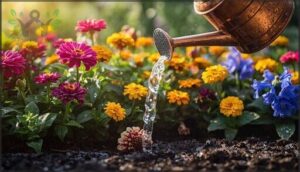
Getting the amount right is one of those things that sounds simple but trips up a lot of gardeners. Too little and your blooms fade fast, too much and you’re inviting root trouble.
Here’s what you need to know about watering your summer flowers just right.
Recommended Weekly Water Amounts
Most summer flowers need about 1 to 1.5 inches of water per week — rain included. That’s your baseline for Water Depth Guidelines. Use this Volume Conversion table to plan your watering schedule:
| Bed Size | Weekly Water Needed |
|---|---|
| 10 sq ft | ~6.2 gallons |
| 25 sq ft | ~15.5 gallons |
| 50 sq ft | ~31 gallons |
| 75 sq ft | ~46.5 gallons |
| 100 sq ft | ~62 gallons |
During a heat wave, bump that up 25–50%.
Adjusting for Flower Type
Not every flower drinks at the same pace. Shallow-rooted annuals like impatiens and petunias dry out faster than deep-rooted perennials like daylilies, which pull moisture from lower in the soil.
Drought-tolerant selections such as lantana and sedum need far less than moisture-loving varieties like astilbes.
Root depth considerations and leaf morphology impact how quickly plants lose water, so match your watering techniques to each flower’s seasonal growth habit. water plants less frequently but more deeply to encourage healthy root systems.
Factoring in Local Weather
Local conditions can shift your watering schedule faster than any calendar will. A heatwave alert, low relative humidity, or high wind speed all pull moisture from soil quickly — sometimes doubling how often your summer flowers need water. Keep these cues in mind:
- Day‑night temp swings dry containers faster in inland gardens.
- Rainfall prediction lets you skip a scheduled session after 25mm or more.
- Drought management means watering deeply before heat arrives, not after.
Soil Moisture Management for Summer Blooms
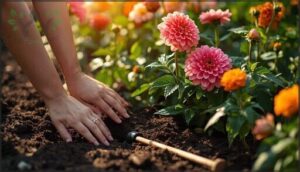
Knowing when to water is only half the battle — knowing whether your soil actually needs it what separates thriving blooms from struggling ones.
Getting that right comes down to a couple of key habits.
Here’s what makes the biggest difference.
Using Soil Moisture Meters
A soil moisture meter takes the guesswork out of watering tips for summer plants. Insert the probe to the correct probe depth — about 4 to 6 inches for most summer flowers — and check the reading before you reach for the hose.
Most meters give a clear low, okay, or high reading, so you always know exactly where your plants stand — no more guessing games like those described in this guide to watering your summer garden effectively.
Analog meters label 1 to 3 as dry and 4 to 7 as moist, giving you a clear signal for plant health.
Smart Alerts from Bluetooth sensors support data logging so you can track dry-out patterns over days.
Wipe the probe clean after each use for reliable meter calibration, and store it indoors to extend battery life and protect accuracy.
Impact of Soil Type on Watering
What’s in your ground matters more than you think.
Sandy soil drainage happens fast — water moves straight through, so summer flowers growing in it need more frequent watering to stay healthy.
Clay soil retention is the opposite: it holds water long after rain, which means you can easily overwater without realizing it.
Loam water capacity hits the sweet spot, holding just enough moisture without staying soggy.
Soil texture influence on pH and water uptake also affects how well roots absorb nutrients.
Knowing your soil type helps you fine-tune your watering techniques and protect long-term plant health.
Deep Watering Vs. Shallow Watering
How you water matters just as much as how often you water.
Shallow, frequent watering keeps roots close to the surface, where heat and drought can easily stress your plants.
Here’s what you need to know about watering deeper and why your flowers will thank you for it.
Benefits of Deep Root Hydration
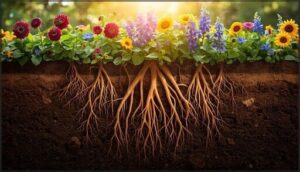
Deep watering isn’t just about quenching thirst — it builds roots that go looking for water on their own.
Deep watering helps your flowers grow stronger roots that search for moisture deep in the soil
When you water slowly and deeply, you encourage Stronger Plant Structure, Improved Drought Tolerance, and a Longer Bloom Period all at once.
| Benefit | What It Does | Why It Matters |
|---|---|---|
| Enhanced Nutrient Uptake | Roots access deeper minerals | Healthier, more vibrant blooms |
| Reduced Weed Competition | Deep roots outpace shallow weeds | Less maintenance for you |
| Better Water Conservation | Less frequent irrigation systems needed | Saves time and water |
Risks of Frequent Shallow Watering
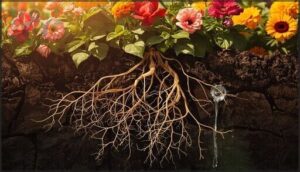
Frequent shallow watering trains roots to stay near the surface — and that is a problem waiting to happen.
When your watering frequency stays high but depth stays low, you’re inviting shallow root development, soil surface crusting, and increased evaporation all at once.
Summer plants end up dependent, stressed, and vulnerable.
| Risk | What Happens |
|---|---|
| Shallow root development | Root system never anchors deeply |
| Soil surface crusting | Water runs off instead of absorbing |
| Increased evaporation | Moisture vanishes before roots access it |
| Nutrient leaching | Nutrients flush past shallow roots |
| Fungal infections | Wet surface soil breeds fungal leaf diseases |
Techniques for Effective Deep Watering
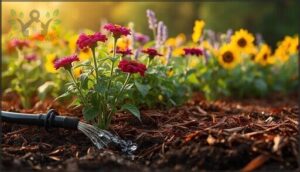
Fixing shallow roots starts with slowing down. A soaker hose placement along the base of your summer flowers, paired with a slow flow rate, pushes water straight to the root zone for true root zone saturation.
Pair that with mulch integration to seal moisture in, and use watering timer settings to run longer, less frequent cycles.
| Technique | Why It Works |
|---|---|
| Soaker hose at base | Targets root zone directly |
| Slow, long irrigation cycles | Encourages deep root growth |
| 2–3 inch mulch layer | Reduces evaporation between waterings |
| Timer set for early morning | Maximizes soil moisture absorption |
Efficient Watering Techniques for Flowers
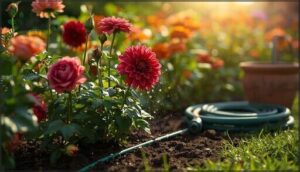
How you deliver water matters just as much as how often you do it. The right technique keeps your flowers healthy and cuts down on wasted effort.
Here are three efficient watering methods worth putting to work in your garden.
Watering at The Base
Always aim water at the base of your plants — this is root zone targeting in action, putting moisture exactly where feeder roots can reach it. A watering wand or narrow-spout can be your best hand watering tools here.
Try the doughnut basin technique: shape a shallow ring around each stem so water pools and soaks down deep instead of running off.
Splash reduction keeps foliage dry, and container base watering follows the same logic — water until it drains from the bottom.
Drip Systems and Soaker Hoses
Drip irrigation and soaker hoses take the guesswork out of summer watering. Lay soaker hoses in a serpentine pattern about 12 to 18 inches apart, or branch quarter‑inch lines off your mainline every 12 inches for even coverage.
- Emitter selection matches flow rate to sun exposure — 0.5 GPH for shade, 1–2 GPH for full sun
- Pressure regulation (10–30 PSI) prevents burst lines and uneven soil moisture
- Clog prevention starts with a 150‑mesh inline filter, especially with well water
- Seasonal flushing clears sediment before winter storage
Pair everything with smart timers for hands‑free, efficient watering all season.
Preventing Wet Foliage and Disease
Even the best drip setup can’t protect your blooms if wet leaves invite fungal leaf diseases.
Water in the early morning so foliage benefits from Morning Drying as the sun rises. Direct flow at the soil for Splash-Free Watering, and keep a Mulch Barrier in place to stop muddy splashes. Good Airflow Enhancement between plants and regular Tool Sanitization round out a reliable watering schedule.
| Practice | What It Does | Why It Matters |
|---|---|---|
| Morning watering | Lets leaves dry by midday | Reduces fungal leaf diseases |
| Base-only watering | Keeps foliage dry | Protects plant health |
| Tool sanitization | Removes spores from equipment | Stops disease spread |
| Mulch barrier | Prevents soil splash | Shields lower leaves |
Using Mulch to Retain Soil Moisture
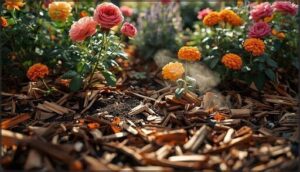
Mulch does quiet, steady work that most gardeners underestimate — it keeps the soil cool, slows moisture loss, and cuts down how often you need to water.
Getting the most out of it comes down to choosing the right material, applying it correctly, and keeping it in good shape through the season.
Here’s what you need to know.
Best Mulch Materials for Flowers
Not all mulch is created equal, and picking the right one makes a real difference in your summer garden care.
Shredded bark holds its structure for seasons and suits most flowers well.
Compost mulch feeds as it breaks down, improving soil moisture over time.
Straw mulch helps sandy beds stay consistently damp around flower bulbs.
Pine needle mulch resists wind and drains well.
Cocoa hull mulch offers a clean look but keep pets away.
Mulch Application Tips
Spreading mulch correctly is where the real benefits kick in. Aim for a mulch depth measurement of 5 to 7.5 centimeters across your beds, and always check timing after watering — applying right after a deep soak locks moisture in.
Keep a stem clearance gap of 2.5 to 5 centimeters around each plant to prevent rot. For containers, a thinner 2.5-centimeter container mulch layer works best.
Maintaining Mulch Effectiveness
Once mulch is down, keeping it working takes just a few minutes every couple of weeks. Check depth regularly — organic mulch shrinks 25 to 50 percent in a season, so Mulch Thickness Monitoring prevents gaps that let moisture escape.
Loosen the top layer monthly for Compaction Prevention, pull weeds every 7 to 10 days for Weed Suppression, and do a Seasonal Mulch Refresh before peak heat to lock in soil moisture.
Water Conservation Strategies in Hot Weather
Hot summers can drain your garden’s water supply faster than you’d think, so a few smart conservation habits go a long way.
The good news is you don’t need expensive equipment to make a real difference. Here are practical strategies to help you stretch every drop.
Collecting and Using Rainwater
A standard rain barrel holds 50 to 80 gallons — enough to cover a 100-square-foot flower bed through one dry week.
Smart barrel placement on raised blocks improves gravity flow for drip irrigation lines and soaker hoses.
Install a first flush diverter to shed the initial dirty runoff, and choose food-safe plastic for clean garden hydration.
Before winter, drain and store barrels to prevent ice damage.
Setting Up Automatic Timers
A smart timer turns your irrigation systems into a hands-free watering schedule that never forgets. Timer programming paired with weather sync keeps your summer garden care consistent without guesswork. Here’s what to set up:
- Zone customization lets you tailor output per bed
- Sensor integration cuts watering on rainy days
- Check power supply reliability before peak heat
That consistency protects plant health all season.
Avoiding Water Waste and Runoff
Every drop counts when the heat is relentless. Pair timer scheduling with drip irrigation so water lands exactly where roots need it — no waste, no runoff.
Use low‑pressure flow to let soil absorb moisture at its own pace.
Soil aeration opens compacted ground so water soaks in rather than sheeting off.
Add contour basins on slopes, practice leaf‑free watering, and your water conservation efforts pay off all season.
Caring for Potted and Container Flowers
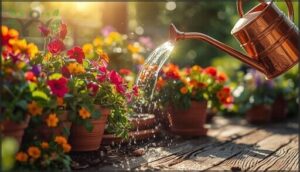
Potted flowers play by different rules than their in-ground cousins.
Containers dry out faster, drain differently, and show stress sooner — so what works in a garden bed won’t always work in a pot.
Here’s what you need to know to keep your container blooms healthy all summer long.
Proper Pot Drainage
Getting drainage right is the foundation of healthy container flowers. Without proper pot drainage, roots sit in standing water and rot quickly.
Keep these non‑negotiables in mind:
- Choose pots with adequate drainage hole size — at least one large opening
- Add a gravel base layer to improve soil drainage
- Prioritize clay pot perforations for natural moisture regulation
Monitor water flow after each watering session.
How Much to Water Flower Pots
Once drainage is sorted, the next question is how much water your flower pots actually need.
Container size matters — smaller pots have lower Root Zone Capacity and a higher Evaporation Rate, so they dry out faster. Match your watering schedule to Pot Size Ratio and use Water Retention Media like peat or coir. Make Seasonal Pot Adjustments as heat increases, checking soil moisture regularly for better water efficiency.
Signs of Overwatering in Containers
Too much water is just as harmful as too little. Watch for Leaf Yellowing — not from drought, but from roots sitting in soggy soil.
Stem Softness, Moldy Soil on the surface, and Stunted Growth are all red flags. If you notice a sour Root Smell when you repot, your watering schedule needs adjusting.
Check soil moisture before every watering session.
Common Watering Mistakes to Avoid
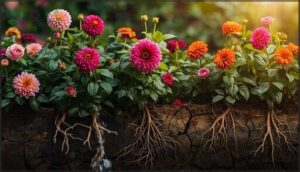
Even the most well-meaning gardeners make watering mistakes that quietly work against their blooms.
Too much water, too little, or the wrong technique can stress your plants before you realize something’s wrong.
Here are the most common pitfalls to watch for — and how to steer clear of them.
Overwatering and Root Rot Risks
Too much water is just as deadly as too little.
Waterlogged soil triggers Root Oxygen Deficiency — roots literally suffocate within days, leaving your root ball vulnerable to Fungal Pathogen Spread from organisms like Pythium and Phytophthora.
Watch for Waterlogged Soil Symptoms: yellowing leaves, a sour smell, or wilting despite wet soil.
Adjust your watering schedule, improve soil drainage, and avoid Container Sump Issues by never letting saucers stay filled.
Signs of Underwatering and Stress
While overwatering drowns roots, underwatering quietly starves your blooms. Wilting foliage and leaf curling are your plant’s first distress signals, followed by soil cracking and reduced blooming as heat stress sets in.
Check soil moisture daily during peak summer heat to stay ahead of watering needs.
Watch for these signs your flower care routine needs adjusting:
- Wilting foliage even in the morning
- Leaf curling or crispy edges
- Dry, cracked soil pulling away from pot edges
- Fewer blooms or buds dropping early
- Stunted growth despite regular summer watering techniques
Preventing Fungal and Bacterial Issues
Watering mistakes don’t just stress your flowers — they open the door to fungal diseases and bacterial rot. Keep leaves dry by watering at the base, and time it for the morning so any splashes dry within hours.
Good airflow management between plants, proper soil drainage, and regular soil aeration all limit moisture buildup.
Clean tools with diluted bleach for tool sanitation, and keep mulching materials fresh for mulch hygiene.
Top 5 Tools for Summer Flower Watering
Having the right tools makes summer watering less of a chore and more of a routine you can actually stick to.
The difference between struggling plants and thriving blooms often comes down to what’s in your hand — or running quietly in your garden while you’re off doing other things.
Here are five tools worth knowing about.
1. Dramm One Touch Rain Wand
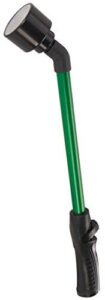
The Dramm One Touch Rain Wand makes gentle watering feel smooth. Its compact 16-inch reach puts you in close control, and the thumb-activated valve lets you start and stop flow without fumbling. The soft, rain-like shower won’t disturb seedlings or knock petals loose — perfect for delicate flowers, hanging baskets, and containers.
Built from lightweight aluminum, it won’t tire your arm during longer watering sessions. Just keep water pressure adequate, since this wand relies on good flow to perform at its best.
| Best For | Home gardeners who grow flowers, seedlings, herbs, or container plants and want gentle, precise watering without damaging delicate growth. |
|---|---|
| Primary Use | Flower & plant watering |
| Water Efficiency | Thumb-controlled flow |
| Ease of Use | One-touch valve |
| Durability | Aluminum construction |
| Eco Friendliness | Minimal water waste |
| Product Weight | 14.4 oz |
| Additional Features |
|
- The soft rain-like shower is easy on seedlings and fragile plants
- One-touch thumb valve gives you instant, effortless flow control
- Lightweight aluminum keeps your arm from wearing out during longer sessions
- Needs solid water pressure to work well — low pressure households may struggle
- Some users have noticed the plastic nozzle components can be less durable over time
- The internal hose attachment may not be included, so check before buying
2. Melnor Flat Soaker Garden Hose
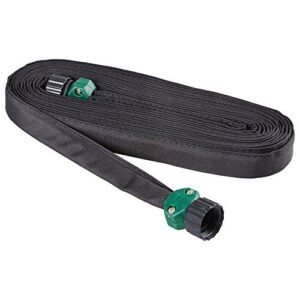
If you want hands-off watering that actually works, the Melnor Flat Soaker Hose is worth keeping in your toolkit. This 50-foot vinyl hose lays flat for easy storage and delivers water slowly and evenly right at the root zone — no splash, no waste.
It works above ground or tucked under mulch, making it ideal for raised beds and vegetable gardens. The rust-resistant end cap keeps connections tight, and the porous design means your flowers get a steady, gentle drink every time.
| Best For | Gardeners who want a low-maintenance, water-efficient way to keep raised beds and vegetable gardens consistently hydrated. |
|---|---|
| Primary Use | Garden bed irrigation |
| Water Efficiency | Porous no-waste delivery |
| Ease of Use | Flat storage design |
| Durability | Vinyl with end cap |
| Eco Friendliness | Reduces runoff |
| Product Weight | 1.34 lbs |
| Additional Features |
|
- Delivers slow, even watering right at the root zone — no runoff, no wasted water
- Flexible enough to lay above ground or tuck under mulch for a cleaner setup
- Flattens out for compact, easy storage when the season wraps up
- Durability can be hit or miss — some users report tearing or ripping with regular use
- 50 feet might be more than you need, which can lead to uneven water distribution in smaller spaces
- Plastic fittings aren’t the sturdiest, so they may not hold up as well over time
3. Coolaroo 90 UV Block Shade Cloth
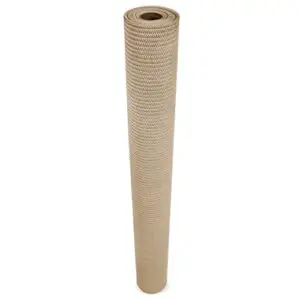
biggest threats to summer blooms — and the Coolaroo 90 UV Block Shade Cloth helps you fight back. It blocks up to 90% of harmful UV rays while still allowing airflow, which can drop temperatures underneath by as much as 32%.
The breathable HDPE material won’t trap heat or moisture.
At 6 by 15 feet, it’s easy to cut and drape over pergolas, patios, or garden frames.
It’s also 100% recyclable, so it’s a win for your flowers and the environment.
| Best For | Gardeners and homeowners who want reliable sun protection for outdoor spaces like patios, pergolas, or garden beds without sacrificing airflow. |
|---|---|
| Primary Use | Plant sun protection |
| Water Efficiency | Reduces heat stress |
| Ease of Use | DIY roll & cut |
| Durability | HDPE material |
| Eco Friendliness | 100% recyclable |
| Product Weight | 2.18 lbs |
| Additional Features |
|
- Blocks up to 90% of UV rays and can drop temps underneath by as much as 32%, keeping plants and people cooler
- Breathable HDPE material lets air move through so heat and moisture don’t build up
- Easy to cut and work with, plus it’s 100% recyclable for a greener choice
- Edges can come out uneven and may need trimming before use
- The material runs stiff, which can make hanging or folding it a bit of a hassle
- Not built for extreme weather, so it may not hold up well in harsh conditions
4. Rainpoint 2 Zone Garden Hose Timer
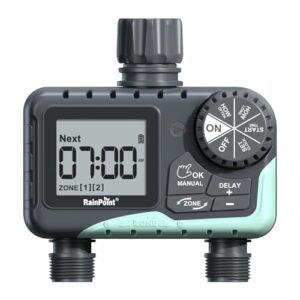
Forgetting to water is one of the easiest ways to lose a whole season of blooms. RAINPOINT 2 Timer takes that worry off your plate.
It runs two separate zones on fully customizable schedules, with watering durations from 1 minute up to nearly 4 hours. You can set frequencies from hourly to every 7 days, plus, a rain delay feature gives you 24, 48, or 72 hours of automatic pause.
The large LED display makes programming simple — no tech background needed.
| Best For | Gardeners who want to automate watering across multiple zones without needing to be tech-savvy. |
|---|---|
| Primary Use | Automated garden watering |
| Water Efficiency | Programmable schedules |
| Ease of Use | 360° rotating interface |
| Durability | Plastic housing |
| Eco Friendliness | Rain delay mode |
| Product Weight | 1.17 lbs |
| Additional Features |
|
- Two separate zones let you set different schedules for different areas of your yard
- Rain delay feature (24, 48, or 72 hours) means you won’t waste water right after it rains
- Large LED display and simple programming make setup easy for anyone
- Battery-powered, so you’ll need to keep up with replacements over time
- May not fit older or rusted faucets and pipes
- Not ideal for spots with extreme heat or freezing temps, which can affect performance
5. Miracle Gro Houseplant Potting Mix
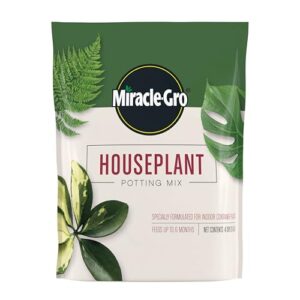
Good timing matters, but so does what’s underneath your plants. The Miracle‑Gro Houseplant Potting Mix gives your container flowers a strong foundation — it holds moisture without staying soggy, so roots stay healthy between waterings.
It feeds for up to 6 months and works beautifully for tropicals like pothos and monstera. One note: it’s not the right fit for succulents unless you mix in extra perlite. For most summer container blooms, though, it’s a dependable base.
| Best For | Anyone growing tropical houseplants like pothos, spider plants, or monstera in containers and wanting a low-maintenance soil that feeds and drains well. |
|---|---|
| Primary Use | Indoor plant nourishment |
| Water Efficiency | Moisture-retaining mix |
| Ease of Use | Ready-to-use bag |
| Durability | Sealed bag packaging |
| Eco Friendliness | No bark or compost |
| Product Weight | 2.07 lbs |
| Additional Features |
|
- Feeds your plants for up to 6 months, so you’re not constantly adding fertilizer
- Holds moisture well without getting waterlogged — roots stay happy between waterings
- Less likely to attract gnats since it skips compost and bark
- The 4 qt bag won’t go far if you have large pots to fill
- Not a great fit for succulents unless you mix in extra perlite or grit
- Costs a bit more than basic potting soils on the shelf
Frequently Asked Questions (FAQs)
Do you need to water flowers every day in the summer?
Most garden flowers don’t need daily watering.
Think of water like a deep drink, not a constant drip — thorough soaking every two to three days builds stronger roots than light daily splashes.
How much water do container flowers need daily?
Container flowers dry out fast, so check them daily. Most need watering when the top inch of soil feels dry — that’s usually once a day in summer heat, sometimes twice.
Can I use tap water for summer blooms?
Yes, tap water works fine for most summer blooms. Let it sit overnight so chlorine can dissipate, and your petunias, marigolds, and zinnias will drink it up without any trouble.
Should I fertilize while watering in summer heat?
Fertilizing during summer heat can stress plants.
Wait until cooler parts of the day, like early morning, then water first before applying fertilizer to avoid burning roots and maximizing nutrient absorption.
Do mulched flowers need less frequent watering?
Mulch is practically a moisture miracle worker.
Yes, mulched flowers generally need less frequent watering — a 2- to 3-inch layer slows evaporation, keeps roots cooler, and helps soil stay consistently moist longer.
Whats the best water temperature for summer flowers?
Aim for water between 60 and 70 degrees Fahrenheit.
That range feels mild to roots, reduces shock, and keeps nutrient uptake steady.
Cold well water or sun-heated hose water can both stress your plants.
Should you water newly planted flowers differently?
Newly planted flowers need water two to four times per week in the first month. Their shallow roots dry out fast, so keep the soil evenly moist until they’re established.
How do wind and sun exposure increase water needs?
Strong sun and steady wind pull moisture from both soil and leaves far faster than calm, shaded conditions.
On hot, breezy days, exposed flower beds can dry out completely within hours of watering.
Do companion plants help reduce watering frequency?
Yes, companion plants can reduce watering frequency.
Low-growing plants like creeping thyme or clover act as living mulch, shading the soil, slowing evaporation, and keeping moisture where your flowers’ roots need it most.
How does fertilizing affect a flowers water requirements?
Fertilizing your flowers boosts growth, but that extra foliage means more water demand — sometimes 20 to 50 percent more. Feed regularly, and you’ll need to check soil moisture more often.
Conclusion
Like a well-timed rain shower, the right watering habits arrive exactly when your flowers need them most.
These watering tips for summer flowers aren’t about doing more—they’re about doing it smarter.
Water deeply, water early, and let the soil guide you.
Protect your roots with mulch, trust your tools, and pay attention to what your plants are telling you.
Do that consistently, and your blooms will reward you all season long.