This site is supported by our readers. We may earn a commission, at no cost to you, if you purchase through links.
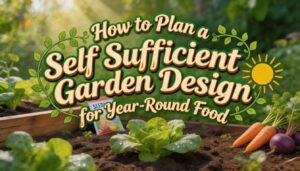
Most people who grow their own food start the same way—a few tomato plants, some basil, maybe a zucchini that takes over the yard. Then one summer, something clicks.
You realize the garden could do so much more than produce occasional salads. A self sufficient garden design works more like an ecosystem than a hobby plot: crops feed the soil, the soil feeds the crops, and your kitchen stays stocked through every season.
Getting there takes more intention than just digging beds and scattering seeds—but the roadmap is clearer than most people expect.
Table Of Contents
- Key Takeaways
- Define Self-Sufficiency Goals
- Assess The Best Garden Site
- Plan a High-Yield Garden Layout
- Build Fertile, Water-Smart Soil
- Choose Crops for Year-Round Harvest
- Frequently Asked Questions (FAQs)
- What is the weakness of permaculture?
- How to plan a garden for self-sufficiency?
- How do I store surplus harvest long-term?
- What tools are essential for garden maintenance?
- Can I raise chickens in my garden?
- How much time does daily garden care require?
- Should I save seeds or buy new ones?
- How do livestock fit into a self-sufficient garden?
- Can a self-sufficient garden work in a cold climate?
- How do you manage a garden during extended absences?
- Conclusion
Key Takeaways
- A self-sufficient garden works like a closed-loop ecosystem—your crops feed the soil, your soil feeds your crops, and smart planning keeps your kitchen stocked through every season.
- Staple storage crops like dry beans, potatoes, and winter squash are the backbone of real food security, delivering calorie-dense harvests that carry you well past the last frost.
- Building fertile, water-smart soil through composting, sheet mulching, cover crops, and rainwater harvesting is the single highest-leverage investment you can make in your garden’s long-term productivity.
- Layering perennials with succession-planted annuals—and saving open-pollinated seeds—turns your garden from a summer hobby into a repeatable, year-round food system.
Define Self-Sufficiency Goals
Before you plant a single bed, get clear on what self-sufficiency means for your home and your daily life. Your goals shape how much food you grow, how much space you need, and what kind of garden makes sense.
Thinking through your goals early also helps you plan smarter layouts—this winter garden planning guide for spring harvests is a great place to start mapping it all out.
These next points will help you set practical targets that fit your time, budget, and skill level.
What Self Sufficient Garden Design Means
Think of a self-sustaining garden as your own resilient food system — not just a patch of vegetables, but a integrated ecosystem where integrated resource loops keep everything working together.
Its low input design meets year-round harvesting, rooted in permaculture principles.
You’re building closed loop production that creates real food security for your household, growing what you eat and eating what you grow.
Setting Realistic Household Food Targets
Once your garden vision is clear, it’s time to get honest about your family portion planning. How much food does your household actually eat?
Start with your calorie budget — most adults need around 2,000 calories daily. From there, build seasonal yield estimates around staple crops like potatoes and dried beans, which anchor real food security.
That foundation drives smarter resource efficiency from day one.
This approach benefits from parallel token generation to speed up planning calculations.
Balancing Nutrition, Calories, and Storage Needs
Calories get you through winter — but nutrients keep you healthy. Lean on calorie-dense staples like dry beans (300+ calories per 100g) and potatoes, then layer in micronutrient rotation with kale, carrots, and garlic.
Seasonal storage planning ties it together: cure your squash, ferment your cabbage, and dry your beans.
Smart nutrient preservation methods mean your summer’s work feeds you well past the first frost.
For maximum energy yield, consider the high calorie crop potatoes that can produce over 15,000 kcal per raised bed.
Estimating Space Per Person
Once nutrition map is set, it’s time to get real about space. For year-round harvesting in a self-sufficient garden, plan roughly 200 square feet per person — or 600 square feet for three.
Intensive bed ratio methods cut that down substantially.
Square foot yield beats traditional rows every time, and smart root crop allocation plus fruit tree footprint planning make garden planning surprisingly manageable on a suburban lot.
Matching Goals to Time, Budget, and Skill Level
Before you plant a single seed, your time, budget, and skill level need an honest look. A beginner spending a few hours weekly does better with a small, low-maintenance gardening setup than an overwhelming half-acre dream.
Skill tiering matters — start simple, then scale incrementally. Budget constraints shape everything too: a 100-square-foot self-sufficient garden runs $250–$500 to set up.
Labor intensity drops naturally as experience builds.
Assess The Best Garden Site
Before you plant a single seed, the ground beneath your feet has a story to tell. Picking the right spot can mean the difference between a garden that thrives and one that just survives.
Here’s what to look at when sizing up your site.
Measuring Daily Sunlight Exposure
Sunlight is your garden’s currency — and you need to count every hour. Walk your backyard garden through the day, checking each spot hourly from sunrise to sunset.
That’s your Hourly Sun Log. Mark sun or shade, then total it up.
Shadow Source Identification matters too — sheds and trees shift seasonally. Aim for a minimum of six hours of sunlight, map it across seasons, and you’ve got reliable Sunlight Data Recording for climate resilient planting.
Checking Soil Type, PH, and Fertility
Think of your soil as a business partner — you need to know what it brings to the table. Start with the Jar Test Method: shake a soil sample in water and watch the layers settle.
Your Soil Sampling Protocol should pull from several spots across the bed. Test for pH (target 6.0–7.0 using a pH Buffer Index), Organic Matter Levels, and Nutrient Deficiency Indicators.
Microbial inoculants, soil amendment, and smart soil fertility practices follow naturally from there.
Evaluating Drainage and Slope
Your garden’s drainage tells a story — and you need to read it before you plant a single seed.
Use a smartphone inclinometer for Slope Gradient Measurement: slopes under 5% are ideal, while anything above 20% demands terracing.
Run a Percolation Test Procedure by digging 12–18 inches deep and timing the water drop. Ideal Drainage Rate Interpretation lands at 1–2 inches per 15 minutes.
Steep sites need Erosion Risk Assessment and a Contour Planting Strategy, swales, sheet mulch, and rainwater harvesting to protect soil health and boost soil moisture retention.
Identifying Wind, Shade, and Microclimates
Your land has its own invisible personality — and microclimate temperature mapping reveals it. Track wind direction logging with simple flags, then note shade intensity mapping across morning, midday, and afternoon.
South-facing walls run 5–7°F warmer, while low hollows trap cold air.
Watch for wind tunnel identification through narrow gaps:
- Leaf scorch signals windburn
- Leaning trunks show persistent wind direction
- Debris patterns reveal tunnel paths
- Sheltered corners retain higher soil moisture retention
- Humidity pocket detection near water features guides climate adaptation and rainwater harvesting placement
Planning Easy Access to Water and Tools
Every wasted step to grab a tool or drag a hose is time stolen from your harvest. Keep your garden shed within arm’s reach of your main beds, and use a retractable hose reel mounted centrally so hoses stay clear of pathways.
| Feature | Spec | Benefit |
|---|---|---|
| Tool Shed Organization | 2×4m weatherproof shed | Everything within 60cm |
| Raised Bed Watering | Drip emitter, 1L/hr | Precise moisture control |
| Moisture Sensor Integration | 40% soil threshold shutoff | Saves water automatically |
| Portable Potting Station | Waist-height bench | Reduces bending 30% |
Pair rainwater harvesting barrels with sheet mulching and compost-rich beds, and your water conservation practically runs itself.
Plan a High-Yield Garden Layout
A smart layout is what separates a productive garden from a frustrating one. How arrange your growing spaces directly affects how much food you get — and how much time you spend maintaining it.
Here’s what to think through when planning your layout for maximum yield.
Zoning Crops by Harvest Frequency
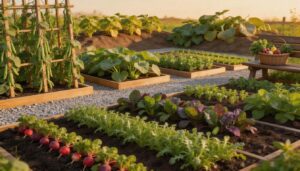
Not all crops want the same attention — and your garden layout should reflect that. Zoning by harvest frequency is the secret to year-round harvesting without burning out.
- Daily Harvest Zones – radishes, arugula, and cut greens (ready in 21–45 days)
- Weekly Harvest Beds – beans, herbs, summer squash with succession planting every 1–3 weeks
- Seasonal Storage Zones – potatoes, carrots, and winter squash pulled in larger batches
Use Harvest Tracking Maps alongside multiseason planting schedules to keep Perennial Harvest Areas and crop rotation running smoothly.
Choosing In-ground Beds, Raised Beds, or Containers
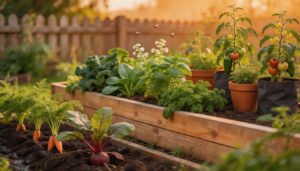
After zoning, match each bed to the job: Root depth, Drainage capacity, Material cost, Accessibility height, and Temperature regulation decide whether raised beds, container gardens, or in‑ground rows win for soil quality, seasonal planting, and year‑round harvesting.
| Type | Best use | Watch |
|---|---|---|
| In-ground | deep roots, low cost, stable moisture | more bending |
| Raised/container | quick drainage, easy reach, warmer spring soil | dries faster daily |
Designing Orchard, Annual, and Perennial Areas
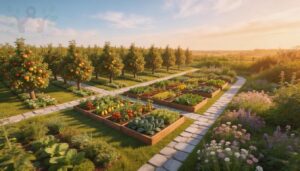
Once your bed type is sorted, think about how your garden’s three core zones—orchard, annuals, and perennials—fit together.
Orchard Row Spacing of 16–18 feet keeps fruit trees from shading each other out.
Tuck Polyculture Companion Zones and Perennial Border Diversity along the edges.
Fill young tree alleys with Crop Staggered Planting and Understory Ground Cover for year-round harvesting without wasting an inch.
Using Layered Planting to Maximize Space

Think of your garden as a layered skyline.
Canopy Layer Integration starts with tall fruit trees, while Midstory Shrub Placement tucks blueberries and currants beneath. Groundcover Companion Crops carpet the floor, and Vertical Vining Systems send kiwis and grapes climbing upward.
Multi-tiered Guild Design—blending a Three Sisters garden, companion planting, polyculture, and perennials and annuals—unlocks multiseason planting schedules from one tight footprint.
Adding Pathways, Windbreaks, and Work Areas
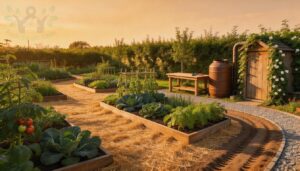
Once your layers are stacked, what holds the whole system together is smart infrastructure. Keep main paths 60–90 cm wide—enough for a wheelbarrow without sacrificing growing space.
Orient windbreaks perpendicular to prevailing winds to shield your self‑sustaining garden. Position workbench near water and tool storage zones for efficiency.
Mulched path maintenance keeps access clear and optimizes alleyways for nutrient cycling throughout your homestead layout.
Integrating Small-space Ideas for Suburban Yards
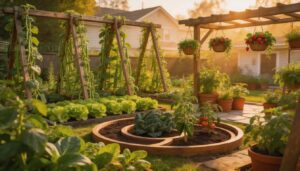
Even a compact suburban lot can feed your family when you stack growing zones vertically and design every square foot with intention.
Squeeze serious productivity out of tight spaces using:
- Vertical Trellises and A-frame Brackets to lift cucumbers and beans upward, freeing ground space for shade-loving greens below.
- Hanging Baskets and Mobile Containers that follow the sun and turn patios into productive urban harvests.
- Keyhole Gardens and raised beds for low-maintenance gardening with built-in composting at the center.
Build Fertile, Water-Smart Soil
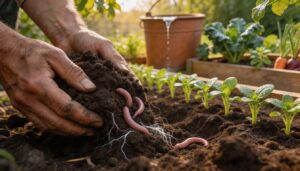
Good soil isn’t luck — it’s something you build on purpose. The steps below cover everything from feeding your soil’s microbial life to catching rainwater before it runs off your property.
Work through them and your garden will practically take care of itself.
Starting With Compost and Organic Matter
Compost is the foundation of any thriving self-sufficient garden. Getting your Greens Browns Ratio right — roughly two to three parts browns (dry leaves, cardboard) to one part greens (kitchen scraps, grass clippings) — keeps your pile aerating properly and odor‑free.
A Hot Composting Process reaching 100–160°F finishes in months, not years. Mix in finished compost at a 20% Soil Incorporation Rate, and you’ll feed your entire soil food web naturally.
Using Sheet Mulching to Suppress Weeds
Sheet mulching is basically a weed-smothering sandwich you build right on the ground. Start with your barrier materials — plain, untreated cardboard or several sheets of newspaper — overlapping edges so no light sneaks through.
Light blocking is everything here, since annual weeds and turf grass die without it. Add 2–4 inches of organic mulches on top. That mulch depth holds moisture and keeps the barrier intact.
Give it a few months, and you’ve got low-maintenance gardening on autopilot.
Growing Cover Crops for Soil Health
Cover crops are like a full-time soil crew working while your beds rest. Plant legumes like clover or hairy vetch to fix nitrogen and boost organic matter — trials show up to 114% gains over bare fallow.
Their living roots feed the soil food web, improve water infiltration, and offer natural weed suppression. Timing 3–4 weeks before transplanting for best results.
Conserving Moisture With Deep Mulch
Think of deep mulch as your soil’s personal thermostat and raincoat combined.
Coarse mulch materials like wood chips and shredded bark deliver serious temperature buffering — dropping summer soil temps by up to 13°F — while giving you a natural weed blockade that chokes out competition.
Aim for 3–4 inches for solid depth control, boosting soil infiltration and locking in every drop of rain your garden receives.
Installing Rainwater Harvesting and Drip Irrigation
Your roof is basically a rain magnet — so put it to work.
A simple rainwater harvesting system starts with a first-flush diverter to dump the dirty initial runoff, then channels clean water into a rain barrel fitted with tank mosquito screens.
Connect it to a soaker hose through a pressure regulator, add drip filtration to prevent clogged emitters, and route overflow drainage away from foundations.
Supporting Microbes for Long-term Fertility
Your soil has its own microbiome — just like your gut. Healthy soil microbes break down organic matter, suppress disease, and release nutrients plants actually use. Think of composting as feeding your underground workforce.
Compost feeds your soil’s underground workforce — microbes that break down matter, fight disease, and unlock nutrients
- Add probiotic soil amendments and microbial inoculants when planting
- Boost prebiotic fiber intake in soil through nutrient-rich compost and crop residues
- Practice fermented food integration — compost teas support microbial immune support naturally
Choose Crops for Year-Round Harvest
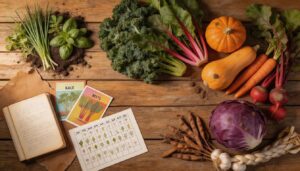
Getting your crop mix right is what separates a garden that feeds you in July from one that feeds you in January too. It’s less about growing everything and more about growing the right things in the right order.
Here’s what to focus on when planning crops for a true year-round harvest.
Prioritizing Staple and Storage Crops
Stock your garden like a pantry — because that’s exactly what it is. Calorie-dense staples like potatoes, dry beans, and winter squash give you year-round harvesting without constant effort.
Extended storage crops bridge the hungry gap between seasons. Protein-rich legumes double as soil builders, making crop diversification a win‑win.
Temperature-sensitive preservation and seasonal yield buffering keep your table full long after frost.
| Crop | Storage Life |
|---|---|
| Potatoes | 2–9 months |
| Sweet potatoes | 6–9 months |
| Winter squash | 2–3 months |
| Dry beans | 12+ months |
| Grain corn | 12+ months |
Mixing Annuals, Perennials, and Fruit Trees
Dry beans last a year in storage — but what keeps the garden itself going year after year?
That’s where mixing annuals, perennials, and fruit trees pays off.
Think of it as a Layered Canopy strategy: fruit trees up top, perennial crops in the middle, fast-growing annuals below.
Guild Planting and smart Companion Selection drive Nutrient Cycling, supporting Seasonal Harvest and true year-round harvesting through natural crop diversification.
Using Crop Rotation to Prevent Soil Depletion
Every crop you grow pulls nutrients from the ground — and rotating crops is how you pay that debt back naturally.
Family Breaks to separate plant families each season, cutting pest cycles short.
Legume Integration rebuilds nitrogen; Cover Crop Timing locks it in.
Match Rotation Length to Nutrient Balancing needs, and lean on soil testing and organic fertilizers to keep your sustainable agriculture system humming.
Succession Planting for Continuous Harvests
Want harvests that never stop? Staggered Sowing is your answer — plant fast‑maturing crops like lettuce, radishes, and bush beans every one to two weeks instead of all at once. A simple Succession Calendar keeps your Intercrop Timing tight and Year‑round harvesting within reach:
- Sow lettuce every 7–14 days
- Stagger carrots every 3–4 weeks
- Reseed cilantro and basil often — they bolt fast
- Use Varietal Maturity differences to extend windows
- Fill harvested rows immediately with a new crop
Implementing crop rotation and succession planting together, while designing multi‑season planting schedules, means your beds stay busy balancing perennial and annual crops for continuous harvest across every season.
Selecting Open-pollinated and Drought-tolerant Varieties
Choosing the right seeds is where your self-sufficient garden either thrives or struggles. Heirloom Variety Selection gives you Genetic Diversity Benefits and real Climate-Adapted Crops that naturally resist stress.
Pair those with Drought-Resistant Roots like pole beans and deep-rooted tomatoes, add native and drought-resistant species, and apply Pollination Isolation Strategies for reliable seed saving.
Year-round harvesting becomes genuinely repeatable with these heirloom fruit varieties locked in.
Planning Seed Saving and Winter Food Storage
Seed saving and winter food storage are what separate a real food system from just a garden. Use isolation distances of 10 feet or more for beans, then master seed drying techniques before sealing everything airtight.
- Label cold storage with Cold Storage Labels showing variety and harvest year
- Maintain Root Cellar Humidity near 90–95% for carrots and beets
- Plan Winter Crop Rotation so storage crops don’t deplete the same beds
- Ferment wet tomato seeds 1–3 days before drying
- Store squash at 50–55°F for up to six months
These seasonal food production and preservation strategies keep your food preservation efforts working all winter long.
Frequently Asked Questions (FAQs)
What is the weakness of permaculture?
Permaculture’s biggest weakness is labor-intensive setup and slow initial yields.
The knowledge barrier is real, complex scaling is tricky, and limited urban applicability makes it tough for city growers starting out.
How to plan a garden for self-sufficiency?
Plan a self-sufficient garden by matching your space to realistic food targets, building fertile soil, choosing storage crops, and layering perennials with annuals for year-round harvesting across every season.
How do I store surplus harvest long-term?
Store surplus with Root Cellar Management for storage crops, Freezing and Blanching, Pressure Canning Techniques, Dehydration Methods, and Vacuum Sealing Storage;
postharvest handling facilitates seasonal food production and preservation strategies through winter months and year‑round use.
What tools are essential for garden maintenance?
Picture your toolkit as a trusted crew: pruning shears, a garden fork, watering hose, knee pads, and a leaf rake covers most jobs.
Add a compost bin and rainwater barrels, and you’re set.
Can I raise chickens in my garden?
Yes, you can! In Germany, chickens are classified as small animals, so backyard flocks are generally legal — just notify your local veterinary office first before bringing any birds home.
How much time does daily garden care require?
Funny enough, daily garden care takes less time than your morning scroll through social media. Most days, you’re looking at 20 to 40 minutes of garden tasks.
Should I save seeds or buy new ones?
Both, honestly. Save seeds from open-pollinated crops like tomatoes, beans, and peas — they’ll come back true next season. Buy new for hybrids. Simple rule, big payoff.
How do livestock fit into a self-sufficient garden?
Livestock pull triple duty — producing protein, recycling waste, and feeding your soil. A chicken tractor moved daily manages manure recycling and rotational grazing without overworking any patch of ground.
Can a self-sufficient garden work in a cold climate?
Absolutely — cold climates are tougher, but they’re far from a dead end. With Cold-Hardy Crops, Season Extension Structures, and smart Winter Storage Techniques, year-round harvesting is genuinely within reach.
How do you manage a garden during extended absences?
Planning garden care during extended absences means: Automated drip scheduling, Mulch evaporation control, Drought‑tolerant crops, Pre‑departure pest inspection, a Rain barrel buffer, plus extended absence gardening, low‑maintenance gardening, low‑maintenance backyard landscaping strategies, and resource‑efficient gardening.
Conclusion
Imagine your garden three years from now: a thriving ecosystem where beans climb cornstalks, berries spill over paths, and winter greens flourish under frost. This isn’t just a garden—it’s your pantry, your pharmacy, your quiet rebellion against fragile food systems.
By weaving together smart planning, living soil, and resilient crops, your self‑sufficient garden design becomes a daily harvest.
Soon, you’ll measure wealth in root cellars full of potatoes, jars of saved seeds, and the deep satisfaction of feeding your family from your own soil.
Now, go plant that first seed.
- https://www.fedcoseeds.com/
- https://swanhose.com/blogs/general-watering/rain-barrel-and-garden-hose-a-perfect-pair-for-year-round-watering?srsltid=AfmBOorGQk8eRSWUp91IF5XZNP3FJj8nKPNr3yegWDC0HP--wBfXqQoz
- https://www.gardendesign.com/plants/natives.html
- https://youtu.be/b3E38LJeDZ8
- https://fryd.app/en/magazine/self-sufficient-garden-the-best-tips