
This site is supported by our readers. We may earn a commission, at no cost to you, if you purchase through links.

Most gardeners learn companion planting the hard way—a thriving tomato bed suddenly overtaken by aphids, or a brassica crop that never quite recovered after a bad pairing with the wrong neighbor. These aren’t random bad luck. They’re the result of planting without a system.
A well-planned companion planting garden layout treats your garden like a working ecosystem, where every plant earns its place by supporting the ones around it. Get the relationships right, and you’re managing pests, building soil fertility, and pulling bigger harvests—all at the same time.
Table Of Contents
Key Takeaways
- Pairing plants with purpose—like basil with tomatoes or marigolds with potatoes—actively suppresses pests, builds soil fertility, and boosts yields without relying on synthetic inputs.
- Mapping your garden before planting—tracking sun exposure, pest hotspots, pollinator pathways, and soil pH—is what separates a productive companion garden from an accidental one.
- Some pairings actively hurt your crops, so keeping tomatoes away from potatoes, beans away from onions, and cucumbers away from sage isn’t optional—it’s damage control.
- Rotation, succession planting, and living mulch aren’t maintenance tasks you do after the garden is set; they’re part of the system that keeps soil healthy and pests off-balance season after season.
Map Your Companion Planting Goals

Before you put a single seed in the ground, you need a clear picture of what you’re working with and what you want to fix. Every good companion planting layout starts with a few honest questions about your space, your soil, and your biggest garden headaches. Here’s what to map out first.
If you’re starting fresh, working through how to plan a spring garden can help you spot the gaps before they become problems.
Pest Pressure Zones
Knowing where pests tend to hit hardest is the first step to a smarter layout. Zone mapping helps you identify high-pressure areas based on crop type, microclimate, and past pest history.
Once you spot those hotspots, create boundary buffer zones around them to slow spillover. Regular scouting at both zone edges and interior points keeps your pest management responsive and accurate.
Pollinator Access Points
Once you’ve mapped your pest pressure zones, turn your attention to where pollinators can actually enter and move through your garden. Think of it as a Flower Ferry Layout — a series of continuous flowering beds that guide bees and butterflies from one crop cluster to the next.
Without clear pollinator access points, even the best companion planting plan falls flat. Integrating diverse plant varieties ensures that these visitors have continuous food sources throughout the year.
Sun and Shade Needs
Once you’ve guided pollinators through your garden, think about which crops actually get the sun they need. Full sun areas — six or more hours daily — suit tomatoes and peppers perfectly.
Lettuce and herbs manage well with partial shade. Morning sun with afternoon shade builds resilience and prevents bolting, especially in summer. Account for seasonal shifts, since shadows lengthen as days shorten.
Soil Fertility Priorities
Sunlight tells you where crops go — but soil fertility decides whether they thrive there. Start by testing your pH. Most vegetables prefer 6.0 to 7.0, and outside that range, nutrients lock up fast. Use lime to raise acidic soil, or sulfur to bring alkaline beds down.
Nitrogen-fixing companions like beans and clover do quiet, valuable work beside corn and squash — building fertility without a bag of fertilizer.
Harvest Timing Plans
Timing your harvest isn’t an afterthought — it’s part of the plan. Build ideal harvest windows into your companion planting chart from the start.
Tomatoes signal readiness with uniform color and slight give; carrots need 1.5–2.5 cm diameter. Align crop-specific schedules with pest synchrony and weather shifts so nothing sits too long and loses quality.
Choose Compatible Plant Partners

Some plant pairings just work, and knowing which ones to lean on makes your whole garden run smoother. Each combo below pulls its weight — whether that’s blocking pests, feeding the soil, or drawing in the right insects. Here are five partnerships worth building your layout around.
Tomatoes With Basil
Few pairings work as hard as tomatoes with basil. Basil releases aromatic compounds — linalool and eugenol — that confuse aphids and whiteflies, reducing pest pressure naturally. It also provides basil shade benefits by cooling lower tomato leaves, which helps prevent sunscald.
Basil confuses aphids and shields tomato leaves — one herb pulling double duty in the garden
Space them 12 to 18 inches apart for healthy airflow and light.
Carrots With Onions
Carrots and onions are a classic duo in both the vegetable garden and the kitchen. Their root systems barely compete — carrots reach deep while onions stay shallow — so they coexist comfortably when spaced properly. Better yet, their contrasting scents create natural pest deterrence, confusing carrot rust flies and onion flies alike.
| Benefit | Detail |
|---|---|
| Pest deterrence | Differing odors deter carrot and onion flies |
| Flavor synergy | Carrot sweetness mellows onion pungency |
| Soil compatibility | Deep and shallow roots avoid competition |
| Nutritional benefits | Beta carotene plus vitamin C in one harvest |
Brassicas With Rosemary
Rosemary is one of the hardest-working herbs you can grow alongside brassicas. Its volatile aromatic compounds confuse cabbage moths and flea beetles within a two-to-three-foot radius, naturally reducing leaf damage on broccoli, cabbage, and kale without broad-spectrum sprays.
Here’s what this pairing delivers:
- Rosemary pest deterrence masks the chemical signals brassica pests use to locate host plants
- Flavor enhancement effects subtly raise earthy terpenoid notes in harvested cabbage and Brussels sprouts
- Soil moisture management improves as rosemary’s established root structure stabilizes microclimate temperature swings
- Beneficial insect attraction brings predatory wasps that prey on common brassica pests
- Harvest timing strategies align naturally, since both plants tolerate light pruning and share similar sun and drainage needs
Plant rosemary at the bed edges, roughly two feet from brassica stems. Both plants thrive in well-drained, full-sun conditions, so your care routine stays simple. Keep scouting for pests regardless — rosemary reinforces integrated pest management, but it doesn’t replace it.
Strawberries With Borage
Few companion pairings are as rewarding as strawberries with borage. Borage attracts bees within 10 to 20 feet, directly boosting fruit set through improved pollination. Its deep roots support soil nutrient transfer, loosening compacted earth and enriching topsoil as foliage breaks down. For a space-efficient layout, plant borage at bed corners, 12 to 18 inches apart, keeping the fruiting zone clear.
| Companion Planting Benefits | Borage Role | Strawberry Outcome |
|---|---|---|
| Bee Pollination Boost | Draws bees with continuous blooms | Higher fruit set and berry yield |
| Natural Pest Control | Deters aphids and thrips | Reduced foliar and fruit damage |
| Soil Fertility | Adds trace minerals via roots | Stronger crown and runner growth |
| Harvest Timing Alignment | Blooms coincide with strawberry flowering | Maximized pollinator activity at peak bloom |
| Beneficial Insects | Attracts lacewings and hoverflies | Indirect fruitworm pressure reduction |
Both plants share irrigation needs, so your garden layout stays simple and low-maintenance throughout the season.
Potatoes With Marigolds
Marigolds are among the best potato companion plants you can grow. Their roots release compounds that create a nematode barrier effect, making the soil far less hospitable to root-attacking pests.
- They act as a beneficial insect magnet, drawing pollinators and pest predators.
- Decaying foliage delivers an organic matter addition, improving soil structure.
- Their chemistry provides rhizosphere protection, shielding potato roots naturally.
Design Your Garden Layout
Good plant pairings only go so far if your layout doesn’t give them room to work. How you arrange beds, mounds, trellises, and strips determines whether those relationships actually deliver. Here are five layout approaches worth building around.
Raised Bed Companion Plan
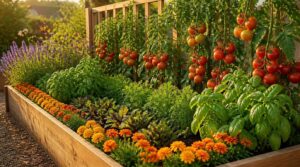
A 4×8 raised bed is the perfect canvas for a companion planting strategy that actually works. Cluster tomatoes with basil every 18 inches for built-in pest suppression, tuck marigolds along the borders to deter nematodes, and add a pollinator habitat strip at one edge.
Vertical trellises along the sunny side free up ground space for root crops below.
Three Sisters Mounds

The Three Sisters system—corn, beans, and squash—is one of the oldest intercropping methods that genuinely delivers. Corn climbs first, beans fix nitrogen at the roots, and squash leaves shade the soil to retain moisture.
Build 4-foot-wide mounds with compost-rich soil, space them 3–4 feet apart, and rotate locations each season to keep soil fertile and pests guessing.
Vertical Trellis Placement
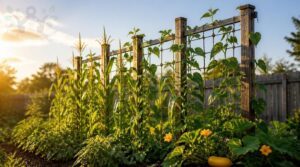
Once your Three Sisters mounds are set, think vertically. A 4–6 foot trellis placed along the north side of your bed keeps tall climbers from shading shorter crops. Use metal or hardwood posts spaced 18–36 inches apart for stability.
Train pole beans and cucumbers with soft ties, and check joints monthly for storm damage.
Pollinator Strip Spacing

Once your trellis is anchored, shift focus to the ground level.
A pollinator strip 12–18 inches wide placed 0.5–1 meter from your bed edge gives bees and hoverflies a landing zone without shading your crops. For small gardens, even a narrow row of calendula or alyssum does the job well.
Fruit Tree Guild Zones

Zoning around a fruit tree turns the whole area into a living system. Keep the inner zone clear, using shallow-rooted garlic or daffodils to deter soil pests without crowding roots. The mid zone nitrogen fixers — clover, comfrey — feed the tree and build fertility. Outer zone groundcovers retain moisture and shelter beneficial insects.
- Inner zone plants deter pests near the trunk
- Mid zone nitrogen comes from clover and comfrey
- Outer zone groundcovers slow runoff and retain moisture
- Canopy shading strategies protect companions in hot climates
- Zone maturity adaptation shifts plant roles as your tree grows
Avoid Problem Plant Pairings
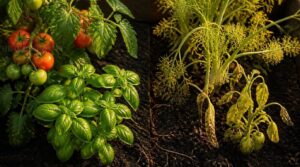
Not every plant plays well with its neighbors, and a few bad pairings can quietly undo a lot of good work. Some combinations compete for the same nutrients, share diseases, or release compounds that slow each other down. Here are the key combinations to keep apart in your layout.
Tomatoes Away From Potatoes
Tomatoes and potatoes belong to the same nightshade family, so they share diseases like late blight—and planting them close is like inviting trouble to spread freely.
Keep a crop separation distance of at least 6 to 8 feet between beds, use raised bed separation where possible, and consider a perennial herb border as a companion plant barrier to buffer pathogens and support airflow.
Beans Away From Onions
Onions release sulfur compounds that interfere with the root symbionts beans rely on for nitrogen fixation, slowing early growth noticeably.
Keep a 2 to 4 foot buffer between beds to reduce allelopathic effects and nutrient competition for boron and zinc. Rotate their locations each season to restore soil microbial balance and protect consistent bean yields.
Dill Away From Carrots
Dill and carrots seem like garden neighbors, but they’re more rivals than allies. Mature dill releases compounds that inhibit carrot root growth, especially once it flowers. Keep 12 to 18 inches between them at minimum.
- Harvest dill early to reduce competitive effects on nearby carrots
- Stagger planting by 2–3 weeks to avoid peak growth overlap
- Rotate dill beds each season to protect long-term carrot yields
Cucumbers Away From Sage
Sage and cucumbers don’t belong side by side. Sage releases volatile oils that travel through both soil and air, suppressing cucumber vigor by up to 25 percent in close plantings. Keep at least 3 feet of buffer between them, and use raised beds or containers to isolate root zones and simplify moisture management for each plant.
| Factor | Sage Needs | Cucumber Needs |
|---|---|---|
| Soil Moisture | Dry, well-drained | Consistently moist |
| Root Space | Compact, contained | Wide, spreading |
| Ideal Companion | Rosemary, thyme | Dill, marigolds |
Beets Away From Chard
Beets and chard are botanical cousins — and that’s exactly the problem. They compete fiercely for the same surface nutrients, and sharing a bed invites late-season leaf diseases to jump between them. Keep them in separate zones to manage boron and potassium for beets without stressing your chard harvest.
| Factor | Beets | Chard |
|---|---|---|
| Root Depth | Deep taproot | Shallow feeder |
| Harvest Window | 50–70 days | Ongoing cut-and-come |
| Soil Priority | Boron, calcium | Organic matter |
| Disease Risk | Shared if adjacent | Higher when crowded |
Plant, Rotate, and Maintain

Getting your plants in the ground is just the beginning. A great companion garden keeps working through smart spacing, seasonal swaps, and a little ongoing care. Here’s what to focus on to keep everything thriving.
Seed Spacing Guidelines
Good spacing turns a companion planting layout into a productive system.
Small seeds like lettuce and radish go 1 to 2 inches apart. Tomatoes and peppers need 18 to 24 inches between transplants. In raised beds, follow square foot planning — 9 to 16 carrots per square foot.
Match spacing to mature plant width and you won’t lose yield to crowding.
Succession Planting Ideas
Once spacing is set, succession planting keeps your garden beds productive all season long. Sow leafy greens every 2 to 3 weeks — spinach, lettuce, and arugula fill gaps fast. Radishes clear in 25 to 30 days, opening space for slower crops.
- Interplant bush beans with quick greens
- Follow early peas with summer squash
- Stagger carrots every 3 to 4 weeks
- Precede peppers with rapid leafy greens
- Record sow and harvest dates to adjust your seasonal planting calendar
Living Mulch Strategies
Living mulch works quietly while you focus on other tasks. White clover and crimson clover are top choices for nitrogen-fixing ground cover in garden beds — they feed the soil without any synthetic input and draw in beneficial insects throughout the season.
| Living Mulch Type | Soil Biodiversity Boost | Weed Suppression Rates |
|---|---|---|
| White Clover | High — fixes nitrogen, feeds microbes | 60–90% early season |
| Crimson Clover | High — improves Root System Depth | 60–80% mid-season |
| Ground Cover Grasses + Legumes | Moderate — enhances Carbon Sequestration | 70–90% continuous |
| Perennial Legume Mix | Very High — builds macropores | 65–85% year-round |
| Drought-Tolerant Species | Moderate — maintains soil cover | 50–75% in dry spells |
A living mulch layer can cut irrigation reduction by 10 to 25 percent in hot months — real savings when companion planting already has your beds packed. Keep mulch mowed to under 12 cm so it doesn’t compete with your crops. Flaming biomass back by 40 to 60 percent occasionally resets growth without stripping soil fertility.
Seasonal Crop Rotation
Once your living mulch is doing its quiet work, rotation picks up where it leaves off. Shift crop families every 2 to 4 years — Solanaceae one bed, legumes the next. This breaks host-specific pest cycles, rebuilds nitrogen, and keeps soil biology diverse. Let soil test results guide your timing, not guesswork.
Five rotation moves worth making:
- Follow tomatoes with beans to restore nitrogen
- Move brassicas after deep-rooting crops for better nutrient access
- Plant cover crops in empty fall beds to protect soil structure
- Use succession planting to slot a different family into harvested spots
- Record each bed’s history so no family repeats before its rest period ends
Beneficial Insect Support
Attracting and keeping beneficial insects starts with giving them somewhere to live. Build flower strips 2–3 meters wide along bed edges — these become pollinator corridors that move lacewings, parasitoid wasps, and hoverflies right into your crops. Beneficial nematodes handle soil-level threats like grubs below the surface while predator habitat like log piles shelters ground beetles above it.
| Insect | Best Attractor Plant |
|---|---|
| Lacewings | Dill |
| Parasitoid wasps | Fennel |
| Hoverflies | Calendula |
| Ground beetles | Alyssum |
| Bees | Borage |
Frequently Asked Questions (FAQs)
Can companion planting work in containers or pots?
Yes, it absolutely can. Pair basil with tomatoes in a 12-inch container for natural pest deterrence. Match light needs, share root space wisely, and keep soil loose and well-drained.
How do I companion plant in a shady yard?
Shady yards work fine for companion planting. Focus on shade-tolerant companions like lettuce, spinach, and nasturtiums. Use vertical trellises to capture light and tuck low-growers beneath.
Which companion plants grow well in dry climates?
Dry climates don’t actually punish gardeners — they just reveal who planned ahead. Drought tolerant herbs like rosemary, thyme, and sage thrive with minimal water while deterring nearby pests naturally.
Does companion planting reduce the need for fertilizer?
Companion planting does reduce fertilizer needs. Nitrogen-fixing plants like beans naturally enrich the soil, while nutrient-sharing partnerships and symbiotic relationships maintain soil health — meaning less synthetic input overall.
Can I companion plant with perennial herbs long-term?
It turns out rosemary, sage, and thyme quietly solve problems you didn’t know you had. Perennial herbs long-term anchor soil health, deter pests seasonally, and keep beneficial insects coming back year after year.
Conclusion
Think of your garden as a neighborhood—every plant either pulls its weight or quietly drains the ones around it. A thoughtful companion planting garden layout works the same way: the right relationships build resilience, the wrong ones invite chaos.
Basil shields tomatoes. Marigolds hold the line against pests. Borage calls in the pollinators.
Once you stop placing plants randomly and start placing them with purpose, your garden stops struggling and starts working for you.
- https://www.nativeseeds.org/blogs/blog-news/how-to-grow-a-three-sisters-garden
- https://gardenbetty.com/planting-a-three-sisters-garden
- https://warren.cce.cornell.edu/gardening-landscape/warren-county-master-gardener-articles/creating-a-three-sisters-garden
- https://www.almanac.com/content/three-sisters-corn-bean-and-squash
- https://fromscratchfarmstead.com/three-sisters-garden