
This site is supported by our readers. We may earn a commission, at no cost to you, if you purchase through links.

Most gardeners measure spacing by gut feel—and most gardeners wonder why their plants look strangled by August. The culprit isn’t usually pests or poor soil. It’s competition happening underground, where roots from two different crops quietly fight over the same water and nutrients before you notice anything wrong.
Companion planting promises big benefits—pest control, better yields, healthier soil—but those benefits depend on getting vegetable garden companion spacing right. Plant basil six inches from your tomatoes instead of eighteen, and you’ve created a rivalry, not a partnership.
The good news: spacing isn’t guesswork. It’s a simple calculation you can run before you put a single seed in the ground.
Table Of Contents
Key Takeaways
- Underground root competition—not pests or poor soil—is what quietly kills most companion plantings, so give each plant at least 1.5× its mature width as root‑zone clearance.
- Use the average spacing method: add both plants’ spacing needs together, divide by two, and bump it up 25–50% if one of them is a vigorous grower like zucchini or indeterminate tomatoes.
- Tall crops go north, short crops go south—non‑negotiable—because getting the vertical layout wrong means even perfectly spaced plants end up starved of light.
- Some pairs simply don’t mix: keep onions away from beans, potatoes away from tomatoes, and dill well clear of carrots—or use lettuce as a neutral buffer crop between them.
Start With Mature Plant Size

Most spacing mistakes start before you ever put a seed in the ground. The fix is simpler than you’d think — it all begins with knowing how big your plants actually get. Here’s what to look at first.
A good starting point is sketching your plot on paper — this spring garden planning guide walks you through mapping sunlight, spacing, and smart companion pairings before anything goes in the ground.
Check Seed Packet Spacing
Your seed packet is the starting point — don’t skip it. It tells you final spacing after thinning, not where to drop every seed.
For example, carrots might say "thin to 1–2 inches," while tomato transplants need 18–24 inches. Direct sow and transplant spacing differ, so read carefully.
That one line on the packet shapes your whole layout. Proper sowing depth ensures good seed‑soil contact and consistent germination, as explained in the sowing depth guidelines.
Estimate Full-grown Width
The seed packet gives you a number — but that number is about final spacing, not final width. A tomato listed at 24 inches apart can grow 18–36 inches wide once it’s branching and leafy. That’s two different things.
Check the packet for mature width specifically, or look up the variety. Knowing this upfront saves you from a crowded mess later.
Account for Root Spread
Width above ground is only half the picture. Roots tell the other half.
Most vegetables spread their roots 12–24 inches laterally from the base. In loamy soil, that reach can extend 1.5 times the plant’s height. So give each plant at least 1.5× its mature width as root zone clearance — that’s the buffer between coexistence and competition.
Give each plant at least 1.5 times its mature width—roots compete underground long before leaves ever touch
Here’s what shapes lateral root expansion:
- Soil texture — loamy soils allow wider spread; clay keeps roots tight
- Moisture levels — drier soil limits reach; wetter soil encourages it
- Neighboring roots — shallow-rooted crops conflict with wide surface feeders like cucumbers
- Root depth layering — pair deep-rooted crops (carrots) with shallow ones (lettuce) to reduce root zone overlap
Managing root competition comes down to depth-based layering. Tomatoes run fibrous and broad but stay relatively shallow. Carrots go deep and narrow. Plant them together smartly, and their root health stays intact — no one’s stealing from the other.
Avoid Nutrient Competition
Root overlap leads straight to nutrient competition. When two plants share the same soil layer, they’re fighting for the same nitrogen, phosphorus, and potassium.
Pair deep-rooted crops like carrots with shallow feeders like lettuce — that’s soil nutrient partitioning in action.
Adding compost improves nutrient retention, so neighbors aren’t depleting the same reserves simultaneously.
Leave Harvest Access Space
Once you’ve planned your spacing, don’t forget you still need to physically reach the plant. Leave 12–18 inches of clearance around bushes and root crops for comfortable picking.
Clear past the drip line on sprawling varieties.
A dedicated tool station nearby keeps shears and baskets off the soil — less compaction, easier access, better harvest flow.
Calculate Mixed Companion Distances
Planting two different crops side by side sounds simple — until you realize they each have their own personal space requirements. Luckily, there’s a straightforward formula that takes the guesswork out of it. Here’s how to calculate the right distance between any companion pair.
Use Average Spacing Method

The average spacing rule is your shortcut when you’re mixing two crops that have different needs. Take both spacing recommendations, find the middle, and you’ve got your working distance. It accommodates seed packet variability well too — packets often assume single-crop rows, so this method adapts those numbers for real companion planting situations in irregular or small garden beds.
Once you’ve nailed your spacing, pair it with deep watering techniques for fruit trees to encourage roots to grow down rather than compete sideways with neighboring plants.
- Grab each plant’s recommended spacing
- Find the midpoint between the two numbers
- Use that distance as your baseline plant spacing
Add Both Spacing Needs

Before you can find the middle ground, you need both numbers on the table. Tomatoes want 24 inches; basil needs 12. So you’re working with 24 plus 12 — that’s your raw total of 36 inches. Think of it as combined spacing needs first, then the math gets easy. No guessing, no eyeballing.
Divide Total by Two
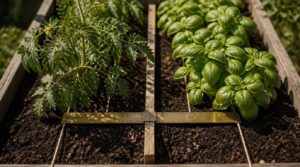
Take that 36-inch total and cut it straight down the middle. Divide by two — 36 ÷ 2 = 18 inches. That’s your planting gap between tomatoes and basil.
- Even totals split cleanly — no rounding needed
- Odd totals give you a half-inch remainder — round up
- This mirrors the 1:1 ratio principle: equal shares, balanced spacing
- Works across square-foot grids and in-ground rows
- Visualize it as a boundary line between two zones
Increase for Vigorous Growers

The average-spacing formula is your baseline — not your ceiling. Some plants just grow bigger, wider, and wilder than the math assumes.
Vigorous growers like zucchini or indeterminate tomatoes can crowd out companions fast. When one plant has a reputation for aggressive spread, bump the calculated distance up by 25–50 percent to protect root volume, airflow, and light access for both.
Adjust for Small Gardens
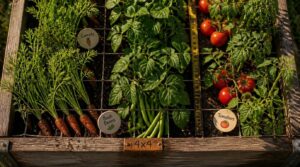
Small gardens demand you round up, not down. If the average spacing lands at 10 inches, go to 12. Tight margins punish mistakes.
In raised beds or containers, use square-foot gardening as your guide — one tomato per square foot, 16 carrots per square foot. Compact varieties like bush beans earn their place here. Less sprawl means more crops in less room.
Plan Sunlight and Plant Height

Sunlight is non-negotiable — get it wrong and even perfect spacing won’t save your garden. The key is thinking vertically, not just horizontally. Here’s how to position every plant so nothing ends up living in someone else’s shadow.
Place Tall Crops North
Tall crops belong on the north side of the bed — full stop. As the sun arcs east to west, anything planted there casts its shadow away from your shorter neighbors. Corn, tomatoes, sunflowers: place them north.
- Trellises anchor on the northern edge to block nothing
- Morning sun exposure reaches every plant evenly
- Microclimate airflow stays stronger with tall crops northmost
Keep Short Crops South
Short crops go on the south side — full stop. Lettuce, radishes, herbs: they need consistent sun, and the southern edge delivers it all day.
Keep rows 12 to 18 inches apart there, and lay down light-colored mulch to reflect heat and steady soil temps. Aim for 60–70°F at two inches deep. That sweet spot keeps quick-harvest greens happy.
Prevent Wide-leaf Shading
Wide leaves are the quiet bullies of the garden. Zucchini, squash, and brassicas spread fast — and before you know it, your sun-loving companions are sitting in the shade.
- Increase front-to-back spacing when foliage is wide
- Pinch new growth to keep tall crops compact
- Use selective thinning to open light gaps between canopies
- Try staggered planting patterns to reduce simultaneous shading
Use Trellises for Vines
Vines are space hogs — until you go vertical. A good trellis reclaims your ground footprint entirely.
Orient rows north to south so both sides get even light. Use galvanized steel or treated timber that holds up to 25 kg per plant.
Attach wires at 30 and 60 cm above ground, and check tension every four to six weeks.
Protect Full-sun Companions
Once a tall crop blocks the sun, your full-sun companions struggle — and yields drop fast.
Keep marigolds 6–9 inches in front of tomatoes so both get unfiltered light. Mulch around them, water in the morning, and let marigolds pull in beneficial insects while doing double duty as a pest barrier.
Choose Rows or Square Feet
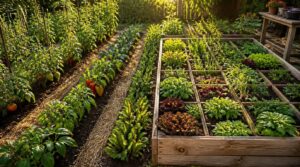
How you arrange your garden—rows or square-foot grids—shapes everything from airflow to how many plants you can actually fit. The layout you pick determines your spacing rules, so it’s worth being deliberate about it. Here’s what to evaluate when deciding how to set up your bed.
Space Rows for Airflow
Row spacing isn’t just about fit — it’s about airflow. Leave 12–18 inches between rows so air can move freely through the canopy.
Orient rows north to south to reduce shade and catch cross breezes. Stake or trellis tall plants to open vertical air channels.
Better airflow means drier leaves — and fewer fungal problems down the line.
Use Tighter Raised Beds
Raised beds let you skip the walkways entirely — and that changes everything. With access from all sides, you can plant 12–18 inches closer than in‑ground rows.
Use 12–18‑inch walls for better soil warmth and less bending. Fill them with a loam‑compost mix (40% compost), add drip lines, and mulch 2–3 inches deep to lock in moisture.
Plant by Square-foot Density
Think of each square foot as its own little zone with a job.
Leafy greens like spinach fit 9 plants per square foot at 4-inch spacing.
Carrots and radishes pack in 9–16 per square foot.
Tomatoes get one square foot each — no exceptions.
Microgreens fill a single square foot completely.
Match the crop to the zone, and your bed pays you back.
Cluster Herbs and Flowers
Herbs and flowers work hardest when grouped together.
Tuck nasturtiums 6 inches apart in a bed corner — they pull aphids away from your beans like a magnet. Cluster marigolds 6–9 inches apart near tomatoes to attract beneficial insects and shut out cucumber beetles.
Basil grouped close releases more scent, doubling as both pest repellent and pollinator magnet.
Edge Beds With Companions
Edge beds let you plant right to the perimeter — no wasted strip along the frame. Run a companion row of basil or marigolds 6–9 inches from your main crop along that outer zone.
Perimeter stability keeps roots undisturbed when you reach in. Removable side panels make maintenance easy without trampling what’s growing.
Separate Incompatible Vegetable Pairs

Not every plant plays well with others — and some combinations can quietly wreck your garden before you notice anything’s wrong. Knowing which pairs to keep apart is just as important as knowing which ones thrive together. Here’s what to watch out for.
Keep Onions From Beans
Onions and beans are classic incompatible plants — keep them at least two to three rows apart. Here’s why it matters:
- Nitrogen management — beans fix nitrogen into soil, which pushes onions toward leafy growth over bulb formation.
- Soil moisture zones — onions want drier soil; beans need steady moisture.
- Staggered planting schedules — planting onions a few weeks earlier helps avoid resource competition peaks.
Separate Potatoes and Tomatoes
Potatoes and tomatoes are both nightshades — and that’s exactly the problem. They share diseases like late and early blight, meaning one sick crop can infect the other fast.
Keep at least 2–3 feet between them. Use separate beds if you can. Potatoes want steady moisture; tomatoes prefer occasional drying out. Different needs, different zones.
Avoid Dill Near Carrots
Dill and carrots might look harmless together, but they’re a quiet disaster. Dill releases compounds that stunt carrot root growth and attract carrot rust flies — raising pest pressure by up to 40%.
They also compete for boron and manganese.
Keep dill at least 12–18 inches away, or better yet, in a completely separate bed.
Use Lettuce as Buffer
So dill poisons the well for carrots — but what do you do when two crops simply can’t share space and you can’t move them far apart?
Plant lettuce between them.
Lettuce acts as a neutral buffer crop, intercepting pests, softening wind shear, and quietly moderating moisture without bullying its neighbors. Its shallow roots keep nutrient competition minimal.
- Space buffer lettuce 8–12 inches from neighboring crops
- Harvest outer leaves regularly to maintain airflow
- Watch for bolting — gaps hurt coverage
- Use it to intercept aphids drifting toward vulnerable plants
- Staggered harvests keep the buffer zone consistently active
Skip Pairings in Containers
Containers don’t forgive bad pairings. In a small pot, incompatible crops fight fast — roots tangle, nutrients vanish, and disease spreads before you notice. Skip them entirely.
Use containers with drainage holes and match pot size to your largest plant’s mature width.
Group crops with similar moisture needs, and add fabric pots for better root aeration.
Adjust Spacing for Healthy Growth

Getting the spacing right is only half the job — keeping it working all season is the other half. Small tweaks to airflow, moisture, and root room can mean the difference between a thriving bed and a fungal mess. Here’s what to watch as your plants grow.
Improve Airflow Around Plants
Good airflow is your silent disease-fighter. When plants sit too close, air stagnates — and humidity pockets form near stems, inviting fungal problems fast.
Aim for spacing that creates vertical airflow corridors between plants. Trellising vines help here — they lift foliage upward, opening channels at ground level.
Prune crowded lower leaves to keep canopy ventilation open and disease risk low.
Match Moisture Needs
Not all plants drink the same way — and spacing helps you honor that. Group moisture-loving crops like lettuce together so you can water them consistently without drowning drought-tolerant neighbors.
Add a 2–3 inch mulch layer to regulate soil moisture between sessions. Drip irrigation keeps water at the roots, not the leaves, cutting waste and disease risk.
Consider Root Depth
Think of roots like invisible hands reaching for different shelves. Shallow-rooted crops like onions and lettuce work the top 12 inches.
Beans and tomatoes push 18 inches or deeper. That natural separation reduces resource competition considerably.
Compacted soil cuts that depth short — so loosen it.
Deep watering encourages taproot establishment and pulls roots downward, keeping neighbors from fighting over the same nutrient access zone.
Prevent Fungal Disease
Fungal disease loves crowded plants. Tight spacing traps moisture, keeps leaves wet, and turns your bed into a breeding ground. Aim for at least 24 inches of open air movement between plants.
Water at the base, early in the day. Add 2–3 inches of mulch — but keep it off stems.
Where you can, choose disease-resistant varieties.
Maintain Pest-deterring Benefits
Spacing keeps companion plants close enough to work — but not so close they lose their edge.
Basil tomato synergy kicks in at 8–12 inches; too far and the pest-repelling volatiles dissipate.
Marigolds need 6–9 inches from target crops for aphid control to hold.
Nasturtiums work best clustered at bed edges, drawing aphids away like bait.
Frequently Asked Questions (FAQs)
What vegetables can grow next to each other in a garden?
Picture a bed with tomatoes and basil side by side—basil boosts flavor and repels pests. You can pair carrots with onions, beans with corn, cucumbers with radishes, or lettuce with herbs for healthy growth.
Can companion planting work in vertical tower gardens?
Yes — companion planting works in vertical towers. Match light needs across tiers, favor shallow-rooted plants, and pair basil near tomatoes. Good sleeve airflow keeps disease low and beneficial insects moving between levels.
How do soil amendments change spacing between plant pairs?
Amendments are a real catalyst. Compost expands canopies 10–20%, so give plants more room. Biochar improves root penetration — you can plant slightly closer. Nitrogen surges push growth out. Mulch stabilizes moisture, tightening spacing safely.
Can mulching reduce the need for wider companion spacing?
Mulching does a lot of heavy lifting. A 2–3 inch layer suppresses weeds, holds moisture, and stabilizes soil temperature — all of which ease the stress that usually forces you to space companions wider.
Conclusion
Good spacing is the difference between a garden that works and one that just looks like it might. Once you understand vegetable garden companion spacing, the whole system clicks—roots have room to breathe, light reaches where it’s needed, and companions actually do their jobs.
You’re not guessing anymore. Measure before you plant, trust the math over your gut, and your plants will quietly reward you all season long.
- https://extension.wvu.edu/lawn-gardening-pests/gardening/garden-management/companion-planting
- https://www.almanac.com/companion-planting-guide-vegetables
- https://www.motherearthgardener.com/organic-gardening/companion-planting-to-maximize-garden-space-zb0z1805
- https://www.portlandnursery.com/veggies/companion-planting
- https://www.azurefarmlife.com/farm-blog/companion-planting-chart-for-a-healthier-happier-garden