
This site is supported by our readers. We may earn a commission, at no cost to you, if you purchase through links.

Most gardeners spend money on fertilizers when the fix is already in the ground—waiting to grow. A single acre of healthy soil can host over a billion bacteria, yet conventional gardening habits quietly starve that workforce.
Companion planting soil health isn’t a trend borrowed from permaculture blogs; it’s how productive soils operated long before synthetic inputs existed.
Plant daikon radish beside your tomatoes and watch it drill 90 cm through hardpan, creating drainage channels no tiller can replicate. Pair beans with corn, and Rhizobium bacteria start converting atmospheric nitrogen into plant-ready ammonia—free fertilizer, built below the surface.
The right plant combinations don’t just coexist; they actively engineer better soil for everything growing around them.
Table Of Contents
- Key Takeaways
- Choose Soil-Building Companion Plants
- Pair Plants by Root Depth
- Boost Nutrients With Legume Companions
- Add Cover Crops and Mulches
- Build Microbes and Pest Resistance
- Frequently Asked Questions (FAQs)
- What to plant to restore soil health?
- Can companion planting improve clay soil over time?
- How does companion planting affect soil pH levels?
- Which companions work best in raised bed gardens?
- Does companion planting help with waterlogged or soggy soil?
- Can companion planting replace the need for composting entirely?
- Conclusion
Key Takeaways
- Pairing deep-rooted plants like daikon radish with legumes such as beans lets the soil break up compaction and build its own nitrogen supply at the same time.
- Mixing root depths — taproots, fibrous, and shallow — naturally improves drainage, prevents erosion, and keeps nutrients from washing away before crops can use them.
- Aromatic herbs and flowering plants like marigolds and nasturtiums do real pest‑control work underground and above it, cutting disease and aphid pressure without chemicals.
- Cover crops earn their place between seasons by protecting bare soil, feeding soil microbes, and setting up heavier feeders with a free fertility boost before you plant.
Choose Soil-Building Companion Plants

Not every plant earns its place in a soil-building garden the same way. Some fix nitrogen, some break up compacted ground, and others quietly feed the microbes working beneath your feet. Here are the companion plants worth adding to your beds first.
If you’re still figuring out which crops belong where, this guide to the best plants for raised garden beds can help you pair nitrogen-fixers and deep-rooters with the right companions from the start.
Nitrogen-fixing Legumes
Start with legumes — plants like beans, peas, and clover that team up with Rhizobium bacteria in root nodules. Inside those nodules, the nitrogenase enzyme converts atmospheric nitrogen into ammonia, your soil can actually use.
Flavonoid signals from the roots attract rhizobia. Inoculating seeds before planting boosts early nodulation, cutting your need for synthetic fertilizer greatly.
Maintaining the optimal temperature range ensures maximum nitrogen fixation efficiency.
Deep-rooted Soil Breakers
Nitrogen feeds your soil, but compaction blocks roots from reaching it. That’s where taproots earn their keep.
Daikon radish drills 60-90 cm down, opening macropores for air and water. Chicory and comfrey do similar work, with comfrey pulling subsoil minerals upward as it decays.
Plant these deep-rooted crops first. They reduce soil compaction and boost aeration before heavier feeders arrive.
Shallow-rooted Companions
Once your taproots break ground, shallow-rooted partners take over up top.
Lettuce, spinach, and arugula work the top six inches, scavenging surface nutrients before rain washes them away. They form a living mulch that suppresses weeds fast and prevents soil crusting after heavy downpours.
Pair them with chives or parsley. You’ll get ground cover, microclimate moisture regulation, and a touch of pollinator nectar from any flowering herbs nearby.
Aromatic Herb Partners
Your shallow-rooted layer covers the surface. Now bring in scent.
Thyme, rosemary, sage, and lavender release essential oil exudates that boost rhizosphere microbial diversity and suppress soil pathogens.
- Thyme cuts whitefly pressure near strawberries
- Sage enhances calcium uptake in crucifers
- Basil and cilantro improve phosphorus uptake for tomatoes
- Lavender draws pollinators to lettuce beds
- Herb clumps create stabilizing microclimates
Flowering Beneficial Insect Plants
Color and bloom timing matter as much as roots. Plant yarrow, echinacea, and phacelia for steady nectar from spring to fall.
Bright blues, purples, and whites pull in bees and hoverflies. Native species offer better rewards than imports. Open flowers let small predators feed easily.
These blooms shelter beneficial insects, boosting pest control and biodiversity throughout your garden.
Pair Plants by Root Depth
Root depth is one of the most overlooked tools in companion planting — but it quietly shapes everything from drainage to nutrient flow. Different plants naturally reach different soil layers, and pairing them thoughtfully puts that to work for you. Here’s how each root type contributes to a healthier, more productive bed.
Taproots Loosen Compacted Soil
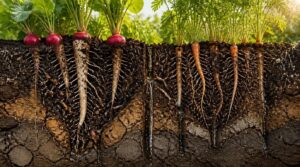
Think of compacted soil as a locked door — taproots are the key. Plants like radishes and carrots drive downward with real force, physically fracturing dense layers.
As they grow, they form vertical biopores: open channels that improve aeration and drainage long after the roots are gone. Your soil becomes noticeably easier to work with each season.
Deep Roots Lift Nutrients

Deep-rooted crops like tomatoes and chicory do more than anchor themselves — they act as natural nutrient elevators.
Through hydraulic lift, roots pull water and dissolved minerals from subsoil layers upward, making them available near the surface. They also trigger subsoil mineral weathering, unlocking trace elements like zinc and iron that shallow roots simply can’t reach.
Shallow Roots Protect Topsoil

While deep roots mine from below, it’s the surface root mat that holds everything together up top.
- Bind topsoil particles to prevent surface erosion control
- Slow runoff during heavy rain
- Retain moisture through microclimate shading
- Prevent nutrient leaching near the surface
- Maintain soil structure and porosity
Companions like clover and creeping thyme are ideal choices.
Mixed Roots Improve Drainage

When you mix deep and shallow roots, your soil gets better at draining water naturally. Macropore formation happens when roots of different lengths carve channels at multiple depths, giving water a clear path downward. This also prevents surface crusting after rain. Try pairing carrots with clover — a simple combination that quietly transforms drainage beneath your feet.
Pair carrots with clover and watch mixed roots quietly transform your soil’s drainage from the ground up
| Root Type | Drainage Benefit |
|---|---|
| Taproot (carrot) | Creates deep channels for rapid water movement |
| Shallow (clover) | Reduces surface sealing and runoff |
| Combined mix | Boosts water infiltration rates up to 40% |
Roots Reduce Erosion

Roots are nature’s erosion control, holding soil together when storms hit hard. Taproots boost soil shear strength, anchoring slopes against downward movement.
Dense root mats add surface roughness, slowing runoff and trapping sediment.
This is root architecture diversity at work—taproots, fibrous roots, and shallow roots reinforcing soil structure together.
Pair them with cover crops, and you’ll cut soil erosion dramatically, season after season.
Boost Nutrients With Legume Companions
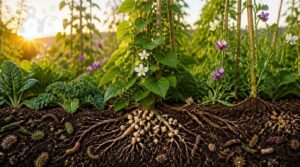
Legumes do more than fill space in your garden beds. Their roots team up with bacteria to pull nitrogen straight from the air, feeding the soil for free. Here are five ways to put that natural fertilizer factory to work.
Beans With Corn
If you’ve ever grown corn alone, you know it’s a hungry crop. Pairing it with beans solves that problem through nitrogen fixation, adding up to 120 pounds of nitrogen per acre.
This is the heart of the Three Sisters system: beans climb cornstalks for vertical growth, while their roots improve soil porosity and feed corn through steady nitrogen transfer.
Peas Near Leafy Greens
Corn isn’t the only crop that loves a legume neighbor. Peas work the same magic for leafy greens, fixing nitrogen right where lettuce and spinach can use it.
This cool-season pairing thrives in spring beds:
- Steady nitrogen transfer efficiency feeds greener leaves
- Pest masking effects keep aphids guessing
- Shared moisture retention strategies via mulch
- Loosened topsoil from pea roots
- A longer harvest window extension for both crops
Clover as Living Mulch
Peas feed greens above ground—clover works below. As a living mulch, it suppresses weeds, conserves soil moisture, and times nitrogen mineralization for nearby crops. Subterranean clover protects topsoil while building pollinator habitat through its blooms.
| Clover Gives | Your Soil Gets |
|---|---|
| Dense shade canopy | Fewer weeds |
| Root nodules | Free nitrogen |
| Flowers | Pollinator visits |
| Cover | Moisture held |
Vetch Before Heavy Feeders
Clover holds ground, but vetch feeds heavy feeders. Hairy vetch fixes 40-100 lbs nitrogen per acre through root nodules, releasing it as residues break down.
- Plant vetch weeks ahead of corn or squash
- Watch carbon ratios—they slow early mineralization
- Time vetch termination near cash crop planting
- Manage biomass for mulch, not weed competition
- Let fibrous roots boost soil porosity first
Composting Legume Residues
Don’t just till spent bean and pea plants under—compost them first. Legume residues carry 2.0 to 3.5% nitrogen, pulling C:N ratios toward that ideal 25:1 range.
Mix with straw for airflow, and you’ll hit thermophilic heating above 55°C, driving pathogen inactivation and boosting microbial diversity. Cure fully for true compost maturity, then spread to lift soil organic matter and fertility.
Add Cover Crops and Mulches
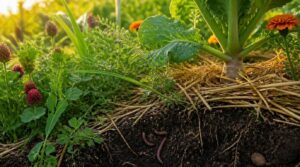
Bare soil is a missed opportunity. Cover crops and mulches fill that gap, protecting your beds while they work quietly underground. Here are five options worth adding to your rotation.
Rye for Soil Protection
Think of rye as a winter blanket for your beds. Its dense canopy delivers serious rye erosion control, shielding soil from raindrop impact and slowing wind erosion too.
Roots boost soil crust stability after storms, while rye soaks up excess nitrogen for nitrate leaching prevention. Come spring, rye biomass decomposition feeds organic matter and steadies winter moisture balance across your soil.
Oats for Organic Matter
Growing oats is one of the easiest ways to build organic matter fast. Their fibrous root benefits improve soil tilth and create stable aggregates. Roots stretch 30 to 90 cm deep, feeding bacteria and fungi along the way.
Oat residue decomposition adds humus gradually, while biomass carbon sequestration locks carbon into your soil. This oat microbial stimulation strengthens fertility season after season.
Buckwheat for Quick Cover
Few cover crops work as fast as buckwheat. Buckwheat germination takes just three to five days, and rapid canopy formation shades out weeds while preventing soil splash.
- Scavenges phosphorus for crops that follow
- Feeds pollinators through nectar corridors
- Builds organic matter as residue breaks down fast
As a green manure, it speeds soil organic matter decomposition, boosting your fertility quickly.
Clover for Moisture Retention
Clover’s dense root network packs the topsoil with pore spaces, boosting moisture retention. That fine, fibrous mat shades the surface, slowing soil evaporation considerably.
Acting as a living mulch, clover insulates the ground and builds organic matter as roots die back. This combination strengthens drought resistance, making clover a smart companion planting pick for long-term soil health.
Green Manure Timing
Timing is everything with green manure crops. For spring, sow 2–6 weeks before your last frost to capture winter rainfall and build biomass fast. Fall planting suits cold-hardy options like winter rye and hairy vetch:
- Incorporate at flowering stage for the best nitrogen release
- Match legume timing to your next crop’s nutrient needs
- Adjust for climate — clay soils need longer growth windows
Build Microbes and Pest Resistance

Your soil’s biology is working harder than you might think—and the right plant companions can give it a serious boost. From root exudates that feed beneficial microbes to flowers that throw off pest cycles, each pairing below fulfills a specific purpose.
Five strategies to build a healthier, more resilient garden from the ground up.
Root Exudates Feed Microbes
Beneath every healthy bed, root exudates quietly feed your soil microbiome. These sugars and acids act as rhizosphere carbon supply, fueling beneficial soil microbes.
Microbial signaling molecules guide nutrient solubilization mechanisms, unlocking phosphorus for uptake. Biofilm formation benefits roots by shielding them from pathogens. As exudate composition shifts with plant age, plant-microbe interactions evolve too—keeping your garden’s underground partnership thriving.
Herbs Suppress Soil Disease
Herbs are doing more underground than you might think. Mustard and radish act as biofumigant herbs, releasing isothiocyanates when chopped into soil. These compounds suppress Fusarium and Rhizoctonia within weeks.
- Basil reduces seedling damping off near vulnerable crops
- Garlic and chives disrupt fungal growth through sulfur-based compounds
- Mint emits volatiles that limit rhizosphere pathogens
Glucosinolates in brassicas determine how strongly disease is suppressed.
Marigolds Reduce Nematodes
Marigolds bring more to the garden than color. Their roots release alpha-terthienyl compounds that disrupt nematode navigation and limit juvenile survival underground. Tagetes patula and Tagetes erecta both suppress Meloidogyne species, though suppression varies by cultivar. Sandy soils disperse these compounds faster, giving broader coverage. Plant marigolds early, before nematode populations peak, for the strongest effect.
| Factor | Detail | Tip |
|---|---|---|
| Best species | Tagetes patula (French) | Choose nematode-resistant cultivars |
| Active depth | Top 12 inches of soil | Dense root growth matters |
| Timing | Early season planting | Align with nematode activity |
Nasturtiums Trap Aphids
Nasturtiums (Tropaeolum majus) work differently than marigolds — instead of repelling pests, they lure aphids in. Their soft tissue and nectar-rich blooms act as a pest magnet, drawing aphids away from your vegetables. Field observations show nasturtiums can reduce aphid pressure on nearby crops by roughly 50%.
- Position them 3–5 feet from key vegetables
- Plant along garden borders to contain pest hotspots
- Use trailing varieties for maximum aphid attraction
- Inspect weekly and treat infestations directly on the trap crop
Polycultures Slow Disease Spread
When you grow just one crop in a row, pathogens find their host quickly. Polyculture companion planting breaks that continuity.
Mixed species disrupt disease pathways, slow pathogen spread, and build microbial ecosystem resilience.
Field data shows polycultures reduce foliar disease incidence by up to 30%, making integrated pest management simpler and your soil naturally more disease‑suppressive.
Frequently Asked Questions (FAQs)
What to plant to restore soil health?
Your soil’s future depends on what you plant today. Nitrogen-fixing legumes, deep-rooted breakers, and aromatic herb partners work together to rebuild fertility, boost microbial life, and restore long-term soil health naturally.
Can companion planting improve clay soil over time?
Yes, it absolutely can. Deep-rooted plants crack compacted clay layers, while legumes add organic matter over time. This improves soil porosity and water infiltration, gradually transforming even heavy clay into workable, nutrient-rich ground.
How does companion planting affect soil pH levels?
As you sow, so shall you reap." Companion planting gradually shifts soil pH balance through legume decomposition buffering, rhizosphere gradients, and microbial activity — quietly building more resilient, nutrient-rich soil health beneath your feet.
Which companions work best in raised bed gardens?
Raised bed gardens thrive with legumes, deep-rooted breakers, and aromatic herbs. Beans, carrots, and marigolds balance nutrients, improve drainage, and deter pests — making them ideal soil-building partners.
Does companion planting help with waterlogged or soggy soil?
Waterlogged soil suffocates roots, stalls drainage, and invites rot. Deep-rooted chicory creates drainage channels, while clover groundcover slows runoff, regulates soil moisture, and improves aeration — together protecting roots from saturation damage.
Can companion planting replace the need for composting entirely?
Companion planting genuinely enriches your soil, but it can’t fully replace compost. Nutrient turnover rates from plant residues are slower and less concentrated than finished compost, so both work best together.
Conclusion
Your soil doesn’t need rescuing—it needs the right neighbors. Companion planting soil health works because plants have always been quiet collaborators, trading nutrients, breaking hardpan, and feeding the microbial workforce beneath your feet.
You’re not forcing the ground to produce; you’re removing the obstacles that kept it from doing what it does naturally. Plant the right combinations this season, and the soil will handle the rest—quietly, reliably, season after season.